
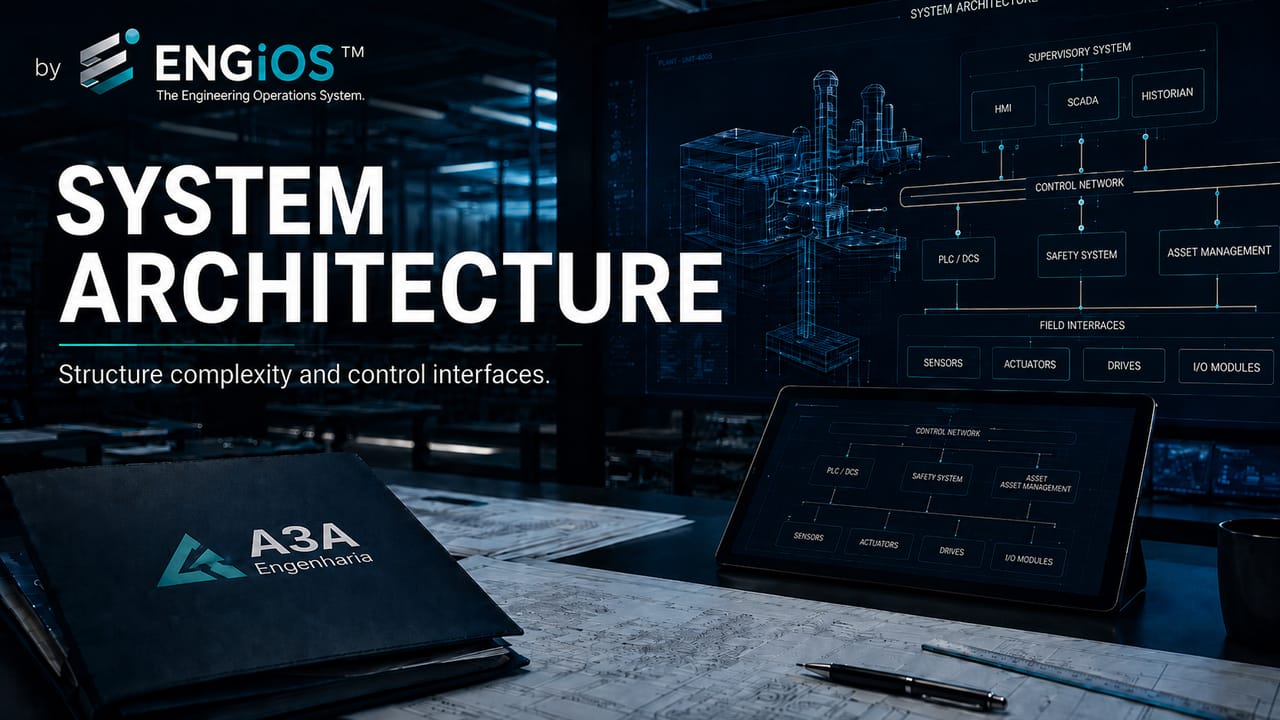
Understand System Architecture for complex systems: requirements, functional, logical and physical architecture, interfaces, viewpoints, trade-offs, baselines and integration.
Check it out!
System Architecture is the conceptual structure that organizes the functions, elements, relationships, interfaces, constraints, and fundamental decisions of a system. In complex systems, it turns stakeholder needs and requirements into a coherent technical organization before each discipline independently details components, software, equipment, networks, or facilities.
Architecture is not merely a block diagram. A useful architecture must explain which responsibilities exist in the system, where those responsibilities will be implemented, how elements relate to one another, which interfaces are critical, which quality attributes must be preserved, and which structural decisions constrain subsequent development.
ISO/IEC/IEEE 42010:2022 establishes requirements for architecture descriptions and organizes concepts such as stakeholders, concerns, viewpoints, views, and model kinds. The standard does not define a “correct” architecture or prescribe a design method; it provides a framework for describing architectures consistently and traceably.
Architecture Is Different from Architecture Description
The architecture exists as the fundamental organization of the system even when it is not fully documented. The architecture description is the set of representations used to express that organization to different stakeholders.
This distinction matters because no single drawing represents the entire system. A physical layout may show equipment and spaces but not behavior. A logical diagram may show functions and flows but not physical location. A matrix may record interfaces but not operational states.
An architecture description must combine coherent views that address different concerns without creating competing versions of the same reality.
Why Complex Systems Need Explicit Architecture
The greater the number of subsystems, disciplines, and suppliers, the greater the risk that each party optimizes its own local solution. A supplier may maximize the performance of its equipment while simultaneously increasing energy consumption, operational complexity, or dependence on the system-wide network.
Explicit architecture creates a common reference for evaluating such decisions. It makes it possible to ask whether a change preserves redundancy, segregation, interoperability, security, maintainability, and other system-level attributes.
In projects without this reference, decisions tend to be made by document or discipline. Cross-cutting impacts often emerge only during integration, commissioning, or operation.
Architecture Begins with Needs and Requirements
Architecture should not begin with an equipment catalog. It begins with the problem the system must solve and the requirements that constrain the solution.
Systems Engineering establishes this sequence by connecting stakeholder needs, requirements, architecture, integration, and validation. Architecture is the point at which functions and constraints begin to be organized into a coherent solution.
An availability requirement, for example, may generate decisions about redundant power supplies, servers, networks, communications, storage, and operations. The requirement is singular; the architecture distributes its realization across several elements.
Concern, Stakeholder, and Viewpoint
ISO/IEC/IEEE 42010 uses the concept of a concern to represent stakeholder interests or issues relevant to the system. Performance, security, cost, availability, maintenance, integration, and operations are examples of concerns.
A viewpoint defines conventions for constructing a view that addresses specific concerns. This avoids trying to place every item of information in a single drawing.
| Stakeholder | Typical concern | Useful view |
| Operations | Operating modes and contingencies | Behavior and states |
| Maintenance | Accessibility, replacement, and diagnostics | Physical decomposition and interfaces |
| IT | Communication, authentication, and capacity | Logical and network architecture |
| Security | Boundaries, trust, and exposure | Flows and security zones |
| Engineering | Functions, allocation, and dependencies | Functional and physical architecture |
| Management | Risks, decisions, and trade-offs | Executive architecture view |
Architecture quality depends on selecting views that support real decisions, not on producing the largest possible number of diagrams.
Functional Architecture
Functional architecture organizes what the system must do without prematurely assuming where each function will be implemented. It decomposes high-level functions into smaller functions and identifies relationships, flows, and dependencies.
This separation between function and physical solution broadens the solution space. An authentication function, for example, may be performed locally, centrally, distributed among devices, or integrated with a corporate service. Functional architecture helps teams discuss the need before selecting a product.
A typical decomposition progresses from needs to requirements, system functions, logical architecture, physical elements, interfaces, and finally integration and validation.
Good functional decomposition also helps identify missing functions, unnecessary redundancy, and poorly defined responsibilities among subsystems.
Logical Architecture
Logical architecture organizes abstract elements that perform functions independently of a specific physical implementation. Services, processing modules, data repositories, security domains, and logical components may exist at this level.
It is particularly useful in systems involving software, networks, automation, and integration. The purpose is to define responsibilities and interactions before selecting servers, appliances, devices, or final topologies.
Logical architecture acts as a bridge between functional behavior and physical realization.
Physical Architecture
Physical architecture represents equipment, devices, facilities, components, networks, cables, panels, servers, and other tangible resources that implement the solution.
It must remain traceable to requirements and functions. A component should not exist merely because “it has always been specified”; its presence should be justified by a function, attribute, or constraint.
Physical architecture also exposes supply boundaries, locations, space availability, power, heat dissipation, maintenance accessibility, and other constraints that may change the logical solution.
Multiple Architectures Must Remain Coherent
A system may have functional, logical, physical, security, data, network, and deployment architectures. These representations should not be treated as independent designs.
When a critical function is allocated to two redundant servers, the network architecture must support that redundancy; power must be compatible; storage must preserve consistency; and operations must understand how failover occurs.
Maintaining coherence across views is one of the main challenges of Systems Architecture. MBSE — Model-Based Systems Engineering can help because it maintains elements and relationships in a common structure.
System of Interest and Boundaries
Before defining architecture, the system of interest and its boundaries must be established. What is inside the system? What is external? Which external services are assumed? Which responsibilities belong to other contracts or organizations?
Poorly defined boundaries create orphan requirements. A system may depend on Active Directory, the corporate network, conditioned power, HVAC, external APIs, or operational procedures that are not under the main supplier’s control.
Architecture must represent these dependencies explicitly even when the external element is outside the supply scope.
Context Diagram: Seeing the System in Its Environment
A context view shows the system of interest and relevant external entities: users, operators, other systems, networks, services, the physical environment, and organizations.
The purpose is not to detail internal components but to understand exchanges across the boundary. Which data enters and leaves? Who supplies power? Which system authenticates users? Which alarm must be shared? Which information is sent to the operations center?
This view often reveals interfaces that remain hidden when the team starts directly with internal design.
When a project involves several disciplines and contracts, the greatest exposures frequently occur at interfaces. Independent architecture helps define boundaries, owners, requirements, and integration criteria before those gaps become scope changes or rework.
Interfaces Are a Central Part of Architecture
Interfaces define how elements exchange information, energy, signals, materials, forces, commands, or responsibilities. In complex systems, interface failures are often more common than failures of individual components.
An interface should have an origin, destination, characteristics, requirements, ownership, definition status, implementation responsibility, and verification method. Under separate contracts, it must also clarify who supplies each side of the interface and who coordinates integrated testing.
Architecture should avoid treating an interface as a simple line between two boxes. The line represents a relationship that must be specified.
Interface Matrix
When dozens or hundreds of interfaces exist, a matrix complements diagrams. Rows and columns represent elements, and intersections indicate exchanges or dependencies.
This format helps detect undocumented interfaces, excessively coupled elements, and concentrations of dependencies around specific components.
A matrix also supports prioritizing interface management by criticality, definition stage, and integration risk.
Interface Control Document
Critical interfaces may require Interface Control Documents (ICDs) or equivalent specifications. An ICD describes parameters, protocols, pin assignments, formats, timing, responsibilities, versions, and test criteria.
The ICD must be linked to architecture and configuration. An approved interface cannot change informally because a supplier updated firmware or replaced equipment.
Interface changes require system-level impact analysis because they frequently affect several downstream elements.
Allocation of Functions and Requirements
Architecture materializes allocation decisions: which element is responsible for each function and requirement. This allocation must be explicit.
A response-time requirement may depend simultaneously on a sensor, network, processing platform, database, and user interface. Architecture distributes performance responsibility among those elements.
Requirements Management in Engineering provides the traceability needed to demonstrate that allocation and prevent requirements from being left without an owner.
Quality Attributes Shape Architecture
Many architectural decisions arise not from functions but from quality attributes: availability, reliability, performance, security, scalability, maintainability, interoperability, and resilience.
Two systems may perform the same functions and still have completely different architectures because of these attributes.
For this reason, non-functional requirements should be quantified whenever possible. “High availability” is vague; target availability, recovery objectives, fault tolerance, and degraded modes guide real decisions.
Redundancy and Elimination of Single Points of Failure
Redundancy is not simply the duplication of equipment. Common dependencies must be assessed.
Two servers may be redundant while sharing the same switch, PDU, database, or link. Architecture must identify common-cause failures that eliminate the intended benefit.
A service-path analysis helps map every element required by a critical function and verify whether single points of failure remain.
Segregation and Independence
Critical systems frequently require segregation among networks, power sources, domains, zones, or functions. Architecture must show where independence is required and how it will be preserved.
Physical and logical segregation have different effects. VLANs may separate traffic logically, while security or availability requirements may require independent physical equipment and paths.
The decision should derive from risk and requirements, not supplier preference.
Coupling and Cohesion
Robust architectures seek to limit unnecessary dependencies among elements. High coupling increases change impact and the risk of failure propagation.
At the same time, separating functions excessively can increase interface complexity. Architecture must balance modularity and simplicity.
This trade-off exists in software, networks, automation, and physical systems. There is no universal rule; the decision depends on performance, maintenance, expansion, and criticality.
Modularity and Replacement
Modularity enables parts of the system to evolve with controlled impact. To achieve this, interfaces must be stable and responsibilities clearly defined.
In procurement, modularity can reduce supplier dependence and facilitate future replacement. However, excessively generic solutions may lose performance or increase cost.
Architecture should record why a particular level of modularity was chosen and which interfaces are considered stable.
Architecture and Interoperability
Interoperability requires more than physical compatibility. Systems must share protocols, formats, semantics, synchronization, authentication, and expected behavior.
Open protocols help but do not guarantee integration. Two devices may support the same standard while implementing different profiles or extensions.
Architecture should define interoperability requirements and plan verification under representative conditions.
Data Architecture
In digital systems, data is an architectural element. Origin, ownership, format, retention, synchronization, quality, access, integrity, and life cycle must be defined.
Multiple systems may store versions of the same data. Without data architecture, inconsistencies arise in registration, identification, and state.
The concept of source of truth should be defined by domain: which system is authoritative for users, assets, events, configurations, or results.
Security Architecture
Security must be integrated from the architecture stage. Trust zones, attack surfaces, identities, privileges, flows, and external dependencies should be considered before deployment.
Adding a firewall or authentication at the end cannot correct an architecture that relies on insecure relationships by design.
In converged systems, cybersecurity and physical security may share infrastructure and should be analyzed in a coordinated manner.
Architecture and Performance
Performance depends on the complete path: acquisition, communication, processing, storage, and presentation. Optimizing one isolated component does not solve system bottlenecks.
Architecture should identify budgets and constraints. Total latency can be allocated across stages; capacity can be reserved by subsystem; and expected growth should be included in sizing.
Parametric models and simulation can support this analysis before equipment is purchased.
Trade Studies and Architectural Decisions
Architecture involves choices among alternatives. Centralized or distributed? Active or standby redundancy? Cloud, edge, or on-premises? One backbone or segregated networks?
These decisions should be documented with criteria, assumptions, and consequences. A Decision Matrix for Engineering Projects and multicriteria methods can support comparisons when several criteria conflict.
The analysis result should enter the architecture decision record so that the rationale is preserved for future changes.
Architecture Decision Record
Architecture Decision Records (ADRs), or equivalent records, document context, the decision, alternatives considered, and consequences.
They are useful because many choices appear obvious during design and lose their context months later. When someone proposes replacing a technology, the ADR shows which constraints motivated the current solution.
In engineering contracts, this history also helps justify changes and avoid repeatedly reviewing decisions that have already been substantiated.
Architecture Baseline
At specific project gates, the architecture must be frozen as a baseline to enable consistent detailed development. This does not prevent changes; it establishes a controlled reference.
The baseline should be associated with the applicable requirements, interfaces, and decisions versions. Subsequent changes must undergo impact analysis.
Without a baseline, each discipline may detail a different configuration and discover the divergence only during integration.
Architecture and Design Review
Design Review should evaluate architectural coherence, not merely verify document completion.
The review should ask whether requirements have been allocated, interfaces defined, critical attributes addressed, single points of failure identified, changes incorporated, and the architecture prepared to support verification.
An effective review combines technical views with traceability and decision records.
Preliminary Architecture and Progressive Maturity
Architecture does not need to begin at full detail. In early phases, the objective is to structure functions, boundaries, and alternatives. As requirements mature, physical elements and interfaces gain definition.
This progressive maturity avoids premature detailing. Selecting an equipment model before understanding the architecture can unnecessarily constrain alternatives.
The level of detail should be appropriate to the project decision gate.
Architecture in Multidisciplinary Projects
In technology infrastructure, architecture may connect electrical systems, telecommunications, automation, electronic security, software, civil works, and operations.
A data center supporting electronic security, for example, involves power, cooling, racks, servers, storage, networks, VMS, authentication, backup, and procedures. Each discipline has its own design, but the system must operate as a whole.
System architecture helps maintain this cross-disciplinary view above individual disciplines.
Architecture and Work-Package Contracting
When a project is divided into Work Packages, each package must receive requirements and interfaces derived from the architecture.
The Scope of Work should translate architectural responsibilities into contractual obligations: who supplies, who integrates, who tests, and who delivers evidence.
If the architecture is not clear before contracting, gaps are transferred into the contract and later emerge as changes or disputes during implementation.
In fragmented contracts, no individual supplier naturally preserves the complete system view. Maintaining an Owner reference architecture allows changes to be reviewed, critical attributes to be protected, and integration across packages to be coordinated.
Architecture and Owner’s Engineering
In projects involving several suppliers, no individual contractor naturally owns the complete Owner perspective. Each controls its own solution and contractual interfaces.
Owner’s Engineering can maintain the reference architecture, coordinate requirements, review changes, and protect system-level attributes during procurement and execution.
This function is especially important when integration among contracts determines final performance.
Architecture in MBSE
In MBSE, architecture stops being a collection of independent drawings and is represented through structured elements and relationships.
Views can be generated for different concerns without duplicating information. Requirements are linked to elements; interfaces are modeled as objects; decisions and verification activities can be traced.
This improves impact analysis and reduces divergence among representations.
Architecture and the V-Model
The V-Model relates system decomposition to integration and verification at corresponding levels. Architecture is the structure that makes those levels definable.
System requirements are decomposed and allocated to subsystems and components. On the right-hand side of the V, elements are integrated and verified against corresponding specifications.
Without clear architecture, the team does not know which integrations must occur or at what level each requirement must be demonstrated.
How to Document a System Architecture
An architecture description should be appropriate to the stakeholders and concerns. Depending on the project, it may include context, architecturally significant requirements, functional, logical, and physical views, interfaces, data, security, decisions, risks, trade studies, and verification criteria.
The set should avoid duplication. Each item of information should have an authoritative source and clear relationships with other artifacts.
The required formality should reflect complexity, criticality, and contractual requirements.
Common Mistakes
One mistake is calling an equipment topology “architecture” without explaining functions, dependencies, and decisions. Another is creating different diagrams for every meeting and allowing them to become inconsistent.
Other common problems include interfaces without owners, unallocated requirements, apparent redundancy with common dependencies, premature product selection, and lack of decision rationale.
Weak architecture does not eliminate complexity; it only hides it until more expensive phases.
Indicators of Architectural Maturity
Maturity can be assessed through coverage of allocated requirements, definition of interfaces, recorded decisions, resolution of architectural risks, consistency among views, and the ability to verify critical attributes.
A mature architecture is not an immutable architecture. It means that changes are controlled and their impact can be understood.
Documentation quality also matters: another team should be able to understand the system organization and reproduce the principal reasoning without depending exclusively on the people who conceived it.
Final Considerations
System Architecture organizes the system before detailed development fragments the solution. It translates requirements into functions, elements, relationships, and interfaces, preserves quality attributes, and establishes a basis for integration, verification, and evolution.
Its greatest value appears in projects where multiple subsystems must operate as a whole. In these situations, explicit architecture reduces gaps among disciplines, improves technical decisions, and enables the impact of changes to be assessed before they reach implementation.
A good architecture is not the most sophisticated diagram. It is the one that makes decisions, dependencies, and responsibilities understandable and verifiable for the stakeholders who must design, procure, integrate, operate, and maintain the system.
Technical References
[1] INTERNATIONAL ORGANIZATION FOR STANDARDIZATION; IEC; IEEE. ISO/IEC/IEEE 42010:2022 — Software, systems and enterprise — Architecture description. Geneva: ISO, 2022. Available at: https://www.iso.org/standard/74393.html
[2] INTERNATIONAL ORGANIZATION FOR STANDARDIZATION; IEC; IEEE. ISO/IEC/IEEE 15288:2023 — Systems and software engineering — System life cycle processes. Geneva: ISO, 2023. Available at: https://www.iso.org/standard/81702.html
[3] NASA. NASA Systems Engineering Handbook. NASA/SP-2016-6105 Rev2. Washington, DC: NASA, 2016. Available at: https://www.nasa.gov/reference/systems-engineering-handbook/
[4] NASA. NASA-HDBK-1009A — NASA Systems Modeling Handbook for Systems Engineering. Washington, DC: NASA, 2025. Available at: https://standards.nasa.gov/standard/NASA/NASA-HDBK-1009
Frequently Asked Questions
What is System Architecture?
It is the organization of the functions, elements, relationships, interfaces, constraints, and fundamental decisions that structure a system and guide its development and integration.
Is systems architecture only a block diagram?
No. Diagrams are views. Architecture includes decisions, relationships, requirements allocation, interfaces, quality attributes, and principles that must remain coherent across different representations.
What is the difference between functional, logical, and physical architecture?
Functional architecture describes what the system does; logical architecture organizes abstract responsibilities and services; physical architecture defines the equipment, software, networks, and other concrete elements that implement the solution.
Why are interfaces so important in architecture?
Because many complex-system problems occur at subsystem boundaries. Interfaces must specify exchanges, responsibilities, requirements, and verification criteria.
How does ISO 42010 relate to systems architecture?
ISO/IEC/IEEE 42010:2022 establishes requirements for architecture descriptions and concepts such as stakeholders, concerns, viewpoints, views, and model kinds.
What is the relationship between System Architecture and MBSE?
MBSE represents architecture through structured elements and relationships, maintaining traceability to requirements, interfaces, and verification while generating different views from the same model.
Additional Technical Materials
Key Content on the Topic
- Systems Engineering: requirements, architecture, interfaces, integration, and validation
- MBSE — Model-Based Systems Engineering for complex systems
- Requirements Management in Engineering
Related Technical Content
Related Solutions
- Requirements, Evidence, and Acceptance Criteria Management
- Contract, Scope, and Deliverables Management
