
Understand the main challenges involved in structured cabling projects for large corporate environments, including sizing, scalability, EMI, cable management, and integration.
Check it out!
Structured Cabling in Corporate Environments – Installing a structured cabling system in large commercial buildings presents significant planning, execution, and maintenance challenges.
These environments usually have extensive infrastructure, a large number of connected devices, and high data transmission demands. In addition, issues such as cable organization, scalability, and guaranteed coverage across all areas must be addressed carefully.
In this article, we discuss the main challenges involved in installing structured cabling in large commercial areas and the most effective solutions for overcoming them.
[elementor-template id=”24446″]
Network Sizing
Network sizing in large buildings, shopping centres, and industrial environments involves defining how many network points are required to meet operational demands. One of the main challenges is determining the number of network points per square metre. It is essential to design an infrastructure that supports both current and future requirements, avoiding network saturation and enabling expansion without major disruption to operations.
Calculating Network Points by Area
To size the network correctly, it is recommended to consider factors such as the number of users and connected devices per area, the type of use involved (offices, meeting rooms, common areas), and the technological density of the environment. A common practice in structured cabling projects for large commercial buildings is to adopt an average of two to three network points for every 10 square metres in office areas, adjusting that figure according to the specific needs of each sector.
Scalability
A fundamental issue is ensuring that the network can grow in a scalable way in the future. Network projects must anticipate the addition of new points whenever necessary, the relocation of existing points, and the integration of new technologies without requiring major changes to the existing infrastructure. Adopting the right topology and implementing cable pathways that allow for expansion, such as shafts and cable trays with spare capacity, are good practices for supporting future network growth.
Large distribution centres and corporate complexes include several environments that require connectivity. The complexity of connecting these different spaces can be a major challenge.
It is necessary to plan an infrastructure that adequately covers all areas of the site, ensuring that every connected device can communicate efficiently and without network bottlenecks.
One effective approach is to divide the project into coverage sectors, using the appropriate topology for each type of building and connecting telecommunications rooms through fiber optic backbones that link those sectors together. In this way, it becomes possible to ensure connectivity throughout the network and efficient data transmission for all buildings and users.
Implementation and Execution Challenges
In practice, installing structured cabling in large commercial buildings presents several challenges. Execution must be carried out in coordinated phases, taking into account the need to synchronise with other disciplines such as electrical systems and HVAC. A common mistake is underestimating the impact that the physical infrastructure (cable trays, racks, consolidation points) can have on network performance. Proper execution of these stages is crucial to avoid interference issues and ensure the long-term integrity of the system.
Cable Organization and Management
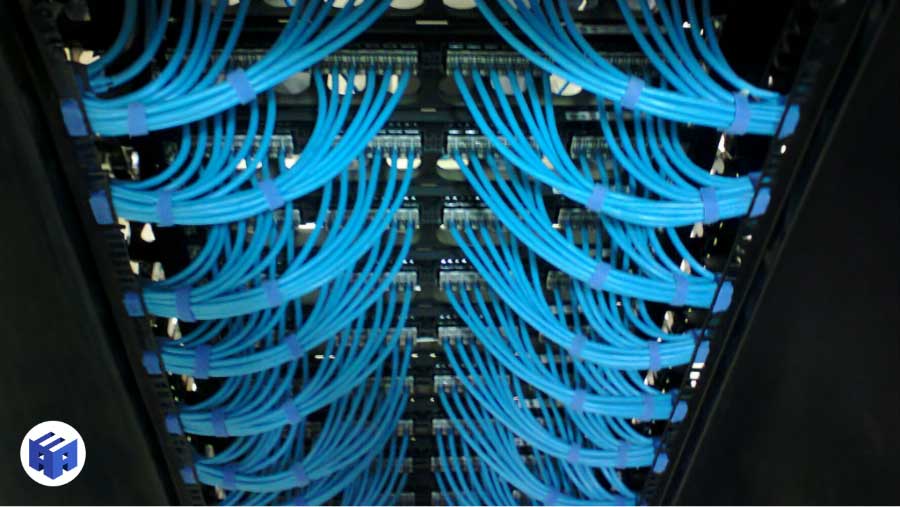
Cable distribution and organization are another critical challenge in large projects with a high number of users, because hundreds of cables are routed through racks and conduits. These cables must be physically protected against bends, sharp edges, and angles that can damage them, while also providing grounding for these metallic structures to minimise the effects of electromagnetic interference.
In addition to care during cable routing, another essential issue is the organization of cable termination at the telecommunications rooms.
Archive: A3A Engenharia de Sistemas
- Challenge: Keeping cables organized and properly identified so that future maintenance is easier and network failures are avoided.
- Solution: Use cable management systems, such as horizontal and vertical managers, trays, and raceways, to keep cables organized and accessible. Clear identification of cables and connections is also essential to make maintenance easier and minimise operational issues.
Long Distances and Signal Attenuation
In large-scale installations where several different buildings need to be interconnected across different areas, the challenge is to create a topology with redundancy. Even when fiber optic backbones are used, signal attenuation remains a factor that must be taken into account. For that reason, it is very important to hire a proper engineering design service so that a complete study and the necessary calculations are carried out to minimise attenuation and achieve the required network performance across all company facilities without significant signal loss.
- Challenge: Ensuring efficient data transmission over long distances without signal quality degradation.
- Solution: Use fiber optics to connect long-distance points and as the network backbone. Fiber optics are ideal for long distances because they provide high transmission capacity with minimal losses and are immune to electromagnetic interference.
Electromagnetic Compatibility (EMI)
In commercial areas with a large number of electronic devices, electromagnetic interference (EMI) can affect signal quality and cause data loss. Environments with industrial equipment or areas with intense human traffic are also susceptible to this issue.
- Challenge: Protecting network cables against electromagnetic interference that can compromise data transmission integrity.
- Solution: Use shielded cables (STP) or fiber optics, especially in areas close to EMI sources. Ensuring proper separation between network cables and power cables is also an essential practice for minimising the impact of interference.
Integration with Security and Automation Systems
In large commercial areas, the structured cabling network also needs to integrate security systems, such as CCTV, access control, and building automation systems. These integrations require cabling that is planned to support devices with high data volumes and continuous operation.
- Challenge: Planning a cabling infrastructure that supports not only the IT network, but also security and automation systems, all of which depend on a robust and reliable network.
- Solution: Design the cabling network so that CCTV and access control systems are integrated together with the IT network. This can be done by using VLANs and dedicated switches for each system, ensuring that data flows do not interfere with one another.
Preserving the Aesthetics of the Environment
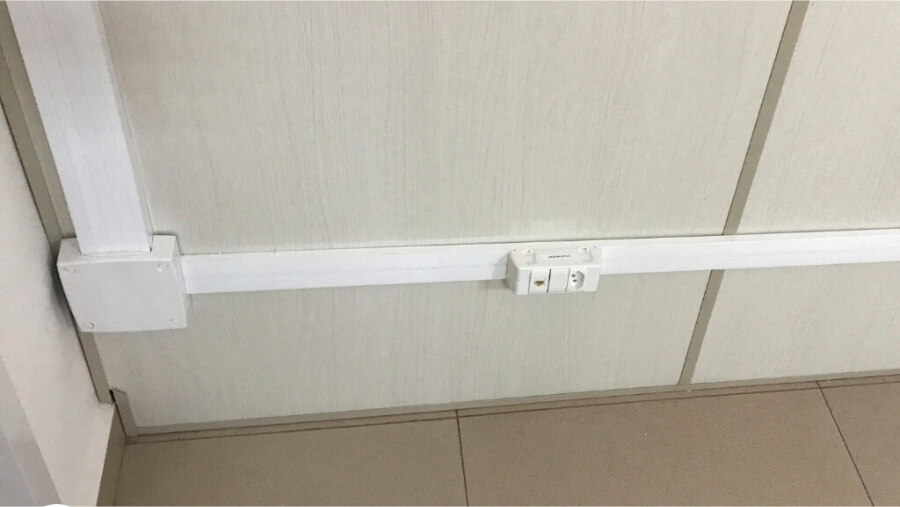
In commercial areas, especially in locations open to the public, the appearance of cabling can affect the aesthetics of the environment. Exposed cables and conduits can harm the visual experience and also create safety risks.
Once again, hiring specialised consultancy is essential to ensure both functionality and a high-quality installation finish.
- Challenge: Installing cabling discreetly so that the infrastructure does not negatively affect the appearance of the environment.
- Solution: Use concealed raceways in walls or ceilings, underground conduits, and hidden racks so that the cabling remains organized and out of public view. In addition, the colour and design of the raceways can be adapted to blend into the environment.
Archive: A3A Engenharia de Sistemas
Conclusion
Installing structured cabling in large commercial areas requires detailed planning and advanced solutions to overcome the specific challenges these environments present. From cable organization to the selection of materials and integration methods, every stage must be carried out with precision to ensure that the network infrastructure meets current and future connectivity demands. Hiring a specialised engineering company helps ensure that the project is delivered with the required quality, resulting in an efficient, scalable, and well-organized network.
