
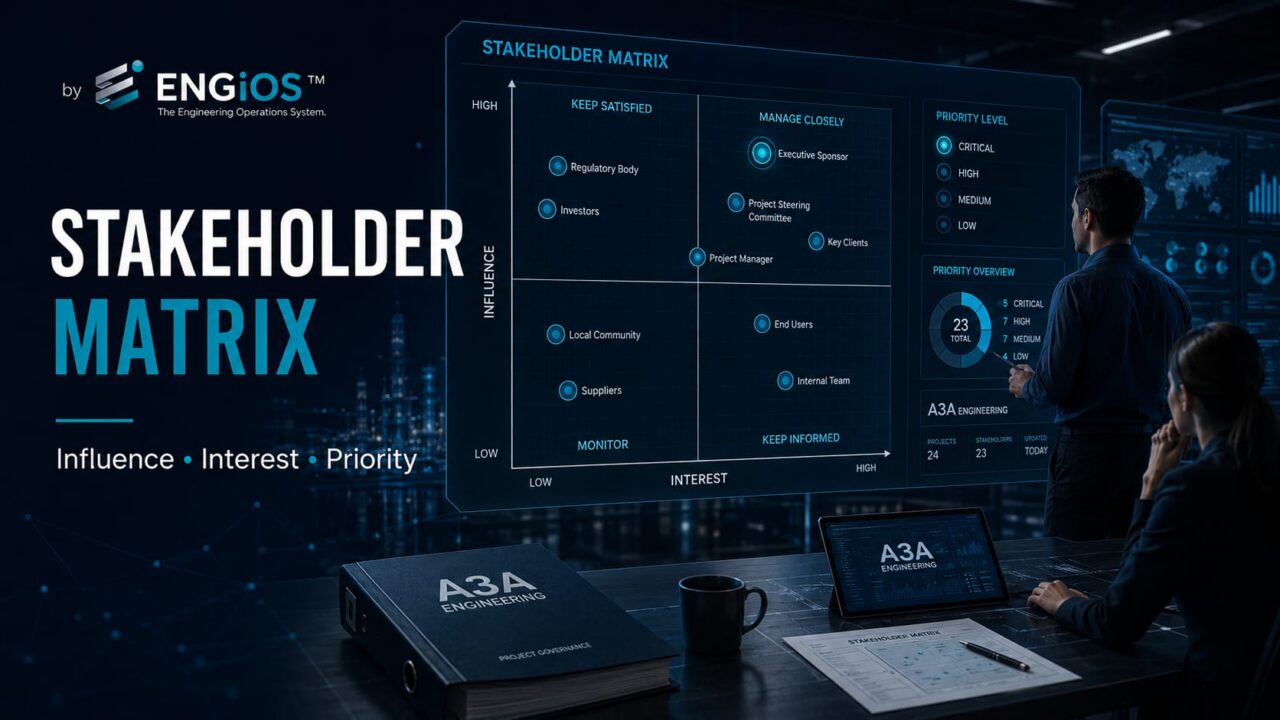
Learn how to build a stakeholder matrix using influence, interest, impact, legitimacy and other criteria to prioritize engagement in projects.
Check it out!
A stakeholder matrix is an analysis and prioritization tool that positions interested parties according to defined criteria—such as influence, power, interest, impact, attitude, legitimacy or urgency—to guide the level of attention, engagement and communication required in a project.
The best-known matrix crosses influence or power with interest, creating quadrants that help differentiate strategies such as engage closely, keep satisfied, keep informed or monitor. This simplicity is useful, but should not be confused with a complete assessment. In engineering projects, a stakeholder with low formal authority may experience high impact, hold critical knowledge, control an operational interface or possess enough legitimacy to alter the result.
Therefore, a robust stakeholder matrix begins by defining the purpose of the analysis and the criteria appropriate to the context. The tool serves to prioritize management attention; it should not label people, replace professional judgment or reduce complex relationships to a single quadrant.
What is a stakeholder matrix
A stakeholder matrix organizes interested parties according to criteria that help the team decide how to manage their participation. It complements stakeholder management and stakeholder mapping.
The difference among these artifacts can be summarized as follows:
| Artifact | Purpose |
| Stakeholder register | Maintain structured data about each stakeholder |
| Stakeholder map | Visualize relationships, dependencies and connections |
| Stakeholder matrix | Classify and prioritize attention according to criteria |
| Engagement strategy | Define how to act on the relationship |
| Communication plan | Define information, channel, timing, owner and feedback |
The matrix is therefore a decision layer. Its value appears when the classification changes the management strategy.
What is the stakeholder matrix used for
In projects with few parties and simple relationships, a manager may maintain a good understanding of the environment without a formal tool. As contracts, disciplines, suppliers, external authorities, users, operations and interfaces increase, prioritization requires a method.
The matrix helps to:
- focus attention on stakeholders capable of affecting critical decisions;
- recognize highly impacted parties even without significant authority;
- differentiate executive, technical and operational communication;
- anticipate resistance and conflicts;
- plan consultations and approvals;
- define relationship owners;
- adjust communication frequency and depth;
- guide escalations;
- review priorities when the context changes.
The tool does not eliminate the need for dialogue. It organizes where the team should look first.
Power-interest matrix: how it works
The best-known form is the power-interest matrix, also described as influence × interest. The horizontal axis represents the stakeholder’s level of interest in the project or a specific decision; the vertical axis represents their ability to influence the result.
The typical interpretation is:
| Power/influence | Interest | Initial strategy |
| High | High | Engage closely and prepare decisions |
| High | Low | Keep satisfied and mobilize at critical moments |
| Low | High | Keep informed, consult and capture knowledge |
| Low | Low | Monitor changes and communicate when relevant |
The word “initial” is important. The quadrant guides, but does not replace analysis of impact, legitimacy or context.
How to define power or influence
Power is not just job title. In engineering projects, the ability to influence may come from different sources.
Formal authority
Sponsors, committees, managers, inspectors, regulatory authorities or approval owners have defined institutional power.
Control of resources
Those who control budget, team, access, equipment, infrastructure or schedule can affect the project even without technical approval authority.
Critical knowledge
Specialists, operations, maintenance and suppliers may hold information without which a decision or execution cannot proceed.
Contractual power
Owners, contractors, subcontractors and suppliers have rights, obligations and notification mechanisms that influence decisions.
Control of external interfaces
Utilities, licensing bodies and authorities can condition important milestones.
Informal influence
Recognized leaders, key users and respected specialists can mobilize support or resistance.
The assessment should record evidence. “Very influential” without justification becomes a subjective opinion.
How to define interest
Interest represents how much a stakeholder cares about the project, a decision, an impact or a result. It can vary throughout the life cycle.
A sponsor may have high interest in cost and schedule and low interest in engineering details. Operations may have moderate interest during contracting and very high interest near testing and handover. An external authority may follow development only loosely and become critical at the authorization stage.
Useful questions include:
- does the stakeholder receive a direct benefit?
- does the stakeholder experience operational impact?
- does the stakeholder have responsibility for the result?
- does the stakeholder have financial or contractual exposure?
- does the stakeholder need to approve or accept a deliverable?
- will the stakeholder have to operate or maintain the asset?
- does the stakeholder face reputational, legal or regulatory risk?
Interest should also be assessed by topic. A person may have low interest in the project as a whole and high interest in a specific decision.
Why power and interest are not enough
The power-interest matrix is a first reading, not a verdict. In engineering, impact received, critical knowledge, legitimacy and dependencies can completely change the strategy.
The two-axis matrix is useful because of its simplicity, but it can distort complex projects.
Consider four cases:
- a maintenance team with low formal power but high long-term impact;
- a community with little authority over the contract but high legitimacy and received impact;
- a specialized supplier with limited formal power but critical knowledge;
- an external authority with low day-to-day interest and high authority over a milestone.
If the team looks at only two axes, it may prioritize incorrectly.
Additional criteria for stakeholder analysis
Engineering projects can incorporate complementary criteria.
Impact received
Assesses how much the project can affect the stakeholder. It is essential for operations, users, communities and areas that will inherit the asset.
Legitimacy
Considers whether the claim or participation has a recognized institutional, contractual, regulatory, technical or social basis.
Urgency
Assesses how quickly the need or decision must be addressed.
Attitude
Records support, neutrality, resistance or lack of awareness, preferably based on observable evidence.
Critical knowledge
Shows how much the project depends on that party’s knowledge, experience or information.
Dependency
Assesses whether a deliverable, authorization, data item or resource depends directly on the stakeholder.
Proximity to the decision
Distinguishes who needs to be involved now from who will become relevant in a future phase.
How to use a multicriteria matrix
When two axes are insufficient, the team can use multicriteria scoring. The objective is not to create sophisticated mathematics, but to make criteria explicit and comparable.
Example of a 1-to-5 scale:
| Criterion | 1 | 3 | 5 |
| Influence | Low | Moderate | Very high |
| Impact received | Minimal | Relevant | Critical |
| Urgency | Long term | Next phase | Immediate |
| Dependency | Low | Partial | Blocking |
| Knowledge | Common | Important | Essential |
The team should define weights only when there is a justification. Arbitrary weights give a quantitative appearance to a decision that remains subjective.
How to avoid false precision
A matrix does not measure people with scientific precision. It structures professional judgment.
To avoid false precision:
- define criteria before scoring;
- describe the meaning of each scale;
- use evidence;
- discuss differences among evaluators;
- record assumptions;
- review when the context changes;
- do not treat a small scoring difference as absolute truth.
The value of the matrix lies in the consistency of the discussion, not decimal places.
How to build a stakeholder matrix step by step
1. Define the purpose of the analysis
The question may be: who needs to participate in defining requirements? who influences the license? who should be involved in commissioning? who can affect a critical change?
A generic matrix for the entire project may be less useful than specific analyses by decision or phase.
2. Use the stakeholder register
Identification should come from documents, contracts, WBS, interfaces, operations, external authorities and impacts. Do not build the matrix only with names already known by the team.
3. Choose the criteria
For a simple analysis, power × interest may be sufficient. For a complex project, add impact, legitimacy, urgency or dependency.
4. Define scales
Explain what low, medium and high mean, or define numerical scores.
5. Classify with evidence
Avoid isolated individual judgment. Workshops with a multidisciplinary team reduce bias.
6. Associate a strategy
Each group should receive an appropriate management action.
7. Define an owner
The relationship needs an owner. Without one, the strategy has no execution.
8. Connect communication
Turn priority into channel, frequency, content and feedback.
9. Review periodically
Classification changes with phases, events, contracts and people.
How to interpret high power and high interest
These stakeholders require management proximity. They normally include the sponsor, key client, decision-making authority or leadership accountable for the result.
The strategy should prioritize:
- participation in relevant decisions;
- objective executive information;
- timely escalation;
- alignment of objectives;
- transparency about risk and trends;
- confirmation of commitments.
The mistake is overloading these stakeholders with operational details that hide the required decision.
How to interpret high power and low interest
These are parties capable of strongly affecting the project but who do not need to follow everything.
Examples may include corporate leadership, an external authority or a critical support department.
The strategy is usually to:
- maintain trust;
- communicate relevant exceptions;
- prepare decisions in advance;
- avoid excessive noise;
- mobilize at the right time.
Low interest does not mean irrelevance.
How to interpret low power and high interest
These stakeholders may include users, specialists, operations, maintenance or directly impacted areas.
The strategy should consider:
- accessible information;
- consultation;
- requirements capture;
- feedback;
- participation in reviews and tests;
- communication of changes.
This quadrant is often underestimated even though it concentrates operational knowledge and risk of late rejection.
How to interpret low power and low interest
The strategy is to monitor and communicate proportionally. But the classification should be reviewed when phases change.
A stakeholder with little relevance during concept development may become critical during implementation or operations.
Stakeholder matrix vs. RACI matrix
The two tools answer different questions.
The RACI Matrix in projects defines who is responsible, accountable, consulted and informed regarding activities or deliverables.
The stakeholder matrix assesses people and groups in relation to influence, interest, impact and relationship strategy.
For example:
- a sponsor may have high influence in the stakeholder matrix and be “A” only for specific decisions in the RACI;
- a designer may be “R” for many deliverables and still have limited influence over strategic decisions;
- operations may be “C” in certain activities but have high impact and interest in the stakeholder matrix.
Used together, the tools improve clarity of responsibility and relationships.
Stakeholder matrix vs. risk matrix
They are also not equivalent. A risk matrix classifies uncertain events according to probability, impact and other criteria. A stakeholder matrix classifies interested parties.
However, there is a connection. Stakeholders may be:
- a source of risk;
- responsible for a response;
- an impacted party;
- an approver of contingency;
- a mitigation agent.
Therefore, the analysis should connect with project risk management.
How to connect the matrix to the communication plan
Classifying stakeholders creates value only when the analysis changes engagement and communication. Quadrants without owners, channels, deadlines and actions do not improve the project.
The matrix helps define the intensity and nature of the relationship. The project communication plan turns this decision into information, channel, frequency, owner and feedback.
Example:
| Classification | Likely communication |
| High power / high interest | Decision meeting, executive reporting, exception alerts |
| High power / low interest | Concise update and milestone-based mobilization |
| Low power / high interest | Workshops, consultations, detailed communication |
| Low power / low interest | Proportional periodic communication |
Frequency should not be defined only by the quadrant. Topic criticality and project timing also matter.
How to connect the matrix to requirements and acceptance
Stakeholders influence requirements, acceptance criteria and validation. Classification helps define who should participate before decisions are frozen.
In engineering requirements management, stakeholders may assume different functions:
- originate a requirement;
- clarify a need;
- validate a solution;
- approve a criterion;
- test the result;
- accept the deliverable.
Ignoring a relevant party until the end is one of the main causes of late change.
How to address resistance in the matrix
Resistance should be recorded as a state, not an identity.
Instead of classifying someone as “difficult,” describe:
- which decision creates disagreement;
- what impact exists;
- which requirement has not been met;
- what information is missing;
- which interest is in conflict;
- what evidence supports the position.
The strategy may involve consultation, negotiation, impact mitigation, clarification, technical review or escalation.
When to use the salience model
The salience model is an alternative that prioritizes stakeholders based on attributes such as power, legitimacy and urgency. It is useful when power × interest does not adequately represent the environment.
In contexts with a strong regulatory, community or institutional component, legitimacy and urgency can be as important as interest.
The team does not need to adopt the model formally in every project. The key is recognizing that different attributes may justify priority.
Example applied to an engineering project
Consider an industrial modernization with the following stakeholders:
| Stakeholder | Influence | Interest | Impact received | Note |
| Sponsor | High | High | Medium | Decides investment and exceptions |
| Operations | Medium | High | High | Receives impact and validates operability |
| Maintenance | Medium | High | High | Influences life cycle and access |
| Utility | High | Medium | Low | Controls external authorization |
| Critical supplier | Medium | High | Medium | Holds essential technical knowledge |
| Affected users | Low | High | High | Experience unavailability |
| Corporate management | High | Low | Low | Acts on strategic exceptions |
If the team uses only power × interest, it may reduce the priority of affected users. When impact received is added, the strategy changes: communication and contingency are planned before the intervention.
This is the kind of value the matrix should produce.
How to review the matrix throughout the project
The matrix needs to be updated when:
- the project changes phase;
- a supplier enters or leaves;
- the sponsor changes;
- a relevant external authority appears;
- a risk occurs;
- scope changes;
- interest or resistance increases;
- operations takes on a larger role;
- commissioning and acceptance approach;
- a contractual relationship changes.
The review may change criteria, classification and strategy.
Common mistakes in the stakeholder matrix
Confusing power with job title
Influence can come from knowledge, contract, legitimacy or control of resources.
Ignoring impact received
Stakeholders without formal authority may experience significant consequences.
Using personal labels
The matrix should analyze the relationship with the project, not personality.
Creating scores without definitions
Numbers without an explicit scale do not improve quality.
Never reviewing
Position changes throughout the life cycle.
Treating the quadrant as an automatic strategy
Each stakeholder needs to be analyzed according to the topic and context.
Exposing sensitive information
Access should be controlled when assessments are sensitive.
Checklist for building a robust matrix
Before using the matrix for decision-making, confirm:
- the purpose of the analysis is defined;
- the stakeholder list is up to date;
- criteria are explicit;
- scales are understandable;
- classifications are supported by evidence;
- impact received has been considered;
- legitimacy and urgency have been assessed where applicable;
- the current position is described professionally;
- a strategy is associated with each group;
- the relationship owner is defined;
- the communication plan is connected;
- the relationship with requirements, risks and interfaces has been considered;
- review frequency or triggers are defined;
- access to sensitive information is appropriate.
Stakeholder matrix and Consulting Engineering
In multidisciplinary projects, Consulting Engineering connects the matrix to the real governance system: interfaces, contracts, requirements, risks, decisions and acceptance criteria.
In complex projects, the challenge is not drawing four quadrants. It is integrating stakeholder analysis with governance, contracts, interfaces, requirements, risks and decisions.
In Engineering Project Management, the matrix can support the definition of governance routines, escalation, executive communication, technical participation and engagement strategy.
In Owner’s Engineering, it helps the owner understand who needs to be involved among designers, suppliers, contractors, inspection, operations and authorities while preserving formal responsibilities and technical criteria.
Consulting adds value when it converts classification into verifiable action: who participates, in which decision, through which channel, at what time and with what evidence of closure.
Final considerations
A stakeholder matrix is a prioritization tool, not an end in itself. Power × interest provides a useful first reading, but engineering projects often require consideration of impact, legitimacy, urgency, knowledge and dependencies.
The method should be simple enough to use and robust enough to avoid superficial decisions. Clear criteria, evidence, periodic review and connection with engagement and communication are more important than graphical sophistication.
When the matrix helps the team engage the right party, at the right time and with the appropriate strategy, it contributes directly to project decisions, requirements, interfaces, risks and acceptance.
Technical references
[1] INTERNATIONAL ORGANIZATION FOR STANDARDIZATION. ISO 21502:2020 — Project, programme and portfolio management — Guidance on project management. Geneva: ISO, 2020. Available at: https://www.iso.org/standard/74947.html
[2] PROJECT MANAGEMENT INSTITUTE. A Guide to the Project Management Body of Knowledge (PMBOK® Guide). 8th ed. Newtown Square: PMI, 2025. Available at: https://www.pmi.org/standards/pmbok
[3] PROJECT MANAGEMENT INSTITUTE. Stakeholder management. Newtown Square: PMI. Available at: https://www.pmi.org/learning/library/stakeholder-management-task-project-success-7736
[4] PROJECT MANAGEMENT INSTITUTE. Stakeholder Management and RACI for AI Teams. PMI Blog, 2026. Available at: https://www.pmi.org/blog/stakeholder-management-raci
Frequently asked questions
It is a tool that classifies interested parties according to criteria such as influence, interest, impact, legitimacy or urgency to guide engagement, communication and management priorities.
It positions stakeholders in four combinations of power and interest. The classification provides an initial strategy such as engage closely, keep satisfied, keep informed or monitor.
Not always. Complex projects may require impact received, legitimacy, urgency, critical knowledge, dependency and current position to avoid superficial prioritization.
The stakeholder matrix analyzes relationship priority and influence. RACI assigns responsibility over activities and deliverables among Responsible, Accountable, Consulted and Informed roles.
Consider formal authority, control of resources, contractual power, critical knowledge, control of interfaces, legitimacy and the ability to mobilize decisions or other parties.
Whenever there is a relevant change in phase, stakeholders, contracts, risks, governance, scope or levels of influence and interest. Dynamic projects may require review in each management cycle.
It is an approach that prioritizes interested parties based on attributes such as power, legitimacy and urgency. It can be useful when the power-interest matrix does not represent the context well.
Yes. Assessments of influence, resistance, interests and informal relationships can be sensitive. Access should be controlled and language should describe evidence and context while avoiding personal labels.
