
Smart CFTV cameras with AI and metadata for VMS are transforming security systems by combining advanced video analytics, automated data generation, and efficient integration with management platforms. This evolution enables more precise monitoring, faster responses, and greater operational efficiency. This article provides an in-depth look at the principles, technologies and […]
Check it out!
Smart CFTV cameras with AI and metadata for VMS are transforming security systems by combining advanced video analytics, automated data generation, and efficient integration with management platforms. This evolution enables more precise monitoring, faster responses, and greater operational efficiency.
In this article, we examine in depth the principles, technologies, and architecture associated with the generation and transmission of metadata by CFTV cameras with artificial intelligence, as well as their system-level integration with video management platforms (VMS), including technical considerations on communication standards such as ONVIF Profile M, edge analytics models, information filtering, intelligent search mechanisms, and application scenarios in corporate and industrial environments.
Read on!
[elementor-template id=”24446″]
AI, Metadata, and Intelligence in Monitoring
The evolution of electronic security systems increasingly relies on cameras with embedded Artificial Intelligence (AI). Unlike conventional cameras, these devices operate as true intelligent sensors, capable of mapping the scene and analyzing images in real time directly at the edge (edge processing), without requiring external servers to process data.
The Artificial Intelligence embedded in some cameras, such as the PNO-A9081R, performs advanced analytics that include:
- Object detection and classification: identifies people, faces, vehicles, and license plates.
- Recognition of detailed attributes such as gender, clothing color, presence of luggage, age, face-mask use, and vehicle type and color.
- Intelligent behavioral analytics, such as:
- Face-mask detection.
- Social-distancing monitoring.
- Slip & Fall detection.
- Intrusion, loitering, and entry or exit analytics for defined virtual areas.
- Business Intelligence (BI):
- People, vehicle, and crowd counting.
- Queue management.
- Heatmap generation for flow and occupancy analysis.
Metadata Generation
All these functions generate rich metadata, consisting of structured information extracted from images, such as object type, characteristics, or the detected event. This metadata is sent directly to the VMS (Video Management System), such as Genetec, Milestone, or Hanwha SSM, where it is stored and integrated into the system database. This enables:
✅ Fast searches for specific characteristics, such as “person wearing a red shirt” or “blue vehicle.”
✅ Generation of intelligent reports.
✅ Creation of dynamic alerts based on attributes or behaviors.
✅ Drastic reduction in event investigation time, optimizing security operations.
This embedded intelligence transforms the monitoring system into a proactive rather than merely reactive tool, raising the level of security and operational efficiency. Integrating and sending analytical data directly to the VMS provides precision, response speed, and valuable insights for decision-making.
In practice, this capability differentiates high-performance professional solutions — such as those tested and demonstrated in the A3A Engenharia showroom — from conventional video surveillance solutions.
Forensic Search
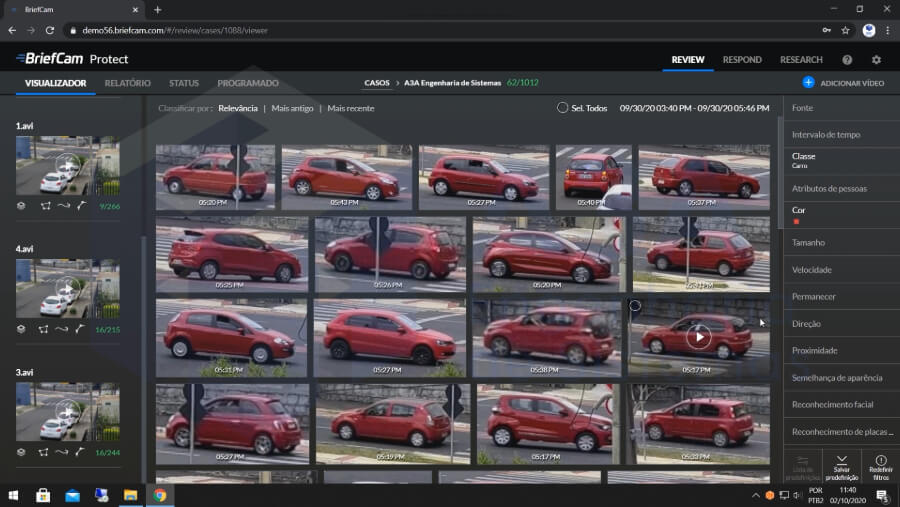
The image shows the BriefCam Protect user interface displaying results from a forensic video analysis based on Artificial Intelligence video analytics algorithms. The software specifically filters red vehicles using metadata generated by intelligent cameras such as the Hanwha PNO-A9081R. This metadata, processed directly in the camera (AI on edge) or on a dedicated server, includes attributes such as object class, color, direction, speed, and dwell time in the scene. When integrated with the VMS, it enables precise searches and data correlation for fast and accurate investigations.
The demonstration, carried out in the A3A Engenharia showroom, illustrates practical applications of advanced analytics to significantly reduce analysis time in electronic security operations.
TECHNICAL ARCHIVE: A3A ENGENHARIA
In high-performance electronic security projects, Forensic Search represents a crucial advance, especially when combined with artificial intelligence embedded in cameras. In the past, investigating incidents in monitoring systems meant reviewing hours or days of recordings to find a specific event — a time-consuming process prone to human error.
Expert Comment — Eng. Altair Galvão
“In the past, searching for an incident in a monitoring system literally meant ‘binge-watching the CFTV system’ — reviewing hours or even days of recordings, an exhausting task prone to human error. Today, with Artificial Intelligence-based video analytics, specific events can be located in seconds, making the system far more accurate and efficient.”
Eng. Altair Galvão is a video analytics specialist certified by BriefCam, a global reference in forensic video analysis, with certification completed at the Axis Experience Center in Fort Lauderdale. He also holds SAFR Facial Recognition certification obtained at RealNetworks headquarters in Seattle. With 29 years of experience in electronic security projects, he leads the A3A Engenharia team, bringing a practical and strategic perspective to intelligent monitoring solutions.
With AI-based video analytics, this scenario has changed radically. Technologies such as object recognition, physical attributes, suspicious behavior, and metadata generation transform each video frame into structured information. This means data such as:
- object type (person, vehicle, license plate),
- clothing or vehicle color,
- direction of movement,
- dwell time in restricted areas,
- anomalous behaviors (such as falls or loitering),
are automatically recorded and indexed.
Intelligent Search
Forensic Search uses this metadata to quickly locate specific events, eliminating the need to manually review lengthy video footage. In just a few seconds, it is possible to filter:
- all people who passed through a given area,
- vehicles of a specific color,
- situations involving intrusion or suspicious behavior.
This process not only accelerates investigations but also significantly increases the accuracy and reliability of analyses. Integrated with the VMS, AI also enables dynamic alerts and detailed reports, supporting fast responses and strategic decisions in critical environments.
The combination of advanced analytics and Forensic Search raises the monitoring system to a new level of operational intelligence, transforming images into valuable insights for security, management, and process efficiency.
Metadata Fundamentals in AI-Enabled CFTV Cameras
In high-performance video surveillance systems, CFTV cameras are essential for generating analytical metadata from images processed in real time.
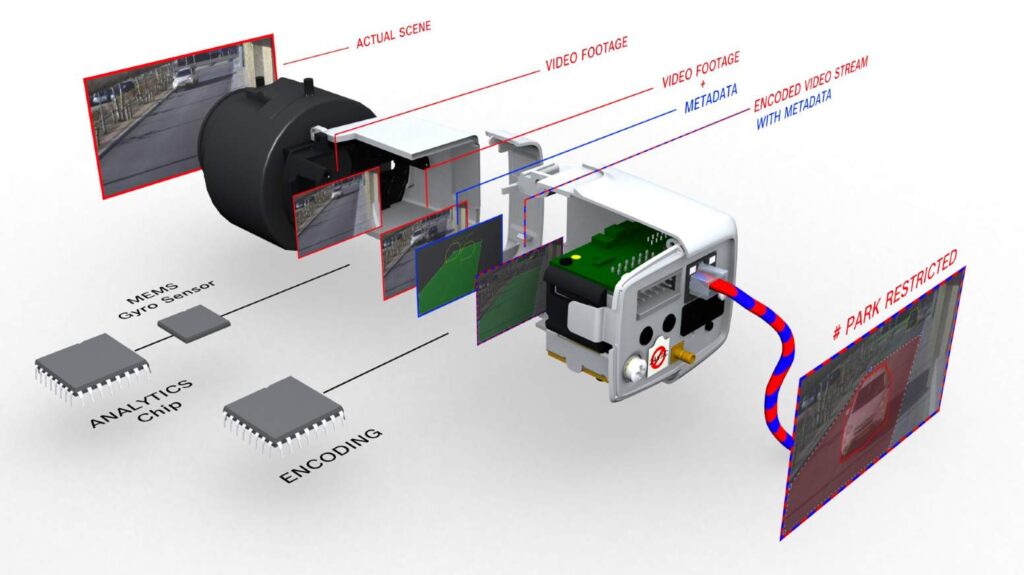
The use of smart CFTV cameras with AI and metadata for VMS ensures detailed event analysis and facilitates centralized system management. Metadata consists of structured descriptions of objects, events, and specific characteristics extracted from the scene, such as:
- Spatial location of detected objects or events
- Exact time of occurrence
- Color, shape, and size of objects
- Movement coordinates and speed
- Dwell time in the scene
- Classification (for example, object type: vehicle, person, animal; class: car, bus; color: black, red, etc.)
- Identifiers such as vehicle license plates
Metadata processing preferably occurs at the edge, that is, within the camera itself, using advanced computer vision and machine learning algorithms. Some analytical models implement multilayer processing, in which preliminary results are reprocessed on servers or IoT platforms to improve accuracy and enrich analytical data.
Analytical metadata adds value by enabling dynamic filters, automated searches, and proactive response. For example, events in a video database can be searched using attributes such as ‘person wearing blue clothing between 8:00 a.m. and 10:00 a.m.’ or ‘white vehicle moving above 30 km/h’.
Benefits of Smart CFTV Cameras with AI and Metadata for VMS
Smart CFTV cameras with AI and metadata for VMS offer significant advantages in advanced monitoring systems. They process images and video in real time, generating detailed information about people, objects, and events. This metadata facilitates intelligent search and analysis in the VMS, enabling faster identification of critical situations and reducing false alarms. In addition, the integration between AI and VMS improves operational efficiency, providing greater security and control in complex environments.
ARCHIVE: A3A ENGENHARIA DE SISTEMAS
Interoperability Standards and Protocols: ONVIF Profile M
Interoperability among devices from different manufacturers in complex projects requires adherence to established communication and data-structuring standards. For metadata integration between intelligent cameras and video management systems (VMS), adoption of ONVIF Profile M stands out. This profile standardizes:
- Transmission of analytical metadata streams and real-time events to servers and VMS applications.
- Semantic structure for describing objects, movements, and events, enabling standardized search and automation.
- Compatibility among different hardware and software solutions, reducing obsolescence risks and expanding possible integrations.
Implementations compliant with ONVIF Profile M allow VMS platforms to query, filter, and receive metadata from multiple manufacturers, standardizing operations such as alarm activation, contextual notifications, and advanced recording indexing.
Metadata Generation and Processing Architecture
The architecture of intelligent CFTV systems can be designed using different approaches, depending on where metadata is generated and processed:
- Camera-Based Systems (Edge Processing): Cameras equipped with integrated processors analyze and filter data directly on the device, reducing bandwidth consumption and offloading central servers.
- Server-Based Systems: Images are transmitted in full to processing centers, where video analytics algorithms extract metadata. This model is recommended for scenarios that require advanced computing resources or integration with other corporate systems.
- Cloud-Based Solutions: Video and metadata streams are directed to cloud platforms, supporting scalability and cross-site analytics.
- Hybrid Approach: Combines preliminary edge analysis with refinement and aggregation on servers or in the cloud, optimizing performance and accuracy.
Text diagram of the hybrid architecture:
<code>
[Câmeras IP Inteligentes]
      ↓
[Envio de metadados via ONVIF Profile M]
      ↓
[Servidores de VMS/Plataformas IoT]
      ↓
[Dashboards, automações, busca inteligente]
</code>
Communication Flow: From Metadata Generation to the VMS
The typical flow for generating and sending metadata to a VMS involves the following steps:
- Analytical Detection: The camera processes the image in real time using AI algorithms to detect objects, patterns, or events.
- Structuring: Metadata is structured according to predefined models (ONVIF Profile M), containing attributes such as object type, location, timestamp, and relevant characteristics.
- Filtering: Local rules are applied to send only events or information of interest, optimizing network and processing use.
- Transmission: Metadata and, when applicable, correlated video streams are forwarded to the VMS.
- VMS Ingestion: The VMS records, indexes, and stores the metadata together with the video, enabling queries, searches, and automation based on actual events.
Robust protocols are essential to ensure reliable data transport, even in critical and distributed environments.
Advanced Metadata Integration with the VMS
Integrating analytical metadata into the VMS environment enhances intelligent searches, automation, and generation of reports with high operational value. Key supported capabilities include:
- Intelligent search: Operators can quickly locate events or objects using filters such as color, type, time, and specific scene zones.
- Dynamic dashboards: Graphical presentation of trends, patterns, movement flows, and correlations among events.
- Automation and alarm triggers: The VMS can initiate automatic procedures, such as locking doors, switching on lights, or sending alerts when conditions defined in the metadata are detected.
- Indexing and auditing: Simplifies subsequent audits by allowing records to be searched using refined criteria without manually reviewing the entire video history.
In addition, integration with IoT platforms broadens the scope of metadata, enabling interdisciplinary analyses and data-driven decision-making.
Operational and Technological Benefits of Metadata Generation
Intensive use of metadata in intelligent CFTV systems provides gains across multiple dimensions:
- Reduced search time: Searching for specific events becomes almost instantaneous, increasing operational agility.
- Storage optimization: With indexed metadata, it is possible to retain only events of interest or apply compression according to the scenario, reducing costs.
- Automation and rapid response: Supports automation based on security policies configured from real contextual data.
- Predictive intelligence: Enables early identification of anomalous patterns, supporting proactive prevention processes.
- Interoperability: Standards-based systems allow future integration with new technologies without requiring major infrastructure revisions.
Quality, Maintenance, and Testing Considerations
Effective metadata extraction and use depend on the quality of the captured image and on device installation conditions. To ensure operational excellence, the following practices are recommended:
- Continuous monitoring of image integrity through the VMS, enabling automatic identification of faults such as obstructions, blur, underexposure, and tampering.
- Use of electronic stabilization and lighting-optimization algorithms, such as Axis Lightfinder and Axis OptimizedIR.
- Implementation of predictive maintenance practices, including Image Health Analytics and hardware monitoring.
- Execution of field test batteries to validate analytics and adjust parameters to the specific conditions of each environment.
These actions ensure continuous performance of analytical systems and metadata availability throughout all operational stages.
Data Storage and Retention: Edge Storage and Integrated VMS
Edge storage refers to storing recordings and metadata locally in the camera itself, using cards designed specifically for video surveillance that offer greater wear resistance and long service life. Integration between edge storage and VMS platforms provides a flexible and resilient architecture, essential for applications in mission-critical environments, remote sites, or mobile installations.
Key operational points:
- Redundancy: Minimizes data loss during network failures or power interruptions.
- Compatibility: Edge storage can be fully integrated with mature VMS platforms, enabling synchronization and recovery of historical records.
- Scalability: Modular expansion of retention capacity according to operational needs.
Proper storage sizing, combined with a retention policy supported by structured metadata, maximizes the efficiency and availability of critical information.
Conclusion
The adoption of CFTV cameras with artificial intelligence, combined with standardized generation and transmission of analytical metadata to video management systems, represents a qualitative leap in electronic security operations and management. Structuring data-oriented projects, following standards such as ONVIF Profile M and applying processing models at the edge, on servers, or in the cloud, provides high efficiency, traceability, and automation in supervision processes. The benefits go beyond operational agility: they enable advanced audits, technological interoperability, and support for future scalability.
The observed benefits range from reduced response times in critical situations to the effective implementation of compliance and predictive-security policies, making monitored environments increasingly intelligent, adaptable, and resilient.
Final Considerations
Based on the detailed analysis of CFTV cameras with AI and the complete flow for generating and sending metadata to VMS platforms, selecting solutions aligned with standards and open architectures is a key differentiator for ensuring longevity, security, and maximized return on investment in electronic security projects.
Acknowledgments
Thank you for reading this technical article from A3A Engenharia de Sistemas.
Follow our social media channels for more specialized content and industry updates.
Related Articles
Main Applications of Video Analytics
Total Cost of Ownership of a Video Monitoring System
Frequently Asked Questions
1 – What are smart CFTV cameras with AI?
→ They are cameras capable of analyzing images in real time, detecting objects, behaviors, and patterns without relying exclusively on external servers.
2 – How does AI on edge work in security cameras?
→ AI on edge processes data directly in the camera, enabling rapid analysis, bandwidth savings, and immediate response to events.
3 – What is metadata generated by CFTV cameras?
→ It is structured information extracted from video, such as object type, color, direction, movement, and detected behaviors.
4 – What is the advantage of integrating metadata with the VMS?
→ It enables fast forensic searches, intelligent report generation, and dynamic alerts, increasing the system’s operational efficiency.
5 – Do smart cameras help reduce investigation time?
→ Yes. AI and metadata make it possible to locate specific events in seconds, avoiding the need to review hours of recordings.
6 – What analytics does the Hanwha PNO-A9081R camera provide?
→ It includes detection of people, vehicles, license plates, attributes such as color, gender, mask use, behavioral analysis, people and vehicle counting, among others.
7 – What is Forensic Search in video systems?
→ It is the ability to quickly search for specific events in large volumes of video using metadata generated by intelligent cameras.
8 – Do smart cameras require more storage space?
→ Not necessarily. Algorithms such as WiseStream II and III optimize compression, reducing traffic and storage requirements without sacrificing quality.
9 – Can smart cameras be integrated with any VMS?
→ It depends on compatibility. The PNO-A9081R, for example, integrates with Genetec, Milestone, and Hanwha SSM, among others.
10 – Why is investing in cameras with AI and metadata important?
→ Because they raise security to a new level, enabling proactive systems, intelligent analysis, and a better return on investment.
