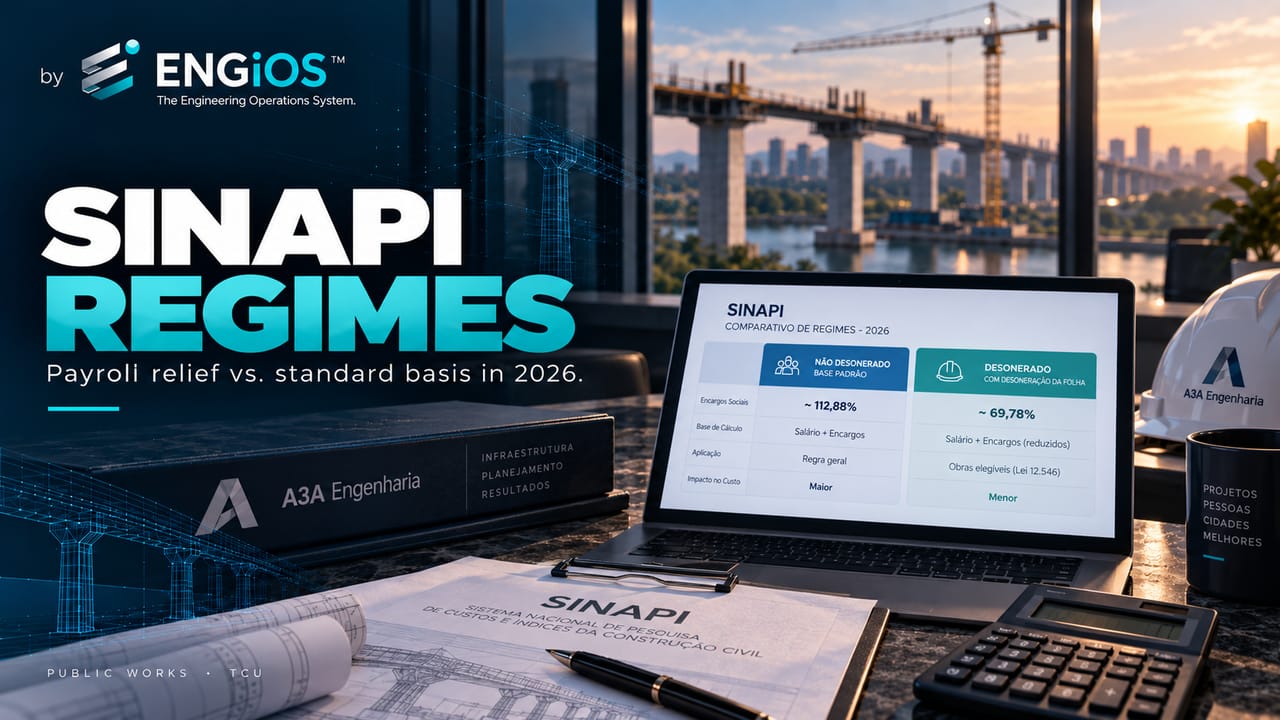
Understand SINAPI with vs. without payroll tax relief in 2026, gradual re-taxation, impacts on labor burdens, CPRB, BDI, and reference selection in public estimates.
Check it out!
SINAPI with payroll tax relief and SINAPI without payroll tax relief represent different scenarios for employer social-security charges on labor and therefore produce different unit costs for services. In 2026, this comparison requires additional care because Law No. 14.973/2024 placed payroll tax relief on a transition toward gradual re-taxation. For companies and projects covered by the regime, the 2026 “relieved” reference no longer corresponds to the former scenario of fully removing the employer contribution from payroll: SINAPI now reflects the partial incidence provided for the period.
In practice, the choice between the relieved and non-relieved reference should not be made by selecting the lowest spreadsheet total. It depends on the legal classification of the company and project, the estimate base date, the applicable tax framework, and how CPRB and labor burdens are allocated. In public-sector estimating, using the wrong table can simultaneously distort labor, cost compositions, BDI, and the total price.
What SINAPI with and without payroll tax relief means
SINAPI calculates labor costs from wages, social charges, and complementary labor costs. The main difference between the relieved and non-relieved scenarios lies in how the employer social-security contribution under Article 22 of Law No. 8.212/1991 is treated and, for activities covered by payroll-relief legislation, in the substitute contribution on gross revenue.
Under the non-relieved scenario, the employer social-security contribution on payroll remains under the regular regime. Under the relieved scenario, legislation historically replaced all or part of this incidence with a contribution on gross revenue — CPRB.
The estimating effect appears in two distinct places:
- in labor social charges, because the social-security component applied to wages changes;
- in BDI or the tax structure of the price, because CPRB applies to revenue rather than payroll.
This separation is essential. If the estimator reduces the social-security incidence within labor burdens and fails to account for CPRB where it actually belongs, the estimate is understated. If the full employer contribution remains in labor while CPRB is also added as though the regime were relieved, double counting is created.
What changed with gradual payroll re-taxation
Law No. 14.973/2024 amended Law No. 12.546/2011 and created a transition from 2025 through 2027. The logic ceased to be a simple full substitution of “payroll or revenue” and, during the transition period, now combines part of the payroll contribution with part of CPRB.
For sectors covered by the regime, the legal transition was structured as follows:
| Year | Share of CPRB rates | Share of employer payroll rates | General interpretation |
| 2025 | 80% | 25% | start of re-taxation |
| 2026 | 60% | 50% | partially re-taxed regime |
| 2027 | 40% | 75% | approach to the regular regime |
| 2028 onward | — | 100% | return to the full payroll regime, subject to legal rules |
In construction, the base CPRB rate provided in Article 7-A of Law No. 12.546/2011 is 4.5% for companies falling within the applicable cases. In 2026, applying 60% of that base rate corresponds arithmetically to 2.7% of gross revenue, while the employer payroll component corresponds to 50% of the regular 20% rate, that is, 10%, in cases effectively subject to the transitional regime.
These figures should not be used as a universal tax shortcut. They are meaningful only when the company, activity, and project are legally covered by the regime.
For construction companies whose base CPRB rate is 4.5% and whose reference employer payroll contribution is 20%, the nominal steps correspond to 3.6% CPRB and 5% on payroll in 2025; 2.7% and 10% in 2026; 1.8% and 15% in 2027; and, from 2028 onward, termination of CPRB with a return to 20% on payroll. Law No. 14.973/2024 also provides that, between 2025 and 2027, the employer contribution subject to partial substitution does not apply to thirteenth-salary remuneration.
| Year | CPRB on revenue, using a 4.5% base rate example | Employer payroll contribution |
| 2025 | 3,6% | 5% |
| 2026 | 2,7% | 10% |
| 2027 | 1,8% | 15% |
| 2028 | terminated | 20% |
There is also a corporate condition that should not be ignored in the estimate: between 2025 and 2027, an opting company must commit to maintaining an average number of employees equal to or greater than 75% of the average for the immediately preceding calendar year. Failure to comply affects the right to use the gross-revenue contribution in the following fiscal year.
The TCU’s 2026 Cost Engineering in Public Works Guide reinforces the estimating consequence of this transition: the employer payroll contribution should be treated within the social charges that make up direct labor cost, rather than being generically shifted into BDI. For multi-year projects, the calculation record should document the base date, the applicable legal step, and, where material, simulate labor costs in subsequent years.
This control is distinct from the impacts of IBS and CBS discussed in Tax Reform in construction: payroll re-taxation and consumption taxation have different economic bases and should not be consolidated into a single BDI rate.
How SINAPI represents the difference in 2026
SINAPI’s 2026 Calculations and Parameters publication maintains social-charge tables “with payroll tax relief” and “without payroll tax relief.” The difference makes clear that the relieved scenario already incorporates partial re-taxation.
In the São Paulo appendix effective from January 2026, for example, the employer INSS item in Group A appears as 10.00% in the relieved scenario and 20.00% in the non-relieved scenario, for both hourly and monthly workers. This difference is consistent with the 2026 legal transition.
The technical point is important: when opening an old 2023 or 2024 spreadsheet and comparing it with a 2026 estimate, the user may find different “relieved” rates even though the basic service methodology has not changed. The change may arise from tax legislation and labor burdens rather than productivity or input prices.
The reference changes by Brazilian state
Total social-charge percentages are not identical across all Brazilian states because certain components vary regionally. The central social-security component may follow the same legal rule, but the overall result for hourly and monthly labor burdens depends on the other groups, collective agreements, and regional parameters.
For this reason, it is incorrect to copy São Paulo’s total social-charge percentage and apply it to a project in Paraná, Rio Grande do Sul, or any other state. The reference should correspond to the project location and estimate base date.
Hourly and monthly workers remain different
The distinction between hourly and monthly workers does not disappear under payroll tax relief. SINAPI uses specific calculation records for each remuneration regime because rest periods, holidays, and other components are allocated differently.
Therefore, the relieved versus non-relieved comparison must also preserve the hourly or monthly basis used in the cost composition.
Which construction companies may be covered by the regime
Law No. 12.546/2011 includes, among activities covered by the regime, construction-sector companies classified under CNAE 2.0 groups 412, 432, 433, and 439, and infrastructure-construction companies classified under groups 421, 422, 429, and 431, subject to the law’s specific rules.
For certain construction cases, the option is linked to the project and its registration, under specific statutory rules. Law No. 14.973/2024 also provides that, beginning January 1, 2028, construction projects not yet closed migrate to the regular employer contributions under Article 22 of Law No. 8.212/1991.
This means that the label “SINAPI with payroll tax relief” does not authorize the conclusion that any contractor, contract, or service should use that reference.
Before selecting the scenario, it is necessary to verify:
- CNAE classification and activity actually performed;
- company eligibility under Law No. 12.546/2011;
- applicable tax option;
- project-specific rule, where applicable;
- project registration date and other relevant legal conditions;
- estimate reference period;
- tax documentation supporting the declared regime.
In public procurement, this classification needs to be addressed with the competent legal, accounting, and tax functions. Cost Engineering should correctly reflect the adopted assumption but should not replace the company’s tax analysis.
Where the difference appears in the estimate spreadsheet
A change in the social-security regime does not appear as an isolated line in the summary estimate. It propagates through the cost structure.
Consider a composition that includes a mason, laborer, and foreman. The hourly cost of each category includes social charges. When the scenario changes, the hourly cost changes. This new cost is multiplied by labor coefficients and changes the service unit cost.
The impact chain can be represented as follows:
social-security regime → social charges → hourly labor cost → cost compositions → direct cost → BDI/taxes → unit price → total estimate.
The greater the labor share in cost compositions, the greater the likely effect of the difference between the scenarios.
In equipment- or material-intensive services, the relative impact may be lower. In predominantly manual services, it may be materially significant.
How CPRB should be treated in BDI
CPRB is a contribution levied on gross revenue. Because of this nature, it should not be hidden inside hourly labor cost as though it were a charge directly levied on wages.
Historically, in estimates under payroll tax relief, the reduction in the employer payroll contribution was accompanied by inclusion of CPRB in the tax structure of BDI or the price, depending on the adopted methodology.
During the 2025–2027 transition, the logic continues to require two simultaneous checks:
- what share of the employer contribution remains in labor social charges;
- what share of CPRB is legally due on revenue.
In 2026, for a construction company subject to a 4.5% base rate, the transitional 60% share corresponds to 2.7%. This value should not be used automatically in every BDI: it is necessary to confirm whether the scope, company, and project are covered and whether that taxation is actually applicable to price formation.
BDI discipline also requires the taxes considered to be itemized. A single BDI copied from another contract, without a record of the tax regime, makes it impossible to know whether CPRB was included, excluded, or duplicated.
Technical example: same composition, two regimes
Consider a hypothetical composition with BRL 100.00 in materials, BRL 20.00 in equipment, and BRL 80.00 in base labor cost before social charges. For simplicity, assume all other charge groups remain constant and the only difference analyzed is the 20% employer share versus 10% in 2026.
Under the non-relieved scenario, the employer social-security contribution would add BRL 16.00 to this hypothetical labor base. Under the transitional relieved scenario, the equivalent amount would be BRL 8.00.
The direct BRL 8.00 difference does not by itself represent the final price difference. The transitional scenario also requires considering CPRB on revenue at the appropriate point in price formation.
The example shows why only comparing the labor-burden rate is insufficient. The correct decision depends on the complete estimate.
Which reference should be used in a public estimate
Choosing between SINAPI with and without payroll tax relief simultaneously changes labor burdens and the tax structure of the price. Estimate review needs to validate both sides to avoid understatement or double counting.
Learn about the Cost Estimating for Construction and Engineering Services service
The correct answer is neither “always use the lower one” nor “always use the non-relieved reference to be safe.” The reference must be consistent with the law, the base date, and the procurement assumption.
Updated federal guidance on gradual payroll re-taxation establishes, for new procurements, that bids and cost spreadsheets use the CPRB and CPP rates in force up to the final bid-submission date, as defined in the tender documents. The same guidance states that average rates or future projections should not replace the percentages legally applicable to the reference period.
For a reference estimate, this leads to a practical rule:
- identify the legal regime applicable at the base date;
- use the SINAPI publication corresponding to the state and period;
- document whether the reference used is with or without payroll tax relief;
- itemize CPRB where applicable;
- preserve a record of the rates;
- avoid anticipating the 2027 or 2028 rate within a 2026 bid merely because the contract will extend over time.
A future change in the statutory burden during contract execution is a separate issue and should be treated according to economic-financial equilibrium rules and the contract conditions.
Must the Administration’s reference estimate and the bidder’s proposal use the same regime?
In procurement, the analysis needs to distinguish the Administration’s reference from the bidder’s tax reality. Consistency among the declared regime, labor burdens, CPRB, and BDI can be technically verified without turning the reference estimate into a mandatory corporate structure.
Learn about Technical Support for Procurement and Bid Analysis
Not necessarily in an absolute sense. The Administration’s reference estimate is a reference for estimating the procurement value. The bidder develops its proposal according to its own corporate and tax reality, while complying with the tender documents and the law.
Two companies may have different tax structures and still compete for the same scope. The Administration needs to ensure that the reference estimate is technically and legally defensible and that bid analysis does not compare incompatible bases.
When the tender requires a detailed spreadsheet, the bidder should demonstrate the assumptions used. If it declares a payroll-relief regime, consistency among social charges, CPRB, and the other components can be verified.
The error occurs when the Administration treats its own reference as though it were an obligation for all competitors to have an identical internal structure, or when it accepts a spreadsheet that combines benefits from two regimes without their corresponding burdens.
How to verify whether there was an improper double advantage
A technical review can identify situations in which the spreadsheet appears to have applied incompatible benefits simultaneously.
Warning signs include:
- reduced social charges as though payroll tax relief applied;
- absence of CPRB when the declared regime would require it;
- use of a 2024 rate in a 2026 estimate;
- application of 0% employer INSS in a scenario that, in 2026, is already partially re-taxed;
- use of the full 4.5% CPRB rate together with the 2026 payroll component without justifying the legal basis;
- social charges from one state applied to a project in another;
- mixing percentages from different months or regimes.
The review should not be limited to the total. The labor-burden calculation record and BDI need to be opened and examined.
How to audit the choice between relieved and non-relieved SINAPI
A spreadsheet may appear correct in total and still combine labor burdens from one regime with BDI from another. Technical Audit reconstructs the calculation record and measures the materiality of the discrepancy.
A well-structured audit can follow five blocks.
1. Identify the declared regime
Clearly record whether the spreadsheet was developed using the relieved reference, the non-relieved reference, or a specifically justified treatment.
2. Verify legal and timing conditions
Confirm the legislation applicable at the base date, the transition period, the company’s option where relevant, and project-specific conditions.
3. Verify social charges
Compare the calculation record used with official SINAPI percentages for the state and period. In 2026, a historical rate that fully eliminates the employer contribution is a strong indication that the data are outdated.
4. Verify BDI
Check whether CPRB was included when due, at the correct transitional rate, and whether it was not counted again in another component.
5. Verify the overall impact
Recalculate the most relevant cost compositions and assess the materiality of the difference on services, the ABC Curve, and the total value.
This approach is more efficient than discussing abstractly whether one table is “more correct.”
How to compare two estimates under different regimes
Comparing only the total price can hide the source of the difference. Equalization should decompose the tax effect.
A useful approach is:
| Check | Estimate A | Estimate B |
| UF | identify | identify |
| Base date | identify | identify |
| Regime | relieved/non-relieved | relieved/non-relieved |
| Employer INSS on labor | percentage | percentage |
| CPRB | percentage/base | percentage/base |
| BDI | complete calculation record | complete calculation record |
| Hourly-worker social charges | percentage | percentage |
| Monthly-worker social charges | percentage | percentage |
| Labor cost composition | same codes? | same codes? |
| Overall impact | recalculate | recalculate |
Only after this normalization is it possible to conclude whether the difference arises from productivity, prices, taxes, or a simple methodological error.
Payroll tax relief and SINAPI social charges
SINAPI social charges include several groups beyond the employer social-security contribution. Vacation, thirteenth salary, rest periods, notice, FGTS, and cross-incidences continue to require their own methodology.
For this reason, comparing relieved versus non-relieved SINAPI does not replace a complete analysis of social charges. It is one specific layer within the calculation.
Anyone preparing the full calculation record should start from the official state table, distinguish hourly and monthly workers, and understand the group structure. The regime choice changes an important part of that record but does not eliminate the other components.
What happens to the thirteenth salary during the transition
Law No. 14.973/2024 established a specific rule for 2025–2027: under the partial-substitution system, the employer contributions provided for in items I and III of Article 22 of Law No. 8.212/1991 do not apply to remuneration paid, due, or credited as thirteenth salary.
Esse detalhe mostra por que não é adequado tentar reconstruir os encargos de 2026 apenas tomando um percentage antigo e trocando a linha de INSS. A complete calculation record precisa seguir a metodologia atualizada do SINAPI.
For estimating, the recommendation is to use the official publication for the period rather than a historical spreadsheet manually adapted without reviewing all incidences.
How payroll re-taxation affects contracts in execution
Legal changes during execution need to be analyzed against the actual bid, the risk matrix, and the contract’s economic record. Owner’s Engineering integrates costs, inspection, and change management to support decisions on economic rebalancing.
The legal change may alter costs in existing contracts. Brazil’s Federal Government Procurement Portal updated its guidance to expressly address gradual payroll re-taxation and possible economic-financial rebalancing.
The guidance distinguishes contracts with and without exclusive labor dedication, mixed activities, and other situations. It also notes that, under re-taxation, increased costs tend to motivate contractors to seek rebalancing, unlike the earlier tax-relief movement, when reduced tax burden could justify revision in favor of the Administration.
In construction and engineering services, any request needs to be analyzed in the context of the specific contract. It is not enough to show that the law changed. It is necessary to demonstrate:
- which portion of the contract was actually affected;
- which regime was considered in the bid;
- which new regime applies;
- the causal link between the legal change and cost increase;
- the calculation record;
- the absence of compensation through another contractual mechanism.
Cost Engineering provides the economic decomposition; the legal characterization of rebalancing should be handled by the Administration with its competent legal advisors.
Gradual payroll re-taxation is not inflation adjustment
Contract price adjustment and rebalancing due to legal change have different legal and economic foundations.
Contract adjustment restores purchasing power according to the contractual index and periodicity. Payroll re-taxation arises from a regulatory change that may directly alter a particular tax burden or business cost.
Mixing the mechanisms can create double compensation or leave a component untreated.
In a claim analysis, the original estimate needs to be reconstructed to identify the tax component embedded in the bid and compare it with the subsequent situation.
How to handle projects spanning 2026, 2027, and 2028
The existence of a known transition does not authorize simply calculating an “average rate” for the entire contract term. Federal guidance for new procurements rejects the use of averages or future projections in place of the rates legally in force up to the final bid-submission date.
This rule prevents the reference estimate from being built on a hybrid tax assumption that does not exist at any actual point in time.
The most defensible procedure is:
- develop the estimate using the legislation and rates in force at the defined reference date;
- clearly record the tax assumption;
- maintain a calculation record that allows the social-security effect to be isolated;
- monitor the transition during execution;
- analyze any potential rebalancing when there is a triggering event and contractual grounds.
For construction projects not yet closed on January 1, 2028, Law No. 12.546/2011, as amended by Law No. 14.973/2024, requires migration to the regular contributions under Article 22 of Law No. 8.212/1991.
What if the estimate used the wrong reference?
The correction depends on when the problem is identified.
Before procurement, the best course is to review the spreadsheet, recalculate cost compositions, labor burdens, and BDI, and issue a new revision of the reference estimate.
During procurement, it may be necessary to assess the impact on the estimated value, bid-submission period, and any need to amend the tender documents.
After contract award, an error in the reference estimate should not automatically be treated as a right to rebalancing. The actual bid submitted, risk matrix, execution regime, contractual rules, and applicable law need to be analyzed.
In all cases, the first step is to quantify the error and identify exactly where it entered price formation.
How to record the assumption in the estimate calculation record
The spreadsheet should allow a reviewer to identify the adopted regime without having to infer it from the percentages.
A minimum calculation record may contain:
| Field | Expected record |
| Social-security regime | with or without payroll tax relief |
| Legal basis | Law No. 12.546/2011 and applicable amendments |
| Period | reference month/year |
| State | location of the SINAPI reference |
| Hourly-worker social charges | percentage and source |
| Monthly-worker social charges | percentage and source |
| CPP on payroll | percentage applied |
| CPRB | percentage and incidence basis |
| BDI | complete calculation record |
| Evidence | SINAPI file/official note |
| Responsible person | who validated the assumption |
This documentation reduces future disputes because it turns an implicit choice into an auditable assumption.
How the ABC Curve helps measure the impact of the change
The effect of payroll re-taxation is not uniform across all services. The ABC Curve of inputs and the labor-percentage report help identify where the change has the greatest materiality.
If the most relevant estimate items have a low labor share, the change in labor burdens may have a relatively limited overall impact. If Class A contains labor-intensive services, the effect tends to be greater.
The audit can combine:
- ABC Curve of services;
- ABC Curve of inputs;
- labor percentage by cost composition;
- resource histograms;
- labor-burden calculation record.
This concentrates the review effort where the tax difference actually changes the price.
How A3A Engenharia approaches this type of review
Analyzing an estimate subject to the payroll-relief transition requires integrating legislation, Cost Engineering, and contractual structure. The consulting approach starts from the estimate baseline and reconstructs the chain linking the tax assumption, labor burdens, cost compositions, BDI, and total price.
When preparing an estimate, the objective is to publish a reference with a clear base date and sufficient supporting records for review. In auditing, the objective is to identify whether the regime was applied consistently and the materiality of any discrepancy. In procurement support, the analysis extends to bidders’ spreadsheets and consistency between the declared regime and price formation.
During execution, the same structure makes it possible to assess legislative changes and rebalancing requests based on evidence rather than generic percentages.
Checklist for choosing between SINAPI with and without payroll tax relief
Before finalizing the estimate, answer:
- what is the base date?
- which Brazilian state applies?
- is the company or project legally covered by the payroll tax relief regime?
- has the applicable option been confirmed?
- what CPP percentage is due for the period?
- what CPRB percentage is due for the period?
- does the SINAPI calculation record used correspond to the same month and regime?
- was CPRB included at the correct point in price formation?
- is there duplication between labor burdens and BDI?
- were hourly and monthly workers treated correctly?
- is the thirteenth salary reflected according to the current methodology?
- is the spreadsheet using an outdated historical rate?
- does the estimate record the source and assumption?
- was the impact tested on the most relevant ABC Curve items?
If any of these answers depends on an assumption, the estimate is not yet ready to be treated as an auditable reference.
Final considerations
SINAPI with and without payroll tax relief are not two equivalent tables from which the estimator simply chooses the one that produces the lower price. They represent distinct social-security assumptions.
In 2026, the analysis became more sensitive because payroll tax relief is undergoing gradual re-taxation. The relieved scenario already incorporates part of the employer payroll contribution while still retaining part of CPRB. In the current SINAPI reference, this appears explicitly in the social charges.
Good practice is to always work with the publication corresponding to the Brazilian state and base date, verify the legal classification, separate payroll charges from taxes on revenue, and document the choice. This discipline avoids understatement, duplication, inconsistent bid comparison, and later economic-financial rebalancing problems.
Technical references
[1] BRASIL. Lei nº 12.546, de 14 de dezembro de 2011. Addresses, among other matters, the social-security contribution on gross revenue and covered sectors. Consolidated text. Disponível em: https://www.planalto.gov.br/ccivil_03/_ato2011-2014/2011/lei/l12546.htm
[2] BRASIL. Lei nº 14.973, de 16 de setembro de 2024. Establishes the transition regime for the substitute contribution and gradual payroll re-taxation. Disponível em: https://www.planalto.gov.br/ccivil_03/_ato2023-2026/2024/lei/l14973.htm
[3] CAIXA ECONÔMICA FEDERAL. SINAPI: Calculations and Parameters. 8th ed. Brasília: CAIXA, 2026. Disponível em: https://www.caixa.gov.br/Downloads/sinapi-metodologia/Livro_SINAPI_Calculos_Parametros.pdf
[4] CAIXA ECONÔMICA FEDERAL. SINAPI: National System for Construction Cost and Index Research. Methodologies, social charges, and monthly reports. Disponível em: https://www.caixa.gov.br/poder-publico/modernizacao-gestao/sinapi/Paginas/default.aspx
[5] BRASIL. Ministério da Gestão e da Inovação em Serviços Públicos. Guidance on gradual payroll re-taxation — amendments to Law No. 12.546/2011 by Law No. 14.973/2024. Federal Government Procurement Portal. Updated July 3, 2026. Disponível em: https://www.gov.br/compras/pt-br/agente-publico/orientacoes-e-procedimentos/43-orientacao-sobre-a-reoneracao-gradual-de-folha-de-pagamento-alteracoes-da-lei-no-12-546-de-14-de-dezembro-de-2011-pela-lei-14-973-de-16-de-setembro-de-2024
[6] BRASIL. Lei nº 14.133, de 1º de abril de 2021. Public Procurement and Administrative Contracts Law. Disponível em: https://www.planalto.gov.br/ccivil_03/_ato2019-2022/2021/lei/l14133.htm
[7] BRASIL. Decreto nº 7.983, de 8 de abril de 2013. Rules and criteria for preparing reference estimates for construction and engineering services. Disponível em: https://www.planalto.gov.br/ccivil_03/_ato2011-2014/2013/decreto/d7983.htm
Frequently asked questions
The main difference lies in the social-security incidence on labor. Under the non-relieved regime, the regular employer contribution applies to payroll. Under the regime subject to transitional payroll tax relief/re-taxation, part of that contribution applies to payroll and part is replaced by CPRB on revenue, according to current legislation.
Yes. SINAPI in 2026 maintains references with and without payroll tax relief, but the relieved reference already reflects the partial re-taxation provided by Law No. 14.973/2024. In 2026, the employer payroll component corresponds to 50% of the regular rate and CPRB to 60% of the base rate applicable to the sector.
In SINAPI’s 2026 social-charge tables, the employer INSS component appears at 10% in the relieved scenario and 20% in the non-relieved scenario, consistent with the legal transition. The total burden percentage depends on the Brazilian state and the other components.
For construction cases subject to the 4.5% base rate, the 2026 transition applies 60% of that rate, resulting in 2.7%. Actual application depends on the classification of the company and project and should not be used as a universal rule without tax validation.
It should use the reference consistent with the law, base date, and procurement assumption. Current federal guidance requires new procurements to use the rates in force up to the final bid-submission date, without replacing statutory percentages with averages or future projections.
It should not be treated as a charge directly levied on wages. Because it applies to gross revenue, its allocation occurs within the tax structure of the price, normally in the BDI calculation record according to the applicable methodology.
There may be a contractual impact, but entitlement and amount depend on the specific contract, the original bid, causal link, and proof of the actual cost increase. The legal change alone does not replace the calculation record and contractual analysis.
Complementary technical materials
Main content on the topic
- SINAPI Social Charges in Public Works: composition, calculation, and application in estimating
- SINAPI Estimating: how to build the estimate, select cost compositions, and structure the spreadsheet
- Construction Labor: how to calculate cost, productivity, and value per m²
Related technical content
- Direct and Indirect Costs in Construction: differences, examples, and impact on estimating
- Public Works Estimate Spreadsheet: structure, fields, and traceability
- Unit-Cost Composition in Construction: inputs, coefficients, and productivity
- ABC Curve of Construction Inputs: how to build, analyze, and use it in estimating
- Public Works Estimating: 18 components for an auditable technical process
Related solutions
- Process, Workflow, and Technical Approval Management
- Requirements, Evidence, and Acceptance Criteria Management
