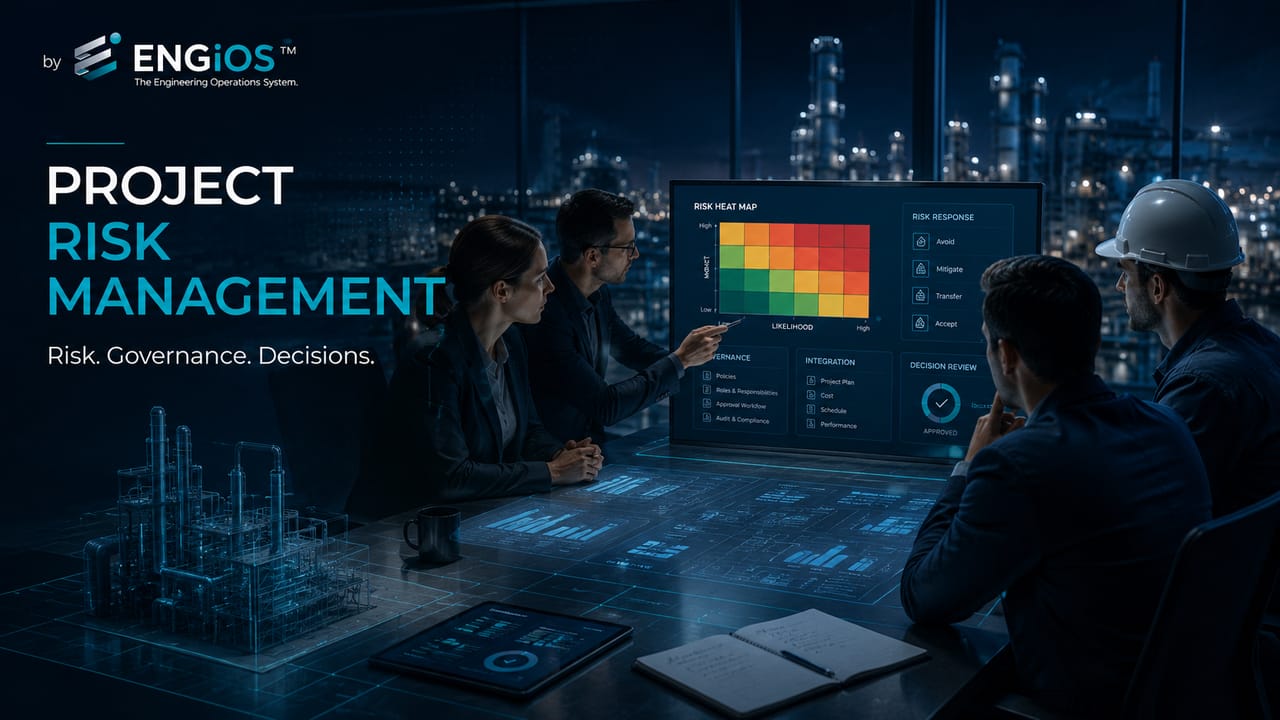
Learn how to structure risk management in engineering projects, integrate responses with schedule, costs, and contracts, and support decision-making.
Check it out!
Risk management in engineering projects is the system used to recognize uncertainties, understand their causes and consequences, define responses, assign responsibilities, and incorporate potential effects into decisions concerning scope, schedule, costs, contracts, quality, safety, and operations.
The subject is not limited to completing a probability-and-impact matrix. A matrix can classify exposures, but it does not ensure that risks have owners, funded responses, monitored triggers, links to the schedule, or influence on the forecast.
In multidisciplinary projects, risk management must connect engineering, procurement, contracts, Project Controls, inspection, commissioning, operations, and governance. A risk becomes manageable only when the organization can answer: what event may occur, why it may occur, which objectives would be affected, who must act, how long the decision window remains open, and how to verify whether the response reduced the exposure.
ISO 31000:2018 presents principles and guidelines for integrating risk management into governance, strategy, planning, and organizational processes. IEC 31010:2019 provides guidance on selecting and applying risk assessment techniques in different contexts.
What is risk management in projects?
Risk management is the coordinated set of activities used to direct and control an organization in relation to uncertainties that may affect its objectives.
In the context of engineering projects, these uncertainties may represent threats or opportunities related to:
- requirements maturity;
- site conditions;
- multidisciplinary interfaces;
- licenses and permits;
- supplier performance;
- resource availability;
- productivity;
- technology;
- safety;
- contracts;
- inflation and market conditions;
- systems integration;
- commissioning;
- operations and maintenance.
Risk does not exist in the abstract. It must be related to an objective, a cause, an event, and a potential consequence.
A useful description can follow this structure:
Due to a cause or condition, an event may occur, producing a specific consequence for a project objective.
Example:
> Due to incomplete definition of the electrical interfaces for the imported equipment, the detailed design may require a late revision, causing rework, delaying panel manufacturing, and increasing costs.
This formulation is more useful than generic entries such as “schedule risk” or “supplier,” because it allows specific responses and triggers to be defined.
What management problem does the risk process solve?
Engineering projects always operate with incomplete information. The challenge is not to eliminate uncertainty, but to prevent it from remaining invisible until it turns into delay, cost overrun, nonconformity, or contractual conflict.
| Management problem | Consequence | Risk-process response | Expected benefit |
| Assumptions treated as facts | Decisions are made on a fragile basis | Register uncertainties, owners, and validations | Greater transparency about maturity |
| Risks described generically | An objective response cannot be defined | Cause–event–consequence structure | Better treatment quality |
| Matrix updated only for reporting | Exposures do not influence the plan | Integration with schedule, costs, and contracts | Effective management, not documentation only |
| Responsibility assigned to the manager | Technical risks have no competent owner | Defined risk owner and action owner | Clear accountability |
| Responses without budget or deadline | Plans are not executed | Actions linked to resources, dates, and criteria | Greater response feasibility |
| Risks analyzed in isolation | Combined effects are not perceived | Consolidation, dependencies, and scenarios | Integrated view of exposure |
| Materializations treated as surprises | The forecast remains optimistic | Triggers, indicators, and periodic review | Earlier anticipation of consequences |
| Contingency without a basis | Reserves are arbitrary or insufficient | Qualitative and quantitative analysis | Better-founded reserves |
| Contracts without coherent allocation | Risks are transferred to parties unable to control them | Contracting strategy and responsibility matrix | Fewer claims and unclear interfaces |
| Lessons not preserved | The same risks recur | Knowledge base, materializations, and response effectiveness | Improvement in future projects |
Risk management transforms uncertainty into structured information for decision-making. It does not guarantee that negative events will not occur, but it increases the ability to avoid them, reduce their effects, or respond in a prepared manner.
The matrix classifies; governance decides and controls. Without owners, responses, resources, triggers, decision authorities, and integration with the plan, the risk register remains only documentary evidence.
Explore the Project, Program, and Portfolio Governance solution.
Are risk, issue, assumption, constraint, and change the same thing?
No. Confusing these concepts undermines treatment and recordkeeping.
| Concept | Operational definition | Example | Main treatment |
| risk | uncertain future event that may affect objectives | supplier may delay manufacturing | prevention, mitigation, transfer, or acceptance |
| problem or issue | event that has already occurred or current condition | supplier reported a four-week delay | corrective action, recovery, and forecast update |
| assumption | condition considered true for planning purposes | site access available in August | validation, deadline, and owner |
| constraint | limit that conditions the project | shutdown permitted only on Sundays | incorporation into the plan and control |
| change | proposed or approved alteration to the reference | new redundancy requirement | impact analysis and change control |
| pending decision | choice required for continuity | select communication architecture | decision authority, deadline, and alternatives |
| opportunity | uncertainty with a potentially favorable effect | bring batch manufacturing forward | exploit, enhance, share, or accept |
A materialized risk is no longer handled only as a risk. It must enter the issue, change, contract, schedule, and forecast processes while preserving the link to the original register entry.
Risk management and risk matrix: what is the difference?
The Risk Matrix in Engineering Projects is a classification tool. It cross-references criteria such as probability and impact to support prioritization.
Risk management is the complete process.
| Risk matrix | Risk management |
| represents exposure in a grid | integrates principles, processes, people, data, and decisions |
| classifies risks at a point in time | follows the exposure lifecycle |
| helps prioritize | defines responses, owners, and resources |
| normally uses qualitative assessment | may include quantitative analysis and scenarios |
| does not control actions by itself | monitors triggers, actions, and effectiveness |
| may be an isolated artifact | must integrate schedule, costs, contracts, and gates |
The new content does not replace the risk-matrix article. The matrix answers “which exposure deserves priority?”. The process answers “how will the organization understand, treat, fund, monitor, and decide on this exposure?”.
Which principles support mature risk management?
ISO 31000 guides an integrated, structured, customized, inclusive, dynamic approach based on the best available information.
In engineering projects, these principles can be translated into practice as follows:
| Principle | Practical application |
| integration | risks participate in planning, design, contracts, changes, and gates |
| structured and comprehensive | criteria, roles, frequency, and records are defined |
| customization | the process is proportional to project size, phase, and criticality |
| inclusion | disciplines, contractors, operations, and relevant stakeholders participate |
| dynamic nature | records change as information, phases, and events change |
| best available information | sources, limitations, and uncertainties are stated |
| human and cultural factors | incentives, communication, and behavior are considered |
| continual improvement | materializations and effectiveness feed the knowledge base |
Mature management does not depend on technique alone. The culture must allow risks to be communicated without the register being interpreted as evidence of team incompetence or pessimism.
How does the risk management process work?
A consistent process can be organized into ten integrated components.
- Define context and objectives. Understand what needs to be protected or achieved.
- Establish criteria. Define scales, tolerances, categories, decision authorities, and rules.
- Identify risks and opportunities. Record causes, events, consequences, and affected objectives.
- Analyze. Estimate probability, impact, proximity, velocity, and relationships.
- Evaluate and prioritize. Compare exposure with criteria and treatment capacity.
- Plan responses. Select strategy, actions, resources, owners, and deadlines.
- Integrate into the project. Update schedule, costs, contracts, contingencies, and decisions.
- Monitor. Track triggers, actions, residual exposure, and contextual changes.
- Communicate and escalate. Bring matters to the appropriate authority before the decision window is lost.
- Record and learn. Preserve results, materializations, and response effectiveness.
These components do not occur only once. The process is iterative and must follow the project lifecycle.
How to define context, objectives, and criteria?
Before identifying risks, the team needs to know which objectives will be assessed and which limits guide the decision.
The context may include:
- strategic objectives and benefits;
- scope and requirements;
- phase and maturity level;
- contracting model;
- stakeholders and authorities;
- operational constraints;
- regulatory environment;
- safety criteria;
- financial capacity;
- technology and interfaces;
- external dependencies;
- decision horizon.
Risk criteria must establish how the organization will assess consequences and probabilities. A generic scale applied to every project may generate classifications without meaningful context.
| Impact dimension | Questions to consider |
| safety | is there potential for an accident, exposure, or loss of a barrier? |
| operations | could the asset become unavailable or operate below requirements? |
| schedule | which milestones, critical paths, or windows would be affected? |
| costs | what is the impact range and which reserve could be consumed? |
| quality | is there a risk of rework, rejection, or inadequate performance? |
| contract | could claims, penalties, or responsibility disputes arise? |
| environment | is there a licensing risk, impact, or additional obligation? |
| reputation | could stakeholders, the community, or leadership be affected? |
| benefits | could the project deliver less value than expected? |
Probability and impact are not the only possible criteria. Proximity, velocity, detectability, persistence, and interdependence may change the priority.
Risk appetite, tolerance, and threshold: how are they different?
| Concept | Management application |
| risk appetite | level and type of risk the organization is willing to assume in pursuit of objectives |
| tolerance | acceptable range of variation around an objective or criterion |
| limit or threshold | point that triggers escalation, decision, or mandatory response |
| risk capacity | maximum exposure the organization can withstand |
In engineering projects, these concepts need to be translated into operational rules. For example: no safety risk classified as critical may be accepted by the project manager; risks with potential impact above a defined value must be submitted to the committee; regulatory milestones with a probability of delay above the threshold require an alternative plan.
Risk appetite does not mean accepting negligence or noncompliance. Legal, regulatory, normative, and safety obligations have their own treatments and decision authorities.
How to identify risks in engineering projects?
Identification should involve different sources and perspectives. Isolated workshops at the beginning of the project are not sufficient.
Useful sources include:
- design basis and assumptions;
- WBS and schedule;
- studies and surveys;
- interfaces between disciplines;
- requirements matrix;
- contracting strategy;
- supplier documents;
- change register;
- nonconformities;
- lessons learned;
- site visits;
- commissioning processes;
- stakeholder analysis;
- benchmarks from comparable projects.
Identification can be structured by categories:
| Category | Risk examples |
| requirements and scope | conflicting requirements, unclear exclusions, or undefined interfaces |
| engineering | incomplete data, incompatibilities, late revision, or immature technology |
| procurement | single supplier, manufacturing lead time, obsolescence, or logistics |
| construction | access, productivity, interferences, mobilization, or site conditions |
| integration | protocols, responsibilities, interoperability, or testing sequence |
| contracts | inadequate allocation, ambiguity, claims, or owner obligations |
| regulatory | license, approval, inspection, or requirement change |
| operations | unavailability, intervention window, or maintainability |
| people and resources | competence, availability, turnover, or excessive workload |
| information | incorrect revision, uncontrolled source, or approval delay |
| safety and environment | insufficient barriers, hazardous condition, or environmental impact |
| financial and market | inflation, exchange rates, capital availability, or input prices |
The category structure improves coverage, but it should not constrain thinking. Relevant risks often arise at the interfaces between categories.
How to write a risk in a useful way?
A good register must avoid vague wording.
| Weak entry | Improved entry |
| schedule risk | due to late approval of supplier documents, manufacturing may start later than required, affecting equipment delivery and the critical path |
| design problem | due to the absence of a reliable survey, clashes may occur between existing infrastructure and new routes, causing rework and work-front stoppage |
| supplier | due to dependence on a single manufacturer, production unavailability may compromise the installation milestone |
| scope change | due to incomplete validation of operational requirements, new requirements may arise after contracting, causing change, claims, and delay |
In addition to the description, the register should contain:
- identifier;
- category;
- cause;
- event;
- consequence;
- affected objectives;
- risk owner;
- probability and impacts;
- inherent exposure;
- response strategy;
- actions and owners;
- dates and triggers;
- response cost;
- residual risk;
- status and history;
- links to activities, contracts, and changes.
How to analyze risks qualitatively?
Qualitative analysis compares risks using defined scales. It is appropriate for initial prioritization and for managing a large number of exposures.
Criteria may include:
- probability;
- impact by objective;
- proximity;
- velocity of materialization;
- detectability;
- persistence;
- response urgency;
- degree of control;
- interdependence;
- data quality.
A risk with low probability but catastrophic consequence should not automatically be treated as irrelevant. The rule must reflect the organization’s obligations, capacity, and risk appetite.
The classification should be supported by justification. Numbers without assumptions create false precision and make auditing more difficult.
When should quantitative risk analysis be used?
Quantitative analysis is useful when decisions depend on schedule ranges, costs, contingencies, or the probability of meeting targets.
Possible techniques include:
| Technique | Application | Result |
| sensitivity analysis | identify the variables that most influence the result | ranking of drivers |
| scenarios | compare plausible combinations of events | ranges and consequences |
| decision tree | assess alternatives with probabilities and outcomes | expected value and structured decision |
| Monte Carlo simulation | combine duration or cost uncertainties | distribution of outcomes and confidence levels |
| expected monetary value analysis | estimate average financial exposure | reference for reserves and comparison |
| FMEA | assess failure modes, effects, and controls | prioritization of failure modes |
| HAZOP | examine process deviations and consequences | operational risks and safeguards |
| bow-tie | relate causes, central event, consequences, and barriers | prevention and mitigation view |
| fault tree | decompose causal combinations | probability and failure logic |
| event tree | explore sequences after an initiating event | consequence scenarios |
IEC 31010:2019 provides guidance on the selection and application of techniques. The tool should be chosen according to the question, data quality, and decision criticality.
Quantitative analysis does not fix a weak WBS, a schedule without sound logic, or an estimate without assumptions. Sophisticated models may simply quantify inconsistencies with an appearance of precision.
Risk must change the plan when exposure changes. If a relevant uncertainty does not influence the schedule, costs, contingencies, contracts, or forecast, the risk process is disconnected from project management.
See how to integrate risks, indicators, and executive engineering reports.
Inherent, residual, and secondary risk: what are the differences?
| Type | Meaning |
| inherent risk | exposure before applying the planned responses |
| residual risk | exposure that remains after responses are implemented |
| secondary risk | new risk created by the response itself |
| emerging risk | new or poorly understood exposure that gains relevance |
| aggregate risk | combined effect of multiple risks on an objective |
Example: engaging an alternative supplier may reduce schedule risk but create a secondary risk of incompatibility, learning curve, or increased costs.
Response approval must consider the full set of effects, not only the reduction in the original classification.
Which response strategies can be used?
For threats, common strategies include:
| Strategy | Meaning | Engineering example |
| avoid | change the plan to eliminate exposure | replace technology that has not yet been proven |
| mitigate | reduce probability or impact | perform a prototype, additional survey, or independent review |
| transfer or share | allocate part of the responsibility to another party capable of managing it | insurance, warranty, or specialized contract |
| accept | recognize the exposure and prepare a proportionate response | maintain contingency and a fallback plan |
| escalate | refer to an authority outside the project’s scope | corporate strategic or regulatory risk |
For opportunities:
| Strategy | Meaning | Example |
| exploit | act to ensure the occurrence | bring procurement forward when the gain is demonstrated |
| enhance | increase probability or benefit | expand testing that may enable scope reduction |
| share | involve a party capable of capturing the benefit | technology partnership |
| accept | take advantage if it occurs without additional investment | occasional productivity gain |
The response must be specific. “Monitor,” “follow up,” or “pay attention” are not sufficient treatments when preventive action is possible.
Risk owner and action owner: who is responsible?
The risk owner is responsible for monitoring exposure, assessing changes, and ensuring that the risk receives appropriate treatment and escalation.
The action owner executes a specific action in the response plan.
These responsibilities may be assigned to different people.
| Role | Responsibility |
| sponsor | define risk appetite, decide strategic exposures, and provide resources |
| project manager | integrate risks into the plan and decisions |
| risk owner | be accountable for the exposure and its evolution |
| action owner | execute a specific action on time |
| technical discipline | identify, analyze, and treat risks within its specialty |
| Project Controls | integrate effects into schedule, costs, contingencies, and forecast |
| contracts | address allocation, obligations, insurance, warranties, and claims |
| PMO | define the method, consolidate the portfolio, audit, and maintain benchmarks |
| Owner’s Engineering | critically review risks and responses in the owner’s interest |
| committee or gate owner | decide on residual exposure, conditions, and phase advancement |
The RACI Matrix in Engineering Projects can organize preparation, analysis, recommendation, approval, and execution.
How to integrate risks into the schedule?
The risk register should not exist separately from the schedule.
Integration may include:
- response activities;
- decision milestones;
- triggers;
- deadlines;
- windows of opportunity;
- exposed activities;
- potential effects on durations;
- schedule contingency;
- recovery scenarios;
- links to the critical path.
A supplier risk needs to indicate the date after which delivery will affect the critical path. A regulatory risk needs submission milestones, review lead time, and an alternative plan.
The S-Curve shows cumulative trends, but the schedule identifies where risk may change the sequence and completion date. The article on the S-Curve in engineering projects explains the relationship among baseline, actual progress, and forecast.
How to integrate risks with costs and contingencies?
Cost management needs to distinguish:
| Element | Function |
| baseline estimate | cost of the planned scope according to assumptions |
| contingency | provision for identified uncertainties within the scope |
| management reserve | provision under management authority for unallocated exposures or controlled changes |
| authorized budget | amount approved for execution and governance |
| potential change | impact under evaluation and not yet approved |
| forecast | probable cost considering performance, changes, and risks |
Contingency drawdown must follow criteria and decision authorities. It is not a free margin for compensating inefficiency or unauthorized scope changes.
Risks may have estimates for response cost, potential impact, and residual range. This information supports decisions on prevention, acceptance, and reserves.
Earned Value Management measures scope, schedule, and cost performance, while the risk process incorporates future events that do not yet appear in cumulative indices.
How to integrate risks into contracts?
Transferring an obligation in the contract does not eliminate the project’s risk. If the contractor lacks the financial, technical, or operational capacity to control the exposure, the owner will remain subject to the consequences.
The contracting strategy should assess:
- the party with the greatest ability to control the risk;
- availability and cost of transfer;
- interfaces between contracts;
- insurance and warranties;
- measurement and acceptance criteria;
- compensable events;
- responsibilities for information;
- owner obligations;
- changes and claims;
- limits of liability;
- incentives and penalties.
Contract, Scope, and Deliverables Management should relate risks to obligations, evidence, and decisions.
A contractual risk matrix may support allocation between the parties, but it does not replace the project’s management register. The risk must continue to be monitored regardless of who assumed the formal obligation.
How do risks relate to changes and issues?
The process needs clear transitions.
| Situation | Routing |
| risk is still uncertain | keep it in the register, monitor triggers, and execute responses |
| risk materialized | open an issue and update schedule, costs, and forecast |
| materialization changes scope | initiate change control |
| event results from nonperformance | activate contract management |
| response requires additional budget | submit the decision to the appropriate authority |
| risk is no longer relevant | close with justification and preserve history |
| new risk arises from the response | register a secondary risk |
Linking the records prevents an event from being handled simultaneously as a risk, change, and issue without reconciliation.
How do stage-gates use risk information?
The Stage-gate process in engineering projects verifies whether the project has sufficient maturity and acceptable residual risk to advance.
A gate may assess:
- critical risks and their respective owners;
- residual exposure;
- completed and pending responses;
- schedule and cost contingencies;
- assumptions not yet validated;
- contracting risks;
- requirements maturity;
- operational readiness;
- safety barriers;
- conditions and deadlines.
The decision does not need to require zero risk. It needs to record which exposures are accepted, by whom, under what conditions, and with which monitoring mechanisms.
How to build and maintain the risk register?
The risk register should function as a living management object, not as an archived spreadsheet.
| Field | Purpose |
| ID and title | unique identification and objective communication |
| cause–event–consequence | structured description |
| category | grouping and pattern analysis |
| affected objectives | scope, schedule, costs, quality, safety, or benefits |
| inherent exposure | condition before the response |
| owner | person accountable for the exposure |
| response | selected strategy |
| actions | activities, responsible parties, resources, and deadlines |
| triggers | signals that require a decision or update |
| residual exposure | condition after the response |
| links | activities, contracts, documents, changes, and decisions |
| status and history | evolution, materialization, closure, and justifications |
Governance should define who can create, change, approve, accept, and close risks. Material changes in classification need to be justified.
How often should risks be reviewed?
The frequency depends on the project’s speed, criticality, and phase.
| Level | Possible frequency | Focus |
| operational | weekly or by event | triggers, overdue actions, and short-term risks |
| management | fortnightly or monthly | consolidated exposure, forecast, and decisions |
| executive | monthly or by gate | critical risks, contingencies, and decision authorities |
| portfolio | periodic | concentration, dependencies, and corporate capacity |
| extraordinary | when a relevant event occurs | materialization, context change, or escalation |
Risks should not wait for the monthly meeting when the response window closes before then.
Which indicators can measure the effectiveness of risk management?
| Indicator | Question answered |
| critical risks without an owner | are there exposures without accountability? |
| overdue actions | is the response plan being executed? |
| escalation time | does governance decide before the decision window is lost? |
| materializations without a previously identified risk | is identification effective? |
| difference between forecast and actual impact | is the analysis calibrated? |
| contingency consumption | are reserves sufficient and well governed? |
| residual exposure | did the responses reduce risk? |
| reopened risks | were closures premature? |
| concentration by category | where are systemic patterns present? |
| captured opportunities | does the process also generate positive value? |
The article on KPIs and performance indicators explains how to define the formula, source, owner, threshold, and associated decision.
Indicators should not encourage concealment. A reduction in the number of recorded risks may indicate improvement, but it may also indicate underreporting.
How to use Pareto, Ishikawa, PDCA, and 5W2H in risk management?
| Need | Method | Application |
| identify concentration of materialized risks | Pareto | locate categories that concentrate losses or delays |
| investigate systemic causes | Ishikawa and 5 Whys | organize hypotheses and deepen causal mechanisms |
| select responses under limited capacity | prioritization matrix | compare impact, urgency, effort, and dependencies |
| structure process improvement | PDCA | plan, execute, check, and standardize |
| detail actions | 5W2H | define owner, deadline, resources, and method |
| control execution | workflow | record states, approvals, and evidence |
| verify effectiveness | KPI | measure exposure, performance, and response results |
The sequence can be represented as follows:
register identifies exposures → matrix prioritizes → Pareto locates patterns → Ishikawa investigates causes → PDCA structures improvement → 5W2H organizes actions → KPI verifies effectiveness.
Which techniques should be used for each type of risk?
| Situation | Possible techniques |
| general prioritization | probability-impact matrix, scoring, and heat map |
| process risks | FMEA, HAZOP, and bow-tie |
| system reliability | fault tree, event tree, and barrier analysis |
| decision alternatives | decision tree, scenarios, and expected value |
| schedule and costs | Monte Carlo, sensitivity, and range analysis |
| interface risks | workshops, interface matrix, and dependency analysis |
| contractual risks | clause review, allocation matrix, and obligation analysis |
| emerging risks | horizon scanning, scenarios, and signal monitoring |
| causes of materialized risks | Ishikawa, 5 Whys, and root cause analysis |
The technique should be proportionate. Applying a complex method to weak data may consume effort without improving the decision.
How to apply risk management throughout the project life cycle?
| Phase | Predominant risks | Supported decisions |
| strategy and portfolio | alignment, benefits, capital, and capacity | select, defer, or cancel initiatives |
| feasibility | alternatives, assumptions, location, and permits | choose solution and investment range |
| conceptual and basic design | requirements, technology, interfaces, and estimates | approve technical basis and contracting strategy |
| detailed design | coordination, detailing, and constructability | release procurement and execution |
| procurement | supplier, manufacturing, logistics, and documents | contract, expedite, and accept supply |
| construction | productivity, field conditions, safety, and resources | prioritize work fronts and recovery plans |
| integration and commissioning | interoperability, testing, defects, and readiness | energize, operate, or maintain conditions |
| closeout | documentation, warranty, outstanding items, and handover | accept, close, and incorporate into the knowledge base |
The risk profile changes. A register copied from one phase to another loses relevance and creates an excess of items without an associated decision.
How does risk management work in Owner’s Engineering?
In Owner’s Engineering, risk management protects the owner’s objectives through independent analysis.
The scope may include:
- reviewing contractors’ risk registers;
- identifying omitted exposures;
- assessing contractual risk allocation;
- analyzing responses and contingencies;
- validating assumptions;
- reviewing schedules and forecasts;
- assessing changes and claims;
- analyzing readiness for gates;
- verifying commissioning and operational risks;
- recommending decisions and conditions.
The contractor responsible for execution may have incentives that differ from the owner’s. Therefore, risks, percentages, impacts, and recovery plans need to be challenged technically.
The owner needs an independent view of exposure. Critical review of risks, contingencies, changes, and recovery plans reduces exclusive dependence on assessments produced by the contractors responsible for execution.
How do risks feed technical knowledge and benchmarking?
Project closeout should preserve:
- identified risks that did not materialize;
- materialized risks;
- forecast and actual impacts;
- responses applied;
- response costs;
- escalation time;
- effectiveness;
- secondary risks;
- recurring categories;
- supplier performance;
- invalidated assumptions;
- contingency consumed;
- gate decisions.
This knowledge base improves estimates, schedules, contracts, contingency criteria, and due diligence for future projects.
Benchmarking needs to consider context, phase, size, technology, contracting strategy, and maturity. Comparing only the number of risks or the amount of contingency consumed can produce incorrect conclusions.
How to assess risk management maturity?
| Level | Characteristics | Main limitation |
| 1 — Reactive | risks treated after materialization | surprise and dependence on individuals |
| 2 — Registered | matrix and periodic list | predominantly documentary process |
| 3 — Controlled | active owners, actions, criteria, and reviews | partial integration with the project |
| 4 — Integrated | risks connected to schedule, costs, contracts, changes, and gates | need for consistent data governance |
| 5 — Predictive | scenarios, simulations, benchmarks, and corporate learning | risk of excessive confidence in models |
Maturity does not mean recording the largest number of risks. It means producing earlier decisions and proportionate responses with evidence of effectiveness.
How to implement risk management in 12 steps?
- Define objectives and governance. Establish the sponsor, committees, decision authorities, appetite, and limits.
- Describe the context. Record phase, scope, assumptions, constraints, and stakeholders.
- Create criteria. Define scales, categories, tolerances, and classification rules.
- Structure roles. Appoint risk owners, action owners, and consolidation responsibilities.
- Implement the register. Standardize cause, event, consequence, links, and history.
- Perform multidisciplinary identification. Use documents, workshops, field observations, contracts, and benchmarks.
- Analyze and prioritize. Combine qualitative and quantitative assessment as needed.
- Plan responses. Define strategies, actions, resources, deadlines, and residual exposure.
- Integrate into the project. Update schedule, costs, contracts, contingencies, and gates.
- Establish routines and triggers. Define frequency, escalation, and mandatory decisions.
- Verify effectiveness. Compare exposure before and after responses and track materializations.
- Preserve knowledge. Update the knowledge base, benchmarks, criteria, and corporate processes.
Implementation can begin with a critical project, but it needs to evolve into PMO and portfolio standards when the organization manages multiple projects.
Applied example in a multidisciplinary project
Consider an industrial expansion involving detailed design, equipment procurement, civil modifications, electrical installations, automation, and commissioning.
The team identifies the risk:
Due to the lack of confirmation of starting currents and the operating logic of the main equipment, a late revision of the electrical supply and automation may occur, causing panel modifications, manufacturing delays, and impact on the shutdown window.
The risk is linked to:
- supplier documents;
- electrical design;
- automation design;
- panel manufacturing;
- shutdown window;
- integration contract;
- manufacturing release gate.
The inherent assessment indicates high probability and high schedule and cost impact. The risk owner is the engineering manager. Responses include:
- bringing the technical meeting with the supplier forward;
- issuing a list of mandatory data;
- making document approval conditional on information completeness;
- reserving space and capacity in the panels within a defined limit;
- creating an alternative starting method in the electrical study;
- establishing a deadline before the manufacturing gate;
- updating the schedule and contingency.
The supplier provides part of the information, but uncertainty remains regarding an operating sequence. Owner’s Engineering recommends conditional approval only for unaffected components. The gate blocks manufacturing of the section dependent on the interface.
In the following weeks, the data are confirmed and the starting solution is selected. Residual risk falls to medium. The response cost less than a potential panel redesign and preserved the implementation window.
Closeout records the avoided materialization, response cost, decision lead time, and the need to include starting data as a mandatory requirement in future procurements.
Common mistakes in risk management
Treating the matrix as the entire process
Classification exists, but there are no owners, responses, resources, or integration with decisions.
Recording only generic threats
Vague descriptions do not allow causal analysis or specific treatment.
Using probability and impact without criteria
The score depends on individual perception and cannot be compared consistently.
Assigning every risk to the project manager
Exposures remain distant from the people with the authority and competence to treat them.
Defining actions as “monitor”
The register does not demonstrate prevention, mitigation, triggers, or a contingency plan.
Failing to integrate risks into the schedule
The organization misses the deadline for acting before the impact occurs.
Keeping the forecast without known risks
The projection remains optimistic despite relevant events under evaluation.
Transferring risks by contract without assessing capacity
The party that received the obligation is unable to control or absorb the exposure.
Closing risks because the rating decreased
Actions may not have been completed, or residual risk may remain relevant.
Penalizing people who report risks
The team begins to hide uncertainties and the process loses quality.
Quantifying weak data
Simulations produce sophisticated numbers without a reliable basis.
Failing to record opportunities
The process becomes limited to losses and stops supporting value generation.
When should specialized risk management support be hired?
Specialized support is particularly relevant when:
- the project involves multiple disciplines and contracts;
- critical risks are not integrated into schedule or costs;
- contingencies lack a defined basis;
- there is significant regulatory, operational, or technological exposure;
- the project requires quantitative analysis;
- changes and claims are increasing without a consolidated view;
- the owner requires independent review;
- stage-gates require readiness assessment;
- the organization wants to implement PMO standards;
- there is a need for a knowledge base and benchmarking;
- projects show recurring risk materializations.
| Engagement model | Application | Typical deliverables |
| maturity assessment | assess the current process | assessment, gaps, and roadmap |
| methodology structuring | create criteria and governance | risk plan, categories, scales, RACI, and workflows |
| workshop facilitation | identify and analyze exposures | structured register and response plan |
| quantitative analysis | estimate schedule or cost ranges | scenarios, sensitivity, and simulations |
| ongoing operation | keep the process active | reviews, indicators, escalation, and reports |
| independent audit | review contractors’ risks | opinion on exposure, responses, and contingencies |
| Owner’s Engineering support | protect the owner’s objectives | critical analysis, gates, and recommendations |
| PMO and portfolio support | consolidate multiple projects | standards, corporate view, and benchmarking |
Ongoing Consulting Engineering Services make it possible to maintain specialized capability throughout the project life cycle.
How to evaluate the consultancy to be hired?
The assessment should consider:
- experience in comparable projects and sectors;
- command of engineering, contracts, and Project Controls;
- knowledge of qualitative and quantitative techniques;
- ability to integrate risks into schedule and costs;
- methodology for facilitation and recording;
- independence from the parties being assessed;
- technical track record and professional qualifications;
- quality of reports and recommendations;
- experience in Owner’s Engineering and stage-gates;
- data governance and traceability;
- ability to transfer knowledge;
- contextualized use of benchmarking.
The proposal should state scope, team, level of effort, data sources, methods, tools, deliverables, frequency, assumptions, exclusions, and acceptance criteria.
How does technology support risk management?
Systems can integrate risks with projects, contracts, documents, actions, changes, indicators, and decisions. The ENGiOS platform connects these objects in a governance trail for engineering companies.
Technology can support:
- recording and versioning;
- analysis and approval workflows;
- trigger notifications;
- actions and deadlines;
- links to documents and activities;
- dashboards by management level;
- portfolio consolidation;
- history of materialized risks;
- knowledge base and benchmarking.
However, software does not define risk appetite, criteria, owners, or the quality of responses. Automating a weak process only distributes inconsistent data more quickly.
Final considerations
Risk management in engineering projects is a governance system for uncertainty. Its purpose is not to fill out a matrix, but to anticipate events, structure responses, and incorporate exposures into decisions before the organization loses its ability to act.
A mature process connects risks to objectives, scope, schedule, costs, contracts, changes, gates, and operations. It distinguishes risk, issue, assumption, and change; assigns owners; funds responses; monitors triggers; updates forecasts; records decisions; and verifies effectiveness.
The risk matrix remains important, but it functions as one instrument within a broader architecture. Value appears when the organization can answer: which uncertainty threatens or favors the objectives, what is the decision window, who has the authority to act, and how will we know whether exposure was actually reduced.
Technical references
[1] INTERNATIONAL ORGANIZATION FOR STANDARDIZATION. ISO 31000:2018 — Risk management — Guidelines. Geneva: ISO, 2018. Available at: https://www.iso.org/standard/65694.html.
[2] INTERNATIONAL ELECTROTECHNICAL COMMISSION. IEC 31010:2019 — Risk management — Risk assessment techniques. Geneva: IEC, 2019. Available at: https://www.iso.org/standard/72140.html.
[3] INTERNATIONAL ORGANIZATION FOR STANDARDIZATION. ISO 21502:2020 — Project, programme and portfolio management — Guidance on project management. Geneva: ISO, 2020. Available at: https://www.iso.org/standard/74947.html.
[4] INTERNATIONAL ORGANIZATION FOR STANDARDIZATION. IWA 31:2020 — Risk management — Guidelines on using ISO 31000 in management systems. Geneva: ISO, 2020. Available at: https://www.iso.org/standard/75812.html.
[5] PROJECT MANAGEMENT INSTITUTE. A Guide to the Project Management Body of Knowledge (PMBOK® Guide). 8th ed. Newtown Square: Project Management Institute, 2025. Available at: https://www.pmi.org/standards/pmbok.
[6] AACE INTERNATIONAL. Total Cost Management Framework: An Integrated Approach to Portfolio, Program, and Project Management. 2nd ed. Morgantown: AACE International, 2019. Available at: https://web.aacei.org/resources/tcm.
Frequently asked questions
It is the continuous process of identifying, analyzing, responding to, monitoring, and integrating uncertainties into decisions on scope, schedule, costs, contracts, quality, and operations.
The matrix classifies exposures using criteria such as probability and impact. Risk management includes context, owners, responses, resources, triggers, monitoring, integration, and governance.
A risk is an uncertain future event. An issue is a condition or event that has already occurred and requires corrective action, recovery, and an update to the plan.
It is the exposure that remains after planned responses have been implemented. It needs to be assessed and accepted by the competent authority.
The risk owner should have the competence, information, and authority to monitor exposure and ensure treatment and escalation. Specific response actions may be assigned to action owners.
When decisions depend on schedule ranges, costs, contingencies, or probability of achievement. The technique should be compatible with data quality and the criticality of the decision.
Risks should be linked to activities, milestones, deadlines, actions, impacts, contingencies, and forecasts, allowing consequences to be assessed and action to be taken before materialization.
When there are multiple contracts, critical exposures, contingencies without a basis, a need for quantitative analysis, PMO implementation, or independent review on behalf of the owner.
Complementary technical materials
1. Risk management and structure fundamentals
- Risk matrix in engineering projects
- Project Controls in engineering projects
- Stage-gate in engineering projects
- WBS in engineering projects
- RACI Matrix in engineering projects
2. Integration with performance, schedule, and decisions
- Earned Value Management
- S-Curve in engineering projects
- KPIs and performance indicators
- Project prioritization matrix
- Workflow and approval flows
3. Diagnosis, treatment, and effectiveness verification
- Pareto Diagram in project management
- Ishikawa Diagram and root cause analysis
- PDCA applied to continuous improvement
- 5W2H applied to action plans
- Contract management in engineering
4. Solutions for governance and process integration
- Project, Program, and Portfolio Governance
- Engineering PMO Implementation and Structuring
- Indicators, Dashboards, and Executive Reports
- Contract, Scope, and Deliverables Management
- Process, Workflow, and Technical Approval Management
5. Platform, management, and owner representation
- ENGiOS — Management Platform for Engineering Companies
- Project Management
- Project Management Services
- Owner’s Engineering
- Ongoing Consulting Engineering Services
6. Technical sources and official references
