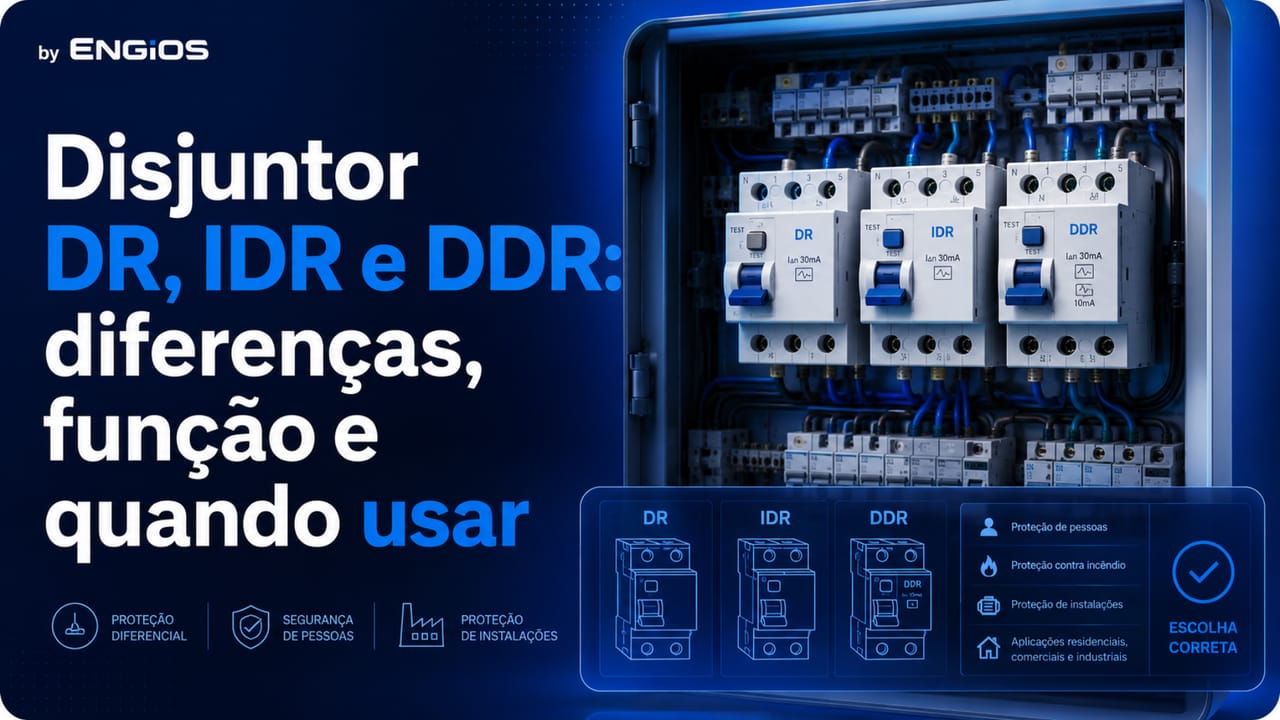
Understand the difference between RCD, RCCB and RCBO, what residual-current protection does, when to use a 30 mA RCD and how to apply the subject according to NBR 5410.
Check it out!
“RCD circuit breaker” is a widely used market expression for residual-current devices, but it can create technical confusion. In an electrical installation, RCD is the general concept of residual-current protection; RCCB is a residual-current circuit breaker without integral overcurrent protection; and RCBO is a residual-current operated circuit breaker with integral overcurrent protection, combining residual-current protection with overcurrent protection.
The direct answer is: an RCCB detects leakage current and disconnects the circuit, but it does not replace a thermomagnetic circuit breaker; an RCBO detects leakage current and also incorporates overload and short-circuit protection; RCD is the generic term used for residual-current protection. Therefore, before buying, replacing or specifying an “RCD circuit breaker,” it is necessary to determine whether the requirement is for an RCCB, an RCBO, a high-sensitivity RCD, a specific detection type or an arrangement combined with overcurrent protection.
In low-voltage electrical design, the subject should not be treated as a simple component choice. Residual-current protection is related to electric shock, leakage current, grounding, equipotential bonding, automatic disconnection of supply, circuit division, continuity of service, compatibility with SPDs and compliance with NBR 5410.
What is an RCD?
RCD means residual-current device. In practical terms, it is a device that compares the current entering a circuit with the current returning from it. Under normal conditions, the sum of currents in the live conductors tends to balance. When part of the current returns through another path, such as leakage to earth or through an exposed conductive part, a residual current appears.
The RCD monitors this difference. When the residual current reaches the device’s operating threshold, it disconnects the protected circuit. This function is essential for reducing risks associated with electric shock and leakage currents.
An RCD does not directly “measure electric shock.” It detects current imbalance. That imbalance may be associated with leakage through damaged insulation, moisture, faulty equipment, accidental contact with an energized part or other abnormal conditions.
Why does the term “RCD circuit breaker” cause confusion?
The expression “RCD circuit breaker” is common, but technically it may refer to different devices. Many people use “RCD circuit breaker” for any panel-mounted device with a test button and residual-current function. However, not every RCD is a circuit breaker in the sense of providing overload and short-circuit protection.
An RCCB, for example, is a residual-current circuit breaker without integral overcurrent protection. It detects residual current and disconnects the circuit, but it does not replace a thermomagnetic circuit breaker. An RCBO, by contrast, combines residual-current protection and overcurrent protection in the same device.
This distinction is decisive in design. Installing an RCCB without adequate overcurrent protection may expose the device and circuit to stresses for which the RCCB was not designed. On the other hand, an RCBO may be appropriate for specific circuits provided its characteristics are compatible with the installation.
Difference between RCD, RCCB and RCBO
The difference between RCD, RCCB and RCBO can be summarized as follows:
| Term | Meaning | Main function | Protects against overcurrent? |
| RCD | Residual-current device | general term for residual-current protection | depends on the device |
| RCCB | Residual-current circuit breaker without integral overcurrent protection | detects residual current and disconnects the circuit | no, it must be associated with overcurrent protection |
| RCBO | Residual-current operated circuit breaker with integral overcurrent protection | detects residual current and protects against overcurrent | yes, when correctly specified |
The confusion occurs because in everyday use many people call everything an “RCD.” In engineering, the distinction matters because each device has a different function, product standard, rating, installation method and application.
What is an RCCB?
An RCCB is a residual-current circuit breaker without integral overcurrent protection. It operates when the residual current reaches the device’s rated operating value, such as 30 mA, 100 mA, 300 mA or another specified value.
An RCCB is not designed to replace a thermomagnetic circuit breaker. It should not be treated as an overload and short-circuit protective device. In an installation, the RCCB must be protected by devices suitable for overcurrent protection.
NBR 5410 addresses this association by requiring that, when an RCD is neither incorporated in nor associated with an overcurrent protective device, overcurrent protection must be provided by suitable devices. The RCCB must also withstand, without damage, thermal and dynamic stresses in the event of a downstream short circuit, taking the associated protection into account.
What is an RCBO?
An RCBO is a residual-current operated circuit breaker with integral overcurrent protection. It combines residual-current protection and overcurrent protection in one device. In practical terms, it combines RCD functionality with circuit-breaker protection against overload and short circuit.
An RCBO can be useful for individual circuits, final circuits, panels requiring segmentation or situations where a residual-current fault should disconnect only one specific circuit rather than a large group of circuits.
Even so, the RCBO must be properly specified. Rated current, trip curve, breaking capacity, residual-current sensitivity, detection type, number of poles, operating voltage and compatibility with the protected circuit must be considered.
Difference between RCCB and RCBO
The central difference is that an RCCB does not incorporate overcurrent protection, whereas an RCBO does.
An RCCB disconnects the circuit in response to residual current. An RCBO can disconnect in response to residual current, overload or short circuit. For this reason, the RCBO is closer to what non-specialists often mean by an “RCD circuit breaker.”
In design, the choice between RCCB and RCBO depends on the panel architecture. An RCCB can protect a group of circuits provided each circuit has suitable circuit breakers and normal leakage currents do not cause nuisance tripping. An RCBO can individually protect a circuit, reducing the impact of a fault on other loads.
RCDs, RCCBs and RCBOs must be compatible with overcurrent protection
An RCCB does not replace a thermomagnetic circuit breaker. When the residual-current function does not incorporate overcurrent protection, the circuit needs a suitable device for overload and short-circuit protection. Also see Thermomagnetic Circuit Breaker: what it is, how it works and when to use it.
How does a residual-current device work?
The operating principle of an RCD is based on the balance of currents flowing through the live conductors of the circuit.
In a single-phase line-to-neutral circuit, the current leaving through the line conductor must return through the neutral. In a line-to-line circuit, the currents in the live conductors must also balance as a set. In three-phase systems, the device considers the vector sum of the currents in the monitored conductors.
If part of the current returns through another path, such as the protective conductor, an exposed conductive part, a structure, the earth or a person in contact with an energized part, a difference appears. When that difference reaches the rated residual operating current, the device opens the circuit.
For this reason, all live conductors of the circuit must pass through the magnetic circuit of the RCD. The protective conductor must not pass through the device. This separation is essential for the RCD to detect leakage correctly.
Residual current: what is it?
Residual current is the difference between the currents flowing through the live conductors of a circuit. Under normal conditions, this difference should be very small. When leakage occurs, part of the current no longer returns through the expected path.
This leakage current can occur for many reasons: degraded insulation, moisture, internal equipment faults, accidental contact, cable aging, conductive contamination, inadequate splices, water ingress into boxes, motors with insulation faults or electronic filters that produce small leakage currents during normal operation.
The RCD does not know the cause of the leakage. It only detects the imbalance. Diagnosing the cause requires technical analysis of the circuit, equipment and installation.
30 mA RCD: additional protection against electric shock
A high-sensitivity RCD with rated residual operating current equal to or less than 30 mA is recognized by NBR 5410 as additional protection against electric shock.
This additional protection is important because it considers situations in which other protective measures may fail or users may make mistakes. However, the standards logic is clear: a 30 mA RCD does not replace the primary protective measures, such as insulation, barriers, protective conductors, grounding, equipotential bonding and automatic disconnection of supply.
This means a 30 mA RCD should be understood as an additional safety layer, not as a standalone solution for an inadequate installation.
Where does NBR 5410 require a high-sensitivity RCD?
NBR 5410 requires additional protection by a residual-current device with rated residual operating current equal to or less than 30 mA in several general cases.
These include circuits supplying points of utilization in locations containing a bathtub or shower, circuits supplying socket-outlets in outdoor areas, indoor socket-outlet circuits that may supply outdoor equipment and circuits in wet areas or areas subject to washing, such as kitchens, laundries, service areas, garages and similar spaces.
The requirement also appears in specific locations addressed in Section 9 of the standard, such as bathrooms, swimming pools and other situations with increased risk of electric shock. In bathrooms, for example, the standard addresses zones around bathtubs and showers and establishes complementary requirements for equipment, wiring systems, socket-outlets and protection.
RCD for showers
Searches for “RCD for showers” are very common because locations containing showers present increased risk of electric shock. The electrical resistance of the human body may be lower under wet conditions, and contact with earth potential may be more likely.
NBR 5410 requires additional protection by a high-sensitivity RCD for circuits supplying points of utilization in locations containing a bathtub or shower. This does not mean that installing any device called an “RCD” is sufficient. The device must be correctly specified, and the circuit, earthing arrangement, protective conductor, equipotential bonding and compatibility with the supplied equipment must be assessed.
This subject should also not be treated as an improvised installation. Connecting an electric shower involves high current, conductors, overcurrent protection, residual-current protection and safety conditions. Design and installation should be performed by a qualified professional.
RCDs for bathrooms, kitchens, laundries and wet areas
Bathrooms, kitchens, laundries, service areas, garages and areas subject to washing require special attention because they combine frequent use, moisture, portable equipment, socket-outlets and contact with conductive surfaces.
In residential premises, NBR 5410 includes circuits supplying points of utilization in these areas among the cases in which additional protection by a high-sensitivity RCD must be applied, subject to the conditions and exceptions of the standard.
In non-residential buildings, kitchens, pantries, laundries, service areas, garages and wet indoor areas are also relevant. In commercial and industrial installations, proper circuit division is often required to prevent leakage in one item of equipment from disconnecting an entire area.
Wet areas require assessment of residual-current protection
The application of RCDs in bathrooms, kitchens, laundries, outdoor areas and shower points should be addressed in the electrical design together with grounding, equipotential bonding and circuit division. See Low-Voltage Electrical Designs.
300 mA RCD: what is it used for?
A 300 mA RCD is generally not used as additional protection against electric shock in the same sense as a 30 mA RCD. Higher residual-current settings may be associated with earth-fault protection, reduction of fire risk caused by leakage currents and coordination at higher levels of the installation.
The application of devices with higher sensitivities, such as 100 mA, 300 mA or 500 mA, should be analyzed according to the intended function, earthing arrangement, selectivity with downstream devices and continuity of service.
In locations with higher fire risk, NBR 5410 also addresses limiting risks associated with fault currents and permits residual-current devices with operating currents up to 500 mA under certain conditions. This reinforces that RCD sensitivity should be selected according to the technical purpose, not a single generic rule.
RCD types: AC, A, F and B
In addition to sensitivity in milliamperes, residual-current devices are also classified by the type of residual current they can detect.
Type AC is associated with detection of sinusoidal alternating residual currents. Type A detects alternating residual currents and pulsating residual currents with a DC component. Type F is applied in situations involving certain electronic loads and variable frequencies, according to the relevant product standard. Type B is used where smooth DC residual currents may occur, in addition to other residual-current waveforms.
NBR 5410 distinguishes situations in which fault current may contain a DC component or may be continuous. In these cases, RCDs capable of detecting those characteristics must be used. Therefore, selecting “30 mA RCD” is not enough. The RCD type must also be checked.
This point is increasingly important in installations with inverters, electronic equipment, switched-mode power supplies, chargers, photovoltaic systems, machinery and power-electronics loads.
Type AC RCD
A Type AC RCD is intended to detect sinusoidal alternating residual currents. It has historically been widely used in traditional installations with linear loads.
The issue is that many current installations contain electronic loads capable of producing leakage-current waveforms other than a pure sine wave. In these cases, indiscriminate use of Type AC may not be technically appropriate.
For this reason, the RCD type should be selected based on the actual circuit loads. The design must assess whether pulsating residual currents, DC components or waveforms requiring another device type may be present.
Type A RCD
A Type A RCD is applied when the residual current may contain a pulsating DC component in addition to the sinusoidal AC component. It is common in modern installations because many electronic devices can generate leakage currents with characteristics that are not purely sinusoidal.
Type A may be relevant in circuits with electronic equipment, modern appliances, switched-mode power supplies, electronically controlled equipment and loads that do not behave as purely resistive loads.
This does not mean every circuit should automatically receive a Type A device, but it does mean that selection should consider the load profile.
Type B RCD
A Type B RCD is applied in situations where smooth DC residual currents may occur, in addition to alternating and pulsating currents. This type appears in more specific applications, such as certain converters, inverters, chargers, industrial equipment, energy systems and power-electronics loads.
It is important not to confuse a Type B RCD with a Type B trip-curve circuit breaker. They are different subjects. Type B trip curves concern the magnetic operation of overcurrent circuit breakers. Type B RCDs concern the ability to detect specific residual-current waveforms.
Difference between an RCD and a thermomagnetic circuit breaker
A thermomagnetic circuit breaker protects against overload and short circuit. It operates through thermal and magnetic mechanisms associated with circuit current.
An RCD protects based on residual current. It is not designed to replace overcurrent protection, except when it is an RCBO that incorporates this function in the same device.
In a well-specified installation, the two functions complement each other. The thermomagnetic circuit breaker protects conductors against overcurrents. The RCD acts on leakage currents and residual-current protection. When used together, they must be coordinated to comply with NBR 5410 and the applicable product standards.
Difference between RCD and SPD
RCDs and SPDs have completely different functions.
An RCD detects residual current and disconnects the circuit when there is an imbalance among currents in the live conductors. An SPD limits transient overvoltages, such as surges originating from switching operations or indirect lightning effects.
NBR 5410 also addresses compatibility between SPDs and RCDs. When SPDs are installed near the origin of the installation or in the main panel and the installation includes RCDs, the relative position and device characteristics must be analyzed. If the SPD is installed downstream of an RCD, the standard establishes surge-current immunity requirements for the RCD.
Therefore, an RCD does not replace an SPD, and an SPD does not replace an RCD. They perform different functions in electrical protection.
RCDs and SPDs do not perform the same function in an electrical panel
The RCD operates based on residual current, while the SPD limits transient overvoltages. In panels containing both, compatibility must be analyzed. For more on surge protection, see SPD: surge protection, NBR 5410, LPS and grounding.
RCD tripping: main causes
When an RCD trips, the cause is not always a fault in the device itself. The trip may indicate that the RCD is performing its function by detecting leakage current.
Common causes include equipment leakage current, moisture in boxes or socket-outlets, cables with damaged insulation, inadequate splices, incorrectly shared neutral conductors, mixing neutrals between circuits protected by different devices, accumulated leakage from electronic filters, motors with insulation faults or inadequate circuit division.
Nuisance tripping can also occur due to surges, transients, harmonics, cable capacitance or electronic loads. For this reason, NBR 5410 advises that RCDs be selected and circuits divided so that normal leakage currents from loads do not cause unwanted operation.
Does an RCD trip by itself?
The expression “the RCD trips by itself” usually means the user did not perceive the cause of the leakage. The device may operate when equipment starts, when moisture is present, when a transient occurs or when the sum of normal leakage currents from several devices exceeds a practical threshold.
Instead of simply replacing the RCD with a less sensitive device, the correct approach is to investigate the circuit. Reducing sensitivity without technical justification can compromise the additional shock-protection function in circuits where it is required.
Normal leakage currents and circuit division
Not every leakage current indicates a serious fault. Many electronic devices have small leakage currents during normal operation, especially due to electromagnetic-compatibility filters.
The problem arises when the sum of these leakage currents approaches the RCD operating threshold. NBR 5410 considers this issue by recommending that circuits and devices be defined so that total leakage current under normal conditions does not cause nuisance tripping.
For this reason, protecting many circuits with a single RCCB can be poor practice for continuity of service. Leakage in one device may disconnect several circuits. In more sophisticated designs, it may make sense to divide protection into smaller groups or use RCBOs on specific circuits.
Selectivity between RCDs
Selectivity between RCDs is the coordination intended to ensure that, in the event of a fault, the device closest to the affected circuit operates preferentially, avoiding unnecessary disconnection of larger portions of the installation.
NBR 5410 addresses selectivity between RCDs connected in series. To ensure selectivity, the non-operating time-current characteristic of the upstream device must be above the operating characteristic of the downstream device, and the rated residual operating current of the upstream device must be higher than that of the downstream device.
In practice, this may involve selective or time-delayed devices, Type S devices and different sensitivities between upstream and downstream protection. This analysis is especially important in commercial and industrial installations, healthcare facilities, data centers, supermarkets, condominiums, schools and systems requiring continuity of service.
RCD in a TN system
In a TN system, automatic disconnection of supply may be performed by overcurrent protective devices or by RCDs, subject to the conditions of NBR 5410.
However, there is an important restriction: in the TN-C variant, RCDs must not be assigned the automatic-disconnection function for protection against electric shock. To enable use of an RCD, the system must be converted to TN-C-S upstream of the installation point of the device, separating neutral and protective functions.
This point is fundamental: an RCD must not improperly include the PEN conductor, and the protective conductor does not pass through the magnetic circuit of the device.
RCD in a TT system
In a TT system, NBR 5410 requires residual-current devices for automatic disconnection for protection against electric shock.
The logic involves the resistance of the earth electrode, protective conductors of exposed conductive parts, the rated residual operating current of the device and the permissible touch voltage. In practical terms, the RCD is a central element of shock protection in a TT system.
This does not eliminate the need for grounding, a protective conductor and equipotential bonding. On the contrary, protection depends on the correct combination of these elements.
RCD in an IT system
In an IT system, the first fault normally does not require immediate automatic disconnection when the applicable standards conditions are satisfied. The installation must include insulation monitoring to indicate the first fault, and a second fault must be treated according to the applicable conditions.
RCDs may be used under certain conditions in an IT system, especially for protection in the event of a second fault or when required by the protection strategy. However, the IT system is more specialized and is normally associated with continuity-of-service requirements.
How to install an RCD?
The question “how to install an RCD” is common, but it should not be treated as a simple wiring procedure. Installing an RCD involves design decisions: which circuit will be protected, which sensitivity will be used, which type of residual current must be detected, whether an RCCB or RCBO will be used, how overcurrent protection will be provided, which conductors will pass through the device, how neutrals will be separated and how continuity of service will be maintained.
As a technical rule, all live conductors of the protected circuit must pass through the RCD, while the protective conductor must not pass through its magnetic circuit. It is also necessary to respect the earthing arrangement, manufacturer instructions and NBR 5410.
Installation must be performed by a qualified professional. Incorrect installation can cause the device to fail to operate, operate incorrectly or compromise protection of other circuits.
Repeated RCD tripping requires diagnosis, not trial-and-error replacement
Recurring trips may indicate actual leakage, moisture, a neutral-conductor error, faulty equipment or inadequate circuit division. The analysis should consider safety, documentation and maintenance. Also see the Complete NR-10 Guide.
Common mistakes when applying RCDs, RCCBs and RCBOs
The most common mistakes are:
- calling every residual-current device an RCD circuit breaker;
- using an RCCB without adequate overcurrent protection;
- mixing neutrals from circuits protected by different RCDs;
- routing the protective conductor through the RCD;
- using a Type AC RCD with loads that require another detection type;
- installing a single RCD for many circuits without evaluating normal leakage currents;
- replacing a 30 mA RCD with a higher setting to avoid trips;
- ignoring selectivity between RCDs;
- positioning SPDs and RCDs without evaluating compatibility;
- failing to verify grounding and equipotential bonding;
- treating the test button as a complete test of the installation;
- modifying panels without updating the single-line diagram and documentation.
These mistakes impair safety, continuity of service and standards compliance. In many cases, the problem is not the RCD itself, but the architecture of the panel and circuits.
How to specify an RCD, RCCB or RCBO in electrical design
Specification should begin with the intended function. Is the objective additional protection against electric shock? Protection in a TT system? Protection of socket-outlets in a wet area? Reduction of leakage-current risk? Individual circuit protection? Coordination with SPDs? Continuity of service?
Next, determine whether the device will be an RCCB or RCBO. If it is an RCCB, associated overcurrent protection is required. If it is an RCBO, rated current, trip curve, breaking capacity and the other circuit-breaker characteristics must also be specified.
Then evaluate sensitivity, type of residual current detected, number of poles, rated voltage, rated current, ability to withstand short-circuit stresses, selectivity, immunity to transients, panel position and division of protected circuits.
Finally, the solution should be represented in technical documentation: single-line diagram, design narrative, load schedule, component specification, maintenance criteria and test records.
RCD test button
The RCD test button checks the device’s internal operating mechanism. It is important, but it does not replace electrical inspection, measurement, proper functional testing or verification of the installation.
An RCD may operate correctly when the test button is pressed and still be installed in a system with a neutral-conductor error, missing protective conductor, inadequate circuit division, equipment leakage or incomplete documentation.
For this reason, device testing is only one part of verification. Protection compliance depends on the installation as a whole.
When should specialized engineering be engaged?
Specialized engineering is recommended when there are recurring trips, panel modifications, load expansion, installation of power-electronics equipment, photovoltaic systems, chargers, motors, machinery, wet areas, industrial kitchens, laundries, swimming pools, outdoor areas, healthcare environments, condominiums, schools and commercial or industrial installations.
It is also indicated when there is no updated single-line diagram, circuits have been modified without documentation, there are questions about RCCB versus RCBO, the RCD trips without an apparent cause or the installation needs to be brought into compliance with NBR 5410.
Technical analysis allows sensitivity, RCD type, circuit division, coordination with overcurrent protection, SPD compatibility, grounding, equipotential bonding and required documentation to be defined.
Deepen your knowledge of RCDs, protection and coordination in low-voltage systems
RCDs, RCCBs and RCBOs must be coordinated with circuit breakers, SPDs, the earthing arrangement and panel documentation. See the white paper Method for Specification and Sizing of Circuit Breakers in Low-Voltage Electrical Installations and complement the technical foundation with the eBook Electrical Grounding: Fundamentals, Design and Standardization.
Conclusion
RCD, RCCB and RCBO are not perfect synonyms. RCD is the general concept of residual-current protection. RCCB is the residual-current circuit breaker without integral overcurrent protection, which detects leakage current and disconnects the circuit but does not replace overcurrent protection. RCBO is the residual-current operated circuit breaker with integral overcurrent protection, combining residual-current protection with overload and short-circuit protection.
Correct application depends on the circuit function, sensitivity, type of residual current, earthing arrangement, circuit division, selectivity, compatibility with SPDs, overcurrent protection and project documentation.
In low-voltage electrical installations, an RCD should be treated as part of a complete protection strategy against electric shock and leakage currents. It does not replace grounding, equipotential bonding, protective conductors, circuit breakers, SPDs, electrical design or proper maintenance.
Technical references
[1] ASSOCIAÇÃO BRASILEIRA DE NORMAS TÉCNICAS. ABNT NBR 5410 — Low-voltage electrical installations. Consult the ABNT Catalog to confirm the current edition and amendments.
[2] INTERNATIONAL ELECTROTECHNICAL COMMISSION. IEC 61008-2-1 — Residual current operated circuit-breakers without integral overcurrent protection for household and similar uses.
[3] INTERNATIONAL ELECTROTECHNICAL COMMISSION. IEC 61009-2-1 — Residual current operated circuit-breakers with integral overcurrent protection for household and similar uses.
[4] INTERNATIONAL ELECTROTECHNICAL COMMISSION. IEC 61140 — Protection against electric shock.
[5] INTERNATIONAL ELECTROTECHNICAL COMMISSION. IEC 61008-1:2024 — RCCBs without integral overcurrent protection — General rules.
[6] INTERNATIONAL ELECTROTECHNICAL COMMISSION. IEC 61009-1:2024 — RCBOs with integral overcurrent protection — General rules.
Frequently asked questions
RCD stands for residual-current device. It detects current imbalance among the live conductors of a circuit and operates when the residual current exceeds the specified threshold.
RCD is the general term. An RCCB is a residual-current circuit breaker without overcurrent protection. An RCBO combines residual-current protection with overcurrent protection.
No. An RCCB provides residual-current protection without integral overcurrent protection. It does not replace a thermomagnetic circuit breaker and must be associated with suitable overcurrent protection.
An RCBO is the device that most closely matches the popular expression RCD circuit breaker because it combines residual-current protection and overcurrent protection in the same device.
An RCD detects leakage current and disconnects the circuit when residual current reaches the device’s operating threshold.
A high-sensitivity RCD, such as a 30 mA device, is recognized as additional protection against electric shock, but it does not replace the other protective measures required by the installation.
No. An RCD does not replace grounding, the protective conductor or equipotential bonding. These elements remain necessary according to the design and NBR 5410.
No, except when the device is a correctly specified RCBO. A standard RCCB does not protect against overload or short circuit.
An RCD detects residual current. An SPD limits transient overvoltages. They perform different functions and can coexist in the electrical panel.
A 30 mA RCD is used as additional protection against electric shock in circuits and locations specified by NBR 5410, such as shower areas, outdoor socket-outlets and wet areas, as applicable.
A 300 mA RCD is not treated as high-sensitivity additional shock protection in the same sense as a 30 mA RCD. Its application is generally associated with other functions, such as earth leakage, fire risk reduction or selectivity.
A Type A RCD detects alternating residual currents and pulsating residual currents with a DC component, making it applicable to many circuits with electronic loads.
A Type B RCD detects smooth DC residual currents and other residual-current waveforms. It is used in specific applications involving power electronics, inverters and similar equipment.
An RCD may trip because of leakage current, moisture, faulty equipment, damaged insulation, incorrectly shared neutrals, accumulated normal leakage currents or transients.
Not without technical analysis. Changing sensitivity may compromise additional shock protection where it is required. The correct approach is to diagnose the cause of the tripping.
Installation must be defined by design and performed by a qualified professional. It is necessary to respect the earthing arrangement, monitored conductors, PE separation, overcurrent protection and NBR 5410.
Additional technical materials
Related solutions
- Electrical Safety and NR-10 Compliance
- Low-Voltage Electrical Infrastructure
- Grounding and Equipotential Bonding
- Surge Protective Devices
Related engineering services
- Low-Voltage Electrical Design
- Electrical Installation Inspection
- Detailed Electrical Installation Technical Report
- Electrical Installations Record — PIE
- Commissioning and Technical Acceptance of Electrical Installations
Related technical content
- NBR 5410: low-voltage electrical installations
- Protection Against Electric Shock
- TN, TT and IT Earthing Arrangements
- Thermomagnetic Circuit Breaker
- SPD: surge protection
- Electrical Grounding
