
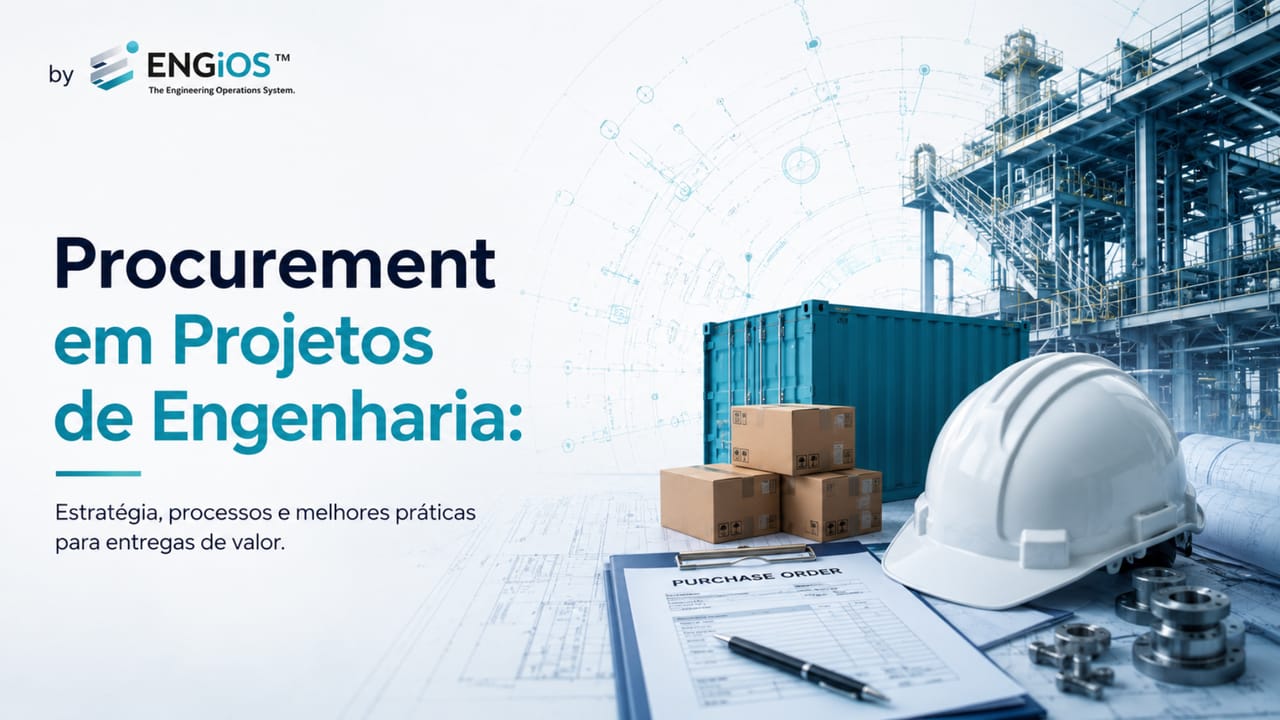
Understand procurement in engineering projects: how to structure packages, qualify suppliers, evaluate bids and manage supply through warranty.
Check it out!
Procurement in engineering projects is the structured process of planning, preparing, contracting and managing the acquisition of goods, equipment, works and services required to implement an undertaking. It begins with identifying the need and defining the contracting strategy, continues through package definition, market consultation, supplier qualification and evaluation, and extends beyond award to document management, manufacturing, inspections, logistics, delivery, commissioning and warranty.
In engineering, procurement cannot be reduced to obtaining three quotations or negotiating the lowest price. A technically inadequate contract can introduce incompatible materials, undersized equipment, incomplete interfaces, unrealistic schedules, insufficient documentation and higher operating costs throughout the asset lifecycle.
Engineering turns requirements and design documents into a verifiable contracting basis. Procurement leads the market process, negotiation, formalization and commercial relationship. The best outcome emerges when engineering, procurement, legal, planning, cost, quality, operations and maintenance work under the same strategy and preserve decision traceability.
The role of procurement in the project lifecycle
Procurement connects developed engineering with the market’s real capacity to manufacture, supply, build and provide the required services. Its role is not merely to contract suppliers, but to ensure that each acquisition contributes to the project’s technical, economic, operational and schedule objectives.
The World Bank defines procurement as the function of planning and obtaining goods, works and services to achieve required objectives. Its cycle starts with identifying the need, includes planning, requirements, budgeting, selection, award and contract management, and closes only after the warranty period ends. This view is particularly suitable for engineering projects, where supply performance can only be confirmed after installation, testing and start-up.
From Detailed Design to procurement packages
Detailed Design should provide drawings, specifications, lists, quality criteria, interfaces and enough information to organize acquisition and execution packages. The procurement strategy converts this set into market requests with defined scope, responsibilities, deadlines, warranties and commercial conditions.
The breakdown needs to consider:
- what will be purchased as equipment, material, system, works or service;
- which items need to remain integrated in the same package;
- which interfaces can be separated without creating responsibility gaps;
- which components have long manufacturing lead times;
- which supplier data needs to return to engineering;
- which inspections, tests and documents are required before delivery;
- which risks should remain with the owner or be allocated to the contractor.
Procurement and implementation strategy
The contracting approach needs to be consistent with the project delivery model. Under EPC, the contractor assumes engineering, procurement and construction within an integrated scope. Under EPCM, the contractor manages engineering, procurement and construction, while supply and execution contracts may remain directly with the owner. Under traditional models, the asset owner may separately contract design, materials, equipment and construction.
No model is automatically superior. The decision depends on engineering maturity, owner capability, available market, need for innovation, schedule, risk allocation and the desired degree of control.
Influence on schedule and the critical path
Long-lead items can determine the project completion date. Transformers, switchboards, generators, chillers, imported equipment, special systems and made-to-order components require engineering, document approval, production, inspection, transportation and installation before commissioning.
Therefore, procurement should be integrated with the schedule from the definition phases onward. Acquisition lead time does not start with the purchase order: it includes package preparation, market consultation, clarifications, evaluation, negotiation, approval, manufacturing, expediting, inspection, logistics and delivery.
Procurement starts before the quotation.
Package strategy, long-lead items and interfaces need to enter planning while there is still freedom to decide.
Procurement, purchasing, sourcing and supply chain: what are the differences?
The terms are related but not equivalent. Understanding their roles prevents an engineering acquisition from being treated only as an administrative transaction.
Purchasing
Purchasing corresponds to executing the acquisition: requisition, quotation, negotiation, purchase order, vendor registration, payment and commercial record. It is part of procurement, but it does not represent the full cycle.
Sourcing and strategic sourcing
Sourcing is the search for and development of supply sources. It involves market research, identification of manufacturers and integrators, capability assessment and formation of a competitive supplier base.
Strategic Sourcing in Engineering extends this analysis by considering spend category, market structure, criticality, supplier concentration, risks, total cost, standardization opportunities and relationship strategy. In engineering, it is especially important for families of critical equipment, proprietary systems, Long Lead Items and technologies with strong support dependency.
Procurement
Procurement integrates strategy, requirements, sourcing, competition, evaluation, contracting and supply management. It connects the project need to the delivered and accepted result.
Supply chain
Supply chain has a broader scope. It covers flows of materials, information, production, inventory, transportation, warehousing, distribution and relationships among organizations throughout the chain. Procurement is an essential function within that chain, but it does not replace logistics, material planning or inventory management.
Technical procurement
Technical procurement applies this process to objects whose suitability depends on engineering. Evaluation needs to consider capacity, performance, interfaces, standards, reliability, maintenance, tests, documentation and integration, rather than price and commercial lead time alone.
In multidisciplinary projects, the decision should be shared: engineering evaluates compliance and technical risk; procurement leads the market and negotiation; legal formalizes responsibilities; cost and planning assess impacts; operations verifies lifecycle suitability.
Technical procurement is not synonymous with purchasing.
The decision requires integration among engineering, procurement, legal, cost, planning, quality and operations.
How to plan procurement and structure contracting packages
The process should be organized through the Supply Plan and fed by a sufficiently mature Technical Requisition before market instruments are issued. When the objective is to reduce uncertainty and understand available capabilities, an RFI is appropriate; when technical solutions and criteria need to be compared, an RFP is used; and for mature, commercially comparable objects, an RFQ is suitable. The comparison among the three instruments is explored in RFI vs RFP vs RFQ. A poorly structured package does not become adequate merely because it received many bids.
1. Define the need and expected results
The team should record what the project needs to achieve, by when, under which conditions and how performance will be verified. Generic requirements produce generic proposals.
The following need to be defined:
- required function and capacity;
- performance, availability and service life;
- environmental and operating conditions;
- interfaces with existing systems;
- standards and regulatory requirements;
- supply boundaries;
- installation, integration and commissioning;
- documentation, training and support;
- acceptance criteria and warranty.
2. Analyze the market and supply strategy
Before restricting technology or contract format, it is necessary to understand the market. The analysis may assess:
- number and location of qualified suppliers;
- production capacity and current lead times;
- import dependency and foreign-exchange exposure;
- technology concentration and single-supplier risk;
- availability of technical assistance and spare parts;
- distribution and representation models;
- performance history in equivalent applications;
- warranty, maintenance and obsolescence conditions;
- standardization and bundled-purchasing opportunities.
RFIs, technical meetings, preliminary consultations and prequalification processes can improve market knowledge without prematurely determining selection.
3. Define the package strategy
The contracting and package strategy should balance competition, coordination and responsibility. Overly aggregated packages reduce the number of participants and may embed management markups. Excessive fragmentation multiplies contracts, interfaces and integration risks.
The decision should consider:
- technical interdependence among components;
- responsibility for integrated performance;
- owner management capability;
- Detailed Design maturity;
- implementation sequence;
- logistics and delivery conditions;
- warranties and testing;
- supplier market;
- incompatibility risk;
- contract coordination cost.
4. Prepare solicitation documents
The market package may include:
- instructions to bidders;
- scope and supply boundaries;
- drawings and specifications;
- data sheets and lists;
- requirements matrix;
- interface and responsibility matrix;
- schedule and contractual milestones;
- delivery and logistics conditions;
- quality, inspection and testing requirements;
- required supplier documentation;
- measurement and payment criteria;
- evaluation criteria;
- technical and commercial proposal template;
- contract terms and warranties.
Evaluation criteria should be defined before proposals are received and applied consistently. Changing them after the bids are known undermines transparency, comparability and governance.
5. Plan governance and responsibilities
A RACI matrix should indicate who prepares, reviews, approves and follows each stage. Authority levels should also be defined for clarifications, negotiation, recommendation, award, changes and acceptance.
Communications with suppliers should be controlled. Relevant technical answers need to be made equivalently available to affected participants and formally incorporated into the documents when they change scope.
The quality of the competition depends on the quality of the package.
Scope, requirements, interfaces and evaluation criteria need to be defined before the market sees competing proposals.
How to qualify suppliers and evaluate proposals
The evaluation should identify the proposal capable of delivering the required result with acceptable risk and the best overall value. Supplier qualification and approval verifies who demonstrates capability for the object; TBE — Technical Bid Evaluation compares proposal compliance; and TCO and lifecycle cost allow alternatives to be compared beyond CAPEX. The lowest price becomes comparable only after scope, compliance, schedule, responsibilities and commercial terms have been equalized.
Prequalification and initial selection
Prequalification verifies whether the supplier has the minimum capacity to participate. Depending on the object, the following may be assessed:
- general and specific experience;
- performance on previous contracts;
- financial capacity;
- engineering and management structure;
- facilities and manufacturing capacity;
- quality, safety and environmental systems;
- human resources and equipment;
- service and support network;
- integrity, conflicts and compliance;
- availability for the required schedule.
Minimum criteria should be proportional to risk and complexity. Unnecessary requirements reduce competition without improving the result.
Compliance review
Before scoring, the proposal should be checked for completeness and compliance with mandatory requirements. Material deviations are those capable of changing validity, purpose, comparability or essential responsibilities.
The analysis should distinguish:
- full compliance;
- acceptable or clarifiable deviation;
- permitted technical alternative;
- exclusion with quantifiable impact;
- material deviation that prevents comparison or compliance.
Technical and commercial equalization
Equalization organizes all proposals on a common basis. It may include:
- included and excluded scope;
- capacities and performance;
- materials and manufacturers;
- interfaces and auxiliary services;
- documentation and training;
- tests, commissioning and warranties;
- manufacturing and delivery schedule;
- payment terms;
- taxes, freight, insurance and currency;
- spares and maintenance;
- risks and conditions.
An equalization matrix should not merely mark “complies” or “does not comply.” It needs to record evidence, deviations, impacts, clarifications and conditions required to make the offer contractible.
Pass/fail criteria and scored criteria
Pass/fail criteria represent minimum requirements. Scored criteria make it possible to differentiate proposals that meet the minimum but offer different levels of quality, schedule, methodology, sustainability, innovation or risk.
The World Bank recommends that criteria be proportional to the type, complexity, risk and value of the acquisition, preferably quantifiable and fully disclosed in procurement documents. Evaluation can combine price, quality, risk, sustainability and innovation to select the most advantageous proposal.
Price, total cost and project value
Acquisition price is not synonymous with cost. Depending on the object, the evaluation should consider total cost of ownership or lifecycle cost, including:
- energy and consumables;
- installation and auxiliary infrastructure;
- licenses and software;
- preventive and corrective maintenance;
- spare parts;
- availability and failure impact;
- training and support;
- upgrades and obsolescence;
- dismantling, disposal or replacement;
- residual value.
The concept of value for money seeks an appropriate combination of total cost and quality or fitness for purpose. The highest-value proposal is not necessarily the cheapest or the most technically sophisticated; it is the one that meets objectives with the best balance among performance, risk and lifecycle cost.
Recommendation and award
The decision should be documented in an evaluation report containing methodology, participants, criteria, results, clarifications, deviations, risks, cost analysis and justification for the recommendation.
Award should occur only when scope, conditions, exceptions and responsibilities have been reconciled. Commitments made during negotiation need to be incorporated into the contract, purchase order or technical appendices.
The lowest price exists only after equalization.
Before that, proposals with different scopes, performance, risks and lifecycle costs do not represent the same object.
From award to warranty: technical supply management
Procurement does not end at signature. After award, the focus shifts to contract administration and ensuring that the supplier delivers the approved object on time and under the contracted conditions. Post-award control combines Vendor Data and submittals, Expediting and Quality Management in Procurement, integrating documents, schedule, manufacturing, inspections, tests and acceptance.
Kick-off and contractual baseline
The kick-off meeting should align:
- scope and boundaries;
- owners and communication channels;
- detailed schedule;
- supplier document list;
- review and approval workflow;
- inspection and test points;
- logistics and delivery conditions;
- measurement and payment;
- change management;
- initial open items and risks.
The baseline needs to consolidate the contractual version of requirements, drawings, specifications, proposal, clarifications and accepted exceptions.
Vendor document review
Supplier drawings, data sheets, calculations, manuals, lists and procedures need to be reviewed by engineering. Document approval does not transfer product responsibility to the owner or authorize silent changes to the specification.
Approved data should return to Detailed Design so interfaces can be updated. Dimensions, loads, connection points, heat dissipation, signals and maintenance requirements need to be incorporated into the coordinated design.
Expediting and schedule control
Expediting monitors progress in supplier engineering, raw-material procurement, manufacturing, assembly, testing, documentation and shipment.
Monitoring should identify:
- critical activities and intermediate milestones;
- actual delays and trends;
- production constraints;
- pending approvals;
- critical materials;
- recovery needs;
- impacts on the integrated schedule.
Reports based only on the percentage declared by the supplier are insufficient. Progress needs to be supported by evidence and verifiable milestones.
Inspection, FAT, logistics and receiving
The inspection and test plan should define hold points, witness points, acceptance criteria, records and responsible parties. FAT verifies the supply at the factory before shipment; field tests, SAT and commissioning verify installation, integration and performance on site.
Logistics should consider packaging, preservation, transportation, insurance, customs clearance, storage, lifting and receiving inspection. Equipment delivered on time may still be unavailable for installation if documents, accessories, preservation or storage conditions are missing.
Changes, claims and supplier performance
Changes in scope, schedule, quantity or condition need to follow a formal workflow. Each change should record origin, justification, impact, responsibility, price, schedule and affected documents.
Supplier performance can be tracked through schedule, quality, documentation, safety, response to open items, nonconformities and reliability indicators. This information feeds future sourcing and qualification decisions.
Gate 1: is the package ready to go to market?
Before issuing the RFP or RFQ, verify:
- Need and results defined: function, capacity, performance and success criteria are approved.
- Scope and interfaces delimited: inclusions, exclusions, supply boundaries and responsibilities are clear.
- Sufficient engineering: drawings, specifications, lists and data sheets have maturity compatible with contracting.
- Traceable quantities: quantities and measurement criteria can be audited.
- Market analyzed: suppliers, capacity, concentration, lead times and risks have been assessed.
- Package strategy approved: contractual breakdown and supply model are consistent with the project.
- Integrated schedule: preparation, competition, manufacturing, inspection, logistics and installation are covered.
- Evaluation criteria defined: pass/fail requirements, scored criteria and comparison methodology are documented.
- Commercial conditions aligned: payment, warranties, insurance, taxes, currency and delivery have been addressed.
- Quality and acceptance defined: inspections, tests, documentation and receiving have objective criteria.
- Risks allocated: relevant events, responsibilities and treatments are recorded.
- Governance approved: responsible parties, authorities and communication workflow are defined.
Gate 2: is the supplier ready to be contracted?
Before award, confirm:
- Technical compliance: essential requirements have been met or accepted deviations are formally recorded.
- Scope equalized: there are no gaps or exclusions capable of changing the comparison.
- Capability demonstrated: resources, experience, organization and supply chain are compatible.
- Schedule validated: the schedule is realistic and includes engineering, manufacturing, testing and logistics.
- Costs reconciled: price, taxes, freight, currency, options and lifecycle cost have been assessed.
- Risks known: conditions and dependencies have owners and treatment.
- Consistent contract documentation: final proposal, appendices, clarifications and draft contract represent the same agreement.
- Performance criteria preserved: commercial negotiation has not reduced essential requirements.
- Warranties and support defined: coverage, term, assistance, spares and obligations are clear.
- Recommendation approved: the decision is recorded and authorized by the appropriate levels.
Award does not end procurement.
Documentation, manufacturing, inspections, logistics, tests, commissioning and warranty remain under management until the contracted result is delivered.
Conclusion: procurement is an extension of engineering
Procurement turns design documents into real commitments for supply, execution, schedule, cost and performance. When managed only as purchasing, it tends to prioritize price and transaction speed. When integrated with engineering, it enables the selection of suppliers capable of delivering the expected result and managing risks through the end of warranty.
Process quality depends on objective requirements, well-structured packages, market knowledge, published criteria, equalized proposals and traceable decisions. It also depends on continuity after award: document review, expediting, inspections, logistics, testing, commissioning and change management are part of the cycle.
The best value for the project does not automatically come from the lowest price. It results from the combination of technical suitability, total cost, schedule, risk, quality, sustainability, supplier capability and lifecycle support.
A3A Engenharia supports technical procurement processes from structuring requirements and contracting packages through proposal analysis, equalization, recommendation, expediting, inspections, documentation and acceptance. The work may be independent or integrated with Detailed Design, EPCM and Owner’s Engineering.
Technical references
[1] WORLD BANK. Procurement Regulations for IPF Borrowers: Goods, Works, Non-Consulting and Consulting Services. Washington, 2025. Available at: Access official source.
[2] WORLD BANK. Procurement Guidance: Evaluation Criteria. Washington, 2016. Available at: Access official source.
[3] INTERNATIONAL ORGANIZATION FOR STANDARDIZATION. ISO 20400:2017 — Sustainable procurement — Guidance. Geneva, 2017. Available at: Access official source.
[4] INTERNATIONAL ORGANIZATION FOR STANDARDIZATION. ISO 21502:2020 — Project, programme and portfolio management — Guidance on project management. Geneva, 2020. Available at: Access official source.
[5] PROJECT MANAGEMENT INSTITUTE. PMBOK Guide and Standards. Newtown Square, 2025. Available at: Access official source.
[6] ORGANISATION FOR ECONOMIC CO-OPERATION AND DEVELOPMENT. Recommendation of the Council on Public Procurement. Paris, 2015. Available at: Access official source.
[7] BRAZIL. Law No. 14,133 of April 1, 2021. Public Procurement and Administrative Contracts Law. Brasília, 2021. Available at: Access official source.
[8] BRAZILIAN FEDERAL COURT OF ACCOUNTS. Evaluation criteria. Procurement and Contracts. Brasília, 2025. Available at: Access official source.
Frequently asked questions
It is the process of planning, preparing, contracting and managing goods, equipment, works and services required by the project, from defining the need through delivery, acceptance and the end of warranty.
Purchasing executes the acquisition transaction. Procurement includes strategy, requirements, sourcing, qualification, evaluation, contracting and technical and commercial supply management.
It is procurement applied to objects that require engineering evaluation, including capacity, performance, interfaces, standards, reliability, maintenance, testing, documentation and integration.
Because proposals may have different scopes, performance, risks and operating costs. The decision should consider compliance, total cost, schedule, quality, risk and supplier capability.
No. The process continues through document review, expediting, inspections, testing, logistics, receiving, commissioning, change management and warranty.
When the need, scope, engineering, interfaces, quantities, schedule, market, evaluation criteria, commercial conditions, quality, risks and governance are sufficiently defined.
Complementary technical materials
Related solutions
- Requirements, Evidence and Acceptance Criteria Management
- Contract, Scope and Deliverables Management
- Project, Program and Portfolio Governance
Related services
- Technical Procurement: specification, equalization, suppliers and contracting support
- Owner’s Engineering
- EPCM
Core content on the topic
- Contracting Strategy in Engineering
- Strategic Sourcing in Engineering
- Supply Plan in Engineering Projects
- Technical Requisition in Engineering
- RFI in Engineering
- RFI vs RFP vs RFQ
- RFP in Engineering
- RFQ in Engineering
- Supplier Qualification and Approval in Engineering
- TBE in Engineering
- TCO and Lifecycle Cost in Engineering
- Vendor Data and Submittals in Engineering
- Expediting in Engineering
- Long Lead Items in Engineering
Related technical content
- Quality Management in Procurement
- Engineering Technical Proposal Analysis
- Contractual and Supplier Risks in Engineering Projects
- Terms of Reference in Engineering
- Complete Guide to Consulting Engineering
- Complete Guide to Cost Engineering and Estimating
- Contracting Consulting Engineering with Traceability, Governance and Cost Engineering
- Owner’s Engineering: Executive Framework for Contracting, Governance and Acceptance
