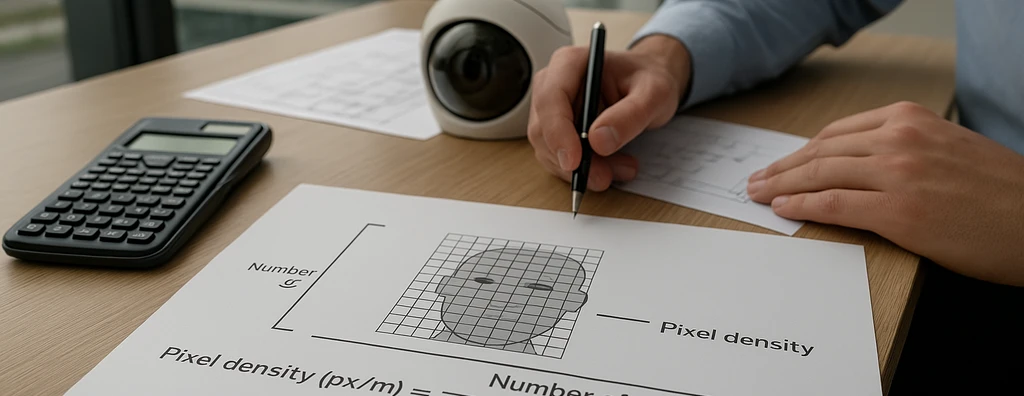
Understand how to calculate pixel density in CCTV projects according to IEC 62676, with regulatory parameters, practical examples, and engineering recommendations for detection, recognition, and identification.
Check it out!
Pixel density is a critical parameter in Closed-Circuit Television (CCTV) systems, directly influencing the ability to capture, analyze, and interpret images for electronic security and surveillance purposes. Within the scope of computer vision, the proper sizing of pixel density is decisive in ensuring effective operations for detecting, observing, recognizing, and identifying people and objects. The international IEC 62676 standard establishes technical guidelines that define the minimum requirements for these operational categories in professional CCTV projects, contributing to system standardization and robustness.
This article details the concept of pixel density in the context of IEC 62676, including mathematical foundations for calculation, regulatory criteria for sizing according to operational objectives, and recommendations applied to CCTV project engineering. Tables, practical examples, influencing factors, and critical aspects for meeting technical and regulatory requirements will be covered.
Read on!
[elementor-template id=”24446″]
Technical Foundations of Pixel Density
Pixel density refers to the number of pixels present per unit of measurement (usually per meter) within the CCTV camera’s field of view. This parameter is directly associated with the spatial resolution that the camera can provide for an object of interest, affecting the accuracy of electronic security operations.
According to IEC 62676, pixel density is calculated by considering the width of the object of interest, often the human face, in relation to the number of pixels representing it horizontally in the captured image. From a regulatory standpoint, a human face is assumed to have an average width of 16 cm (0.16 m).
Influence of Pixel Density on Operations
- High pixel density provides greater detail, enabling precise identification.
- Low pixel density limits the level of detail, making it suitable only for broad detection or observation.
Proper sizing of pixel density is essential to align system performance with the operational objectives defined for each monitored zone.
Application Categories and Their Respective Pixel Densities
The IEC 62676 standard establishes four main categories of requirements for CCTV images, each associated with minimum pixel density values to meet the following operational purposes:
- Detection: identifying the presence of an object or person.
- Observation: monitoring actions or events with greater detail.
- Recognition: clearly distinguishing types or categories of objects or people.
- Identification: enabling the unequivocal identification of the individual or object.
Pixel Density Table – IEC 62676 Regulatory Parameters
| Operational Category | Pixel Density per Face | Pixel Density per Meter |
|---|---|---|
| Detection | 4 px/face | 25 px/m |
| Observation | 10 px/face | 63 px/m |
| Recognition | 20 px/face | 125 px/m |
| Identification | 40 px/face | 250 px/m |
These regulatory values are established based on the average face width (16 cm), and the conversion to pixels per meter makes it possible to apply the calculations to any field-of-view dimension in a project.
Calculation Procedure for CCTV Projects
To determine pixel density in a CCTV project based on IEC 62676 requirements, the following technical procedure is recommended:
- Define the operational objective of the monitored location: Identify whether the need is detection, observation, recognition, or identification.
- Obtain the dimensions of the field of view: Calculate the width of the area (in meters) that will be captured by the camera at the point of interest.
- Verify the camera sensor resolution: Quantify the total number of available horizontal pixels (for example, 1920 for Full HD resolution).
- Calculate the resulting pixel density: Use the formula:
Pixel density (px/m) = Number of horizontal pixels of the camera / Width of the field of view (in meters) - Compare the result with the regulatory parameters: Adjust the camera position and/or select higher-resolution equipment if the calculated density is below the minimum value for the desired category.
Practical Example
Consider a camera with 1920 horizontal pixels installed to monitor an area 8 meters wide. The pixel density calculation will be:
- Pixel density = 1920 / 8 = 240 px/m
According to IEC 62676, 240 px/m meets the requirements for recognition (125 px/m), but does not reach the density required for identification (250 px/m).
Complementary Aspects and Limit Conditions
Although pixel density is a fundamental criterion, other technical factors may influence the system’s effective performance, especially under adverse conditions or in critical security applications. The following stand out:
- Site lighting: Insufficient levels can degrade image quality, impairing identification even if pixel density meets the regulatory value.
- Camera orientation and positioning: The relative angle between the object/person and the lens can alter the proportion of pixels captured in critical areas such as the face.
- Compression technology: Video compression algorithms can affect image sharpness and detail by reducing the volume of transmitted data.
- Optical characteristics of the lens: Long focal lengths can modulate pixel density across the field of view, requiring careful modeling during project design.
Therefore, pixel density, as established by IEC 62676, serves as a baseline, but it must be complemented by analysis of environmental and operational factors.
Guidelines to Maximize System Efficiency
- For full identification, prioritize cameras and positioning that provide at least 40 pixels across the width of the human face (16 cm), that is, 250 px/m.
- In areas with heavy traffic, consider safety margins above the minimum recommendation due to variations in lighting and target positioning.
- When designing large-scale systems, adopt simulation tools that allow visualization of pixel density across the entire monitored field.
- For bidding and technical specification, document in detail the regulatory criterion adopted in order to avoid ambiguous interpretations regarding the desired operational level.
- Whenever possible, use monitors and display equipment compatible with the maximum resolution of the camera sensors, since the ability to detect, observe, recognize, or identify depends on the resolution of the display used.
Pixel density represents one of the most critical parameters for the operational success of CCTV systems, being grounded in objective criteria established by IEC 62676. Its proper sizing ensures not only regulatory compliance but also directly contributes to risk mitigation and the efficiency of response and investigation actions. The engineer responsible for the project must always consider environmental particularities, functional objectives, and the required level of detail for each monitored area, adopting values that meet or exceed regulatory recommendations. It is advisable to incorporate technical margins in critical situations and to prepare descriptive memoranda that clearly present the adopted calculation criteria. The systematic adoption of the concepts presented in this article enhances the reliability, standardization, and effectiveness of systems, constituting an indispensable parameter for professional electronic security projects in compliance with international standards.
