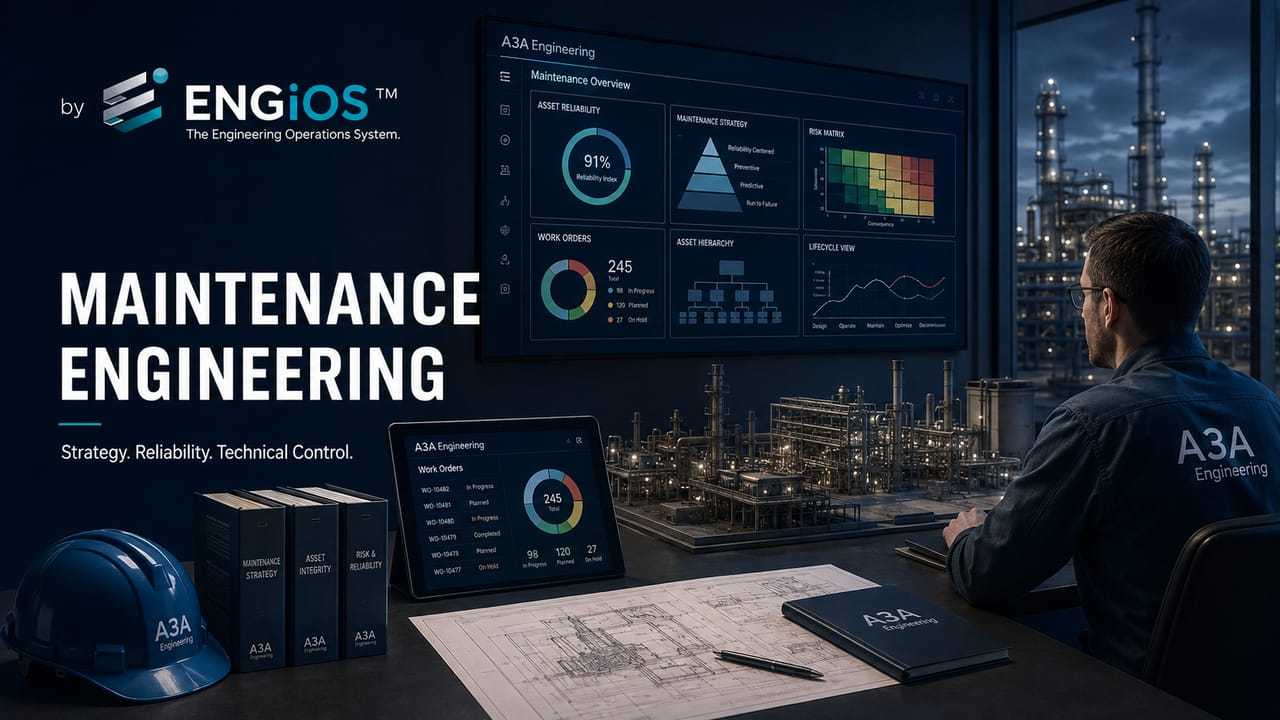
Maintenance Engineering: understand how functions, failure modes, criticality, backlog, indicators, and asset lifecycle decisions connect maintenance to engineering governance.
Check it out!
Maintenance Engineering is the discipline that technically structures how an organization preserves the functions, reliability, availability, safety, and performance of its assets throughout the lifecycle. It is not limited to maintenance execution: it defines strategies, criteria, plans, indicators, failure-analysis processes, investment priorities, and interfaces among operations, maintenance, projects, supply, and suppliers.
The distinction matters because executing a work order well does not guarantee that the strategy is correct. A team may complete 100% of scheduled preventive tasks and still face recurring failures if those tasks are not related to actual failure modes, if criticality is poorly defined, or if the cause lies in design, specification, operation, documentation, or obsolescence. Maintenance Engineering operates precisely at this decision layer.
Under ABNT NBR 5462, maintenance comprises technical and administrative actions, including supervision, intended to maintain or restore a required function. The same standard relates reliability, maintainability, availability, failure analysis, FMEA/FMECA, design review, and reliability management. ABNT NBR ISO 55000:2024 and ABNT NBR ISO 55001:2024 broaden this view by placing assets within organizational objectives, risks, opportunities, value, and lifecycle.
Maintenance Engineering therefore acts as a bridge between what happens in the field and the organization’s Engineering decisions. A failure may generate a correction; recurrence may require cause analysis; a degradation pattern may justify predictive monitoring; a capacity limitation may require design work; outdated installation documentation may require inspection, records updating, and an upgrade plan; an obsolete asset may require renewal planning, procurement, and commissioning.
What Distinguishes Maintenance Engineering from Execution and Maintenance Planning and Control
Maintenance execution, Maintenance Planning and Control, and Maintenance Engineering are complementary functions, but they have distinct responsibilities. Confusing them causes technical decisions to be driven by operational urgency or immediate resource availability.
| Layer | Central question | Typical deliverables |
|---|---|---|
| Maintenance execution | How should the planned intervention be carried out safely and with quality? | Inspection, adjustment, repair, replacement, testing, and records |
| Maintenance Planning and Control | When should work be executed, with which resources, and how should the workload be controlled? | Planning, scheduling, backlog, work orders, resources, and completion indicators |
| Maintenance Engineering | Which strategy should be adopted and why? | Criticality, plans, failure analysis, criteria, reliability, changes, and improvement |
| Asset Management | How do asset decisions create value and support organizational objectives? | Policy, objectives, risks, management plans, lifecycle, and governance |
Maintenance Planning and Control turns strategy into an executable work portfolio. Maintenance Engineering, in turn, needs to continually assess whether that portfolio remains technically appropriate.
Required Function Comes Before the Maintenance Task
The technical basis is understanding what the asset needs to do, under which conditions, and at what level of performance. NBR 5462 defines reliability as the ability of an item to perform a required function under specified conditions for a given interval. This formulation changes the perspective: the object of maintenance is not the isolated equipment, but the function it supports.
A circuit breaker, transformer, pump, network switch, or security system may be physically present and still fail to deliver the required function under expected conditions. Maintenance criteria therefore need to consider capacity, protection, redundancy, environment, interfaces, configuration, and actual demand.
This reasoning is particularly important in existing facilities, where expansions and operational changes may alter the context without designs, diagrams, and plans being updated at the same pace.
Criticality Turns Urgency into Technical Priority
Backlog and operational requests naturally compete for resources. Without criticality, priority tends to be defined by whoever requests most urgently, by the most visible equipment, or by ease of execution. Maintenance Engineering needs to create a hierarchy based on consequences.
Criticality may consider personnel safety, environment, service continuity, production, quality, legal requirements, financial impact, redundancy, and recovery time. The methodology should be compatible with the organization’s reality and produce classes that actually change decisions.
A classification creates value only when it affects inspection frequency, strategy, spare-parts inventory, analysis depth, contingency plans, backlog priority, and renewal criteria. If every asset receives the same policies, the criticality matrix has become merely a register.
Failure Modes Guide Strategy Selection
When maintenance meets schedules but the same failures continue to occur, the problem may lie in the strategy rather than execution. Maintenance Engineering reviews criticality, failure modes, criteria, and plans to distinguish useful tasks from routines that merely consume resources.
Maintenance Engineering should not start from the question “what maintenance should be performed on this equipment?” but rather “in what ways can this function be lost and what mechanisms lead to that loss?” The answer makes it possible to choose among interval-based prevention, condition monitoring, predictive maintenance, functional testing, planned corrective maintenance, redesign, or other actions.
Preventive, Predictive, and Corrective Maintenance should not be treated as three mutually exclusive boxes. The same system may contain components with different policies. Reliability-Centered Maintenance (RCM) formalizes this reasoning by relating functions, functional failures, failure modes, consequences, and technically applicable tasks.
Some risks are not solved by increasing maintenance frequency. If the architecture does not support the required function, the component is inadequate, redundancy is absent for a critical function, or obsolescence prevents acceptable recovery, the correct decision may be an Engineering project.
Maintenance Engineering and Failure Analysis
Failures are sources of information about the system. Repairing and closing the work order may restore operation, but it does not necessarily reduce the probability of recurrence. Technical analysis needs to distinguish symptom, failure mode, mechanism, physical cause, contributing factors, and organizational causes.
NBR 5462 distinguishes design failures, manufacturing failures, misuse, deterioration, degradation, and systematic failures. The same standard defines failure analysis, FMEA, FMECA, and FTA as tools related to reliability. In practice, the choice of technique depends on the problem and the available evidence.
The article on Failure Analysis in Engineering details evidence-based investigation. A good analysis does not need to end with “train the team” or “increase preventive maintenance”; it may lead to specification review, design modification, supplier change, facility upgrade, procedure change, or redefinition of acceptance criteria.
Risk, Safety, and Compliance Are Not Appendices to the Process
Recurring failures, documentation that does not reflect field conditions, and risks without technical ownership indicate that the organization first needs to consolidate evidence and actual condition. Due Diligence provides the basis for prioritizing technical reports, documentation updates, projects, and upgrades.
Maintenance acts directly on operating facilities and often on critical systems. The strategy needs to consider execution risks and risks associated with the asset’s own condition. This requires integration with safety, Engineering, operations, and applicable legal requirements.
In electrical installations, maintenance findings may reveal gaps related to the condition of panels, protections, grounding, lightning protection systems, diagrams, procedures, documentation, and the Electrical Installation Record where applicable. NR-10, NBR 5410, NBR 5419, and other relevant references should be applied according to the actual scope of the installation, without assuming that a maintenance routine replaces reports, inspections, risk analyses, or engineering projects required by the context.
When documentation does not reflect field conditions, an Engineering Technical Due Diligence can consolidate condition, evidence, risks, and priorities before deciding the sequence of upgrades.
The Maintenance Plan Is an Engineering Output, Not a List of Frequencies
The Maintenance Plan needs to document the logic that was built: assets, functions, criticality, tasks, frequencies or triggers, acceptance criteria, responsibilities, evidence, and treatment rules.
Engineering also needs to define how the plan will be reviewed. Process changes, capacity expansion, retrofit, recurring failures, manufacturer changes, new requirements, or performance degradation may invalidate previous assumptions. Periodic review should be guided by operational evidence, not merely by a calendar date.
Backlog Is a Representation of Pending Risk
Backlog is not merely a number of unexecuted hours. Each pending work order represents a condition that remains open for a period of time. Maintenance Engineering should help Maintenance Planning and Control classify this risk and establish escalation criteria.
A backlog composed of minor cosmetic improvements is different from one that concentrates anomalies in critical assets, overdue tests, repeated failures, or documentation deviations. Total hours should therefore be interpreted together with criticality, age of pending items, service category, execution capacity, and operational impact.
This interpretation turns backlog into management information. It may indicate the need for temporary resource reinforcement, specialized contracting, a planned shutdown, scope review, component procurement, or opening an upgrade project.
Indicators Need to Explain Performance, Not Just Activity
Number of closed work orders, percentage of preventive tasks completed, and hours worked help control execution, but they do not prove reliability. Engineering needs to relate activity to outcomes such as availability, recurrence, MTBF, MTTR, functional failures, performance of critical assets, and risk evolution.
Maintenance KPIs should be selected according to the decisions they are intended to support. A metric without an owner, criterion, and associated action may produce a sophisticated dashboard without improving the system.
Data, History, and Traceability Support Better Decisions
An organization learns when it can compare what happened across similar assets, recognize patterns, and verify whether adopted actions worked. This requires consistent asset identification, useful failure codes, condition records, controlled documents, and linkage between intervention and outcome.
ABNT NBR ISO 55001:2024 treats data and information as an explicit part of the asset management system, including attributes, units, quality, sources, collection, integration, and sharing. The practical consequence is that maintenance information should not remain isolated in PDF reports, personal spreadsheets, or unstructured histories.
Engineering Asset Management makes it possible to connect asset registers, criticality, condition, documents, and decisions throughout the lifecycle, creating a more consistent basis for plans and investments.
The Interface with Projects, Procurement, and Commissioning
One of the highest-value roles of Maintenance Engineering is recognizing when the solution goes beyond maintenance and needs to enter the project lifecycle. Recurring failures, low maintainability, lack of redundancy, capacity limitations, unacceptable risk, and obsolescence are examples.
In these cases, the sequence may involve surveys, requirements, conceptual or basic design, technical specifications, budgeting, procurement, bid analysis, manufacturing follow-up, implementation oversight, testing, commissioning, acceptance, and As-Built updates. Maintenance provides operational evidence; Engineering transforms that evidence into scope and solution criteria.
ISO 55001:2024 also requires control over externally provided processes, products, technologies, and services. This reinforces the need to define interfaces, responsibilities, requirements, and third-party monitoring rather than fully delegating technical decisions to the contracted supplier.
This logic is consistent with Engineering Technical Consulting and Owner’s Engineering: the owner maintains technical representation capable of structuring requirements, comparing solutions, overseeing execution, and verifying whether the delivered result meets the original need.
Maintenance Engineering as Support for the Asset Master Plan
When a facility accumulates problems of different types, treating them separately through work orders may produce contradictory decisions. Equipment may receive significant maintenance only a few months before being replaced; a local upgrade may hinder a planned modernization; different disciplines may compete for the same shutdown window.
Consolidating diagnoses into a Master Plan makes it possible to sequence interventions by risk, dependencies, CAPEX, criticality, obsolescence, and implementation opportunity. Maintenance Engineering contributes condition and performance evidence; projects and asset management structure the future transformation of the facility.
This type of planning is particularly useful in campuses, industrial plants, complex buildings, critical infrastructure, and organizations with large numbers of distributed assets.
When to Engage Specialized Maintenance Engineering
Engagement makes sense when the organization has problems that are not solved merely by expanding the execution team: inherited plans without clear technical basis, assets without criticality classification, recurring failures, large technical backlog, outdated documentation, multiple suppliers, the need to review strategy, or significant modernization investments.
The scope may start with surveys and diagnosis and evolve according to need. Possible deliverables include asset registers and hierarchy, criticality matrices, plan reviews, failure analysis, indicators, procedures, specifications, technical opinions, action plans, technical documentation, and support for contracting and oversight.
When implementation or modernization is involved, the work may continue into procurement, project management, construction follow-up, oversight, testing, commissioning, and assisted operation. The objective is to maintain continuity between the problem identified in the asset and the solution actually delivered.
Final Considerations
Maintenance Engineering is the function that transforms operational experience into technical decisions. It connects failures, condition, reliability, risks, and costs to maintenance strategy and the asset lifecycle.
Its maturity becomes visible when the organization stops merely reacting to work orders and starts governing functions, criteria, evidence, and decisions. At this level, maintenance, Maintenance Planning and Control, Engineering, asset management, projects, and suppliers stop operating as silos and become a single process: identify risk, decide, plan, execute, verify, and learn.
When the solution involves design, suppliers, contracting, implementation, and acceptance, the organization needs to preserve independent technical representation throughout the entire cycle. Consulting and Owner’s Engineering connect the initial diagnosis to requirements, procurement, oversight, and commissioning of the solution.
Technical references
[1] ASSOCIAÇÃO BRASILEIRA DE NORMAS TÉCNICAS. ABNT NBR 5462:1994 — Reliability and maintainability — Terminology. Available at: https://www.abntcatalogo.com.br/.
[2] ASSOCIAÇÃO BRASILEIRA DE NORMAS TÉCNICAS. ABNT NBR ISO 55001:2024 — Asset management — Management systems — Requirements. Available at: https://www.iso.org/standard/83054.html.
[3] INTERNATIONAL ELECTROTECHNICAL COMMISSION. IEC 60300-3-10:2025 — Dependability management — Part 3-10: Application guide — Maintainability and maintenance. Available at: https://webstore.iec.ch/en/publication/65334.
Frequently asked questions
It is the discipline that defines and improves strategies, plans, criteria, reliability, failure analysis, risks, and asset-lifecycle decisions by integrating maintenance, operations, Maintenance Planning and Control, projects, and suppliers.
Maintenance Engineering technically defines strategies and criteria. Maintenance Planning and Control turns that strategy into planning, scheduling, resources, work orders, and control of the maintenance workload.
No. Maintenance Engineering is an important technical function within the asset lifecycle. Asset Management has a broader scope and relates asset decisions to organizational objectives, risks, opportunities, and value.
When the cause lies in capacity, architecture, specification, maintainability, obsolescence, lack of redundancy, or another condition that cannot be effectively controlled by a maintenance task.
It can identify inconsistencies among field condition, plans, diagrams, and records and direct the need for inspections, risk analysis, documentation updates, technical reports, or engineering projects. The applicability of each document depends on the installation context.
When there are recurring failures, plans without technical basis, critical assets without a clear strategy, large risk backlog, outdated documentation, multiple suppliers, or a need for modernization, procurement, and technical follow-up.
Related technical materials
Related solutions
- Requirements, Evidence, and Acceptance Criteria Management
- Electrical Safety and NR-10 Compliance: Design, Risks, Documentation, and Controls
- Technical Knowledge Management and Lessons Learned
Related services
- Maintenance Engineering: Strategies, Reliability, Plans, and Indicators
- Reliability and Availability Engineering: Criticality, Failures, Performance, and Continuity
- Engineering Technical Consulting: Diagnosis, Strategy, and Decision Support
Main content on this topic
- Predictive Maintenance: What It Is, How It Works, Techniques, and Application Criteria
- Maintenance Plan: How to Structure Activities, Frequencies, and Criteria
- Preventive, Predictive, and Corrective Maintenance: How to Define the Right Strategy