Understand what an LPS technical report is, what should be verified during inspection, inspection frequency, electrical continuity, documentation, ART, and NBR 5419-3:2026 requirements.
Check it out!
An LPS technical report is the technical document used to record and interpret the condition of a Lightning Protection System based on inspections, document checks, and applicable tests. In market usage, the term “report” is common; technically, ABNT NBR 5419-3:2026 requires the issuance of a technical report at each periodic inspection, identifying the structure and professional, verifying documentation, and recording the checks applicable to the system.
The objective is not merely to state whether a lightning rod is installed. The assessment must verify whether the LPS corresponds to the design and available documentation, whether its components remain in adequate condition, whether electrical continuity exists where applicable, whether the building has undergone changes, and whether the documentation represents the condition actually implemented.
It is also important to distinguish inspection, testing, reporting, and technical responsibility. Inspection is the verification activity; tests produce specific evidence; the report consolidates findings, limitations, nonconformities, and recommendations; and the technical-responsibility document formalizes the work of the qualified professional under the applicable professional system.
Therefore, a reliable LPS technical report should be treated as an engineering deliverable based on evidence and traceability. It should not be reduced to an isolated measurement, photographs without interpretation, or a generic “approved” or “failed” statement.
What Is an LPS Technical Report?
In practice, the LPS technical report is the technical consolidation of the checks performed on the condition of the system and its documentation. Contractual terminology may vary among technical report, inspection report, or compliance report, but the scope must clearly define what will be inspected, what evidence will be produced, what criteria will be adopted, and what technical conclusion will be delivered.
ABNT NBR 5419 organizes lightning protection into a four-part series. For LPS technical reports and inspections, Part 3 is central because it addresses design, installation, inspection, maintenance, and documentation of the external and internal system related to physical protection of the structure and people.
A well-structured report should allow the person responsible for the building to understand three points: the condition found, the deviations or limitations identified, and the actions necessary to maintain or restore the expected technical condition.
Are an LPS Technical Report, Inspection, and ART the Same Thing?
No. They are related elements, but they have different functions.
| Element | Main function |
| LPS inspection | Verify the condition of the system in the field and through documentation |
| Test | Produce measurable evidence about a specific characteristic, such as electrical continuity |
| Technical report | Record criteria, evidence, results, nonconformities, limitations, and technical conclusion |
| ART | Formalize technical responsibility for the engineering activity within the Confea/Crea system |
LPS Inspection is therefore the activity that generates the technical data. The LPS Technical Report is the documentary deliverable that organizes and interprets this evidence according to the contracted scope.
The existence of an ART does not replace the technical quality of the report, just as a report without defined professional responsibility does not solve the need for service traceability.
When Should the LPS Be Inspected?
NBR 5419-3:2026 does not limit inspection to a single interval. The sequence of inspections follows the system lifecycle.
It provides for checks during installation; after installation, when the as-built documentation is prepared; after physical changes or changes in use of the structure; after changes to the LPS itself; when there is suspicion that the system has been struck or that Class I SPDs at line entries have operated; and periodically.
For periodic inspections, the standard establishes different intervals according to the risk and condition of the structure:
1. one year for structures with certain classified areas, ammunition, explosives, toxic components, locations subject to severe atmospheric corrosion, and structures belonging to providers of services considered essential; 2. three years for other structures.
These normative intervals do not prevent legislation, contracts, insurers, maintenance policies, or specific project conditions from establishing stricter requirements.
What Should Be Verified in a Periodic LPS Inspection?
The inspection must combine documentation and physical condition. NBR 5419-3:2026 directs verification toward items that allow the actual installation to be compared with the design and determine whether the components remain capable of performing their function.
Key points include technical documentation in design or as-built condition, previous inspection reports, deterioration and corrosion of air-termination, down-conductor, grounding and equipotential-bonding subsystems, safety distances, conductor cross-sections and dimensions, and electrical continuity of applicable elements.
The condition of Class I SPDs, associated overcurrent devices, and isolating spark gaps, where present, should also be considered, as well as possible operations recorded by lightning counters.
This approach shows why an LPS inspection should not be reduced to a quick visual visit. Diagnosis depends on the relationship among design, installed condition, applicable tests, changes performed, and available documentation.
Is Grounding Resistance Measurement Mandatory to Validate the LPS?
No, not as a universal criterion for LPS effectiveness. This is an important point in the 2026 edition of NBR 5419-3: the standard states that grounding resistance measurement is not required to verify LPS effectiveness.
This does not mean that soil or grounding measurements never have an application. They may be necessary in design, diagnosis, investigation of specific conditions, assessment of other electrical systems, or when required by the technical scope. The point is that an isolated resistance value does not replace the checks required for the LPS.
Grounding Measurement should therefore be contracted and interpreted according to the engineering objective, and not automatically used as a synonym for LPS inspection.
What Is the Role of Electrical Continuity Testing?
Electrical continuity is a different verification from grounding resistance. In LPS inspection, it is relevant to confirm the integrity of conductive paths at points where visual inspection is insufficient or in non-natural elements indicated by the standard.
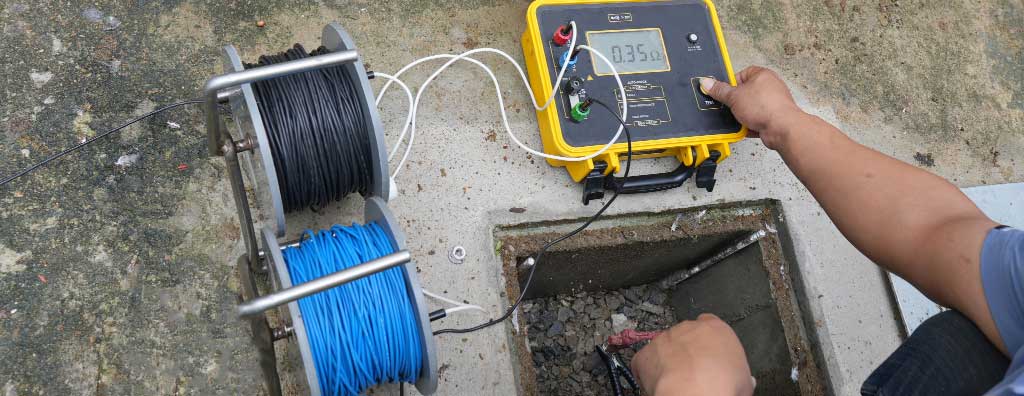
NBR 5419-3:2026 presents specific procedures for continuity testing of down conductors, non-natural electrodes, and equipotential-bonding connections. The objective is to demonstrate that sections that should form a continuous electrical path maintain that condition.
The report should record the method, instrument, tested points, execution conditions, results, and interpretation. Presenting only numbers without identifying the evaluated sections reduces traceability and makes future comparisons difficult.
What Should Be Included in the Technical Inspection Report?
The report must contain enough information to reconstruct the technical reasoning behind the inspection. NBR 5419-3:2026 establishes as minimum content for the periodic report the identification of the structure and the professional, including registration with the professional council and the technical-responsibility document, verification of the conformity of existing design documentation with its originating standard, and recording of the applicable inspection checks.
For a more complete engineering deliverable, it is also advisable to organize:
- identification and scope of the inspection;
- documents received and documents missing;
- criteria and references used;
- photographic records linked to the findings;
- condition of the air-termination, down-conductor, grounding, and equipotential-bonding subsystems;
- continuity checks and other applicable tests;
- changes to the structure or installations that may affect the LPS;
- nonconformities and technical observations;
- priority classification of actions, when adopted by the report methodology;
- inspection limitations;
- recommendations for maintenance, upgrading, design, or document completion.
The document should clearly distinguish observed evidence, technical criterion, conclusion, and recommendation. This separation avoids turning opinion into a requirement and improves traceability for maintenance, audits, and contracting of corrective work.
LPS Documentation and As-Built
Documentation must faithfully represent the condition actually implemented. NBR 5419-3:2026 requires as-built documentation and determines that it remain available at the site.
Relevant documentary elements include identification of the responsible professionals, verification of the need for protection measures, protection-level criteria, validation of natural components where applicable, soil data when necessary, definition of an isolated or non-isolated LPS, the air-terminal positioning method, sizing of down conductors and grounding, drawings and component details, and information on safety distance and protection of internal systems.
When the existing installation does not correspond to the design or when documentation is insufficient, the appropriate path may require an Electrical Survey and As-Built before or together with the system upgrade.
How Should Nonconformities Found in the LPS Be Addressed?
The inspection report must inform the person responsible for the structure of the irregularities observed. The standard also determines that the professional recommend a maintenance deadline based on the nonconformities found, ranging from immediate action to preventive-maintenance items.
Not every nonconformity should result in the same solution. Some findings are maintenance issues; others require construction correction, documentation updates, design review, or a new risk analysis. In installations modified over time, the root cause is often the loss of compatibility between the original design and the current condition.
A coherent technical journey may follow:
1. inspection and evidence collection; 2. technical report and classification of findings; 3. definition of maintenance and corrective actions; 4. LPS Design when the intervention changes design criteria; 5. implementation and recording of corrections; 6. new verification and updating of the as-built documentation.
Who Can Issue and Sign an LPS Technical Report?
Periodic inspection must be performed by a qualified professional with credentials, competence, and experience compatible with the activity. The definition of professional attributions depends on the legislation and the professional oversight system applicable to the contracted service.
Within the Confea/Crea system, ART is the instrument used to define technical responsibility for engineering works and services. The contracting party should verify that the professional has active registration and attributions compatible with the activities actually performed.
It is inappropriate to choose the responsible professional only by the title of the document. The central point is compatibility among professional attribution, contracted scope, tests performed, responsibility assumed, and conclusion issued.
When Should You Contract an LPS Report, Design, or Maintenance?
The choice depends on the problem that must be solved. When the issue is understanding the current condition of the system, the path begins with inspection and diagnosis. When the installation must be changed, expanded, or reconfigured, a design may be required. When the system is documented and the deviations are related to implementation or conservation, the need may be maintenance and upgrading.
A3A Engenharia structures this journey from diagnosis through design, upgrading, documentation, and new verification, keeping assessment and intervention stages separate to preserve technical traceability.
Conclusion
An LPS technical report should transform an inspection into useful engineering information. To do this, it must connect documentation, physical condition, applicable tests, structural changes, and normative criteria into a traceable conclusion.
The 2026 update to NBR 5419-3 reinforces a broader approach to inspection, maintenance, and documentation and moves away from simplifications such as treating grounding-resistance measurement as isolated proof of LPS effectiveness. The value of the report lies in the quality of the evidence, the criterion applied, and the ability to guide actions proportional to the findings.
Technical references
[1] BRAZILIAN ASSOCIATION OF TECHNICAL STANDARDS. ABNT NBR 5419-3:2026 — Protection against lightning — Part 3: Physical damage to structures and life hazard. Consult the current version in the ABNT Catalog.
[2] FEDERAL COUNCIL OF ENGINEERING AND AGRONOMY. Technical Responsibility Record — ART. Consult the official guidance at Confea.
[3] REGIONAL COUNCIL OF ENGINEERING AND AGRONOMY OF PARANÁ. ART registration and completion. Consult the procedure at CREA-PR.
Frequently asked questions
Not in every case. NBR 5419-3:2026 establishes annual periodic inspection for certain higher-risk structures, locations with severe atmospheric corrosion, and essential services, and a three-year interval for other structures. Inspections are also required after installation, changes, and specific events. Legal, contractual, or insurer requirements may be stricter.
No. NBR 5419-3:2026 states that grounding-resistance measurement is not necessary to verify LPS effectiveness. Inspection includes documentation, component condition, applicable electrical continuity, safety distances, structural changes, and other criteria.
Not exactly. Inspection is the technical field and document-verification activity. The report records the criteria, evidence, results, nonconformities, limitations, and conclusions arising from that inspection.
When the service falls within the Confea/Crea system, technical responsibility for engineering activities must be formalized through the applicable instrument. The ART records this responsibility and must be compatible with the professional’s scope and attributions.
Missing documentation reduces traceability and must be recorded in the inspection. Depending on the condition found, a cadastral survey, reconstruction of the as-built, design review, risk analysis, and system upgrading may be required before documentation is consolidated.
Additional technical materials
Related solutions
Related engineering services
Related technical content
- NBR 5419: LPS, risk analysis, grounding, SPDs, and technical documentation
- LPS Design: example, NBR 5419, risk analysis, and ART
- LPS Types: Franklin, Faraday cage, and rolling sphere
