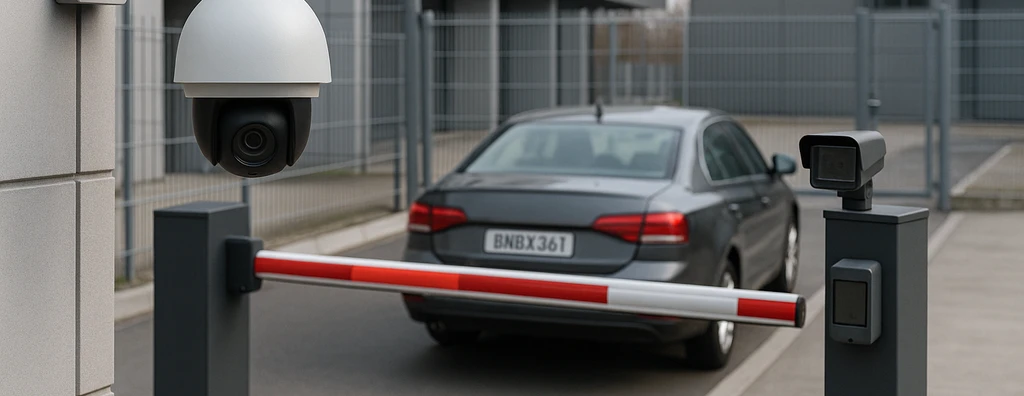
Learn how LPR supports access control, perimeter monitoring, and vehicle flow management in electronic security engineering projects.
Check it out!
The automatic recognition of vehicle license plates (LPR, from the English License Plate Recognition) fits into the context of computer vision, leveraging image analysis algorithms to identify and interpret alphanumeric characters on vehicle plates, usually captured by video monitoring systems. Its use in electronic security applications is motivated by the ability to automate access control processes, perimeter monitoring, and intelligent management of vehicle flows, facing technical challenges such as variations in lighting, angles, speeds, and plate patterns.
This article will detail the applications of LPR in electronic security, covering requirements, architecture, integration with systems, operational advantages, regulatory aspects, performance, limitations, and trends for engineering projects.
Check it out!
[elementor-template id=”24446″]
Essential Components of LPR
- Certified cameras for video monitoring: Capturing high-definition images of vehicles and plates, following performance requirements recommended by standards such as ABNT NBR IEC 62676-1-2.
- Auxiliary lighting: A critical element to ensure good readability of plates under different environmental conditions.
- Embedded or centralized processing: Use of proprietary AI algorithms for character extraction, identification, and cross-validation with databases.
- Network and storage infrastructure: Transmission of relevant events, minimizing bandwidth usage by sending only necessary information, compatible with performance requirements for video transmission.
- Integration interface: API or communication protocol allowing automation and sending commands to access control systems, building automation, and security management platforms.
Operational Flow of LPR
- Capture of the plate image.
- Processing of the video at the edge or on a centralized server.
- Automatic reading of characters and validation of data.
- Decision-making: release, block, or generate alert according to pre-configured rules.
- Event logging with the storage of associated data (image, identification, timestamp, and actions taken).
Main Environments
- Vehicle access control: Allows automatic admission of registered vehicles, replacing cards or remote controls.
- Parking monitoring and auditing: Facilitates the management of spaces, tracking, and circulation auditing.
- Management of condominiums, industries, and restricted areas: Ensures traceability of entries and exits, integrating with visitor and employee data.
- Integration with police systems: Automatic alert upon identifying stolen, missing, or restricted vehicles, enhancing the effectiveness of property security.
Example of Operational Flow for Access Control
1. Detection and reading of the license plate.
2. Comparison with the database (authorized, restricted, or interest lists).
3. Activation of gate/barrier in case of positive validation.
4. Event registration in the database or sending to operators.
- High precision and speed: Real-time processing, suitable for high vehicle flow.
- Reduction of fraud and human errors: Eliminates manual intervention, reducing possibilities of failures and inconsistencies.
- Scalability and integration: Solutions compatible with video monitoring platforms, access control, and centralized databases via standardized protocols.
- Edge intelligence: Processing on the device itself reduces bandwidth, storage costs, and response latency.
- Traceability and auditing: Automatic generation of logs, images, and reports for inspection, investigation, or integration with BI platforms.
- Regulatory compliance: Meets performance and security requirements set forth in applicable technical standards for the video monitoring segment.
Technical and Regulatory Criteria
- Reading performance: Accuracy rates must be validated according to environmental conditions, plate formats, and operational requirements.
- Camera resolution and positioning: Adherence to minimum requirements for data capture, according to ABNT NBR IEC 62676-1-2 (field of view, lighting parameters, and capture angle).
- Latency: The time between capture and system response must meet the demands of access points.
- Availability and reliability: Redundant structures, predictive maintenance, and constant monitoring increase the mean time between failures and reduce downtimes.
LPR solutions must be evaluated for data transmission security, information integrity, and ease of integration, adhering to best practices for critical environments.
Topologies and Integration Interfaces
- Native integration: Direct communication via APIs, SDKs, or specific protocols for access control platforms, condominium management, and command and control systems.
- Synergy with video monitoring: Sharing video, events, and logs, optimizing the use of the network and storage only for relevant occurrences.
- Building automation: Interaction with automation systems, lighting, alarms, and physical barriers for automatic responses to events captured by the LPR.
Infrastructure Requirements
- Structured network with performance compatible with real-time event processing and transmission.
- Storage and processing capacity to ensure secure archiving of images and logs.
- Communication security and network segregation, minimizing attack vectors and exposure to systemic failures.
Cost-Benefit Analysis and Constraints
- Reduction of operational costs: Automation decreases the demand for human resources for control and supervision.
- Initial investment: May vary according to the sophistication of algorithms, integration with legacy structures, need for certified equipment, and camera resolution.
- Maintenance: Requires regular inspections to ensure the integrity of sensors, lighting, and updates to algorithms according to board standards and any regulatory changes.
- Limitations: Influences from lighting, dirt, physical damage, non-standard or tampered plates impact the accuracy rate. Precision can also be affected by adverse weather conditions and vehicle speed.
- Valuation of benefits: When considering increased security, audit capability, and loss prevention, the LPR presents a particularly relevant return on investment for high-criticality environments.
Innovations and Technical Guidelines
- Distributed processing and AI: Use of artificial intelligence in local data capture and analysis, reducing the volume of data transmitted and optimizing infrastructure.
- Compliance and privacy: Implementation of policies for the ethical treatment of collected data, restricting access and storage according to purpose and current legislation.
- Standardizations: Employment of recognized technical standards to ensure interoperability, performance, and quality in video capture and transmission.
- Centralized management: Monitoring platforms that integrate multiple capture points, facilitating management and response to large-scale incidents.
- Automated responses: Adoption of fully automated workflows from detection to blocking or authorizing access, eliminating operational latency.
Recommended Practices
- Development of an executive project defined by operational requirements and expected performance, according to the functional scope.
- On-site validation of the LPR accuracy rates for all operational and environmental conditions of the project.
- Provisioning of scalable infrastructure for potential expansions.
- Creation of contingency plans and continuous monitoring of the systems.
The automatic recognition of vehicle license plates (LPR) currently represents a technically consolidated tool for electronic security, providing high efficiency in access control, auditing, automation, and integration of critical systems. Its foundation on performance standards for video monitoring, combined with the increasing adoption of embedded intelligence and integrated architectures, enables robust, auditable applications aligned with compliance and privacy requirements. Continuous evaluation of deployment conditions, technological updates, and adherence to best engineering practices is recommended, maximizing return on investment and ensuring operational reliability in mission-critical environments. The advancement of LPR is also likely to support autonomous and predictive operations, promoting greater resilience and responsiveness to emerging risks and incidents in the electronic security landscape.
