
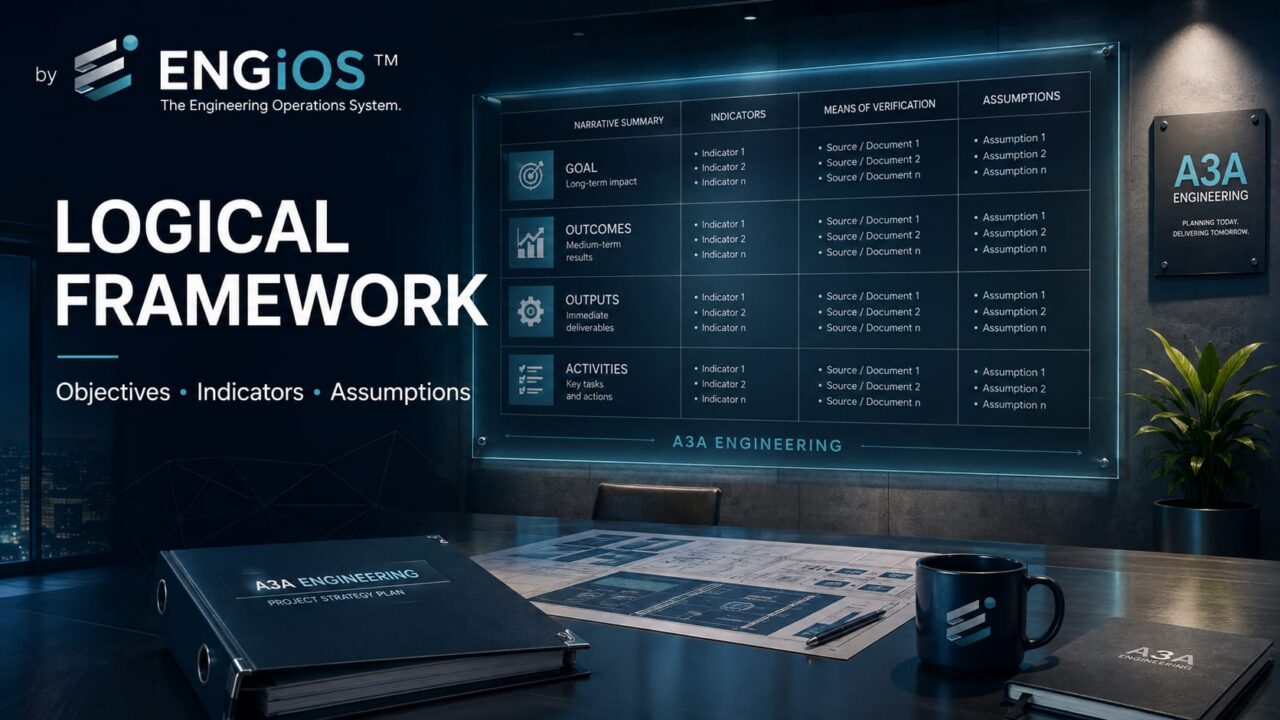
Understand the Logical Framework Approach (LFA), how to build a Logframe Matrix, define objectives, indicators, means of verification and assumptions, and integrate the Logframe into Engineering project management.
Check it out!
The Logical Framework Approach (LFA) is a planning methodology that transforms a project’s logic into a verifiable cause-and-effect chain. Rather than limiting planning to a list of activities and deliverables, LFA makes explicit why the project exists, which results it intends to produce, how those results will be measured, which evidence will demonstrate their achievement and which external assumptions must remain valid for the strategy to work.
Its main product is the Logical Framework Matrix, also called the Logframe. The matrix typically organizes the intervention logic into levels — activities, products/outputs, results/outcomes and impact — and relates them to indicators, sources or means of verification and assumptions. The value of the method, however, is not in filling out a table: it lies in the analytical process that precedes the matrix and forces the team to test coherence, causality, measurability and external conditions.
In Engineering project management, LFA can be particularly useful in project conception, front-end development, CAPEX programs, public projects, modernization initiatives, sustainability programs and situations in which it is necessary to demonstrate the connection between investment, technical deliverables, operational changes and benefits. It does not replace the schedule, WBS, budget, risk register or Project Controls; it functions as a layer of intervention logic and value realization that can integrate these instruments.
What is the Logical Framework Approach (LFA)?
The Logical Framework Approach is a structured approach for analyzing, designing, implementing, monitoring and evaluating projects or interventions. The European Commission describes it as a planning methodology whose central output is the Logical Framework Matrix, while emphasizing that the process begins before the matrix: context, stakeholders, problems, objectives, alternatives and strategy must be analyzed so that the resulting logic is credible.
This distinction is essential. LFA is not synonymous with Logframe. LFA is the analysis and planning process; the Logframe is a concise representation of that reasoning. When the team starts directly with the table, without testing the problem, stakeholders, causal relationships and alternatives, the document may look organized while still representing a poorly conceived project.
This logic connects naturally with the work of an Engineering PMO, because it provides an explicit structure for relating objectives, deliverables, indicators, assumptions and evidence. It also connects with Benefits Management in Engineering Projects and Programs, which follows the transition between technical delivery and effective value realization.
The value of LFA appears when project logic guides real decisions. In multidisciplinary projects, a well-structured PMO can connect objectives, evidence, risks, benefits and gates within a single governance framework, preventing the Logframe from becoming merely compliance documentation.
Are LFA, Logframe, Logical Framework and Logical Framework Matrix the same thing?
The terms are closely related, but not perfectly interchangeable. Terminology varies among institutions and countries.
| English term | Use in Portuguese | Use in Spanish | Practical meaning |
| Logical Framework Approach (LFA) | Abordagem do Quadro Lógico / Abordagem do Marco Lógico | Enfoque del Marco Lógico | Analytical and planning process |
| Logical Framework Matrix | Matriz do Quadro Lógico / Matriz de Marco Lógico | Matriz del Marco Lógico | Matrix that summarizes project logic |
| Logframe | Quadro Lógico / Marco Lógico | Marco Lógico | Short form for the matrix or, informally, for the method |
| Intervention Logic | Lógica de intervenção | Lógica de intervención | Causal relationship between actions and results |
| Result Chain | Cadeia de resultados | Cadena de resultados | Causal sequence through to impact |
| Means/Sources of Verification | Meios/fontes de verificação | Medios/fuentes de verificación | Evidence used to confirm indicators |
| Assumptions | Premissas | Supuestos | Relevant conditions outside the project’s direct control |
Therefore, an international article, procedure or report should declare the terminology adopted. This article uses LFA for the complete approach and Logframe for the matrix.
Why is LFA different from planning based only on activities?
A schedule can show precisely what will be done and when, but it does not necessarily demonstrate why that sequence of work will produce the expected benefit. A WBS can decompose scope into controllable work packages, but it also does not prove, by itself, that the outputs produced will cause the intended operational change.
LFA introduces an additional question at each level: if this is accomplished and certain assumptions are true, will the next level of result actually be achieved? This is the vertical logic of the method.
Consider a simplified example of modernizing a critical system:
- installing new equipment is not the impact;
- installed and accepted equipment is an output;
- higher operational availability may be an outcome;
- greater process continuity and reduced losses may represent the strategic impact or benefit;
- availability of an outage window, integration with legacy systems and operator adoption may appear as relevant assumptions.
The difference may look semantic, but it changes governance. A project can complete 100% of its activities and still fail to generate the result for which it was approved. LFA forces that possibility to appear in project design before it becomes an operational surprise.
What are the stages of the Logical Framework Approach?
The structure varies among organizations, but institutional sources converge around two broad moments: analysis and planning. The matrix is a consequence of the analysis, not its starting point.
Context and stakeholder analysis
The project must be situated in the environment in which it intends to produce results. This involves understanding users, operators, sponsors, affected communities, regulators, suppliers, technical areas and other stakeholders that influence or are influenced by the intervention.
Stakeholder management in projects remains necessary throughout the lifecycle, but in LFA the initial analysis has an additional function: discovering needs, conflicts of interest, capabilities, constraints and conditions that change the project’s own logic.
In Engineering, an apparently technical problem may have governance, operations, maintenance, supply or behavioral causes. Modernizing infrastructure without considering who operates it, who maintains it, who approves changes and who provides data can produce perfect outputs and weak outcomes.
Problem analysis
The team seeks to establish the central problem and its cause-and-effect relationships. Tools such as a problem tree are common because they prevent symptoms from being treated as causes.
For example, “a high number of operational interruptions” may result from different mechanisms — obsolescence, maintenance failures, lack of redundancy, improper configuration, spare-parts unavailability or poor power quality. The solution changes according to the causal chain identified.
Problem formulation should avoid two frequent errors:
- defining the problem already in the form of the desired solution, such as “a new system is missing”;
- building an excessively generic tree without evidence supporting the cause-and-effect relationships.
Objectives analysis
The problem tree is converted into a positive structure of objectives. Undesired causes are reformulated as desired conditions and negative consequences become expected positive effects.
This conversion should not be mechanical. Some causes are not within the project’s reasonable sphere of influence; others may be economically infeasible to address. The objective is to discover which changes need to occur, not simply to reverse every negative statement.
Alternatives and strategy analysis
With the objectives mapped, the team evaluates which paths are technically, economically and institutionally feasible. Here LFA approaches project front-end development: different strategies may produce similar results through different mechanisms.
In a reliability program, for example, alternatives may combine asset replacement, redundancy, maintenance review, automation, training, strategic inventory and contractual changes. Strategy selection should consider cost, schedule, risk, organizational capability, dependencies and expected benefits.
Building the intervention logic
The selected strategy is organized into a hierarchy of results. Depending on the institution, names may vary among goal, impact, purpose, outcome, result and output. The central point is to preserve causal relationships and clearly state what is under the project’s direct control and what depends on adoption or external conditions.
Defining indicators and means of verification
Each level must be observable. Indicators turn abstract objectives into criteria that can be monitored. Means or sources of verification define where the evidence will be obtained.
An indicator without a viable data source is weak. Likewise, an available source does not justify measuring something irrelevant merely because the data already exists. The design should start from the decision that needs to be supported.
Identifying and testing assumptions
Assumptions represent conditions important to success that are not under the team’s direct control. They complete the “if–then” relationship. USAID emphasizes this logic: moving from one level to the next depends on what the project delivers and on the validity of relevant assumptions.
If an assumption is critical and its probability of failure is high, the design must be reviewed. It may be necessary to internalize that condition as an activity, create a risk response, modify the strategy or recognize that the project is not viable under existing conditions.
How is a Logical Framework Matrix structured?
The classic form is a matrix in which the rows represent levels of the intervention logic and the columns represent control and verification dimensions. Legitimate institutional variations exist: some versions use four rows, others add inputs, impacts or intermediate levels; some keep “means of verification” as a separate column while others reorganize that information.
A widely recognizable structure is:
| Intervention logic | Indicators | Means/sources of verification | Assumptions |
| Impact / higher-level objective | How to know whether the long-term contribution occurred | Corporate systems, statistics, business indicators | Conditions for sustaining the benefits |
| Outcome / purpose | How to measure the change produced by use of the outputs | Operational data, audits, performance | Conditions for transforming outputs into outcome |
| Outputs / delivered results | Quantity, quality, schedule and acceptance criteria | Reports, tests, certificates, records | Conditions for effective use of the deliverables |
| Activities | Execution milestones, when applicable | Schedule, execution records, measurements | Preconditions and execution dependencies |
This matrix must be read in two directions.
Vertical logic
Vertical logic tests causality among the levels. A typical reading moves from bottom to top:
- if the activities are performed and the corresponding assumptions are valid, the outputs should be produced;
- if the outputs are produced and the assumptions at the next level are valid, the outcome should occur;
- if the outcome occurs and the strategic assumptions remain valid, the project will contribute to the expected impact.
The word contribute is important at the highest level. Projects rarely control broad strategic impacts in isolation.
Horizontal logic
Horizontal logic verifies whether each objective can be demonstrated objectively: objective → indicator → source of verification. It reduces vague statements such as “significantly improve reliability” and requires the team to specify how that improvement will be recognized and with what evidence.
Balance matters. Too many indicators make the matrix bureaucratic; too few leave important decisions without evidence.
How do you define good indicators in a Logframe?
An indicator must represent the objective it is intended to measure, not merely something that is easy to count. In technical projects, it is common to confuse activity performed with result achieved.
Consider an electrical protection modernization project:
- “20 panels inspected” measures execution;
- “100% of critical nonconformities treated and verified” measures a technical output;
- “reduction in exposure to failures identified in the study” approaches an outcome;
- “reduction in downtime and losses associated with electrical events” may represent an operational benefit, provided attribution and measurement are technically defensible.
Strong indicators normally need to state, according to the nature of the objective:
- variable measured;
- baseline or initial condition;
- target;
- time horizon;
- unit and calculation method;
- data source;
- update frequency;
- person accountable for the evidence;
- data-quality criteria.
This discipline is compatible with the role of PMO and Portfolio KPIs, but the Logframe adds something specific: each indicator is associated with an explicit level of the causal chain, preventing all indicators from being treated as equivalent.
What are means or sources of verification?
Means of Verification (MoV) or Sources of Verification (SoV) specify where the team will find evidence to confirm an indicator. In Engineering, they may include:
- test and commissioning reports;
- acceptance records;
- maintenance and asset-management systems;
- process historians;
- supervisory systems, BMS, EPMS, SCADA or VMS;
- inspection reports;
- availability and failure records;
- financial and production data;
- decision minutes;
- audits and documentary evidence.
The source must be defined during planning because it may require instrumentation, data integration, a process change or specific accountability. Discovering at closeout that nobody collected the required baseline is a design failure, not merely a reporting failure.
A Project Dashboard for PMO can consolidate part of this information, but the dashboard is the visualization layer. The Logframe defines which evidence is required and why.
What is the relationship between Logframe assumptions and risk management?
Assumptions and risks are closely related, but they are not identical concepts. In the Logframe, an assumption is an external condition important to the transition from one causal level to the next. In risk management, the universe is broader: it includes uncertain events or conditions, threats and opportunities, causes, consequences, responses, owners, triggers and residual exposure.
An assumption such as “the plant will make a 24-hour outage window available during the planned period” can be converted into a risk when the uncertainty is material. In that case, it should appear in the project’s risk register with probability, impact, response, owner and triggers.
The governance principle is simple:
- Logframe assumptions should not become a forgotten parallel list;
- critical assumptions need to be monitored;
- when material uncertainty exists, they should be integrated into the risk management process;
- changes in assumptions may require review of the intervention logic itself.
This connection prevents the team from treating external factors as later excuses for failure. If they were known and critical, they should have been monitored from the planning stage.
Critical assumptions require governance, not merely documentation. When an external condition can compromise the transition between output, outcome and impact, it should be monitored, have an owner and be integrated into the risk process whenever material uncertainty exists.
Example of a Logframe for an infrastructure modernization project
Consider an industrial organization that intends to modernize electrical and automation infrastructure whose obsolescence has contributed to unplanned interruptions. The scope includes surveys, studies, design, procurement, implementation, testing, training and handover.
A simplified Logframe could be structured as follows:
| Level | Statement | Example indicators | Sources of verification | Critical assumptions |
| Impact | Increase operational continuity and resilience | system-related downtime; avoided losses; operational stability | failure history, production, maintenance, operations reports | comparable demand and operating regime; sustained maintenance |
| Outcome | Improve availability and reliability of modernized systems | availability; MTBF where applicable; reduction in attributable failures; post-startup performance | CMMS/EAM, historian, performance reports | operators adopt new procedures; spares are available |
| Outputs | Infrastructure designed, implemented, tested and accepted | approved IFC deliverables; equipment installed; tests passed; training completed | EDMS, FAT/SAT, commissioning protocols, acceptance records | suppliers meet requirements; interfaces are compatible |
| Activities | Survey, design, procure, implement, test and hand over | schedule milestones; packages released; inspections completed | schedule, RFI, minutes, construction and commissioning reports | access and outage windows are released; approvals occur on time |
This example shows why a logical matrix should not be confused with the WBS. “Perform FAT,” “install panels” and “issue As Built” remain relevant components of the plan, but LFA requires demonstrating how those outputs connect to the performance that justified the investment.
How would the example change a project decision?
Suppose all new equipment is installed, but the assumption “maintenance procedures will be updated and incorporated by the operations team” does not materialize. The technical output may be complete, while the reliability outcome may remain below target.
Without an explicit results chain, the organization may close the project as “100% complete.” With LFA, there is a basis for asking whether transition to operations, training, documentation, spare parts and maintenance routines should have been treated as part of the benefit-realization strategy.
Does LFA replace the WBS, schedule or Project Controls?
No. The instruments solve different problems.
| Instrument | Main question | Primary object |
| LFA / Logframe | Why should this intervention produce these results, and how will we prove it? | causality, results, indicators, assumptions |
| WBS | Into which components will the scope be decomposed? | deliverables and work packages |
| Schedule | When and in what sequence will the work occur? | activities, dependencies and milestones |
| Project Controls | How will schedule, cost, progress, risk and trends be controlled? | performance and forecasting |
| Risk Register | Which uncertainties threaten or favor objectives, and how will they be treated? | risk, response, owner and trigger |
| Benefits Register | Which benefits will be realized, by whom and when? | post-delivery value and ownership |
In a mature management architecture, LFA can function as the strategic and causal coherence layer, while the WBS, schedule and Project Controls materialize execution control.
What is the difference between Logical Framework and Theory of Change?
Both instruments deal with causality, but they should not be treated as equivalent. A Theory of Change (ToC) usually allows a broader explanation of the expected transformation: mechanisms of change, alternative pathways, assumptions, context, actors and relationships that do not always fit in a compact matrix.
The Logframe tends to be more structured and operational: it summarizes the results chain, its indicators, sources of verification and assumptions in an architecture that can be governed throughout the lifecycle.
A practical application is to use Theory of Change to explore why and through which mechanisms change should occur and use the Logframe to consolidate what will be monitored, at which level and with which evidence. Simple projects may not require both; complex, transformational programs or those with a strong behavioral component may benefit from this complementarity.
What is the relationship between LFA, the Business Case and Benefits Management?
The Business Case justifies the investment decision: need, alternatives, costs, risks, benefits, feasibility and economic or strategic rationale. LFA does not replace that assessment. Its contribution is to make explicit the causal hypothesis that connects the investment to the expected changes.
Benefits Management, in turn, tracks whether those changes generated value after or beyond project delivery. Together, the three instruments can form a robust sequence:
- the Business Case answers whether the investment is worthwhile;
- LFA makes explicit how the intervention expects to transform resources and activities into results;
- Benefits Management defines ownership, metrics, transition and monitoring of value realization.
This integration reduces the risk of projects being approved with generic benefits and then controlled only by schedule and cost.
How can LFA be integrated into a PMO and project governance?
LFA does not need to become an isolated artifact. In an Engineering PMO, the matrix can serve as a reference for portfolio decisions, stage-gates, indicator baselines, risk management and benefits reviews.
The PMBOK Guide — Eighth Edition presents projects, programs, portfolios, products and operations as components of an integrated value delivery system aligned with organizational strategy. This does not mean that PMBOK prescribes LFA; it means there is useful conceptual compatibility: LFA can make more explicit the hypothesis connecting project work to the results and value that justify its existence.
A practical governance framework can establish that the Logframe be reviewed at the main gates:
- Concept gate: are the problem, stakeholders and objective correctly defined?
- Feasibility gate: is the selected strategy plausible and have critical assumptions been tested?
- Authorization gate: are indicators, baseline, targets and evidence defined?
- Execution gate: have scope or context changes altered the causal logic?
- Handover gate: have outputs been accepted and do the conditions exist to produce outcomes?
- Benefits gate: are results and impacts occurring according to the approved hypothesis?
This connects directly with decision authorities, committees and Stage-Gates: the matrix stops being a form and becomes a source of evidence for decisions.
In Consulting Engineering, the challenge is not to produce one more management artifact, but to integrate decisions. The Logframe can help connect need, scope, evidence, performance and value realization from conception through transition to operations.
How can LFA be applied in Engineering projects without creating bureaucracy?
The risk of bureaucracy increases when the matrix is used as a compliance checklist rather than a decision instrument. A lean implementation can begin with a conception workshop and evolve with project maturity.
Start with the decisions the project must support
Before defining the matrix, identify which decisions will depend on it. In a CAPEX project, these may include investment approval, alternative selection, phase release, deliverable acceptance or confirmation of benefits.
Keep few levels, but make them causally defensible
Adding too many layers does not increase quality. What matters is that each level has its own meaning and that the transition to the next level can be explained.
Differentiate output from outcome
This is one of the most valuable distinctions for Engineering. An approved design, installed equipment, issued report and commissioned system are deliverables. The operational result depends on the use and performance of those deliverables in the real environment.
Connect indicators to evidence systems
Do not create metrics that depend on nonexistent data without planning how those data will be produced. Information governance is part of the design.
Link critical assumptions to the risk process
Materially uncertain assumptions should have an owner, monitoring and a response proportional to their criticality.
Make the Logframe a living artifact
The European Commission treats LFA as an iterative process. Changes in context, scope, risks, strategy or evidence may require the matrix to be revised. Freezing the Logframe at initial approval contradicts its management function.
In which types of projects is the Logical Framework most useful?
The method became widely used in international development, public policy and projects financed by multilateral organizations, but its logic does not depend on that context. It tends to generate more value when there is a meaningful distance between delivering something and producing the change that justified the project.
Particularly relevant applications include:
- infrastructure modernization programs;
- resilience and reliability initiatives;
- energy-efficiency and decarbonization programs;
- digital-transformation projects;
- security, mobility or sanitation programs;
- investments with multiple stakeholders and funding sources;
- innovation and R&D projects;
- operational-performance improvement programs;
- ESG initiatives with measurable outcome targets;
- public programs and projects subject to outcome and impact monitoring.
In strictly deterministic, low-complexity projects, the cost of formalizing a complete LFA may exceed the benefit. The technique should be proportional to the decision problem.
What are the main mistakes when building a Logframe?
Treating the matrix as a form
Filling four columns after the project has already been decided removes much of the method’s analytical value. The matrix should reflect decisions made after analysis, not merely document them retrospectively.
Using activities as if they were results
“Conduct training,” “install equipment” and “issue a report” describe work or deliverables. The result question is what changes because those products came into existence and were used.
Creating causality without evidence
An arrow between output and outcome represents a hypothesis. The more complex the system, the more that hypothesis should be tested with data, experience, benchmarking or studies.
Writing generic assumptions
Assumptions such as “stakeholder support” or “favorable conditions” are difficult to monitor. The condition must be specific enough for the team to recognize when it is no longer true.
Measuring what is easy instead of what matters
Counting meetings, reports or equipment can generate indicators with good data availability and low decision value.
Ignoring the baseline and data source
Without an initial condition, target and reliable source, the indicator may fail to demonstrate any change.
Freezing the Logframe
Context and causality can change. An artifact that is not reviewed during execution and transition loses management value.
How do you review the quality of a Logical Framework?
A technical review can be conducted as a consistency test.
- Relevance: are the problem and stakeholders demonstrated by evidence?
- Causality: is there a defensible explanation for each transition between activities, outputs, outcomes and impact?
- Control: is it clear what the project directly controls and what depends on third parties or context?
- Measurement: does each relevant result have an appropriate indicator?
- Verification: is there a viable data source for each indicator?
- Assumptions: are critical external conditions explicit and monitorable?
- Risk: have uncertain assumptions been integrated into the risk register where necessary?
- Governance: are there owners for results, data, assumptions and decisions?
- Integration: does the Logframe connect with scope, schedule, risks, costs, benefits and stage-gates?
- Updating: is there a rule for review when the context or project changes?
A negative answer to any of these points does not automatically invalidate the project, but it shows where the logic needs to be strengthened before it can serve as a governance baseline.
Logical Framework in PT, EN and ES: how do you preserve technical equivalence?
Translation should preserve the concept, not only the word. Different institutions use different vocabularies even in English, and the same occurs in Portuguese and Spanish. Before translating a real Logframe, it is advisable to identify the convention of the funder, owner or applicable methodology.
For international editorial content, a safe strategy is to present the English term on first occurrence and then use the local form consistently:
- PT-BR: Logical Framework Approach (LFA) — Abordagem do Quadro Lógico/Marco Lógico;
- EN: Logical Framework Approach (LFA) — Logical Framework Matrix / Logframe;
- ES: Enfoque del Marco Lógico (EML) — Matriz del Marco Lógico.
It is also important not to impose a single translation for outcome, result, purpose or impact. Meaning depends on the results architecture adopted by the institution. Editorial translation should preserve the concept’s position in the causal chain.
Final considerations
The Logical Framework Approach is most useful when treated as a method for reasoning about the project rather than as an accountability table. Its central contribution is to connect problem, strategy, activities, outputs, outcomes, impact, indicators, evidence and assumptions in a logic that can be questioned and monitored.
For Engineering projects, this structure addresses a gap that schedule, budget and scope cannot solve in isolation: demonstrating how technical delivery is expected to produce the operational or strategic change that justified the investment.
When integrated with PMO, Project Controls, Risk Management, Benefits Management and Stage-Gates, the Logframe can become a particularly useful governance instrument in the front-end and in the transition between project and operations. In this context, the matrix does not replace existing controls; it explains the logic that gives them meaning.
Technical references
[1] EUROPEAN COMMISSION. Logical Framework Approach (LFA) — EXACT External Wiki. 2025. Available at: https://wikis.ec.europa.eu/spaces/ExactExternalWiki/pages/50108980/Logical%2BFramework%2BApproach%2B-%2BLFA.
[2] WORLD BANK. The Logframe Handbook: A Logical Framework Approach to Project Cycle Management. Available at: https://documents1.worldbank.org/curated/en/783001468134383368/pdf/31240b0LFhandbook.pdf.
[3] USAID. The Logical Framework — Technical Note, Version 1.0. 2012. Available at: https://pdf.usaid.gov/pdf_docs/pbaab555.pdf.
[4] EUROPEAN COMMISSION — ECHO. Manual Project Cycle Management — The Logical Framework. Available at: https://ec.europa.eu/echo/files/evaluation/watsan2005/annex_files/ECHO/ECHO10%20-%20ECHO%20Project%20Cycle%20Management%20Guideline.pdf.
[5] FAO. Project Planning and Management — Unit 3: The Logical Framework Matrix. Available at: https://www.fao.org/fileadmin/user_upload/investment/Documents/c134_unit_03.pdf.
[6] PROJECT MANAGEMENT INSTITUTE. A Guide to the Project Management Body of Knowledge (PMBOK Guide) — Eighth Edition. 2025. Available at: https://www.pmi.org/standards/pmbok.
Frequently asked questions
It is an analysis and planning methodology that structures the causal logic of a project or intervention, relating objectives, activities, outputs, outcomes, impact, indicators, sources of verification and assumptions. Its main product is the Logical Framework Matrix, or Logframe.
Not exactly. LFA is the complete analysis and planning approach. Logframe is the matrix that summarizes project logic. In practice, the terms are often used interchangeably, but the distinction is important to avoid reducing the method to filling out a table.
A classic structure uses intervention logic, objectively verifiable indicators, means or sources of verification and assumptions. Legitimate institutional variations exist, so the convention of the funder or organization should be checked.
Vertical logic tests the causal relationship among activities, outputs, outcomes and higher-level objectives while considering assumptions. Horizontal logic tests whether each objective has indicators and sources of verification capable of demonstrating achievement.
Both address causality. Theory of Change generally allows a broader causal narrative, with mechanisms, context and pathways of change; the Logframe tends to summarize results, indicators, verification and assumptions in an operational monitoring structure.
No. The WBS decomposes scope and deliverables. LFA explains the logic connecting activities and deliverables to expected results and impacts. The instruments are complementary.
It can be applied from conception to connect the technical problem to the investment objective, define outputs and outcomes, establish indicators and evidence, make assumptions explicit and integrate this information with schedule, risks, benefits and stage-gates.
Critical assumptions with material uncertainty should be evaluated through the risk-management process. Not every assumption needs to become a formal risk, but conditions whose failure could compromise objectives should have monitoring, an owner and a response consistent with their criticality.
Yes. LFA is iterative. Relevant changes in context, strategy, scope, assumptions or evidence may require review of the intervention logic, indicators or targets.
No. Although it has a strong tradition in international development and public projects, its logic can be applied to Engineering, CAPEX, digital transformation, sustainability, resilience, innovation and other projects where it is necessary to demonstrate how technical deliverables will produce results and value.
Complementary technical materials
Related solutions
- Engineering PMO Implementation and Structuring
- Project, Program and Portfolio Governance
- Requirements, Evidence and Acceptance Criteria Management
Related services
- Project Management: Schedule, Costs and Earned Value (Project Controls)
- Technical Engineering Consulting
- Engineering Risk Management
Main content on the topic
- PMO: what it is, types, functions and how to structure a Project Management Office
- Benefits Management in Engineering Projects and Programs
- Decision Authorities, Committees and Stage-Gates in Engineering Projects
- Risk Management in Engineering Projects
