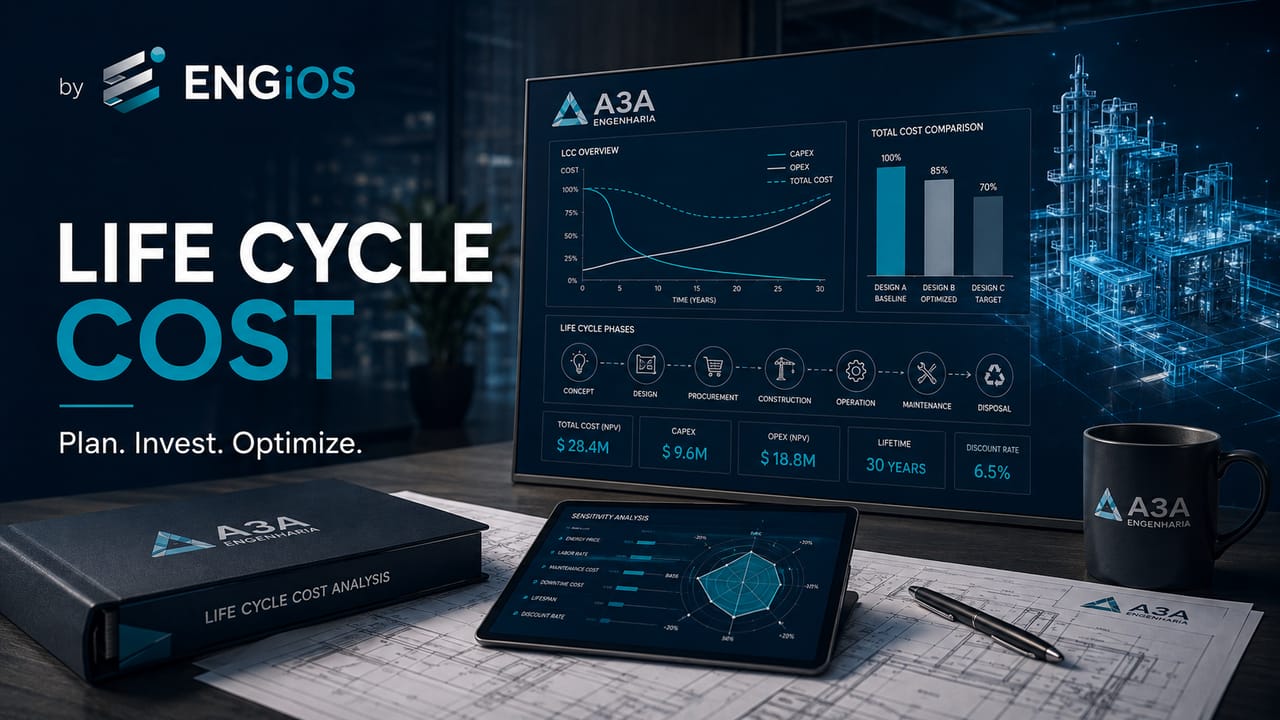
Understand Life Cycle Cost (LCC): CAPEX, OPEX, present value, discount rate, sensitivity, reliability, maintenance, asset management and lifecycle decisions.
Check it out!
Life Cycle Cost — LCC — is an economic analysis methodology used to compare alternatives by considering relevant costs over a defined horizon rather than only the initial investment. In engineering, this means evaluating acquisition, implementation, energy, operation, maintenance, failures, logistics, upgrades, downtime where applicable, and disposal in a manner consistent with the decision objective.
The method is particularly important when two alternatives have different economic profiles. Equipment that is cheaper to purchase may consume more energy, require more maintenance, have lower availability, or generate higher replacement costs. Likewise, a solution with higher CAPEX may produce a lower total lifecycle cost if it reduces recurring expenses or operational risks sufficiently.
LCC is not a rule for always choosing the mathematically lowest-cost option. It is a tool for structuring assumptions, making future costs comparable, testing uncertainties, and supporting traceable engineering decisions. Performance, safety, compliance, capacity, risk, and technical requirements remain decision constraints.
What is Life Cycle Cost — LCC
IEC 60300-3-3:2017 presents life cycle costing as a generally applicable approach and highlights the relationship between lifecycle costs and dependability. ISO 15686-5:2017, focused on buildings and constructed assets, also structures cost analysis from acquisition through operation and disposal within a defined analysis period.
In practical terms, an LCC model answers:
How much is each alternative expected to cost, on a comparable-value basis, over the relevant decision horizon?
To answer correctly, the model needs to state:
- analysis objective;
- alternatives compared;
- system boundary;
- analysis horizon;
- lifecycle events considered;
- usage assumptions;
- costs and revenues included or excluded;
- monetary basis;
- discount rate;
- inflation treatment;
- residual value;
- uncertainties and scenarios.
Without these definitions, LCC figures may appear precise while still comparing different things.
LCC is not the same as purchase price
Acquisition price is only one component of lifecycle cost. Depending on the asset, it may dominate or represent only a small share of total cost.
A typical breakdown is:
LCC = acquisition + implementation + operation + energy + maintenance + support + failures + renewals + disposal − residual value
Not every element needs to be included in every analysis. The boundary should reflect the decision. If the objective is to compare two chillers, energy and maintenance are likely material. If the objective is to compare two low-consumption components that are easy to replace, modeling twenty cost categories may add complexity without changing the choice.
LCC and TCO: what is the difference
Life Cycle Cost and Total Cost of Ownership — TCO — are closely related concepts, but they are not necessarily identical across organizations.
TCO is frequently used in procurement and management to represent the total cost of owning and using a given solution. LCC tends to emphasize economic modeling throughout the lifecycle, including horizon, cash flows, events, discounting, and alternative analysis.
In practice, terminology should be defined in the study. What matters is that the cost boundary and analysis horizon are explicit.
Which costs are included in an LCC analysis
A useful structure organizes costs by lifecycle stage.
| Stage | Examples of costs |
| acquisition | equipment, licenses, engineering, procurement |
| implementation | construction, installation, integration, testing, commissioning |
| operation | labor, consumables, services, utilities |
| energy | electricity, fuel, associated losses |
| maintenance | preventive, predictive, corrective, inspections, contracts |
| support | tools, training, software, documentation, inventory |
| failures | repair, mobilization, parts, downtime when monetized |
| renewal | retrofit, overhaul, intermediate replacements |
| end of life | dismantling, disposal, environmental remediation |
| residual | resale, reuse, or remaining value |
The model should not count the same effect twice. If downtime cost is already incorporated into lost production, it should not be added again under another name.
Lower CAPEX does not mean lower cost. A cheaper acquisition alternative may shift cost to energy, maintenance, failures, support, or renewal over the asset’s life.
Analysis horizon
The horizon needs to be long enough to capture relevant differences among the alternatives.
Comparing two long-life assets over only three years may artificially favor the lower-CAPEX alternative. On the other hand, adopting a 30-year horizon when the technology will be replaced in eight may introduce speculative assumptions with little decision value.
The horizon may be defined by economic life, expected service life, contract period, project horizon, or the organization’s strategic window.
When alternatives have different lives, the study needs to treat the difference consistently, for example through replacements, residual value, or another appropriate economic method.
Time value of money
Costs occurring at different times should not simply be added when the horizon is material. An expense of R$ 100 thousand today is not economically equivalent to the same expense ten years from now.
The present value of a future cash flow can be expressed as:
VP = C / (1 + i)^t
where:
- VP is the present value;
- C is the cost in the future period;
- i is the discount rate per period;
- t is the number of periods.
For a uniform annual series, the present-value annuity factor may be used, provided the assumptions are compatible.
The study should state whether it uses real or nominal values. Mixing cash flows with embedded inflation and a real discount rate, or the reverse, distorts the result.
Comparative LCC example
Consider two alternatives for an engineering function over a ten-year horizon with an 8% annual discount rate.
| Parameter | Alternative A | Alternative B |
| acquisition and implementation | R$ 300.000 | R$ 420.000 |
| annual energy | R$ 80.000 | R$ 55.000 |
| annual maintenance | R$ 20.000 | R$ 12.000 |
| residual value in year 10 | R$ 20.000 | R$ 30.000 |
Alternative B requires an additional R$ 120 thousand upfront but reduces annual costs by R$ 33 thousand.
Bringing the cash flows to present value, the approximate LCC is:
- Alternative A: R$ 961.7 thousand;
- Alternative B: R$ 855.7 thousand.
In this scenario, Alternative B has a lifecycle cost approximately R$ 106 thousand lower, despite the higher initial investment.
The example does not prove that the more expensive option always wins. It shows why CAPEX alone can produce an economically inadequate decision.
Sensitivity: when the conclusion depends on the assumption
An LCC analysis without sensitivity testing may hide fragility. If a 2% change in the energy tariff changes which alternative performs better, the decision is far more uncertain than a single final value suggests.
Variables commonly tested include:
- discount rate;
- energy or fuel price;
- operating hours;
- cost growth rate;
- failure frequency;
- downtime;
- service life;
- overhaul interval;
- spare-parts cost;
- residual value.
The purpose of sensitivity analysis is to identify which assumptions actually drive the decision.
An LCC without sensitivity analysis may hide a fragile decision. When small changes in energy, service life, failure rate, or discount rate alter the result, that uncertainty needs to appear in the technical assessment.
Scenarios and uncertainty analysis
Not every parameter needs to be treated as a single value. In higher-impact studies, conservative, base, and optimistic scenarios may be built, or probability distributions may be used when sufficient data and justification exist.
A conservative scenario may combine shorter service life, higher energy cost, greater failure frequency, and lower residual value. The base scenario uses the most likely assumptions. The optimistic scenario tests superior performance.
More sophisticated probabilistic methods only add value when input quality is adequate. Simulating thousands of combinations using arbitrary data produces apparent precision, not confidence.
LCC and reliability
Reliability affects lifecycle cost because failures generate parts consumption, labor, mobilization, operational losses, and, in some cases, secondary damage.
Consider two electrical power architectures. The more redundant solution may have higher CAPEX and maintenance cost but a lower probability of critical interruption. If downtime has a material economic consequence, the benefit may exceed the additional investment.
This relationship is one reason why LCC and RAM Analysis are complementary. The RAM model estimates reliability, availability, and maintainability behavior; LCC translates part of those differences into economic implications when appropriate.
How to monetize downtime carefully
Not every consequence should be converted into money. Safety, compliance, and environmental impacts may act as mandatory constraints regardless of LCC.
When downtime can be economically estimated, the model needs to avoid excessive simplification. The cost of one hour of downtime may vary according to production, time of day, work-in-process inventory, recovery possibilities, contract terms, and event duration.
A cost function may be more appropriate than a fixed rate. A five-minute stop may generate no economic loss, while a four-hour interruption may cause batch disposal, production loss, and restart costs.
LCC and maintenance
Maintenance plans alter the asset’s economic profile. A more intensive strategy may increase preventive cost while reducing corrective maintenance, failures, and downtime. Another may reduce periodic interventions and accept greater exposure on non-critical assets.
For this reason, LCC should not use only an “average annual maintenance cost” when significant events exist such as overhaul, component replacement, stepped contracts, or major shutdowns.
The analysis should reflect the maintenance strategy defined by Engineering. See Maintenance Engineering and Reliability-Centered Maintenance — RCM.
LCC in design and specification
The greatest potential of LCC usually appears before the solution is contracted. During concept development, design, and procurement, it is still possible to change architecture, capacity, efficiency, redundancy, standardization, and support strategy.
A specification based only on the lowest purchase price may shift cost into operations. Procurement requirements may incorporate criteria for efficiency, availability, maintainability, warranty, support, parts, training, documentation, and design life.
In competitive processes, it is essential that the economic evaluation method be predefined and auditable. Suppliers need to be compared using the same assumptions.
LCC and CAPEX management
Lifecycle cost analysis helps avoid two common distortions: minimizing CAPEX at the expense of OPEX and maximizing specifications without demonstrating economic or risk benefit.
The objective is to identify the alternative that delivers value within technical and risk requirements. This brings LCC closer to decisions in CAPEX Management and asset management.
A well-structured investment decision should record which portion of the benefit comes from energy, reliability, maintenance, service life, productivity, or avoided risk.
LCC and asset management
ABNT NBR ISO 55001:2024 requires the decision-making framework to consider appropriate methods and tools for dealing with options that offer the best value over the lifecycle of assets or other relevant horizons.
LCC can be one of these tools. It is particularly useful in decisions such as:
- repair or replace;
- retain existing technology or modernize;
- buy standard or higher-efficiency equipment;
- centralize or distribute redundancy;
- outsource a service or internalize capability;
- hold a spare or accept lead time;
- perform a retrofit now or defer it;
- compare design alternatives.
The full context is in Asset Management.
LCC supports the decision; it does not replace requirements. Safety, compliance, performance, and risk remain technical constraints. Cost only compares alternatives that satisfy the engineering problem.
Repair or replace: a decision example
Suppose existing equipment requires a repair costing R$ 90 thousand and is expected to provide three additional years of service, with annual maintenance of R$ 35 thousand. A replacement costs R$ 280 thousand, has a longer expected life, and reduces annual maintenance to R$ 12 thousand.
Comparing only R$ 90 thousand against R$ 280 thousand favors repair. However, the correct decision requires a common horizon, residual value, risk of new failures, energy, performance, and the need for another replacement after three years.
LCC forces these events to be made explicit. Many apparently obvious decisions change when the horizon is no longer limited to the current year’s budget.
Avoided costs are not automatically guaranteed benefits
A frequent mistake is assuming that every difference between the current scenario and the proposed scenario will be captured financially.
If a project reduces theoretical consumption by 10% but the facility operates only a few hours, the actual benefit may be small. If redundancy reduces shutdown risk, the economic value depends on event probability and consequence. If a system reduces maintenance hours, this does not necessarily reduce payroll; released capacity may be used for other activities.
The model should distinguish cash savings, avoided cost, released capacity, and reduced risk.
Common mistakes in LCC analyses
Among the most frequent problems are:
- using only easily available costs and ignoring decisive ones;
- using different horizons for different alternatives;
- not documenting the discount rate;
- mixing real and nominal values;
- assuming savings without validating the operating regime;
- counting downtime twice;
- ignoring intermediate replacements;
- assuming identical service life without justification;
- using maintenance values without history or a technical basis;
- presenting only one scenario;
- using excessive precision for highly uncertain inputs.
The most dangerous mistake is turning the result into an absolute financial truth. LCC is an assumption-dependent decision model.
How to structure an LCC analysis step by step
A robust sequence is:
1. define the decision to be supported; 2. establish requirements all alternatives must meet; 3. define boundary and horizon; 4. describe alternatives and configuration; 5. map lifecycle events; 6. structure the cost breakdown; 7. collect and qualify data; 8. define the discount rate and inflation treatment; 9. model cash flows by period; 10. bring cash flows to the same economic basis; 11. compare results; 12. perform sensitivity and scenario analysis; 13. review risks and non-monetary aspects; 14. document assumptions, sources, and the decision.
The spreadsheet is only the mathematical implementation. The engineering work lies primarily in defining the boundary, events, assumptions, and the relationship between performance and cost.
When an LCC analysis adds the most value
LCC tends to be particularly useful for long-life assets, energy-intensive systems, equipment with significant maintenance, alternatives with very different CAPEX, critical systems, retrofit decisions, and situations where the lowest initial price does not represent the cost relevant to the organization.
It is also useful when preparing specifications and procurement processes because it allows economic criteria to be established before proposals are received.
A good analysis ends with a traceable decision: which alternatives were considered, which assumptions drive the result, which risk remains, and under which conditions the decision should be reviewed.
Learn about the Engineering Asset Management service →
Technical references
[1] IEC. IEC 60300-3-3:2017 — Dependability management — Part 3-3: Application guide — Life cycle costing. Geneva: IEC, 2017.
[2] ISO. ISO 15686-5:2017 — Buildings and constructed assets — Service life planning — Part 5: Life-cycle costing. Geneva: ISO, 2017.
[3] ABNT. NBR ISO 55001:2024 — Asset management — Management systems — Requirements. Rio de Janeiro: ABNT, 2024.
[4] ISO. ISO 55000:2024 — Asset management — Vocabulary, overview and principles. Geneva: ISO, 2024.
Frequently asked questions
It is the analysis of the relevant costs of an alternative over a defined lifecycle horizon, including acquisition, operation, energy, maintenance, renewals, and end of life according to the scope.
Purchase price is only the initial outlay. LCC also considers future costs and, where applicable, residual value and other economic lifecycle events.
They are closely related concepts and may overlap, but usage varies among organizations. What matters is clearly stating the study boundary, horizon, and cost categories.
No. The alternative must first meet technical, safety, compliance, and risk requirements. LCC supports the economic comparison among technically acceptable options.
Because costs at different times do not have the same economic value. The discount rate makes it possible to bring future cash flows to a comparable basis.
When alternatives have material differences in CAPEX, energy, maintenance, reliability, service life, support, renewal, or disposal over the decision horizon.
Additional technical resources
Related solutions
- Requirements, Evidence, and Acceptance Criteria Management
- Technical Knowledge Management and Lessons Learned
- Field Applications, Inspection, and Technical Data Collection
Related engineering services
Related technical content
- Asset Management: lifecycle, value, risk, and performance
- RAM Analysis
- Reliability Engineering
- CAPEX Management in Engineering Projects
- Maintenance Engineering
- Asset Criticality Analysis
Guides, frameworks, and references
