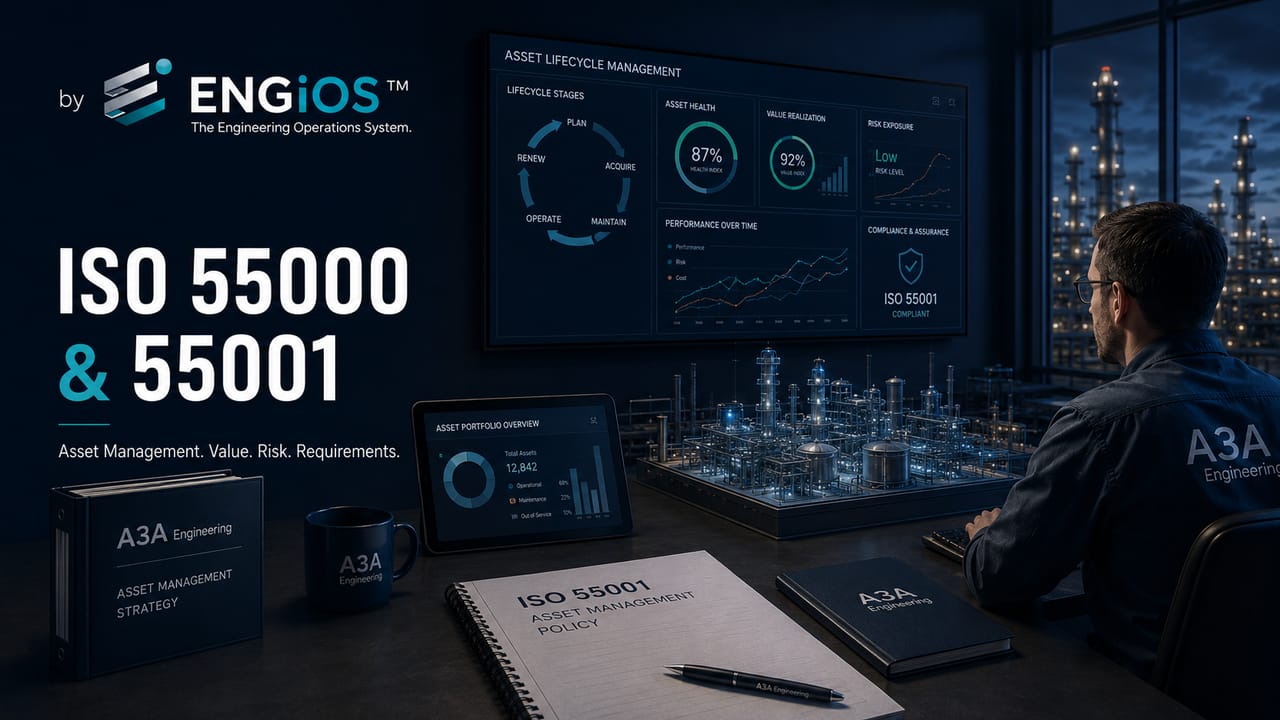
Understand ISO 55000 and ISO 55001: asset management principles, requirements, value, risk, SAMP, lifecycle, information, maturity, implementation and certification.
Check it out!
ISO 55000:2024 establishes the vocabulary, overview, and principles of asset management; ISO 55001:2024 defines the requirements for an asset management system. Together, they structure how an organization connects objectives, decisions, assets, risk, performance, cost, and value throughout the lifecycle. ISO 55002 provides guidance on applying the requirements, but it neither replaces ISO 55001 nor creates a universal list of maintenance tasks.
Asset management under the ISO 55000 series is broader than maintenance, asset registers, or software. The focus is to ensure that asset-related decisions contribute to organizational objectives while considering value, risks, opportunities, performance, and expenditure throughout the lifecycle. This requires governance, decision criteria, information, competence, planning, and continual improvement.
What ISO 55000 is and how it relates to ISO 55001
ISO 55000 is the conceptual foundation of the family. The 2024 edition presents the vocabulary, overview, principles, and outcomes associated with asset management. It helps the organization understand what it means to manage assets systematically and how that system connects to value and organizational objectives.
ISO 55001 is the requirements standard. It specifies what an asset management system needs to establish, implement, maintain, and improve. It is the reference used when an organization wants to structure its system in an auditable manner or pursue certification.
ISO 55002:2018 provides practical guidance for applying ISO 55001. In August 2026, this edition remained published while a new revision was under development. A working document or committee draft should not be treated as a current requirement.
| Document | Role in the family | Main question |
| ISO 55000:2024 | Vocabulary, overview, and principles | What is asset management, and which concepts guide the system? |
| ISO 55001:2024 | Asset management system requirements | What does the organization need to establish and control? |
| ISO 55002:2018 | Application guidance | How should ISO 55001 requirements be interpreted and implemented? |
| ISO/TS 55010:2024 | Alignment between financial and non-financial functions | How can technical and financial asset decisions be aligned? |
| ISO 55012:2024 | People involvement and competence | How should participation and required competencies be structured? |
| ISO 55013:2024 | Data management to support asset objectives | How can information usefulness and governance be improved? |
Asset management is not synonymous with maintenance
Maintenance is one of the activities within the lifecycle. Asset management determines why, where, and with what priority resources should be deployed so assets create value. A management decision may conclude that the best treatment is maintenance, but it may also be redesign, replacement, renewal, operational change, redundancy, decommissioning, or conscious risk acceptance.
This distinction changes the management logic. The objective is no longer to maximize availability or minimize maintenance cost in isolation, but to balance performance, risk, and expenditure according to organizational objectives.
An asset does not need to be physical
The ISO 55000 series uses a broad concept of an asset. Organizations may define the system scope according to the assets relevant to their objectives. For infrastructure-intensive organizations, physical assets are usually central, but information, software, contracts, rights, and other objects may also have value and require management.
The system should make clear which assets are within scope and why.
What changed in the 2024 edition
The 2024 edition of ISO 55000 updated the principles, introduced asset management outcomes, expanded benefits, reinforced integration among management systems, and incorporated the concept of asset management organization maturity.
In ISO 55001:2024, one of the most important advances is the explicit strengthening of decision-making and value. The standard requires the organization to establish an approach and criteria for decisions related to assets and asset management. This brings the standard closer to the realities of CAPEX, OPEX, renewal, risk, and prioritization.
Decisions need to be governed, not merely justified afterward
Many organizations have plans and budgets but lack consistent criteria for deciding whether to maintain, replace, modernize, or accept risk. The new emphasis in ISO 55001 makes this gap more visible.
Decision criteria may consider safety, continuity, legal requirements, performance, lifecycle cost, criticality, obsolescence, capacity, sustainability, and opportunity. The set should be consistent with organizational objectives.
| Decision | Questions a mature system should answer | Expected evidence |
| Maintain or replace | What risk remains? What is the residual service life? What is the lifecycle cost? | History, condition, criticality, LCC, budget |
| Renew or modernize | Does the asset meet future capacity and requirements? | Studies, roadmap, obsolescence, performance |
| Accept risk | Is the consequence tolerable? Is there contingency? | Formal criterion, approval, response plan |
| Prioritize CAPEX | Which investment delivers greater value and risk reduction? | Decision criteria, portfolio, business case |
| Change the maintenance strategy | Is the failure mode controlled by the current task? | FMEA/RCM, indicators, failures, condition |
Value: the central concept of asset management
Assets exist because they deliver or support value. That value is not necessarily the equipment’s market price. It may involve production, continuity, safety, public service, quality, regulatory compliance, reputation, or operational capability.
For this reason, asset decisions should not be evaluated only by direct cost. Inexpensive equipment may support a function with extremely high consequences; an expensive asset may be redundant and have low operational consequence.
Value is perceived by different stakeholders
Shareholders, users, operations, maintenance, safety, regulators, and the community may value different outcomes. The system needs to recognize these interests without turning every decision into subjective negotiation.
The asset management policy and objectives create the link between relevant expectations and technical decision criteria.
Asset management policy, objectives, and planning
The policy defines commitments and direction. Objectives translate the policy into measurable results aligned with strategy. Planning defines how those objectives will be achieved.
Weak objectives are generic, such as improving maintenance. Useful objectives connect outcomes and context: reduce exposure to critical failures, increase availability of a given function, reduce obsolescence risk, or improve renewal predictability.
SAMP and asset management plans
The Strategic Asset Management Plan — SAMP — connects organizational objectives and asset management objectives and presents the strategic approach for achieving them. Asset management plans detail actions, resources, responsibilities, horizons, and controls.
The SAMP should not be a document isolated from budgeting, maintenance, or investment planning. Its value lies in aligning decisions that were previously made by separate areas.
How to connect risk, performance, and expenditure
When maintenance, operations, Engineering, and finance use different criteria to prioritize assets, the organization loses comparability and tends to decide based on urgency or available budget. An asset management system creates a common language for value, risk, and performance.
Asset management requires balance. Reducing every risk to zero would be economically infeasible; minimizing all expenditure may increase risk and degrade performance; maximizing performance may consume resources without proportional benefit.
The system should make these relationships explicit and allow decisions to be comparable.
Risk should be related to uncertainty about objectives
An isolated probability-impact matrix does not replace risk management. It is necessary to understand the scenario, consequence, existing controls, and uncertainty. Criticality helps prioritize assets but does not eliminate analysis of specific risks.
Performance needs to be defined by function
Indicators should represent what the asset needs to deliver. Availability may be critical for one system, while energy efficiency, quality, capacity, response time, or compliance may be more relevant for another.
Lifecycle and renewal decisions
The lifecycle comprises the stages through which the asset passes. Decisions made during design and acquisition may determine a large portion of the costs, risks, and limitations that will appear during operations.
Mature asset management brings maintenance and operations into design decisions. Maintainability, accessibility, redundancy, spares, documentation, and obsolescence should be considered before entry into service.
Accounting, technical, and economic lives may differ
An asset may be fully depreciated and still remain technically adequate. Another may be relatively new and already economically obsolete due to energy consumption, support difficulties, or downtime risk.
The renewal decision should consider condition, function, risk, performance, support, cost, and strategy.
Information and data in the asset management system
Reliable decisions depend on information of sufficient quality for its intended use. The organization needs to define information requirements, responsibilities, sources, format, governance, and controls.
It is not necessary to centralize everything in a single software platform. CMMS/EAM, BIM, GED, ERP, SCADA, and other platforms may coexist, provided there is an information architecture and clear responsibilities.
The asset register is a foundation, not the whole system
TAGs, hierarchy, attributes, and relationships make it possible to connect work orders, failures, documents, inspections, and costs. Without a reliable asset register, the organization loses the ability to compare performance and trace decisions.
Information management needs to include updating. Data that were correct in 2024 may be wrong in 2026 if a retrofit or configuration change has occurred.
People, responsibilities, and competence
Management systems do not work through procedures alone. The organization needs to define roles, responsibilities, and competencies for decisions and activities related to assets.
Engineering, operations, maintenance, supply, finance, safety, and management have different perspectives. Governance should integrate these views without diluting technical accountability.
Decision rights need to be explicit
Who approves renewal? Who accepts temporary risk? Who changes maintenance intervals? Who changes criticality? Who authorizes decommissioning? These decisions need criteria and authority commensurate with their consequences.
Integration between financial and non-financial functions
A recurring difficulty is the gap between technical and financial language. Engineering speaks in terms of condition, failure, redundancy, and service life; finance speaks in terms of budget, cash flow, CAPEX, and return.
ISO/TS 55010:2024 addresses alignment between financial and non-financial functions in asset management. The objective is not to turn every technical decision into a financial calculation, but to ensure that both perspectives use consistent information.
CAPEX and OPEX cannot be analyzed in isolation
Deferring replacement reduces CAPEX in the short term but may increase maintenance, risk, and downtime. Replacing too early reduces risk but may destroy residual value. Asset management provides context for comparing alternatives throughout the lifecycle.
How ISO 55001 relates to maintenance and reliability
If the main problem is recurring failures, low availability, or maintenance strategies that do not reduce risk, ISO 55001 implementation needs to be connected to Reliability Engineering—not merely to system documentation.
The standard does not prescribe RCM, FMEA, CBM, thermography, or specific indicators. These are tools that may be used when appropriate to the objectives and risks.
The system should ensure that selected activities are consistent with decision criteria. An organization may use RCM for critical assets, preventive maintenance for age-related failure modes, CBM when condition is detectable, and planned corrective maintenance when the consequence is acceptable.
Excellent maintenance does not compensate for poor design
Systemic failures, insufficient capacity, low redundancy, or obsolescence may require Engineering. A system aligned with ISO 55001 should allow maintenance problems to generate redesign or renewal decisions when necessary.
How to assess asset management maturity
Certification and maturity are different concepts. An organization may meet minimum management-system requirements and still have substantial room to evolve in decision quality, data integration, and technical practices.
Maturity may be assessed across dimensions such as governance, strategy, decision-making, risk, information, lifecycle, maintenance, competencies, and improvement.
| Conceptual level | Predominant characteristics | Next advancement |
| Reactive | Decisions after failure, scattered information | Create visibility and responsibilities |
| Controlled | Basic processes and structured asset register | Integrate risk and planning |
| Integrated | Common criteria across functions and lifecycle | Optimize decisions and data |
| Value-oriented | Decisions comparable by value, risk, and performance | Improve forecasting and portfolio management |
| Adaptive | The system continuously learns from results | Refine scenarios and innovation |
This table is a conceptual maturity model, not an ISO normative scale.
How to implement an asset management system
In brownfield installed bases, implementing asset management without knowing actual condition, documentation, criticality, and risks tends to produce abstract plans. Technical diagnosis creates the baseline for maintenance, renewal, and CAPEX decisions.
Implementation should not begin by writing dozens of procedures. The first step is to understand context, objectives, relevant assets, and decision problems.
An initial diagnosis may assess governance, scope, asset register, criticality, planning, maintenance, information, indicators, projects, and renewal. Based on the gaps, the organization defines a proportionate roadmap.
Starting with the business problem reduces bureaucracy
If the greatest exposure is electrical obsolescence, the pilot may structure the asset register, criticality, condition, and renewal plan for that system. If the problem is production downtime, the focus may be reliability, maintenance, and spares.
The system grows from real decisions and produces evidence of value sooner.
Practical implementation steps
- Define context, scope, and interested parties.
- Assess the current state and major risks.
- Establish policy and objectives.
- Define governance and decision criteria.
- Structure information, the asset register, and hierarchy.
- Develop the SAMP and asset management plans.
- Integrate maintenance, reliability, projects, and CAPEX.
- Define indicators and evaluation mechanisms.
- Execute, audit, and review the system.
ISO 55001: certification and when it makes sense
Certification can demonstrate that the system meets the standard’s requirements and create audit discipline. However, it should not be the program’s only objective.
If procedures exist only for audits and do not improve decisions, the system becomes bureaucratic. The organization should use the standard as a management architecture and certification as possible evidence of conformity, not as a substitute for performance.
What to prepare for an assessment
Policy, objectives, scope, decision criteria, plans, responsibilities, information, execution evidence, performance evaluation, audits, and improvement need to be consistent with one another. A robust audit tests application, not merely the existence of documents.
Common mistakes when applying ISO 55000 and ISO 55001
The first is treating asset management as a new name for maintenance. The second is buying software before defining processes and information requirements. The third is copying generic documents without connection to real decisions.
Also common are criticality classifications with no practical effect, objectives that never reach the budget, indicators without linkage to value, and renewal plans disconnected from actual condition.
The standard works best when it reorganizes decision logic, not merely documentation.
When Consulting Engineering support adds value
Organizations with a large installed base, multiple disciplines, or heterogeneous documentation may first need to build a technical baseline. Asset surveys, condition, criticality, reliability, risks, and renewal needs form evidence for the management system.
Consulting Engineering can also support the definition of criteria, master plans, remediation projects, specifications, procurement, and Owner’s Engineering, connecting diagnosis to execution.
Final considerations
ISO 55000 and ISO 55001 provide an architecture for turning assets into governed decisions. The value does not lie in creating an additional layer of procedures, but in connecting strategy, risk, performance, expenditure, information, and lifecycle.
For infrastructure-intensive organizations, mature application of these standards brings Engineering, maintenance, operations, and finance closer together. The expected result is greater predictability regarding where to invest, which risk to accept, which asset to renew, which maintenance strategy to apply, and how to demonstrate that these decisions contribute to organizational objectives.
Technical references
[1] INTERNATIONAL ORGANIZATION FOR STANDARDIZATION. ISO 55000:2024 — Asset management — Vocabulary, overview and principles. 2024. Available at: https://www.iso.org/standard/83053.html.
[2] INTERNATIONAL ORGANIZATION FOR STANDARDIZATION. ISO 55001:2024 — Asset management — Asset management system — Requirements. 2024. Available at: https://www.iso.org/standard/83054.html.
[3] INTERNATIONAL ORGANIZATION FOR STANDARDIZATION. ISO 55002:2018 — Asset management — Management systems — Guidelines for the application of ISO 55001. 2018. Available at: https://www.iso.org/standard/70402.html.
[4] INTERNATIONAL ORGANIZATION FOR STANDARDIZATION. ISO/TS 55010:2024 — Asset management — Guidance on the alignment of financial and non-financial functions in asset management. 2024. Available at: https://www.iso.org/standard/84051.html.
[5] INTERNATIONAL ORGANIZATION FOR STANDARDIZATION. ISO 55013:2024 — Asset management — Guidance on the management of data assets. 2024. Available at: https://www.iso.org/standard/82455.html.
Frequently asked questions
ISO 55000 presents the vocabulary, overview, and principles of asset management. ISO 55001 defines requirements for establishing, implementing, maintaining, and improving an asset management system.
No. Maintenance is part of the lifecycle. ISO 55001 addresses the asset management system and connects objectives, decisions, risk, performance, expenditure, information, and improvement.
The current international version is ISO 55001:2024, second edition, published in July 2024.
In August 2026, ISO 55002:2018 remained published. A new revision is under development, but draft documents do not replace the current edition.
No. An organization may use the requirements and principles to structure its management without pursuing certification. The decision depends on objectives, clients, governance, and context.
It is the Strategic Asset Management Plan, a document that connects organizational objectives to asset management objectives and presents the strategic approach for achieving them.
Additional technical resources
Related services
- Engineering Asset Management: asset register, criticality, lifecycle, and performance
- Reliability and Availability Engineering: criticality, failures, performance, and continuity
- Engineering Technical Consulting: diagnosis, strategy, and decision support
Core content on the topic
- Asset Management: what it is, lifecycle, value, risk, and performance
- Asset Management Plan: SAMP, AMP, objectives, risks, and roadmap