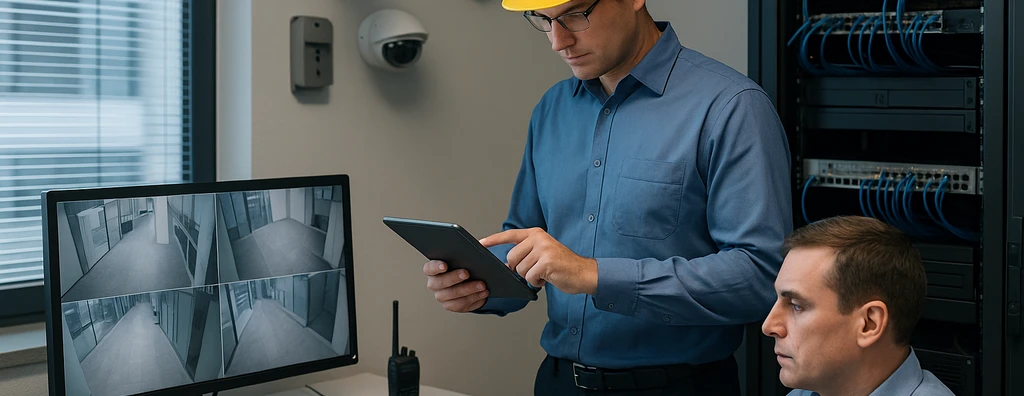
Learn the engineering criteria for integrating surveillance technology, operational processes, and trained teams in physical security projects.
Check it out!
The need for secure physical environments requires systemic approaches in which the integration of electronic surveillance systems, operational processes, and people management is imperative. Effective physical security depends on the convergence of monitoring technologies, robust data networks, response protocols, and human training. Today’s challenges involve growing data volumes, automation, cyber risks, and mandatory regulatory compliance, requiring engineering solutions that meet the criticality and operational continuity needs of facilities of all sizes.
This article explores the foundations for designing physical security projects, detailing the criteria for integrating technology, processes, and people. It covers physical and logical infrastructure requirements, platform integration, regulatory criteria, system sizing, and best practices for operation, maintenance, and team training, from device architecture to incident-response management.
Take a look!
[elementor-template id=”24446″]
Integration of Physical Security Systems: Principles and Architectures
The development of physical security projects must be based on integrated architectures capable of connecting cameras, sensors, access controllers, and analytics solutions through resilient physical and logical networks. The modern concept of physical security includes:
- Unification of video, access control, and alarm platforms in centralized management software (VMS);
- Automation of event responses, integration between physical and cyber events, and detailed records for auditing;
- Application of logical security layers, component status monitoring, and notifications in the event of failures;
- Adoption of intelligent devices and analytics systems with edge processing, dedicated servers, or cloud resources, depending on the risk profile and response requirements.
Efficient event and notification management is enabled by associating each relevant occurrence with video records, mobile-device alerts, and an intuitive interface for operators, increasing speed and accuracy in decision-making.
Operational Requirements and Technical Sizing
Correct sizing of systems for physical security requires rigor in defining operational requirements, following detection, observation, recognition, and identification (DORI) parameters. These requirements are directly linked to the monitoring objective, camera resolution, and pixel density required in the covered areas. The specification stages include:
- Define surveillance objectives: intrusion prevention, perimeter control, internal auditing, and flow monitoring;
- Determine the proper DORI criteria for each sector;
- Select cameras and sensors according to environmental characteristics such as lighting, temperature, and obstructions;
- Provide local and central processing capacity in line with video recording and analytics demands;
- Map people and asset flows, adapting the infrastructure to operational dynamics;
- Establish critical zones and the physical positioning of devices, including redundancy and overlapping coverage where needed.
Regulatory recommendations regarding image quality, interoperability, and mandatory features for safe and efficient operation must also be considered.
Network Infrastructure and Information Security for Surveillance
The robustness of a physical security project is closely tied to the data network infrastructure design and to information security. Systems must be implemented on redundant networks with:
- Logical segmentation through dedicated VLANs for video traffic, access control, and management;
- Secure physical demarcation points for switches, servers, and storage, with physical protection against unauthorized access;
- Firewalls, intrusion detection and prevention systems (IDS/IPS), packet filters, and application gateways to isolate critical zones;
- Encrypted communications and strong authentication for all connected devices;
- Active monitoring and continuous updates of firmware and software for all network equipment and cameras;
- Procedures to maintain backups and audit logs that are easy to trace.
The physical security of server rooms, racks, and access points must be reinforced with electronic access control, fire detection and suppression systems, uninterrupted power supply, and water-removal mechanisms, following best practices for critical corporate networks.
Technical Standards and Regulatory Compliance in Surveillance Projects
Compliance with national and international technical standards is mandatory for the integrity, effectiveness, and legal acceptance of physical security projects. The following stand out:
- ABNT NBR IEC 62676: establishes criteria for the performance, interoperability, and security of video surveillance systems, including specifications on recording quality, data protection, and multisystem integration;
- ABNT NBR 5410: governs low-voltage electrical installations, including power supply for security equipment and automatic protective devices;
- ABNT NBR 5419: standardizes grounding and equipotential bonding systems, which are essential for lightning protection and potential equalization;
- Specific criteria for substations and critical services, including redundancy, insulation supervision, and fire resistance;
- Inspection and maintenance periodicity according to regulatory requirements, covering the integrity of connections, conductors, and cable shielding.
These standards aim to ensure not only the security of the monitored assets, but also the protection of the information technology and power infrastructures involved in the surveillance ecosystem.
Automation, Analytics, and Operational Efficiency
The application of analytics solutions based on artificial intelligence, automatic event and perimeter detection, facial identification, license plate recognition, audio analysis, and device integrity monitoring adds significant value to a physical security project. Analytics technologies may be implemented according to the architecture:
- Edge: processors embedded in the cameras themselves, enabling local analysis and immediate response;
- Central server: consolidation of data from multiple sources, ensuring greater flexibility and scalability;
- Cloud: a solution for distributed scenarios, offering elasticity, remote backup, and the processing of large volumes.
These tools provide:
- Reduction of false alarms through logical event segmentation;
- A preventive and proactive posture toward threats and incidents;
- Automation of notifications, blocks, or releases through integration with other systems such as access control, building automation, and industrial systems;
- Optimization of human resources, focusing team efforts on critically selected cases.
Operational Process Management and Incident Response
The effectiveness of physical security is built on the integration between technological systems and the operational processes for identifying, evaluating, and responding to incidents. A technical management flow must be established, covering:
- Continuous monitoring: use of the VMS to aggregate real-time data, correlating events from video, sensors, and access control records;
- Standardized procedures: immediate-action protocols, escalation of notifications, and rapid response to security incidents;
- Alarm and event management: automatic prioritization according to occurrence type, location, and risk level;
- Recording and auditing: generation of chronological and audiovisual logs for retrospective analysis, legal use, and improvement of internal processes;
- Periodic simulations and training: testing of system functionality and training of teams in the use of technological resources and response to different scenarios.
People at the Center of the System: Training, Profile, and Integrated Communication
The technical training and behavioral profile of security operators are indispensable for effective physical security. Project engineering should consider:
- Recruitment of teams with competencies in IT, electronics, interpersonal communication, and visual-evidence interpretation;
- Intensive and continuous training on VMS use, information security protocols, and recognition of critical events;
- Development of an analytical posture, emphasizing discernment between real alarms and non-critical events;
- Instruction in the use of secure and rapid-response communication channels, ensuring traceability and information protection;
- Periodic performance assessment and adherence to operational protocols, with retraining directed to the identified gaps.
The human factor, intelligently integrated with technological systems and processes, enables effectiveness in the prevention, detection, and response cycle and contributes to maintaining operational readiness.
Electrical Infrastructure: Power Supply, Protection, and Operational Continuity
The electrical infrastructure of a physical security project must comply with the requirements of ABNT NBR 5410 and ABNT NBR 5419, considering:
- Sizing of dedicated panels and circuits for security systems in order to avoid interference and overloads;
- Use of protective devices for automatic disconnection of the power supply in the event of failures, preventing electrical hazards;
- Uninterruptible power supply (UPS) systems to guarantee operation during utility outages;
- Equipotential grounding, preferably in a mesh, reducing potential differences and protecting sensitive equipment;
- Use of safety power supplies with fire resistance and redundancy according to continuity requirements;
- Regular inspections of contacts, connections, cable shielding, and the integrity of surge protective devices (SPDs);
- Easy access for maintenance, measurements, and periodic audits while maintaining high safety standards.
Maintenance, Continuous Improvement, and Project Evolution
The sustainability and reliability of projects are ensured by an operation based on preventive, corrective, and evolutionary maintenance. The technical aspects include:
- Systematic monitoring of the status of all devices, with automatic notifications of failures and performance issues;
- Execution of visual inspections and periodic measurements to ensure the physical, electrical, and functional integrity of the entire infrastructure;
- Application of regular updates to software systems and device firmware;
- Continuous training of technical and operational teams so they stay current with technological and process changes;
- Analysis of indicators and analytical reports aimed at improving performance and updating internal procedures.
Maintenance engineering should also take into account the evolution of the technological asset base and emerging cybersecurity requirements when updating solutions and processes.
Conclusion
A physical security project requires a multidisciplinary approach, integrating systems engineering, network architecture, electrical infrastructure, and people management. Technical alignment with standards, careful device sizing, and full integration with organizational processes are decisive for the effectiveness and continuity of the systems. Investments in technology and automation must be accompanied by team reskilling, process updates, and improvements in IT and power infrastructure.
It is essential to establish proactive maintenance and monitoring flows, as well as agile auditing and response processes, aimed at the full protection of people, assets, and sensitive data. The engineering outlook for physical security projects points to intensified integration between intelligent devices, automated processes, and well-trained people, maintaining high levels of efficiency, resilience, and adherence to current regulations.
Final Considerations
This article highlights the importance of balancing advanced technology, well-defined processes, and qualified people for the success of physical security in critical and dynamic environments. Thank you for reading, and we invite you to follow A3A Engenharia de Sistemas on social media for more information, trends, and updates about the sector.