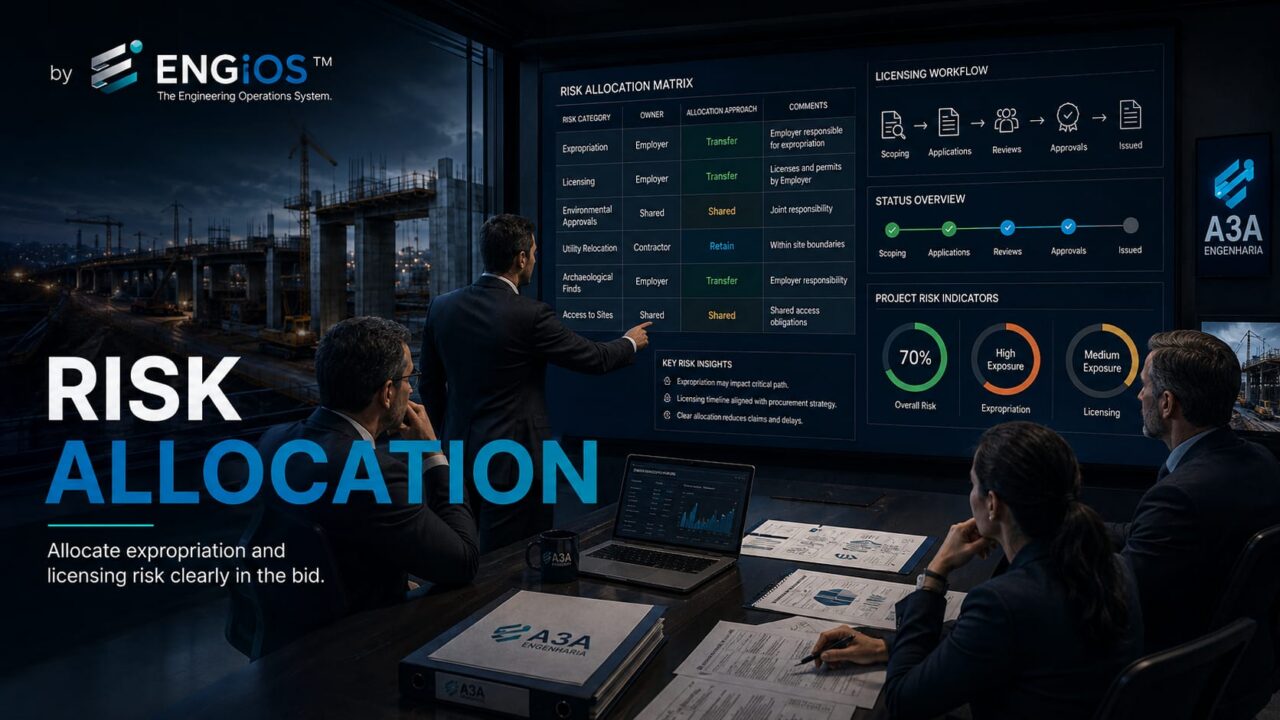
How to address expropriation and environmental licensing in public works: Law 14.133, Law 15.190/2025, risk matrix, schedule, licensing conditions, and tender documents.
Check it out!
Expropriation and environmental licensing are two constraints that can most seriously compromise schedule, cost, and continuity of a public works project when they are treated as matters separate from the design. Allocating risk in the tender documents means identifying in advance which areas, licenses, authorizations, and conditions are required; defining who performs each action; establishing release milestones and evidence; estimating impacts; and contractually distributing the consequences of delays or changes without transferring to the contractor risks controlled by the Administration — or assuming risks that depend on the contractor’s execution.
Law 14.133/2021 expressly addresses these matters. Under integrated and semi-integrated contracting, art. 46, §4, requires the tender documents and contract, where applicable, to provide for expropriation measures, the party responsible for each phase, payment of compensation, estimated values, and objective risk allocation, including cost differences and delays in making the property available. Art. 115, §4, establishes that when environmental licensing is the Administration’s responsibility, the prior opinion or preliminary license, when applicable, must be obtained before publication of the tender.
In addition, Law 15.190/2025 — the General Environmental Licensing Law, in force in 2026 — established general rules for licensing before Sisnama entities, defined licensing modalities, and reinforced the need to coordinate the environmental process with the planning, implementation, and operation stages of the project. For public-works managers, this increases the importance of integrating engineering, contractual planning, and licensing from the preparatory phase.
The problem is not merely “taking too long to obtain a license” or “failing to complete expropriation.” The structural problem is launching procurement without knowing which work fronts will be released, which conditions alter the design and construction method, which areas have regular title, which costs are foreseeable, and which party has governance over each risk. When these answers appear only after signature, the project begins by managing impediments that should have been addressed before price and schedule were established.
Why Expropriation and Licensing Must Enter the Design Before the Tender
When land, title, interferences, licenses, and conditions are still dispersed among different teams, procurement tends to price uncertainty. Technical Due Diligence consolidates these constraints before they become execution blockers.
Technical Due Diligence to map constraints before the tender
A public works project is executed in real territory. The design may be technically correct on paper and still be unbuildable in the field if the land is unavailable or the solution is incompatible with environmental conditions.
For highways, transmission lines, networks, stations, dams, sanitation systems, and urban infrastructure, land availability can define the construction sequence. For buildings, access, easements, external utilities, and interventions may depend on third parties. In licensing, mitigation measures, compensatory measures, seasonal restrictions, vegetation clearing, waste control, monitoring, water-use permits, or related authorizations may alter schedule and cost.
Therefore, the preparatory phase should produce a territorial and environmental matrix for the project. It does not replace the legal expropriation process or the licensing authority’s decision. Its function is to give engineering and procurement an objective view of constraints.
Technical Due Diligence is appropriate when the Administration needs to consolidate land status, documents, interfaces, technical constraints, and risks before defining the procurement strategy.
What Law 14.133 Requires for Expropriation under Integrated and Semi-Integrated Contracting
Art. 46, §4, establishes particularly clear rules for these regimes. When expropriation is required, the tender documents and contract must provide for the necessary measures and, among other points:
- the party responsible for each phase of the expropriation procedure;
- responsibility for payment of compensation;
- estimated compensation amounts and related costs;
- objective allocation of risk for differences between actual cost and estimate;
- allocation of risks for damages and losses resulting from delays in making property available;
- provisions relating to provisional possession and property registration.
The practical consequence is that a generic clause such as “the contractor shall arrange the necessary expropriations” may be insufficient. The Administration needs to understand the process, legal competencies, and limits before transferring activities or consequences.
The Risk Allocation Matrix for Engineering Contracts should reflect this reality through specific events rather than simply listing “expropriation” as a single risk.
Expropriation Is Not a Binary Event
In project management, the situation is often simplified to “area released” or “area not released.” The actual process can have several states.
| Status | Meaning for the works | Planning decision |
| public ownership confirmed | area available, subject to other constraints | release according to requirements |
| administrative negotiation under way | access remains uncertain | do not treat the work front as released |
| declaration of public utility issued | process has advanced, but possession may not be available | treat as an open constraint |
| possession obtained | legal access may be available | verify physical and environmental conditions |
| occupancy/improvements pending | formal possession does not eliminate interferences | plan vacation and relocations |
| material litigation | schedule and cost may be uncertain | provide contingency and evaluate alternatives |
| easement required | partial use requires the proper legal instrument | address the corridor and specific restrictions |
This breakdown improves schedule quality. A work front should be considered available only when all conditions required for execution have been met.
Engineering Surveys, Topography, and Land Records Are Procurement Inputs
Expropriation depends on correctly identifying what will be affected. Inaccurate geometry, a changed alignment, outdated records, or unmapped interferences can expand affected areas and costs after the tender.
The Engineering Existing-Conditions Survey should be coordinated with topography, designs, and land records. In linear infrastructure projects, small geometric changes can affect a large number of properties.
Engineering needs to distinguish:
- area directly occupied by the works;
- right-of-way;
- permanent easements;
- temporary construction-site and access areas;
- areas for auxiliary devices and structures;
- interferences from existing utilities;
- compensation areas or environmental conditions, when applicable.
Without this basis, the expropriation budget is merely a generic allowance.
How to Turn Expropriation into a Contractual Risk Matrix
The matrix should break events down by cause and control.
| Event | Party with greater control | Possible treatment |
| delay in an administrative act within public-sector authority | Administration | prior milestone, Administration obligation, time extension according to contract |
| record error supplied by the Administration | Administration/designer according to arrangement | defined correction and effects |
| change in solution proposed by the contractor that expands the affected area | contractor under applicable regimes | contractor risk when resulting from its own choice |
| compensation above the estimate | depends on regime and clause | band, sharing, or objective allocation |
| subsequent irregular occupation | assess control and foreseeability | specific response plan |
| contractor delay in documents under its responsibility | contractor | defined deadline and consequence |
The rule is not “all land risk remains with the Administration.” The principle is to allocate each event to the party with the greatest ability to manage, prevent, or price it, while respecting legal competencies and the contracting regime.
Environmental Licensing: the Legal Framework Changed and the Tender Must Reflect the Current Regime
Law 15.190/2025 established general environmental licensing rules and is in force in 2026. It defines licensing as an administrative process before the competent Sisnama authority and provides for types such as Preliminary License (LP), Installation License (LI), Operating License (LO), Single Environmental License, License by Adherence and Commitment, Corrective Operating License, and Special Environmental License.
Classification depends on project type, location, scale, pollution potential, and the jurisdiction of the licensing authority. Therefore, a public-works tender should not simply copy the LP-LI-LO sequence without verifying which procedure applies to the specific project.
The General Law also requires coordination between licensing and the planning, implementation, and operation stages. For engineering, this means that the environmental schedule and project schedule must be integrated.
Art. 115, §4, of Law 14.133 Is a Gate in the Preparatory Phase
When licensing is the Administration’s responsibility, Law 14.133 requires the prior opinion or preliminary license, when applicable, before publication of the tender.
This requirement prevents the agency from tendering a project whose environmental feasibility has not yet been demonstrated at the required level. It does not mean that every installation and operating license must necessarily be issued before the tender; the sequence depends on legislation, the applicable procedure, and the allocation of responsibilities.
The governance point is different: do not launch procurement while a critical environmental dependency remains unknown.
A Preliminary License Is Not Merely a Document to Attach to the File
The environmental license or opinion may contain conditions capable of changing the design, construction method, and schedule. The engineering team should convert conditions into executable requirements.
A conditions matrix may contain:
- identification of the condition;
- phase in which it must be fulfilled;
- affected discipline;
- evidence document;
- responsible party;
- deadline;
- dependencies;
- estimated cost;
- impact if not fulfilled.
If a condition requires a drainage solution, monitoring, authorized vegetation clearing, wildlife crossing, noise control, or waste management, that requirement must reach the design and cost estimate.
The Installation License and Detailed Engineering Design Need to Be Aligned
Law 15.190 establishes that, for the LI, a PBA may be required together with engineering-design elements and a report demonstrating compliance with conditions, depending on the applicable classification. This reinforces the interdependence between design development and licensing.
A recurring problem occurs when Detailed Engineering Design advances without incorporating the conditions or when the environmental process relies on a solution that engineering has already changed. The divergence can generate redesign, delay, or the need for amendment.
The solution is configuration governance: changes in alignment, capacity, location, or process should also be assessed for their impact on licensing.
How to Allocate Environmental Licensing Risk in the Tender
The clause needs to break activities and consequences down explicitly.
When the Administration Obtains the Main Licenses
This may be appropriate when the project and its location are defined by the public authority and environmental feasibility must exist before competition. In this case, the tender documents should provide the market with existing licenses, studies, conditions, and future responsibilities.
When the Contractor Performs Subsequent Actions
Under some contracting regimes, the contractor may prepare studies, file documents, fulfill conditions, or obtain authorizations linked to its execution, within the applicable competencies and rules.
The contract should state which documents are provided by the Administration, which activities belong to the contractor, and which decisions remain with the licensing authority.
When Design Changes Affect Licensing
If the change results from the contractor’s choice, related effects may be allocated to it where legally permissible and technically controllable. If it results from an Administration directive or a supervening condition not allocated to the contractor, treatment should follow the risk matrix and contractual regime.
The Risk of a Sovereign Decision by the Environmental Authority Should Not Be Transferred to the Contractor
The contractor may be responsible for producing quality studies, meeting deadlines, responding to information requests, and fulfilling conditions. It does not control the decision of an independent public authority.
Therefore, the tender documents should distinguish:
- risk of contractor performance in producing documents and meeting requirements;
- risk of administrative review time;
- risk of changes in requirements;
- risk of design changes proposed by the contractor;
- risk of preexisting environmental conditions not disclosed;
- risk of failure to comply with conditions during construction.
This breakdown improves pricing and reduces disputes.
Expropriation and Licensing Must Appear in the Schedule as Real Predecessors
Schedules often record these matters on a parallel line without linking them to work fronts. Planning should connect each release to specific activities.
A work front enters the execution path only when both relevant tracks have been released.
How to Address Delays in Land Availability and Licensing During Execution
Art. 137 of Law 14.133 recognizes situations related to delay or impossibility of environmental licensing and delay in releasing areas. Art. 124 also addresses economic-financial rebalancing in specific situations, subject to the risk matrix.
The first response should not be to immediately debate “who pays.” The inspection team needs to record the facts:
- which work front was prevented;
- since when;
- what the planned predecessor was;
- which alternative activities existed;
- which resources were affected;
- which communications occurred;
- which party was responsible for the event;
- which mitigation measures were adopted.
Without this evidence, any later analysis of schedule, cost, or responsibility is weakened.
Delay Analysis and Time Impact Analysis can be used when it is necessary to evaluate the effect of an impediment on the critical path.
The Tender Must Provide Enough Information for the Market to Price the Risk
Conditions, areas, and responsibilities need to appear in the Terms of Reference as executable requirements, with milestones, documents, and criteria. Technical review identifies gaps before the market formulates prices based on different assumptions.
Technical Review of Terms of Reference for works and services
Undocumented risk tends to become a price contingency or a later claim. The tender package should make available, as applicable:
- land plans and records;
- status of each area;
- acts and documents already issued;
- compensation estimates;
- environmental licenses and studies;
- conditions;
- related permits and authorizations;
- planned release schedule;
- responsibilities by phase;
- risk matrix;
- rules for design changes;
- information on interferences and occupations.
The Technical Review of the Terms of Reference is a useful step for verifying whether these conditions have been converted into clear obligations before publication.
How to Review the Tender from the Perspective of Future Work Stoppages
Before publication, the Administration can perform a “constructability + contractability” review: ask whether the scope can actually be executed under the conditions being offered.
Some critical questions:
- will all areas needed for the first execution cycle be available?
- is there a release map by work front?
- has the license required for the tender already been obtained when applicable?
- are environmental conditions reflected in the design and budget?
- does the contractor know exactly which environmental actions it will assume?
- is there a realistic schedule for Administration actions?
- does the risk matrix address delays and cost differences?
- do design changes have rules for environmental repercussions?
- are there construction alternatives if a work front is delayed?
- does the schedule consider land and environmental predecessors?
The Technical Review of Tender Documents and Attachments allows this due diligence to be performed before gaps become requests for clarification, challenges, or contract amendments.
Integrated Contracting Does Not Eliminate the Administration’s Duty of Maturity
Integrated contracting transfers greater design responsibility to the contractor, but it does not automatically convert every territorial and environmental risk into private risk.
The Administration still needs to define the need, parameters, boundary conditions, and legal obligations. Art. 46, §4, exists precisely because expropriation needs to be organized and objectively allocated.
If the preliminary design uses an area that the agency does not know whether it can make available, the contractor cannot transform that uncertainty into engineering through a simple contractual clause.
The Role of Owner’s Engineering at the Interface Between Land, Licensing, and Construction
In projects with land, environmental, legal, and design interfaces, Owner’s Engineering organizes the owner’s technical view and connects constraints to decisions, schedule, risk matrix, and procurement.
In complex projects, expropriation and licensing involve legal, environmental, engineering, cost, planning, and procurement functions. Lack of coordination among these areas creates inconsistent decisions.
Owner’s Engineering can structure the owner’s integrated view by:
- consolidating constraints and assumptions;
- coordinating designers and specialists;
- monitoring the interface matrix;
- verifying incorporation of environmental conditions;
- monitoring release gates;
- supporting review of the Terms of Reference, tender documents, and risk matrix;
- tracking impacts during execution;
- producing evidence to support Administration decisions.
The consultancy does not replace legal counsel, the environmental agency, the expropriating authority, or the public official. It organizes the technical basis so these actors can decide using consistent information.
For Stalled Public Works, Both Tracks Need to Be Audited Again
A stalled project may have expired licenses, outstanding conditions, areas that are still unavailable, or design changes that altered environmental impacts. Resumption should not assume that the conditions of the original contract remain valid.
The protocol for resuming stalled public works should include land and environmental due diligence.
It is necessary to verify:
- validity of licenses and authorizations;
- transition to the current legal regime when applicable;
- compliance with environmental conditions;
- areas effectively available;
- supervening litigation and occupations;
- design changes;
- need for new studies;
- cost of updates and mitigation.
Retendering the remaining works without updating this information means transferring the same blockers from the previous contract to the new one.
What to Procure When the Agency Does Not Yet Control These Risks
The need may vary according to the project phase.
Technical and Documentary Due Diligence
Appropriate when the agency needs to understand the status of areas, documents, constraints, conditions, risks, and gaps before deciding on the procurement strategy.
Existing-Conditions Survey and Design Support
Appropriate when geometry, interferences, and existing conditions need to be confirmed to define the area actually required.
Review of the Terms of Reference and Tender Documents
Appropriate for translating land and environmental obligations into responsibilities, deliverables, milestones, criteria, and the risk matrix.
Owner’s Engineering
Appropriate for continuous coordination among disciplines and stakeholders during design, procurement, and implementation.
Technical Support for Construction Inspection
During construction, it helps record impediments, assess impacts, monitor conditions, and support contractual decisions without replacing the inspector’s statutory responsibilities.
A Technical Checklist Before Publishing the Tender
The project should reach publication with documented answers:
- implementation area defined and compatible with the design;
- land records updated to the required level;
- legal status of the areas known;
- expropriation or easement strategy defined;
- estimated costs and budget source assessed;
- release schedule by work front;
- responsibility for each stage identified;
- environmental classification confirmed;
- prior opinion/preliminary license obtained when required and under the Administration’s responsibility;
- environmental conditions converted into design and execution requirements;
- studies and licenses made available to bidders;
- contractor obligations clearly specified;
- risk matrix consistent with control and management capability;
- rules for design changes and environmental repercussions;
- plan for critical interferences and constraints;
- monitoring governance defined.
If several of these answers are still unknown, the problem is probably not the final wording of the tender documents. The project still requires technical maturation.
Final Considerations
Expropriation and licensing are not “external matters” to procurement engineering. They define where the works can occur, under which conditions, when each work front can begin, and which requirements need to be incorporated into the design.
Law 14.133 introduced explicit requirements for allocating expropriation risks under integrated and semi-integrated contracting and for obtaining a prior opinion or environmental license when licensing is the Administration’s responsibility. Law 15.190/2025, in force in 2026, reinforced the integration of licensing with planning, implementation, and operation.
The best time to address these risks is before competition. When records, areas, licenses, conditions, responsibilities, and the schedule are known, the market prices an executable scope. When they remain open, the contract starts with uncertainties that can turn into stoppages, amendments, economic-financial rebalancing, disputes, and delays in delivering the public benefit.
Engineering consulting operates precisely at this interface: transforming territorial and environmental constraints into requirements, milestones, evidence, and responsibilities that can be managed throughout the project life cycle.
Before publishing the tender, an independent review can verify consistency among the design, available areas, licenses, environmental conditions, schedule, budget, and risk matrix — exactly where many stoppage triggers arise.
Technical Review of Tender Documents and Attachments for Engineering Procurement
Technical references
[1] BRAZIL. Law No. 14.133, April 1, 2021. Public Procurement and Administrative Contracts Law. Available at: https://www.planalto.gov.br/ccivil_03/_ato2019-2022/2021/lei/l14133.htm.
[2] BRAZIL. Law No. 15.190, August 8, 2025. General Environmental Licensing Law. Available at: https://www.planalto.gov.br/ccivil_03/_ato2023-2026/2025/lei/l15190.htm.
[3] BRAZIL. Decree-Law No. 3.365, June 21, 1941. Provides for expropriations for public utility. Available at: https://www.planalto.gov.br/ccivil_03/decreto-lei/del3365.htm.
[4] BRAZIL. Complementary Law No. 140, December 8, 2011. Environmental administrative competencies. Available at: https://www.planalto.gov.br/ccivil_03/leis/lcp/lcp140.htm.
[5] FEDERAL COURT OF ACCOUNTS. Procurement and Contracts: TCU guidance and case law. Available at: https://licitacoesecontratos.tcu.gov.br/.
Frequently asked questions
Allocation should be objective and consider legal competence and management capability. Under integrated and semi-integrated contracting, Law 14.133 requires the tender documents and contract to define responsible parties, compensation, estimates, and allocation of expropriation-related risks.
It depends on the project and on responsibility for licensing. When licensing is the Administration’s responsibility, art. 115, §4, of Law 14.133 requires a prior opinion or preliminary license, when applicable, before publication of the tender.
Yes. During 2026, the General Environmental Licensing Law is in force and establishes general rules, licensing modalities, and transition rules for ongoing proceedings.
Not necessarily in that sequence for every project. Law 15.190 provides for different modalities, and classification depends on project type, location, scale, pollution potential, and the jurisdiction of the licensing authority.
The contract may assign activities and obligations to the contractor according to the contracting regime and legislation, but it should distinguish what depends on contractor performance from what depends on the licensing authority’s decision. Public competencies are not transferred by a simple contractual clause.
By mapping areas and status before the tender, defining a release schedule by work front, estimating costs, assigning responsible parties, and linking execution to areas that are effectively available.
When they generate design, execution, monitoring, mitigation, or documentation obligations, their costs and impacts need to be considered in the scope, budget, and schedule.
Technical Due Diligence, existing-conditions surveys, design review, review of the Terms of Reference and tender documents, risk matrix development, Owner’s Engineering, and technical support for construction inspection, according to the project phase.
Complementary technical materials
Related solutions
- Contract, Scope, and Deliverables Management
- Project, Program, and Portfolio Governance
- Process, Workflow, and Technical Approval Management
- Requirements, Evidence, and Acceptance Criteria Management
Related services
- Engineering Technical Due Diligence
- Engineering Existing-Conditions Survey
- Technical Review of Terms of Reference
- Technical Review of Tender Documents and Attachments
- Owner’s Engineering
- Technical Support for Construction and Contract Inspection
Core content on the topic
- Risk Allocation Matrix for Engineering Contracts
- Integrated and Semi-Integrated Contracting in Engineering
- How to Resume Stalled Public Works
- Remaining Works after Contract Termination