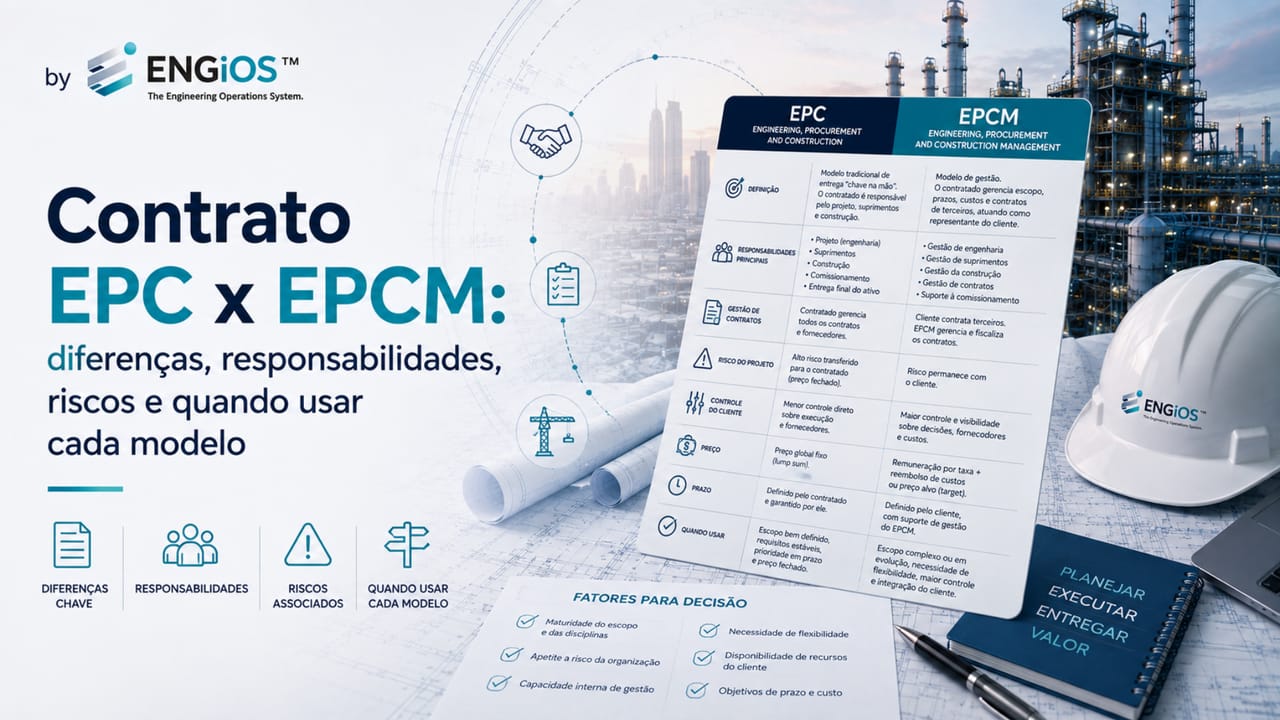
Understand the differences between EPC and EPCM contracts, how responsibilities, costs, schedules, and risks are allocated, and which criteria to use when selecting a delivery model.
Check it out!
EPC and EPCM are delivery models that allocate contracts, responsibilities, risks, and decision-making authority in different ways. In EPC — Engineering, Procurement and Construction — the owner engages a main contractor to integrate engineering, procurement, and construction and to be accountable for the contracted package under defined requirements, boundaries, and contractual conditions. In EPCM — Engineering, Procurement and Construction Management — the engineering organization develops or coordinates engineering, supports Procurement, and manages construction, while supplier and construction contracts normally remain directly with the owner.
The central difference is not simply that “EPC includes construction while EPCM only manages it.” An EPC contractor may subcontract virtually all field execution and still remain accountable for the integrated outcome. An EPCM organization may work intensively on site and coordinate dozens of contractors without assuming the performance obligations of each supplier toward the owner. The decisive question is who holds the contracts, who bears the risks, and who is accountable for final integration.
Neither model is universally superior. EPC tends to favor concentrated accountability and greater predictability when requirements are mature and performance can be specified. EPCM tends to favor flexibility, cost transparency, and direct owner control over suppliers, but it requires significantly stronger governance capacity. The selection should consider maturity, interfaces, market conditions, schedule, financing, risk appetite, and the owner’s internal organization.
EPC vs. EPCM in a direct comparison
The comparison must begin with contractual architecture. Under EPC, a main contract concentrates the EPC contractor’s internal delivery chain. Under EPCM, the owner engages the management organization and retains separate contracts with suppliers and construction contractors.
The article on EPC in Engineering examines the first model in greater depth. The EPCM service represents the second approach: integrated engineering and management on behalf of the owner, without automatically making the EPCM organization liable for every execution contract.
| Criterion | EPC | EPCM |
| Main relationship | Owner contracts the EPC contractor | Owner contracts EPCM plus multiple suppliers/contractors |
| Engineering | EPC contractor responsibility within scope | Performed/coordinated by EPCM |
| Procurement | EPC contractor purchases and manages its supply chain | EPCM structures and supports procurement; owner normally contracts |
| Construction | Integrated responsibility of EPC contractor | Contractors hired by owner and coordinated by EPCM |
| Internal interfaces | More concentrated within EPC contractor | Managed by EPCM, with risks remaining more distributed |
| Package costs | Embedded in EPC contract | Owner has direct visibility of individual contracts |
| Changes | Can have major impact after scope is fixed | Greater flexibility to adjust packages |
| Owner capability required | Strong definition and oversight, fewer direct contracts | Intensive governance and decision-making |
| Accountability for outcome | More concentrated | Distributed among owner, EPCM, and contractors |
The table represents common configurations, not absolute rules. Contracts may adopt hybrid structures, different pricing models, and specific allocations of responsibility.
How the EPC contractual structure works
Under EPC, the owner has one principal counterparty for the package. The EPC contractor engages designers, manufacturers, suppliers, and construction contractors and is accountable to the owner for the interfaces and obligations it has assumed.
This concentration does not eliminate owner responsibility. Requirements, owner-furnished information, external interfaces, access areas, approvals, and strategic decisions may remain with the owner. The article on EPC Contracts in Engineering shows how scope, battery limits, risks, and acceptance must be structured.
The contractual advantage is that many disputes among the owner’s separate contracts are moved inside the EPC contractor’s delivery chain. If equipment fails to integrate with engineering developed by the same EPC contractor, resolution will normally remain within that contractor’s chain. This does not eliminate disputes, but it creates a more concentrated accountability boundary.
Can the EPC contractor subcontract the entire construction scope?
Yes, if the contract allows it. EPC responsibility does not depend on employing its own labor for every activity. It depends on assuming the obligations toward the owner and managing the subcontracted delivery chain.
The owner may establish requirements for critical subcontractors, vendor lists, or approval rights. The key is to avoid intervening so extensively that the EPC contractor loses the ability to manage risks it is still contractually required to bear.
How the EPCM contractual structure works
Under EPCM, the management organization acts as a technical and management extension of the owner. It may develop engineering, prepare work packages, support tendering, perform technical bid evaluations (TBE), recommend awards, monitor fabrication, control schedule and cost, and manage construction.
Supply and execution contracts, however, normally belong directly to the owner. A delay caused by a construction contractor may therefore be technically managed by EPCM, while the contractual consequences are administered between the owner and that contractor.
This creates transparency and control. The owner has direct visibility of prices, suppliers, conditions, and changes for each package. In return, the owner must have an organization capable of approving procurements, paying suppliers, administering claims, and making timely decisions.
EPCM should not automatically be treated as if it were an EPC contractor for failures by companies it did not contract in its own name. Its responsibility should be tied to the quality of its professional services, management, coordination, and the obligations expressly defined in its contract.
Under EPCM, the owner retains supply and construction contracts and uses an engineering and management organization to coordinate them. This model increases transparency and flexibility, but requires governance capable of managing multiple packages, interfaces, decisions, and risks directly on the owner’s behalf.
Engineering: where responsibility is concentrated
Under EPC, detailed development of the solution is normally the contractor’s responsibility, subject to owner requirements and reference engineering. The owner must define the required outcome without unintentionally taking over the role of designer for the EPC contractor.
Under EPCM, engineering may be performed directly by the management organization, by specialist designers, or by package suppliers. EPCM coordinates documents and interfaces within its scope, while the owner maintains greater visibility of design decisions.
Requirements Management in Engineering is important in both models. The difference is who controls its evolution. In EPC, the EPC contractor uses the requirements to develop its solution; in EPCM, the owner participates more directly in package definition and engineering decisions.
FEED and reference engineering
FEED in Engineering can support both models. For EPC, it reduces ambiguity before responsibility is transferred. For EPCM, it establishes a baseline for progressive development and package contracting.
The greater the need for committed price and schedule under EPC, the greater the value of mature definition. EPCM can accommodate more evolution during implementation, but that flexibility leaves the owner more exposed to changes in contracts and quantities.
Procurement: who contracts suppliers
Procurement is one of the most tangible differences between EPC and EPCM.
Under EPC, the main contractor normally purchases equipment and materials, manages suppliers, follows up fabrication, coordinates inspections, and assumes supply-chain risks as defined by the contract. The owner may establish technical requirements and inspection rights but does not directly negotiate every purchase order.
Under EPCM, the management organization prepares requisitions, qualifies vendors, conducts or supports competitive procurement, and recommends awards. The final contract is normally executed by the owner. Technical Procurement provides the capability to structure requirements and technically level bids on the owner’s behalf.
Cost transparency
EPCM tends to provide greater transparency because the owner sees package prices directly. Under EPC, the integrator’s price includes purchases, administration, contingencies, and margin, and the degree of cost breakdown depends on the commercial model.
Transparency, however, does not necessarily mean lower cost. The EPCM owner remains exposed to actual variations in each direct contract, whereas an EPC contractor may absorb part of those variations within a lump-sum arrangement. The economic comparison must consider risk, not only apparent markup.
Construction: execution versus management
Under EPC, construction is part of the integrated obligation. The EPC contractor may self-perform or subcontract, but remains responsible for coordinating its work fronts and interfaces.
Under EPCM, the owner engages constructors and installers directly. EPCM performs Construction Management: planning, work-front coordination, supervision, interface management, safety within the agreed scope, quality, measurement, and reporting. Each contractor remains accountable for its own contract.
The difference becomes clear when an interference arises. Under EPC, resolution between two subcontractors normally remains inside the principal contractor’s chain. Under EPCM, the management organization coordinates the technical solution, but the commercial impact may affect two separate owner contracts.
Interfaces: integration by responsibility or by management
EPC integrates interfaces through concentrated contractual responsibility. EPCM integrates them through management processes.
Interface Management in Engineering Projects is important in both models, but its function differs. Under EPC, it helps the owner verify internal and external package boundaries. Under EPCM, it becomes a central mechanism for coordinating independent companies.
In multi-package projects, interface management must control data, documents, dates, and physical conditions across contracts. A failure in one package may block several others even when no single contractor is contractually responsible for overall integration.
How risks are allocated
The statement “EPC transfers risk and EPCM retains risk” is an oversimplification. Both models allocate risks; the difference is the degree of concentration.
Under EPC, risks related to detailed engineering, Procurement, subcontractors, productivity, and internal integration may be assumed by the EPC contractor. The owner retains risks allocated to it, such as changes, owner-furnished data, external interfaces, and other defined events.
Under EPCM, many supplier and construction risks remain directly with the owner because the owner is the contracting party. EPCM mitigates those risks through engineering, selection, management, and controls, but does not economically absorb them unless a specific obligation says otherwise.
Engineering Contracting Strategy should allocate each risk to the party best able to control or price it.
Risk transfer has a cost
An EPC contractor receiving risk must price it. The greater the uncertainty, the greater the contingency or the number of exclusions. The owner should ask whether it is paying a reasonable amount to transfer a risk the contractor can actually manage.
Under EPCM, the owner avoids part of the aggregated contingency but carries the actual volatility of the direct contracts. Potential savings must therefore be compared with exposure and internal management capability.
The choice between EPC and EPCM fundamentally changes who bears engineering, procurement, construction, and interface risks. Before comparing prices, the owner needs to understand which events are effectively transferred, which remain under its responsibility, and how much each risk transfer costs.
Explore the risk and responsibility structure of EPC contracts
Price and predictability
EPC is frequently associated with lump-sum pricing, although other commercial regimes are possible. EPCM normally compensates the management organization through fees, hours, team-based rates, or hybrid structures, while supply and construction contracts are paid separately by the owner.
EPC predictability depends on maturity. A lump-sum price with an immature scope may generate large contingencies or claims. EPCM provides continuous visibility of commitments, but final cost evolves as packages are contracted and quantities are consolidated.
| Aspect | EPC | EPCM |
| Initial price | May concentrate a large share of CAPEX | EPCM fee plus estimated package costs |
| Contingency | Partly embedded in EPC contractor price | Owner manages program contingency |
| Supplier visibility | Depends on contract | Normally high |
| Exposure to variations | Lower for transferred risks | Higher for direct contracts |
| Owner changes | May be expensive | Adjusted directly in affected packages |
Schedule and phase overlap
EPC can integrate engineering, procurement, and construction into a single schedule under the contractor’s responsibility. This facilitates internal optimization, but committed price and schedule make owner changes more sensitive.
EPCM facilitates progressive overlap. Long-lead packages may be procured before engineering is fully complete, while early construction can advance as other packages continue to be defined. This flexibility requires strong configuration control to avoid building on assumptions that are still changing.
Project Controls is central to both models. Under EPC, it verifies the contractor’s integrated schedule; under EPCM, it consolidates multiple supplier schedules into one project-wide view.
Changes and flexibility
EPC tends to be less flexible after the commercial baseline is frozen. If the owner changes a requirement, equipment item, or interface, the EPC contractor may evaluate the impact through a Change Order.
Under EPCM, changes can often be incorporated while packages are still being developed. This allows adaptation, but the effects propagate directly through contracts, quantities, and sequences.
Flexibility does not eliminate the cost of change. It changes where and how that impact appears. Change and Claims Management helps record the event, causation, and consequences.
Claims and disputes
EPC concentrates the principal claims relationship between owner and EPC contractor. Supplier subclaims remain within the contractor’s chain unless specific mechanisms provide otherwise.
EPCM may create multiple claim relationships because each constructor and supplier has a direct contract. The management organization must preserve records, schedule logic, and interface evidence so the owner can identify cause and responsibility.
This makes document control and Project Controls particularly important under EPCM. When a delay in one package affects another, the owner must be able to demonstrate the chain of causation across contracts.
What organization the owner must maintain
EPC reduces the number of direct contracts but does not permit a passive owner. The owner still needs to define requirements, manage external interfaces, review critical points, monitor risks, and formally accept the result.
EPCM requires an even stronger owner organization. The owner is party to multiple contracts and must decide on tenders, changes, payments, claims, and priorities. EPCM prepares analyses and recommendations, but certain decisions remain with the owner.
Lack of decision-making capacity is one of the greatest EPCM risks. A management organization may identify the correct solution and still be unable to advance if authority levels, budgets, or owner approvals are slow.
Governance and technical independence
Owner’s Engineering is more typical when the owner uses EPC and needs independent review. Under EPCM, some of those functions may be performed by the EPCM organization itself, although the owner may still want independent assurance on critical projects.
Project Assurance, audits, or independent review can verify whether project governance remains aligned with objectives, requirements, and risks without replacing the execution line.
The article on Project Assurance examines this governance layer in greater depth.
Quality and oversight
Under EPC, the EPC contractor implements its QA/QC system and the owner verifies compliance as provided by the contract. Inspections, FATs, audits, and hold points may be performed directly by the owner or through Owner’s Engineering.
Under EPCM, the management organization may coordinate the project quality system and supervise multiple contractors. Quality Management in Engineering Projects helps organize requirements, controls, and acceptance across a multi-package environment.
In both cases, quality must generate evidence throughout execution. A final inspection cannot adequately recover hidden work or fabrication decisions that have already become irreversible.
Commissioning and acceptance
Under EPC, the main contractor normally coordinates completion, commissioning, and performance within its scope. The owner witnesses and accepts the result under defined protocols.
Under EPCM, the management organization must coordinate tests for equipment supplied by different companies and build an integrated sequence. Responsibility for correcting failures remains with the contract that generated the deviation.
The Commissioning Guide is relevant to both models because system-based organization, readiness criteria, protocols, evidence, and punch lists do not depend on the commercial structure.
Acceptance must be requirement-based. An EPC project cannot be considered complete merely because the EPC contractor declares delivery; an EPCM project cannot close each package in isolation without verifying the integrated project outcome.
Documentation and handover
Under EPC, the principal contractor must consolidate documentation from its delivery chain in accordance with contractual requirements. This can simplify the formation of data books and As-Built documentation, provided the obligation has been properly defined.
Under EPCM, documentation comes from multiple contracts and must be standardized and consolidated under owner governance. EPCM can coordinate standards, coding, revisions, and acceptance.
The Technical Handover Framework helps structure the transition from implementation to operations in both models.
When EPC tends to be more appropriate
EPC is a strong candidate when:
- requirements and performance criteria are sufficiently mature;
- the owner wants fewer direct contracts;
- capable integrators exist to assume the package;
- internal interfaces are numerous;
- contractually committed price and schedule are high priorities;
- future changes are expected to be limited;
- risks can be identified and rationally transferred;
- financing or governance favors a single point of principal responsibility.
EPC Procurement in Engineering explains how to structure requirements, RFP, TBE, and bid leveling when this strategy is selected.
When EPCM tends to be more appropriate
EPCM is a strong candidate when:
- the owner wants direct control over suppliers;
- the project will be divided into many packages;
- engineering will continue to evolve during implementation;
- long-lead items and preliminary works must be advanced early;
- cost transparency is a priority;
- changes are likely;
- there is no competitive EPC integrator for the entire scope;
- the owner has strong governance and decision-making capacity;
- interfaces with existing facilities require high flexibility.
The model still requires discipline so that “flexibility” does not become an absence of baseline. Scope, cost, schedule, and risks must remain under formal control.
Hybrid models and package-based strategies
The decision does not have to be binary. A project may use EPC for a defined technology package or plant and EPCM to coordinate other contracts. The owner may also procure critical equipment directly and transfer integration responsibility to the EPC contractor through specific interface requirements.
Hybrid models require additional attention to boundaries. Poorly structured division can create independent “mini-EPCs” with no party accountable for overall integration.
Each package should have its own strategy, but project governance must view all packages as parts of one system.
How to choose between EPC and EPCM
The decision can be supported by a criteria matrix. EPC should not be selected merely because it appears “simpler,” nor EPCM merely because it appears “cheaper.”
- Assess maturity of requirements and engineering.
- Map interfaces and risks.
- Evaluate market capability.
- Assess the owner’s internal organization.
- Compare the need for flexibility.
- Analyze cost and financing strategy.
- Verify the ability to define performance and acceptance.
- Compare schedule and Procurement scenarios.
- Evaluate the consequences of changes.
- Document the decision and residual risks.
A Decision Matrix for Engineering Projects can support multicriteria comparison when no single factor dominates.
The decision between EPC and EPCM should not be based only on contractual preference. Scope maturity, the owner’s internal capability, required flexibility, market structure, interfaces, and risks must be assessed before defining who will contract suppliers and who will assume responsibility for overall project integration.
Structure the decision and governance with Owner’s Engineering
Final considerations
EPC and EPCM are governance and responsibility-allocation strategies, not merely contracting acronyms. EPC integrates engineering, Procurement, and construction under one principal contractor and concentrates a significant share of risks and interfaces. EPCM integrates the project through management while the owner retains direct contracts and greater exposure to package-level variations.
EPC tends to work better when the required outcome can be defined and the owner values concentrated accountability. EPCM tends to work better when flexibility, transparency, and direct control are priorities and the owner has the capability to govern multiple contracts.
The decision should be made before major packages are contracted and documented based on maturity, interfaces, risks, market conditions, schedule, and organizational capability. When the strategy matches the reality of the project, either EPC or EPCM can deliver strong results; when it does not, the acronym merely changes where the problems appear.
Technical references
[1] INTERNATIONAL FEDERATION OF CONSULTING ENGINEERS — FIDIC. Conditions of Contract for EPC/Turnkey Projects — Silver Book. 2nd ed. Geneva: FIDIC, 2017. Available at: https://fidic.org/books/epcturnkey-contract-2nd-ed-2017-silver-book
[2] AUSTRALIAN CAPITAL TERRITORY TREASURY. Delivery Model Analysis — Capital Framework. Canberra: ACT Government. Available at: https://www.treasury.act.gov.au/capital-framework/prove/detailed-technical-guidance/delivery-model-analysis
[3] WORLD BANK. Procurement Framework and Standard Procurement Documents. Washington, DC: World Bank. Available at: https://www.worldbank.org/en/projects-operations/products-and-services/brief/procurement-new-framework
Frequently asked questions
Under EPC, one main contractor integrates engineering, procurement, and construction and is accountable for the contracted package. Under EPCM, the organization manages engineering, procurement, and construction, while supplier and execution contracts normally remain directly with the owner.
No. EPC incorporates integration, contingency, and transferred risks; EPCM provides greater visibility of package costs, but the owner remains exposed to actual variations. The comparison should consider expected cost and risk, not only fees or markup.
EPCM normally allows packages and decisions to be adjusted with greater flexibility during implementation. EPC is generally more sensitive to changes after price, schedule, and scope have been committed.
EPCM normally requires greater governance capacity because the owner is a direct party to multiple contracts. EPC reduces direct contracts but still requires strong definition, administration, oversight, and acceptance.
Under EPC, the principal contractor normally coordinates commissioning of the package. Under EPCM, the management organization coordinates testing across multiple contracts while each supplier remains accountable for its own obligations.
Yes. Different packages can use different strategies, provided interfaces and responsibility for overall integration are clearly defined.
Assess maturity, interfaces, risks, market capability, owner capacity, required flexibility, cost transparency, schedule, financing, and the ability to define performance and acceptance.
Additional technical materials
Related solutions
- Project, Program and Portfolio Governance
- Contract, Scope and Deliverables Management
- Requirements, Evidence and Acceptance Criteria Management
- Process, Workflow and Technical Approval Management
Related services
- EPC — Turnkey Delivery
- EPCM — Integrated Implementation Management
- Owner’s Engineering
- FEED — Front-End Engineering Design
- Technical Procurement
- Project Management and Project Controls
Key content on the topic
- EPC in Engineering: What It Is and How It Works
- EPC Project: From Engineering to Delivery
- EPC Turnkey in Engineering
- EPC Contract in Engineering
- EPC Procurement in Engineering