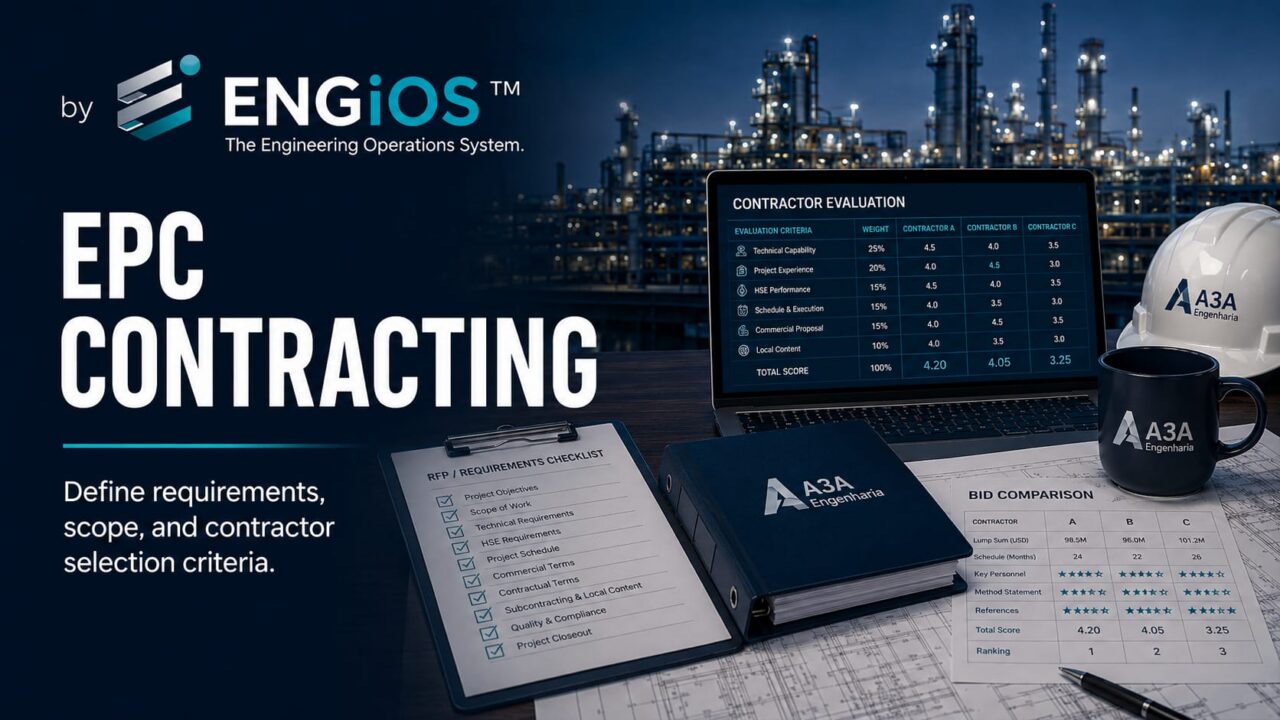
Learn how to structure EPC contracting in Engineering: requirements, reference engineering, RFP, qualification, TBE, risks, negotiation, and acceptance criteria.
Check it out!
EPC contracting in Engineering needs to transform a business need into a technical and commercial package that is clear enough for companies capable of assuming Engineering, Procurement and Construction to compete for the same object on comparable terms. The process does not begin by sending a spreadsheet to a few suppliers. It begins with the decision that EPC is actually the appropriate model, by maturing the requirements, and by defining which responsibilities, risks, interfaces, performance obligations, and evidence will be transferred to the contractor.
Contracting EPC requires balance. If the Owner defines too little, each bidder interprets the object differently and incorporates contingencies, exclusions, or qualifications; if the Owner specifies too much, it may constrain solutions, interfere with the EPC contractor’s responsibility, and reduce the benefits of integrated contracting. Reference engineering should provide sufficient basis for price, schedule, interfaces, and acceptance while preserving the technical freedom the model is intended to provide.
A robust process normally passes through readiness, requirements, reference engineering, contracting strategy, market sounding, prequalification, RFP, clarifications, TBE, commercial leveling, residual-risk analysis, negotiation, consolidation of appendices, and award. The quality of contracting is measured less by the number of documents issued than by the ability to produce technically equivalent proposals and an executable contract without significant gray areas.
First: confirm that EPC is the right model
Before preparing the RFP, the Owner needs to verify whether concentrating responsibility creates value. EPC tends to be appropriate when requirements are sufficiently stable, internal interfaces can be transferred to an integrator, the market has companies capable of assuming the package, and performance can be specified and tested.
If the project is still evolving significantly, if the Owner wants to contract many suppliers directly, or if existing conditions involve major uncertainties, EPCM, multiple packages, or an additional definition phase may be better alternatives.
The comparison EPC vs. EPCM should be reviewed before the RFP when the delivery strategy has not yet been decided. Engineering Contracting Strategy broadens the analysis to packages, risks, and contractual models.
Decision criteria
A structured decision should consider:
- requirements maturity;
- number and nature of interfaces;
- Owner’s internal capability;
- need for flexibility during implementation;
- availability of qualified EPC contractors;
- price and schedule criticality;
- site conditions and brownfield risks;
- financing and cash-flow strategy;
- need for transparency regarding supplier costs;
- ability to define testing and performance.
The choice should be documented before competition begins to avoid changing the rules after the market has already formed its pricing.
Project Readiness: is the project ready to be contracted?
Readiness verifies whether the Owner has enough information and decisions to transfer responsibility rationally. Project Readiness in Engineering assesses scope, interfaces, risks, documentation, decisions, and resources before moving forward.
For EPC contracting, relevant questions include: are requirements approved? Have site data been validated? Are external interfaces identified? Does the Owner know what it will provide? Can performance and acceptance be measured? Have the main risks been discussed? Does the market understand the type of solution?
The PDRI — Project Definition Rating Index can also support the assessment of definition maturity. The objective is not to reach perfection before contracting, but to explicitly understand what remains open and decide whether the risk of moving forward is acceptable.
Readiness is not only documentation
A project may have many documents and still be immature. If critical decisions are pending, interfaces lack owners, or assumptions contradict field surveys, the volume of files does not reduce risk.
The assessment should consider the quality, consistency, and governance of information. A smaller, consistent package may be more contract-ready than a large documentary volume with conflicting versions.
Before issuing an EPC RFP, the Owner needs to know whether the project is sufficiently defined to receive price, schedule, and risk. Readiness assesses not only available documents, but also pending decisions, interfaces, site data, assumptions, risks, and conditions that may materially alter proposals.
Assess Project Readiness before opening the procurement process
Define Owner requirements
Owner requirements are the reference for the required result. They need to state what the project must do, under which conditions, with what performance, and subject to which restrictions.
Requirements Management in Engineering makes it possible to organize functional, technical, safety, maintenance, integration, documentation, and operational requirements. Each relevant requirement should have a compatible verification method.
Specify results, not adjectives
Expressions such as “high quality,” “robust system,” or “best technology” do not support a technical competition. Requirements need to be converted into parameters, minimum architectures, behaviors, applicable standards, tolerances, and test criteria.
At the same time, specifying a single model or solution without necessity may limit competition and remove part of the EPC contractor’s autonomy that justifies the delivery model. The appropriate balance depends on the Owner’s risks and strategy.
Operation and maintenance requirements
EPC contracting should consider the period after handover. Accessibility, spare parts, documentation, licenses, training, tools, backups, maintenance strategy, and standardization may affect life-cycle cost and need to be included in the definition.
Develop compatible reference engineering
Reference engineering creates the bridge between requirements and the EPC proposal. It may include studies, design bases, surveys, design narratives, diagrams, layouts, specifications, conceptual design, Basic Design, or FEED.
FEED in Engineering is particularly useful in industrial and multidisciplinary projects because it matures design bases, alternatives, main equipment, interfaces, schedule, and estimates.
Reference engineering should clearly distinguish what is mandatory, what is reference information, and where the EPC contractor has freedom to optimize. Without this distinction, bidders may interpret a conceptual drawing as a mandatory requirement or, at the opposite extreme, disregard decisions the Owner intended to preserve.
Site data
Topography, interferences, infrastructure capacity, existing networks, access conditions, environmental characteristics, shutdown windows, and other relevant conditions should be verified to the extent required.
In brownfield projects, field due diligence is especially important. Indiscriminately transferring to the EPC contractor the risk of every unknown condition may increase proposals or generate future disputes.
Define the Scope of Work and battery limits
The Scope of Work in Engineering should describe activities and deliverables. Battery limits and the interface matrix define the boundaries.
For each interface point, the RFP should indicate who provides information, equipment, power, access, connection, testing, and acceptance. This reduces the classic “not in my scope” gap.
Inclusions, exclusions, and assumptions also need to be addressed. Contractual Scope in Engineering goes deeper into how these categories affect pricing and changes.
Completeness rule
When technically applicable, the package may establish that accessories and services normally required for the final function are part of the scope even if they are not individually listed. This rule needs to be balanced with clear boundaries so the contract does not become an indefinite obligation.
Build the responsibility matrix
The matrix organizes the Owner, EPC contractor, third parties, utilities, and nominated suppliers. It may use RACI or an equivalent model.
Beyond “who does what,” it should indicate who supplies data, who approves, who witnesses tests, and who accepts. Owner responsibilities need deadlines because a late approval or release may enter the critical path.
The matrix also helps separate approval from technical responsibility. The fact that the Owner reviews a document does not automatically mean it becomes responsible for the EPC contractor’s design.
Identify and allocate risks before the RFP
Risks should be discussed before the market prices them. The matrix may include existing conditions, external interfaces, productivity, logistics, permitting, exchange rates, regulatory changes, utilities, supplied data, and third-party events.
The principle is to allocate risk to the party with the best ability to control or mitigate the event. Arbitrary transfer increases contingency and may reduce competition.
The matrix should also indicate which risks trigger a change, extension of time, or a specific contractual mechanism. Without this bridge to the contract, risk discussion remains only managerial.
Define performance, testing, and acceptance before competition
The Owner needs to define what will be measured to accept the result. Guarantees for capacity, availability, efficiency, or other performance need a verification method.
The test plan may include FAT, SAT, functional, integrated, and performance tests. The Commissioning strategy should influence the RFP so bidders include the resources, instruments, software, consumables, and support required.
Documentation is also part of acceptance: As-Built drawings, manuals, reports, certificates, training, backups, licenses, and data books need to appear in the package.
Perform market sounding and map EPC contractors
Before the formal RFP, the Owner may assess market capability. The objective is not to negotiate the contract in advance, but to verify whether there are companies capable of assuming the package, which risks the market considers critical, and whether the proposed strategy is competitive.
Market sounding may reveal that the scope is too large for a single integrator, that certain equipment requires a specialized supplier, or that an interface should be removed from the package. This information helps adjust the strategy before the procurement process is frozen.
The process should preserve equal treatment when applicable. Relevant information obtained and incorporated into the object needs to be made available consistently to participants.
Prequalification: who can actually assume the EPC
Prequalification reduces the risk of receiving proposals from companies without adequate capability. Criteria should reflect project complexity, not only revenue or formal corporate existence.
The assessment may consider:
- experience with comparable scopes;
- multidisciplinary engineering capability;
- Procurement and supplier management;
- construction and subcontractor management;
- Project Controls;
- QA/QC;
- commissioning and integration;
- financial health;
- key personnel;
- document management systems;
- safety and quality track record;
- ability to provide bonds and insurance.
Requirements should be proportional. Excessive restrictions may reduce competition without real benefit; weak requirements may allow incapable companies to reach the proposal stage.
Structure the EPC RFP
The RFP in Engineering organizes scope, requirements, and selection criteria. In EPC, it needs to form a consistent package across technical and commercial documents.
A typical structure may include:
- instructions to bidders;
- Owner requirements;
- Scope of Work;
- reference engineering;
- battery limits and interfaces;
- responsibility matrix;
- risk matrix;
- schedule and milestones;
- Procurement requirements;
- quality and inspections;
- commissioning and performance;
- documentation and handover;
- price proposal and commercial conditions;
- draft contract;
- evaluation criteria.
The RFP should require deviations and exceptions to be presented in a structured format. Proposals that hide qualifications in commercial letters are difficult to level.
Conduct clarifications without losing version control
During competition, suppliers submit questions, clarification requests, and alternatives. Owner responses may change the interpretation of the object and need to be controlled.
A relevant clarification should be issued to all participants according to the competition rules and incorporated into the contracting baseline. When the response changes scope, schedule, or risk, it may be necessary to issue an addendum and allow proposals to be revised.
Technical meetings also need to generate records. Verbal decisions should not replace the formal package that will be incorporated into the contract.
Technical evaluation: TBE and leveling
The Technical Bid Evaluation — TBE compares proposals against requirements and records deviations. The objective is to determine whether each company is offering the same result obligation.
The analysis should consider architecture, equipment, engineering, methodology, schedule, critical suppliers, quality, commissioning, documentation, and contractual qualifications.
A technically “acceptable” proposal may still contain deviations with economic impact. Therefore, TBE should feed commercial leveling.
Do not compare price before leveling scope
If one bidder excludes integration and another includes it; if one provides for three FATs and another for none; if one includes training and another does not, the prices do not represent the same object.
Leveling may assign estimated costs to differences, require revisions, or request a Best and Final Offer after technical alignment.
Commercial comparison only becomes meaningful after technical leveling. Deviations, exclusions, alternatives, proposed suppliers, documentation, tests, and interfaces need to be normalized so that the lowest price does not simply represent a smaller scope or a risk transferred back to the Owner.
Support the competition with Technical Procurement and bid leveling
Commercial evaluation and total cost
After technical leveling, the analysis turns to price, payment terms, taxes, escalation, exchange rates, guarantees, insurance, cash flow, and exposure to changes.
The lowest nominal price does not always represent the lowest expected cost. A proposal with many qualifications may generate change orders during execution. A higher proposal that is complete and has well-defined risk may offer greater predictability.
The analysis should also consider payment terms. High advances, front-loaded milestones, or payments not linked to evidence may increase the Owner’s financial exposure.
Analyze the schedule and execution capability
The proposed schedule needs to be technically coherent. Aggressive dates have no value if they depend on engineering, vendor data, or deliveries that are incompatible with realistic lead times.
The Project Controls team can verify the critical path, interfaces, long lead items, construction logic, commissioning sequence, and resource availability.
A credible schedule should relate engineering, Procurement, fabrication, logistics, construction, completion, and testing. A lack of integration among these networks is a risk signal.
Assess the residual risks of each proposal
Even after leveling, proposals may allocate risks differently. One EPC contractor may accept a given condition while another requests an exclusion; one may assume supplier schedule risk while another makes it conditional.
The decision should record residual risks and their potential impact. A decision matrix may consider price, technical quality, schedule, risk, and execution capability using weights defined before the result whenever possible.
The Decision Matrix in Engineering Projects can support multicriteria processes when the choice is not determined by a single factor.
Negotiation: close gaps, do not reopen the entire object
Final negotiation should consolidate deviations, assumptions, guarantees, schedule, price, responsibilities, and risks. The objective is to close the gaps identified during leveling.
Any technical concession needs to be reflected in the corresponding documents. Changing only a commercial clause without updating a specification or responsibility matrix may create a contradiction.
It is also necessary to consolidate the list of documents forming the contract and their order of precedence. The final proposal, clarifications, and addenda need to be incorporated in a controlled manner.
Award and transition from contracting to execution
Award does not end Procurement work; it begins contract execution. The team that negotiated needs to transfer to the project team all assumptions, accepted deviations, risks, commitments, and clarifications.
An internal handover may include the contract, appendices, final TBE, risk matrix, schedule, interface list, pre-NTP open items, and Owner obligations.
Without this transfer, the execution team may administer the contract as if it were the original RFP package and overlook agreements reached during negotiation.
What to require from the EPC contractor immediately after contracting
The first deliverables help transform the proposal into an executable plan. Depending on the project, they may include:
- Project Execution Plan;
- detailed schedule and baseline;
- master document list;
- Procurement plan;
- vendor list;
- quality plan;
- interface matrix;
- risk plan;
- construction plan;
- commissioning plan;
- documentation and handover strategy;
- organization and responsibility matrix.
These documents need to be consistent with the contract and establish operational governance.
How the Owner should govern after award
Integrated contracting does not eliminate oversight. The Owner needs to administer its own obligations, control external interfaces, review submittals, monitor risks, verify progress, and prepare for acceptance.
Owner’s Engineering can support the process from RFP preparation through final acceptance. During execution, activities may include Design Review, Procurement, technical supervision, Project Controls, change management, commissioning, and documentation.
The EPC Contract in Engineering should be treated as the baseline: changes need to follow a formal process and maintain traceability to requirements and risks.
After award, the Owner is no longer running a competition and begins administering a result obligation. Governance needs to monitor requirements, submittals, interfaces, changes, schedule, quality, Procurement, testing, and evidence without assuming the responsibilities that belong to the EPC contractor.
How to contract for prevention rather than correction
High-quality EPC contracting invests more effort before award to reduce the cost of resolving ambiguities during execution. This does not mean eliminating changes, but reducing predictable changes caused by weak scope definition, unmapped interfaces, and late acceptance criteria.
The combination of FEED, requirements, contracting strategy, TBE, Owner’s Engineering, and commissioning creates a preventive journey. Each tool acts at a different point: definition, selection, governance, and verification.
When these mechanisms are treated as parts of a single process, the Owner stops reacting to field problems and begins controlling the project from the origin of the decisions.
EPC contracting checklist
Before award, the Owner should be able to answer objectively:
- Why was EPC selected as the delivery model?
- Which requirements are mandatory?
- Which engineering is reference information and which is prescriptive?
- Where are the battery limits?
- Who is responsible for each interface?
- Which risks were transferred and which remain with the Owner?
- How were price and schedule formed?
- Which long lead items affect the critical path?
- Which vendors are critical?
- How will quality and inspections be verified?
- Which tests demonstrate performance?
- What do mechanical completion and ready for commissioning mean?
- Which documents are conditions for handover?
- How will changes and claims be handled?
- Which warranties remain after acceptance?
- Which Owner obligations may affect the schedule?
- Have all qualifications in the final proposal been consolidated into the contract?
If several answers remain undefined, the process is not yet ready for award, even if an apparently attractive commercial proposal already exists.
Final considerations
EPC contracting is an engineering, Procurement, and governance process before it is a price negotiation. The Owner needs to transform needs into requirements, mature interfaces and risks, define performance, and build an RFP that produces comparable proposals.
Prequalification, TBE, and leveling are essential because price only has meaning when companies are offering equivalent obligations. Qualifications, exclusions, and assumptions need to be consolidated before award so the final contract represents what was actually negotiated.
After signature, governance continues. The contract becomes the baseline for engineering, Procurement, construction, changes, testing, and acceptance. When preparation has been consistent, the EPC contractor has sufficient freedom to integrate the solution and the Owner has sufficient criteria to verify the result without assuming execution.
Technical references
[1] INTERNATIONAL FEDERATION OF CONSULTING ENGINEERS — FIDIC. Conditions of Contract for EPC/Turnkey Projects — Silver Book. 2nd ed. Geneva: FIDIC, 2017. Available at: https://fidic.org/books/epcturnkey-contract-2nd-ed-2017-silver-book
[2] WORLD BANK. Procurement Framework and Standard Procurement Documents. Washington, DC: World Bank. Available at: https://www.worldbank.org/en/projects-operations/products-and-services/brief/procurement-new-framework
[3] PROJECT MANAGEMENT INSTITUTE — PMI. Standards and PMBOK Guide. Newtown Square: PMI. Available at: https://www.pmi.org/pmbok-guide-standards
Frequently asked questions
First confirm that EPC is the appropriate model; then assess readiness and define requirements, reference engineering, scope, interfaces, risks, performance, and acceptance before structuring the RFP.
Not in every case, but reference engineering compatible with the project’s complexity is necessary. FEED is especially useful in industrial and multidisciplinary projects.
Technical Bid Evaluation is the structured technical assessment of proposals against requirements and criteria, recording compliance, deviations, and exceptions before commercial comparison.
Because proposals may have different scopes, exclusions, performance obligations, tests, and risks. Price becomes comparable only after technical and commercial leveling.
Through prequalification proportional to the object, assessing experience, engineering capability, Procurement, construction, management, quality, commissioning, financial condition, and team.
Requirements, scope, interfaces, risks, price, schedule, qualifications, guarantees, tests, documentation, and all clarifications and addenda that changed the proposal.
When the Owner needs independent support for requirements, reference engineering, RFP, TBE, negotiation, execution governance, testing, and technical acceptance.
Complementary technical materials
Related solutions
- Project, Program and Portfolio Governance
- Contract, Scope and Deliverables Management
- Requirements, Evidence and Acceptance Criteria Management
- Process, Workflow and Technical Approval Management
Related services
- EPC — turnkey delivery
- Owner’s Engineering
- FEED — Front-End Engineering Design
- Technical Procurement
- Project Management and Project Controls
- Technical Acceptance
Main content on the topic
- EPC in Engineering: what it is and how it works
- EPC Project: from Engineering to delivery
- EPC Turnkey in Engineering
- EPC Contract in Engineering
- EPC vs. EPCM: differences and when to use each model
