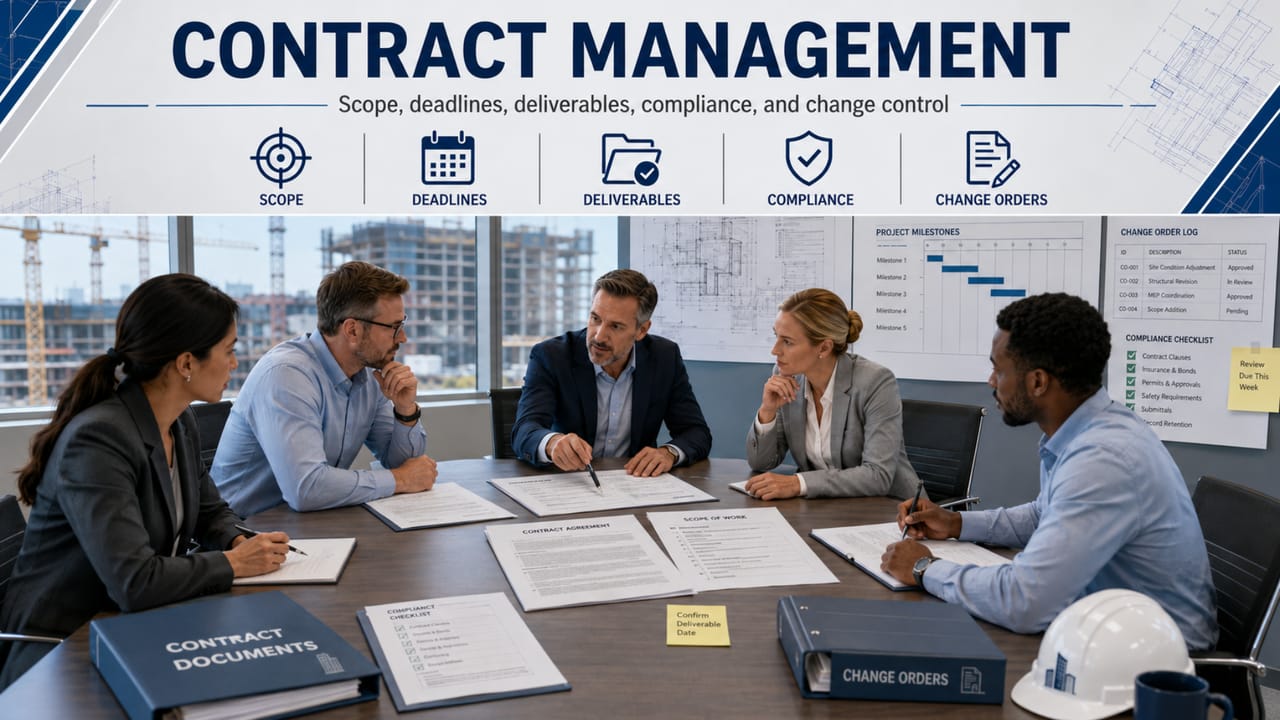
Understand engineering contract management, governance, responsibilities, traceability, measurements, technical inspection, commissioning, acceptance and closeout.
Check it out!
Engineering contract management should not be treated merely as administrative control of deadlines, documents, and payments. In technical contracts, it needs to organize governance, responsibilities, scope, obligations, formal communication, measurements, open items, risks, technical acceptance, and closeout.
When contract management is conducted without a technical method, the contracting party can lose traceability over decisions affecting schedule, cost, quality, performance, operational safety, and engineering responsibility.
Therefore, engineering contract management should connect administrative and technical aspects. The contract is not merely a legal instrument. It is also the basis for controlling deliverables, obligations, interfaces, milestones, measurements, documentation, validations, and acceptance conditions.
This topic is directly connected to Engineering Terms of Reference, to Technical Procurement, to Engineering Construction Monitoring and to the service of Owner’s Engineering.
What is engineering contract management
Engineering contract management is the process of conducting, controlling, and documenting contract execution for works, services, designs, implementations, systems, or technical consulting engagements.
It involves monitoring obligations, validating deliverables, controlling schedules, managing changes, reviewing measurements, recording open items, coordinating interfaces, monitoring risks, and preparing acceptance or receipt of the deliverable.
In engineering contracts, management cannot be restricted to administrative routines. It needs to consider technical aspects that affect the validity of the deliverable, future operations, and the contracting party’s responsibilities.
Well-structured contract management helps answer:
- which obligations are defined;
- which deliverables were completed;
- which measurements were submitted;
- which open items remain unresolved;
- which risks affect schedule, cost, or quality;
- which decisions were formalized;
- which documents support acceptance;
- which conditions allow contract closeout.
This control is essential for private companies, industrial organizations, institutions, and public bodies that procure engineering services.
Contract management is not just administrative control
Administrative control is necessary, but insufficient.
In technical contracts, it is not enough to track term, balance, invoices, contractual deadlines, and amendments. It is necessary to verify whether execution matches scope, technical requirements were met, documentation was delivered, measurements have a technical basis, and open items prevent acceptance.
This distinction matters because many contractual problems arise from technical failures, not only administrative ones.
A contract may be formally active and financially controlled while technically disorganized. There may be measurements without adequate validation, open items without owners, unrecorded changes, incomplete documentation, and final acceptance without sufficient technical analysis.
Engineering contract management needs to prevent this scenario.
Contract governance and technical responsibility
Contract governance is the set of rules, responsibilities, decision flows, records, and controls that guide contract execution.
In engineering, this governance should be associated with technical responsibility. Decisions about scope, changes, measurements, open items, testing, commissioning, and acceptance can affect performance, operations, maintenance, safety, and future cost.
Therefore, contract management needs to define:
- who makes technical decisions;
- who approves changes;
- who validates measurements;
- who records open items;
- who follows up corrective actions;
- who recommends acceptance;
- who formalizes receipt;
- who is responsible for technical interfaces.
This clarity reduces conflicts and improves the quality of decisions throughout the contract.
Scope, obligations, and responsibility matrix
Contract management begins with understanding scope and obligations.
Scope defines what must be delivered. Obligations define responsibilities, deadlines, conditions, documents, measurement criteria, tests, warranties, interfaces, and contractual boundaries.
When this information is not organized, gaps emerge: the contractor understands one thing, the contracting party expects another, and execution proceeds with divergent interpretations.
A responsibility matrix helps reduce this risk. It can record responsibilities of the contracting party, contractor, designers, integrators, suppliers, inspection teams, operations, maintenance, and third parties.
This matrix should also connect to the terms of reference, the contract, and the technical procurement documents.
Formal communication and document traceability
Formal communication is an essential part of contract management.
In engineering, decisions made in meetings, messages, or informal conversations can have significant impact. Scope changes, schedule adjustments, work-front releases, acceptance of reservations, approval of measurements, and recording of open items should have document traceability.
Contract management should define channels, responsible parties, response times, record formats, minutes, reports, notices, work orders, and validation documents.
Document traceability makes it possible to reconstruct contract history. This is important for audits, warranties, accountability, cost control, and technical closeout.
Contract administration, technical inspection, and construction monitoring
Contract administration is a function within contract management. It monitors execution of agreed obligations and verifies whether the contractor is complying with conditions, deadlines, scope, documentation, and deliverables.
Technical inspection verifies technical conformity of execution with the design, requirements, measurements, and acceptance criteria.
Engineering construction monitoring organizes this verification over time by recording progress, open items, documents, measurements, and acceptance conditions.
In significant contracts, these three dimensions need to work together: contract management, contract administration, and technical inspection.
Construction measurement, measurement certificate, and technical validation
Construction measurement is a critical point in contract management.
Measurement should not be merely a financial record of progress. It should be linked to the executed scope, measurement criteria, supporting documentation, inspection report, open-item control, and acceptance conditions.
The measurement certificate formalizes executed services, measured deliverables, or completed stages. Contract management should verify whether the certificate is consistent with actual execution and contractual conditions.
In consulting services, deliverable-based measurement helps organize payments based on verifiable deliverables rather than only hours or declared effort.
Open-item matrix, risks, and deviation treatment
Contract management needs to control open items and risks in a structured way.
Open items may involve incomplete execution, missing documentation, nonconformities, pending tests, incompatibilities, supplier delays, integration failures, or items conditioning acceptance.
The open-item matrix allows classification of impact, responsible party, deadline, corrective evidence, and closure condition.
The risk matrix helps organize events that may affect schedule, cost, quality, safety, performance, or closeout.
Contract management without open-item and risk control tends to push problems to the end of the contract, when correction is more difficult, more expensive, and more contentious.
Commissioning, testing, and delivery performance
In critical systems, contract management should consider commissioning, testing, and delivery performance.
A delivery may be installed but still not ready to operate. Configuration, integration, documentation, functional testing, training, alarm validation, automation adjustments, or proof of performance may still be missing.
The commissioning of critical systems verifies whether systems, subsystems, integrations, automation, operational flows, and documentation are consistent with the contracting party’s requirements.
Where applicable, FAT, SAT, and integrated-test records should be considered before acceptance or receipt. The content on FAT, SAT, and integrated testing complements this analysis.
Technical acceptance and provisional/final receipt
Technical contract closeout depends on well-structured acceptance and receipt.
The acceptance criteria define how a deliverable will be validated. The technical acceptance formalizes validation of the deliverable.
The technical acceptance certificate records the acceptance decision, including open items, reservations, or applicable conditions.
The provisional and final receipt formalizes stages of submission, verification, and acceptance of the delivery.
Contract management should prepare for this closeout from the beginning, not only at the end of execution.
Risks of managing engineering contracts without technical governance
The absence of technical governance in contract management can create significant risks:
- measurements without sufficient validation;
- open items without assigned owners;
- unrecorded scope changes;
- conflicts between the contracting party and contractor;
- incomplete final documentation;
- insufficient commissioning;
- premature final acceptance;
- difficulty enforcing warranties;
- poor decision traceability;
- additional costs after closeout;
- accountability for poorly documented decisions.
These risks increase when the contract involves critical systems, multiple suppliers, public entities, industrial environments, technical integration, or continuous operation.
How A3A Engenharia supports engineering contract management
A3A Engenharia supports private companies, industries, public bodies, and institutions in the technical management of engineering contracts, focusing on governance, technical responsibility, document traceability, measurements, open items, commissioning, acceptance, and closeout.
This work may include scope review, responsibility matrix, support for formal communication, measurement analysis, open-item control, construction monitoring, technical inspection, reporting, commissioning support, and technical-acceptance support.
This work may be integrated with:
- Owner’s Engineering;
- EPCM;
- Ongoing Engineering Consulting Services;
- Technical Procurement;
- Technical Due Diligence;
- Detailed Engineering.
The objective is to allow the contracting party to manage technical contracts with method, clear responsibilities, governance, and a documented basis for relevant decisions.
Recommended complementary content
To explore contract management, technical governance, measurement, acceptance, and closeout in greater depth, also see:
- Engineering Terms of Reference;
- Engineering Construction Monitoring;
- Technical Inspection of Engineering Works and Services;
- Technical Inspection Report in Engineering;
- Measurement Certificate in Engineering Consulting;
- Provisional and Final Receipt in Engineering.
Conclusion
Engineering contract management is a governance and technical-responsibility function.
It organizes scope, obligations, formal communication, measurements, open items, risks, commissioning, acceptance, and closeout. When well structured, it reduces conflicts, improves decision quality, and protects the contracting party throughout the contract lifecycle.
In engineering contracts, good management is not merely controlling dates and payments. It means technically supporting decisions that affect schedule, cost, quality, performance, and responsibility for the delivery.
Talk to our Engineering Department
If your organization needs to structure contract management, technical governance, a responsibility matrix, measurement validation, open-item control, or contract closeout for engineering services, contact the A3A Engenharia Engineering Department.
A3A Engenharia supports private companies, industries, public bodies, and institutions in the technical management of engineering contracts with method, technical responsibility, and document traceability.
Technical references
[1] A3A Consulting Engineering. Complete Guide to Engineering Consulting. Available at: https://a3aengenharia.com.br/conteudo/guias-tecnicos/guia-completo-sobre-engenharia-consultiva/.
[2] A3A Consulting Engineering. Procurement of Engineering Consulting with Traceability, Governance, and Cost Engineering. Available at: https://a3aengenharia.com.br/conteudo/whitepapers/contratacao-engenharia-consultiva-governanca-rastreabilidade/.
[3] PMI. PMBOK Guide.
[4] AACE International. Recommended Practices for Cost Engineering.
Frequently asked questions
It is the process of conducting, controlling, and documenting contract execution for works, services, designs, implementations, systems, or technical consulting engagements, considering scope, responsibilities, measurements, open items, risks, acceptance, and closeout.
No. In engineering, contract management also involves technical governance, responsibility for decisions, measurement validation, open-item control, commissioning, acceptance, and technical receipt.
Contract administration monitors compliance with agreed obligations. Contract management organizes the broader contract-governance framework, including responsibilities, communication, measurements, risks, open items, and closeout.
Measurement should be validated according to scope, measurement criteria, supporting documentation, inspection report, open items, and acceptance conditions.
A3A Engenharia supports technical contract management with scope review, responsibility matrices, formal communication, measurement analysis, open-item control, technical inspection, commissioning, and acceptance support.
