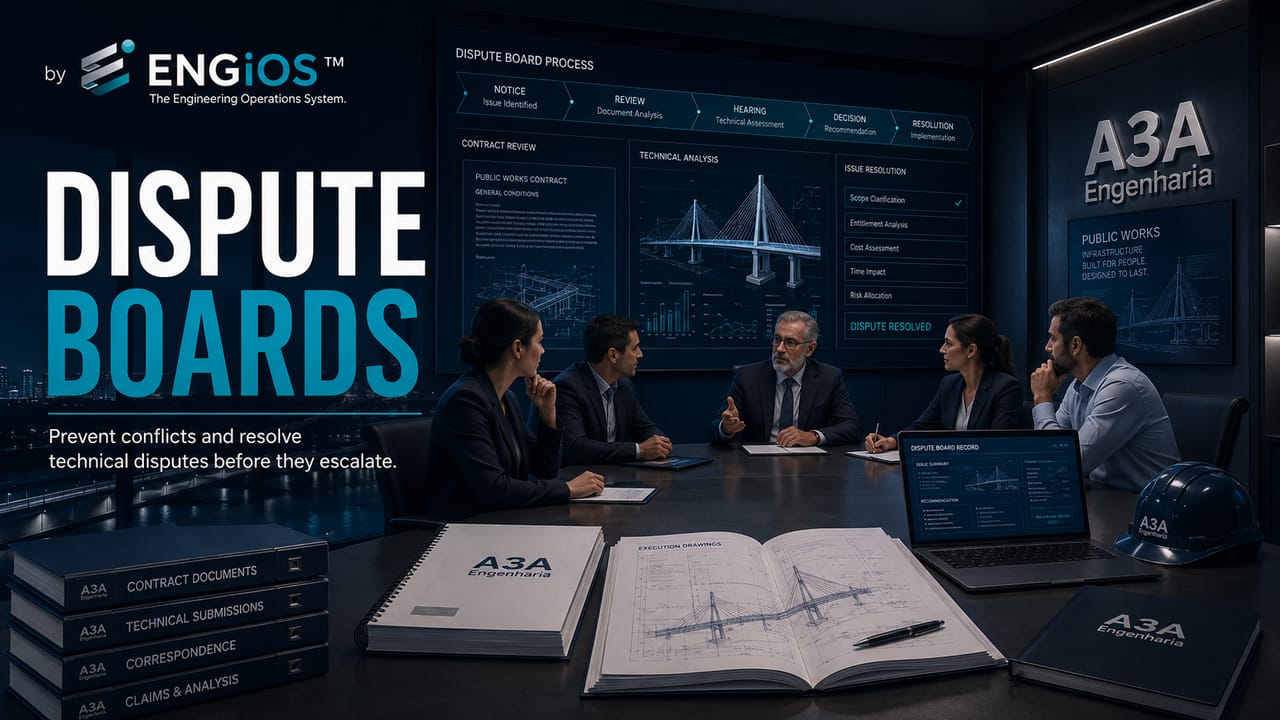
Understand how Dispute Boards work in public works: Law 14,133, board types, technical disputes, claims, decisions, prevention of stoppages, and contract governance.
Check it out!
A Dispute Board, referred to by Brazilian Law No. 14,133/2021 as a dispute resolution committee, is a mechanism for preventing and addressing disputes that accompanies complex contracts and may issue recommendations or decisions on conflicts before they evolve into arbitration, litigation, or project stoppage. In engineering, its main advantage is addressing the problem while the facts are still recent, records are available, and the impact can still be controlled.
Law No. 14,133 expressly recognizes, in Article 151, the possibility of using conciliation, mediation, dispute resolution committees, and arbitration in public procurement. The sole paragraph includes disputes involving disposable patrimonial rights, such as economic-financial rebalancing, contractual default, and calculation of compensation. Article 153 even allows contracts to be amended to incorporate these mechanisms, and Article 154 requires equal, technical, and transparent criteria in selecting committee members.
For public works, a Dispute Board is especially useful when the contract has high technical complexity, many interfaces, a long duration, material change risk, or significant claims potential. However, it is not a substitute for inspection, contract management, or project engineering. The board performs best when supported by sound designs, schedules, records, measurements, and a risk matrix.
What is a Dispute Board
It is a committee composed of independent and technically qualified professionals to monitor or analyze disputes arising during contract execution.
Unlike a tribunal engaged only after a conflict has crystallized, a standing board can become familiar with the project from the outset, follow its development, and understand the technical and contractual logic before a specific dispute arises.
This proximity reduces a classic problem in engineering disputes: years after the event, experts have to reconstruct facts from incomplete documents, outdated schedules, and conflicting recollections.
What Law 14,133 says about dispute resolution committees
Article 151 expressly includes dispute resolution committees among the alternative methods for preventing and resolving disputes permitted in procurements governed by the Law.
The sole paragraph defines the scope: disputes involving disposable patrimonial rights, such as:
- restoration of the economic-financial balance;
- default on contractual obligations;
- calculation of compensation.
Article 153 allows contracts to be amended to incorporate alternative dispute-resolution mechanisms. Article 154 requires the selection of members to observe equal, technical, and transparent criteria.
The subject is therefore no longer merely an international practice or contractual innovation: it has an express legal basis under Brazil’s Public Procurement Law.
Why engineering conflicts need to be resolved early
A technical dispute rarely remains isolated. An unresolved interference blocks a work front; the blockage delays the schedule; the delay increases indirect cost; the cost becomes a claim; the claim deteriorates the relationship; the contractor reduces production; the public authority hardens inspection; and the project enters a spiral of conflict.
The later the issue is addressed, the harder it becomes to separate cause, effect, and responsibility.
The article on Claim Management shows how contractual events need to be recorded contemporaneously. A Dispute Board acts precisely at that point: before the event becomes a historical liability.
Which disputes can reach a Dispute Board
In complex works and contracts, recurring disputes involve:
- scope interpretation;
- unforeseen interferences;
- differing physical conditions;
- design responsibility;
- equivalent technical solutions;
- changes in construction method;
- measurement criteria;
- acceptance or rejection of work;
- extensions of time;
- concurrent delay;
- economic-financial rebalancing;
- mobilization and demobilization costs;
- productivity;
- changes in requirements;
- calculation of compensation;
- responsibility for events allocated in the risk matrix.
Brazil’s National Land Transport Agency (ANTT), when regulating boards for concessions through Resolution No. 6,040/2024, expressly included disputes related to the execution of works and services, engineering solutions, compliance with contractual parameters, asset valuation, and events affecting obligations and their financial effects. Although the regulation is sector-specific, it provides a concrete Brazilian institutional example.
A Dispute Board is not arbitration
The mechanisms serve different functions.
Arbitration is an adjudicatory procedure that results in an arbitral award and is normally engaged after the dispute is already structured. A Dispute Board can operate closer to execution and, depending on the adopted rules, issue a recommendation, a decision, or a hybrid determination.
| Mechanism | Typical timing | Main function |
| Negotiation | Beginning of disagreement | Seek direct agreement |
| Mediation | Established disagreement | Facilitate settlement |
| Dispute Board | During execution | Prevent and address disputes with technical knowledge of the contract |
| Arbitration | Consolidated dispute | Produce an arbitral award |
| Courts | Litigated dispute | Judicial resolution |
The objective is not to replace one forum with another in every case, but to create a dispute-resolution ladder proportionate to the problem.
Standing, temporary, and ad hoc boards
ANTT regulations provide a useful classification.
Standing board
It is established at the beginning and follows the contract over a long period. Its advantage is knowing the project, teams, risks, and history before a dispute arises.
It is appropriate when the project has high complexity, long duration, and a high probability of technical disputes.
Temporary board
It operates during a specific phase, such as a construction package, expansion, tunnel, bridge, system implementation, or investment cycle.
It can be efficient when dispute risk is concentrated in a particular phase.
Ad hoc board
It is established for a specific dispute. It costs less during periods without conflict, but loses part of the preventive advantage because it needs to learn the contract after the problem has appeared.
The choice should consider value, complexity, duration, and the project’s risk profile.
Why a standing board can prevent disputes
The greatest benefit of a Dispute Board is not necessarily the number of formal decisions it issues. It is its ability to prevent disagreements from maturing to that stage.
When members know the project, they can better understand the context of a change, the boundaries of the contract, and the impacts of a solution.
The mere existence of an independent technical forum also changes the behavior of the parties. Weak positions tend to be filtered before being formalized; decisions by the public authority need better substantiation; and the contractor has an incentive to record events more consistently.
How to select board members
The Law requires equal, technical, and transparent criteria. This is especially important because the board’s value depends on the trust of both parties.
In engineering contracts, members need to combine:
- independence;
- absence of conflicts of interest;
- technical knowledge compatible with the project;
- contract experience;
- ability to analyze evidence;
- availability;
- ability to understand schedules, costs, risks, and interfaces.
ANTT Resolution No. 6,040/2024 provides, as a general rule, for a three-member board: one appointed by the Agency, one by the concessionaire, and a third jointly selected member who acts as chair. The regulation also requires compatible education and experience, independence, and a declaration of absence of conflict.
Engineering and Law need to work together
Construction disputes are rarely purely legal or purely technical.
An extension of time may involve a contractual clause but depends on schedule analysis. Rebalancing is legal and economic, but requires technical causation. A design change may be legally admissible but needs to be technically necessary and quantified.
For this reason, board composition and support should combine contractual understanding with engineering, planning, and cost expertise.
The importance of the schedule in a dispute
Many delay disputes are decided superficially because the parties discuss dates without analyzing the critical path.
To assess the impact of an event, it is necessary to understand:
- the current baseline;
- the affected activity;
- float;
- predecessors and successors;
- contemporaneous updates;
- prior delays;
- mitigation actions;
- any concurrent delay.
The article on Delay Analysis and Time Impact Analysis explores this logic in greater depth.
A technically competent Dispute Board can assess the narrative against the schedule instead of treating every delay as a simple sum of days.
The importance of the Daily Construction Report and contemporaneous evidence
The quality of a Dispute Board also depends on the quality of execution records. Inspection, daily construction reports, measurements, and nonconformities form the factual basis of any technical dispute.
The Daily Construction Report records resources, conditions, work fronts, occurrences, and instructions as the facts occur.
In a dispute, contemporaneous records have significant value because they help confirm:
- when the event arose;
- which work front was affected;
- which resources were mobilized;
- what instruction was given;
- when the other party became aware;
- which mitigation measures were attempted.
Without this, the board receives retrospective narratives that are difficult to verify.
How the risk matrix enters the analysis
The risk allocation matrix is one of the central documents in disputes.
The first step should be to identify whether the event was anticipated and to whom it was allocated. Then verify whether reality corresponds to the contractual definition and whether there was an obligation to mitigate or notify.
A generic matrix makes the board’s work more difficult. A specific matrix reduces room for interpretation and allows the decision to focus on the occurrence and its impact.
Dispute Boards and economic-financial rebalancing
The Law itself cites restoration of the economic-financial balance as an example of a dispute involving disposable patrimonial rights that may be submitted to alternative mechanisms.
The analysis requires distinguishing:
- extraordinary event;
- contractually assumed risk;
- act attributable to the public authority;
- actual impact;
- causation;
- quantification.
The article on economic-financial rebalancing in engineering contracts details this structure.
Dispute Boards and contract amendments
Not every dispute should end in a contract amendment, and not every amendment means there is a dispute.
The board can be useful when there is disagreement over the need for, responsibility for, or quantification of a change. A technical decision can help unblock execution while the competent authorities formalize the administrative instruments.
The Dispute Board does not replace the authority that approves the amendment and does not remove legal limits. It provides a dispute-resolution layer for the underlying controversy.
What needs to be in the bidding documents and contract
If the public authority intends to use the mechanism from the outset, the bidding documents and draft contract need to define its architecture.
Relevant aspects include:
- type of board;
- timing of establishment;
- number of members;
- appointment process;
- independence criteria;
- compensation and costs;
- eligible matters;
- submission procedure;
- deadlines;
- nature of determinations;
- effect of decisions;
- relationship with negotiation, arbitration, and courts;
- duty to continue performance;
- access to documents and the site;
- confidentiality where compatible with public transparency;
- replacement of members;
- termination of the board.
Lack of clear rules turns the dispute-resolution mechanism itself into a new source of dispute.
When to add a Dispute Board after contract execution begins
Article 153 of Law No. 14,133 allows contracts to be amended to incorporate alternative dispute-resolution mechanisms.
This opens the possibility of later adoption when the public authority identifies that the dispute profile justifies the mechanism.
Late introduction, however, requires care. The parties need to define how prior events, ongoing disputes, the board’s temporal jurisdiction, and already formalized claims will be treated.
Is the cost of a Dispute Board worth it?
The cost should be compared with the risk the mechanism is intended to reduce.
A standing board has compensation and expenses even when no formal decision is issued. However, in high-value contracts, the cost of a few months of stoppage, litigation, or demobilization may greatly exceed the cost of the mechanism.
The analysis should consider:
- contract value;
- duration;
- complexity;
- expected history of changes;
- number of interfaces;
- geotechnical or technological risk;
- impact of stoppage;
- design maturity;
- management capability of the parties.
It makes no sense to copy the mechanism into simple contracts merely because it is sophisticated. Governance should be proportionate.
Can a Dispute Board prevent a work stoppage?
It can help significantly, but there is no absolute guarantee.
The mechanism works best when the dispute is one of the causes of stoppage and can be resolved through interpretation, a technical determination, or definition of responsibility. It does not solve lack of public budget, incomplete land acquisition, missing permits, severe insolvency, or a completely unfeasible design.
Even so, reducing the duration of disputes over measurements, changes, schedule, and rebalancing can prevent manageable problems from turning into contractual breakdown.
Continuity of performance during the dispute
One objective of contemporary conflict-management mechanisms is to separate the contractual dispute from continued physical performance when doing so is possible and safe.
ANTT Resolution No. 6,040/2024 expressly states that submission to dispute-prevention and resolution mechanisms does not authorize interruption of activities required for adequate provision of the public service.
In works contracts, the specific rule needs to be designed carefully because some disputes can effectively block a work front for technical reasons. Even so, the principle is valuable: discussing entitlement and responsibility should not automatically mean stopping all performance.
How to prepare a case for the board
Disputes over scope, schedule, productivity, measurement, and rebalancing require a consistent technical basis. Before reaching the board, the case should be structured around facts, causation, schedule, costs, and evidence.
Learn about Technical Analysis of Contract Amendments and Claims
An efficient submission should not be an indiscriminate document dump.
It needs to present a traceable narrative:
- issue to be decided;
- applicable clauses and requirements;
- chronology of facts;
- contemporaneous evidence;
- positions of the parties;
- technical analysis;
- schedule analysis;
- financial analysis;
- risk matrix;
- requested relief or proposed solution.
This reduces the time required for the board to understand the dispute.
How Engineering Consulting supports a dispute without replacing the board
The board needs to remain independent. The public authority’s consultant should not assume the decision-making role of the Dispute Board.
Its role is to prepare the technical basis so that the public authority can present a consistent position:
- design analysis;
- chronological reconstruction;
- audit of measurements;
- schedule analysis;
- impact quantification;
- productivity assessment;
- risk matrix;
- claims analysis;
- organization of evidence;
- preparation of technical memoranda.
A3A provides a specific service for Technical Analysis of Contract Amendments, Scope Changes, and Claims in Engineering Contracts, directly connected to this type of technical preparation.
Dispute Board as part of contract governance
The mechanism works best when connected to the management system rather than operating in isolation.
Before an issue reaches the board, the contract should have internal treatment routes:
- event registration;
- analysis by the inspector;
- assessment by the contract manager;
- negotiation between the parties;
- executive escalation;
- submission to the board when necessary.
After a decision or recommendation, the outcome needs to be translated into actions: schedule update, contract amendment when applicable, measurement adjustment, design revision, or another instrument.
Relationship with decision paralysis in public administration
A Dispute Board can also reduce decision paralysis. When the public manager and contractor technically disagree on a high-impact matter, reluctance to assume an interpretation alone may block the contract.
An independent forum established in the contract creates an institutional route for resolving the disagreement.
This does not eliminate the manager’s responsibility, but it reduces the situation in which a decision remains indefinitely backlogged because there is no mechanism for overcoming opposing positions.
What should not be done
Create the board without defining the effects of its determinations
If no one knows whether a determination is a recommendation or decision and what effect it has, a new dispute will arise.
Select members only for legal prominence
Complex contracts require the ability to understand engineering, schedule, and costs.
Take every issue to the board
Routine matters should be resolved through management. A Dispute Board cannot become the project’s operational department.
Expect the board to compensate for poor documentation
Without records, even excellent specialists will have difficulty reaching a determination.
Treat the mechanism as an instrument of the public authority against the contractor
Legitimacy depends on independence and bilateral trust.
Checklist for structuring a Dispute Board in a public works contract
Before bidding or a contract amendment, verify:
- is there a justification based on complexity and risk?
- will the board be standing, temporary, or ad hoc?
- are eligible matters defined?
- is member selection technical, equal, and transparent?
- are independence and conflicts of interest addressed?
- are compensation rules defined?
- are submission and response deadlines established?
- is the nature of determinations clear?
- is the relationship with arbitration and courts established?
- does the contract define continuity of performance during disputes where possible?
- will the board have access to designs, schedules, measurements, and records?
- does the public authority have a technical team capable of preparing cases?
How to price the Dispute Board in the project estimate
The cost of the Dispute Board needs to appear in the economic planning of the procurement before bidding. The mechanism should not emerge as an improvised administrative expense after the dispute already exists. When the bidding documents define a standing or binding board, member compensation, meeting expenses, visits, administrative support, and any dispute-analysis work become predictable costs of contract governance.
TCU Decision 2,191/2025-Plenary consolidated a particularly useful reference for this discussion. The report cites literature according to which Dispute Board costs average between 0.05% and 0.25% of total contract value, with an average of approximately 0.15% in projects involving complex disputes and problems. This range is a literature reference, not a legal ceiling or an automatic estimating percentage.
This distinction is essential. The appropriate amount depends on duration, number of members, complexity, frequency of visits, number of interfaces, location, compensation model, and adopted rules. A five-year project with three standing members should not be estimated using the same logic as an ad hoc board activated only after a dispute arises.
| Variable | Expected effect on cost | Evidence for the estimate |
| Contract duration | extends the period of member availability | contract schedule |
| Number of members | increases fees and expenses | rules and complexity |
| Frequency of visits | increases travel and effort | meeting plan |
| Technical complexity | may require greater specialization | risk matrix and interfaces |
| Standing or ad hoc model | changes cost structure and readiness | contract clause |
| Expected number of disputes | may increase analysis hours | history and project profile |
The 0.05% to 0.25% range is not a price table
The correct use of the reference is to test reasonableness, not replace market research and a calculation basis. If the estimated board cost is well above or below the observed range, the team should investigate why. There may be a legitimate particularity, but it needs to be documented.
It is also inappropriate to multiply the project value by 0.25% and treat the result as the final estimate. This would create the same weakness found in any unsupported parametric rate: lack of decomposition, difficulty updating the price, and inability to determine what is actually included.
A robust estimate should separate availability fees, ordinary meetings, visits, reimbursable expenses, dispute work, and administrative support. Cost Engineering for Engineering Works and Services can structure this calculation basis and compare the mechanism’s cost with the economic exposure it is intended to reduce.
Tripartite contracting: why the board is not an exclusive supplier to either party
The classic Dispute Board structure is tripartite: the public authority, the contractor, and the board members participate in a contractual framework designed to protect performance of the main contract. This distinguishes the mechanism from a unilateral consultancy retained to defend only one party.
Economic independence needs to be consistent with decisional independence. If only one party selects, pays, and controls the board without counterweights, there is a risk of perceived capture and loss of legitimacy.
The bidding documents should clarify how members will be selected, how they will be replaced, who pays each portion, how expenses are approved, and how conflicts of interest are addressed. Financial design and governance design are inseparable.
How to divide costs between the public authority and contractor
The contract can be structured to share costs between the parties, provided the rule is established transparently. One alternative discussed in the literature and in the context analyzed by the TCU is economic sharing of the cost, including a mechanism for reimbursement of the contractor’s portion under the conditions established in the bidding documents.
The choice should not be presented as a universal rule. The model needs to be compatible with budget law, the payment method, and the project’s contractual structure.
The technical point is different: whoever prepares the bid needs to know in advance which portion will be borne, when it will be paid, and which expenses may occur. An undefined obligation tends to appear as a risk premium in the bid.
Dispute Board as proactive insurance: what the analogy means
TCU Decision 2,191/2025 uses a relevant economic comparison: a Dispute Board can function as proactive insurance. The expression does not mean that the board is an insurance policy. It means that the cost is incurred preventively to reduce the probability and impact of conflicts that could cause stoppage, litigation, and loss of efficiency.
The correct comparison, therefore, is not merely “how much does the board cost?” It should include the potential cost of stoppage, demobilization and remobilization, additional site overhead, delayed entry of the asset into operation, price adjustments, arbitration or court proceedings, late expert examinations, and productivity loss caused by decisions not being made.
This approach directly connects the Dispute Board with the cluster on stalled public works: the mechanism does not eliminate every cause of stoppage, but it can reduce those associated with technical and contractual disagreements that remain unresolved.
Why the TCU began to value the standing and binding model
In Decision 2,191/2025-TCU-Plenary, the Court recommended incorporating a standing and binding Dispute Board into the bidding documents or future contract to increase the likelihood of a more advantageous bid and more effective performance. The recommendation is associated with the specific profile of the procurement examined and does not create a general obligation to use the mechanism in every public works project.
The benefit of the standing model comes from continuity. Members follow the project before a formal dispute exists, become familiar with the design, schedule, parties, and history of changes, and can act with a lower learning cost when a disagreement arises.
Under the binding model, the decision produces effects according to the contractual rules while any review follows the established route. This can prevent the project from remaining suspended while awaiting a long-term final resolution.
| Model | Main advantage | Point of attention |
| Standing | continuous knowledge and prevention | availability cost throughout the contract |
| Ad hoc | lower cost when there is no dispute | late mobilization and learning curve |
| Recommendatory | supports consensual resolution | may not resolve an immediate impasse |
| Binding | produces an operational decision during execution | effects and review need to be clearly defined |
How the cost should appear in the owner’s estimate
The estimate should avoid a generic line item called only “Dispute Board.” Ideally, there should be a specific calculation basis, even when the final amount is presented on a consolidated basis.
- fixed availability fees;
- ordinary meetings;
- site visits;
- document review;
- dispute sessions;
- travel expenses;
- secretariat or administrative support;
- additional experts where permitted.
The allocation method needs to be consistent with the model. Recurring costs may follow contract duration. Costs triggered by disputes may require a provision or specific rule.
A Dispute Board should not be confused with contingency
The predictable cost of the board is part of the governance structure. Contingency, by contrast, represents exposure to identified and quantified risks.
If the public authority includes the board’s cost within a generic contingency, traceability is lost. If it adds contingency for conflicts while also including a Dispute Board as a mitigation measure, it needs to recalibrate residual exposure to avoid double coverage.
The Contingency Reserve and Risk Matrix should reflect the existence of the mechanism.
How to assess whether the board’s cost is reasonable
- Percentage benchmark: compare the ratio between estimated cost and contract value with available references, without turning the range into an automatic ceiling.
- Decomposition: verify the number of members, level of effort, meetings, visits, and expenses.
- Complexity: relate cost to the technical and contractual criticality of the project.
- Expected benefit: compare cost with exposure to stoppage, claims, and high-value disputes.
On a BRL 500 million project, 0.15% corresponds to BRL 750 thousand. Viewed in isolation, the amount may appear high. However, if an unresolved dispute produces one month of delay with site overhead, equipment, price adjustment, and postponed operations, the order of magnitude of the impact may be much greater. The calculation needs to use project-specific data, not a generic argument.
How to procure a Dispute Board in a technically verifiable way
The bidding documents and contract need to turn the mechanism into verifiable obligations. It is not enough to copy a standard clause stating that “there may be a Dispute Board.” The procurement needs to define structure, jurisdiction, effects, compensation, and interface with project management.
Inputs for structuring the mechanism
- risk matrix;
- contract value and duration;
- delivery model;
- schedule;
- map of critical interfaces;
- measurement and payment model;
- draft contract;
- history of similar projects;
- claims and change-management strategy.
Structuring deliverables
- technical memorandum justifying the mechanism;
- definition of standing, ad hoc, recommendatory, or binding model;
- member-selection criteria;
- independence and conflict-of-interest rules;
- operating rules;
- authority matrix;
- cost calculation basis;
- cost-sharing rule;
- submission and decision deadlines;
- interface with arbitration, courts, and contract management;
- criteria for continuity of performance.
Acceptance criterion
The structure is mature when any bidder can determine how much it will bear, which disputes may be submitted, how long a response will take, what effect the decision will have, and how the board will be compensated.
Technical Planning for Engineering Procurement can organize these definitions before the bidding documents are published, while technical support for amendments and claims structures the evidence once the dispute has already arisen.
Evidence matrix for a technically prepared dispute
The board can make sound determinations only if the parties can present traceable facts. Project governance should produce evidence from the outset rather than reconstruct it after the dispute has matured.
| Topic | Primary evidence | Use before the board |
| Scope | design, design narrative, RFIs, and instructions | define original obligation and change |
| Schedule | baseline schedule and updates | assess critical path and delay |
| Field | daily reports, photos, inspections | prove contemporaneous condition |
| Cost | measurements, cost build-ups, invoices, and calculation records | quantify impact |
| Risk | matrix and notices | identify responsibility |
| Change | event register and approvals | reconstruct causation |
This matrix connects with Claim Management, which organizes the event, evidence, causation, and quantification before formal submission.
When a Dispute Board tends to add the most value
- large-scale projects;
- long duration;
- multidisciplinary interfaces;
- material geotechnical uncertainty;
- integrated or semi-integrated contracting;
- multiple delivery milestones;
- high cost of stoppage;
- critical operating asset;
- history of claims in similar projects.
For simple, short-duration, low-exposure scopes, a standing structure may not be justified. The decision needs to be proportionate.
Economic and contractual Dispute Board checklist
- board model defined;
- effect of decisions defined;
- number and profile of members justified;
- cost calculation basis prepared;
- reasonableness benchmark recorded;
- cost sharing established;
- meeting and decision deadlines established;
- member-replacement mechanism established;
- conflict of interest addressed;
- interface with arbitration and courts defined;
- continuity of performance addressed;
- evidence documents identified;
- estimate consistent with duration and complexity;
- inspection team prepared to feed the mechanism.
Final considerations
A Dispute Board is most valuable when it acts before a contractual breakdown. In complex public works, the ability to resolve quickly a disagreement over design, schedule, measurement, risk, or rebalancing can preserve the schedule and prevent a technical problem from becoming a contractual stoppage.
Law No. 14,133 provides an express legal basis for its use and even allows later incorporation through a contract amendment. Brazilian regulatory experience, such as ANTT’s, demonstrates that the mechanism can be structured with board types, technical composition criteria, and clearly defined eligible matters.
But no board replaces mature contract management. To produce sound determinations, it needs sound engineering inputs: coherent contracts, risk matrices, updated schedules, daily construction reports, evidence, measurements, and causal analyses. The combination of dispute prevention and robust technical documentation is what turns the mechanism into a real tool for continuity of the works.
Engineering Consulting helps turn contractual conflict into a technically analyzable problem without replacing the board’s independence or the public authority’s jurisdiction.
Technical references
[1] BRAZIL. Law No. 14,133, of April 1, 2021 — Public Procurement and Administrative Contracts Law. 2021. Available at: https://www.planalto.gov.br/ccivil_03/_ato2019-2022/2021/lei/l14133.htm.
[2] BRAZILIAN NATIONAL LAND TRANSPORT AGENCY. Resolution No. 6,040, of April 4, 2024 — dispute prevention and resolution committees. 2024. Available at: https://anttlegis.antt.gov.br/action/ActionDatalegis.php?acao=detalharAto&numeroAto=00006040&orgao=DG%2FANTT%2FMT&tipo=RES&valorAno=2024.
[3] BRAZILIAN NATIONAL LAND TRANSPORT AGENCY. ANTT advances regulation of Dispute Boards for concession contracts. 2024. Available at: https://www.gov.br/antt/pt-br/assuntos/ultimas-noticias/antt-avanca-na-regulamentacao-do-comite-de-prevencao-e-solucao-de-disputas-para-contratos-de-concessao-de-rodovias-e-ferrovias.
[4] BRAZILIAN FEDERAL COURT OF ACCOUNTS. Decision 4036/2020 — analysis of a Dispute Board mechanism in a concession. 2020. Available at: https://pesquisa.apps.tcu.gov.br/documento/acordao-completo/4.036%252F2020/%2520/DTRELEVANCIA%2520desc%252C%2520NUMACORDAOINT%2520desc/0.
[5] BRAZILIAN FEDERAL COURT OF ACCOUNTS. Decision No. 2,191/2025-TCU-Plenary. Fiscobras 2025 — expansion of the Salvador Metro, Bahia; analysis of standing and binding Dispute Board, costs, and dispute prevention. Session of Sept. 17, 2025. Available at: https://pesquisa.apps.tcu.gov.br/resultado/acordao-completo/dispute%2520board.
[6] BRAZILIAN FEDERAL COURT OF ACCOUNTS. Cost Engineering in Public Works — A Questions and Answers Guide. Brasília: TCU, 2026. Available at: https://portal.tcu.gov.br/infraestrutura.
Frequently asked questions
It is an independent board created to prevent and resolve disputes during contract execution, especially in complex engineering and infrastructure contracts.
Yes. Article 151 expressly includes dispute resolution committees among the alternative methods for preventing and resolving disputes.
Yes. Article 153 allows contracts to be amended to incorporate alternative dispute-resolution mechanisms.
No. A Dispute Board can follow the contract and address disputes during execution; arbitration is a distinct adjudicatory procedure.
Depending on the contract and applicable legal basis, they may involve rebalancing, default, compensation, and technical disputes over execution, design, schedule, measurement, and risks.
The process should follow equal, technical, and transparent criteria. The contract or rules define the appointment and composition process.
No. Inspection and contract management remain responsibilities of the public authority. The board acts in dispute prevention and resolution.
It can reduce risk when stoppage results from technical or contractual disagreements that can be resolved quickly, but it does not eliminate causes such as lack of budget, permitting problems, or an unfeasible design.
Additional technical materials
Core content on this topic
- Claim Management in Engineering Projects
- Contractual Claims in Engineering
- Delay Analysis and Time Impact Analysis
Related services
- Technical Analysis of Contract Amendments, Scope Changes, and Claims
- Technical Support for Engineering Works and Contract Inspection
- Technical Engineering Consulting