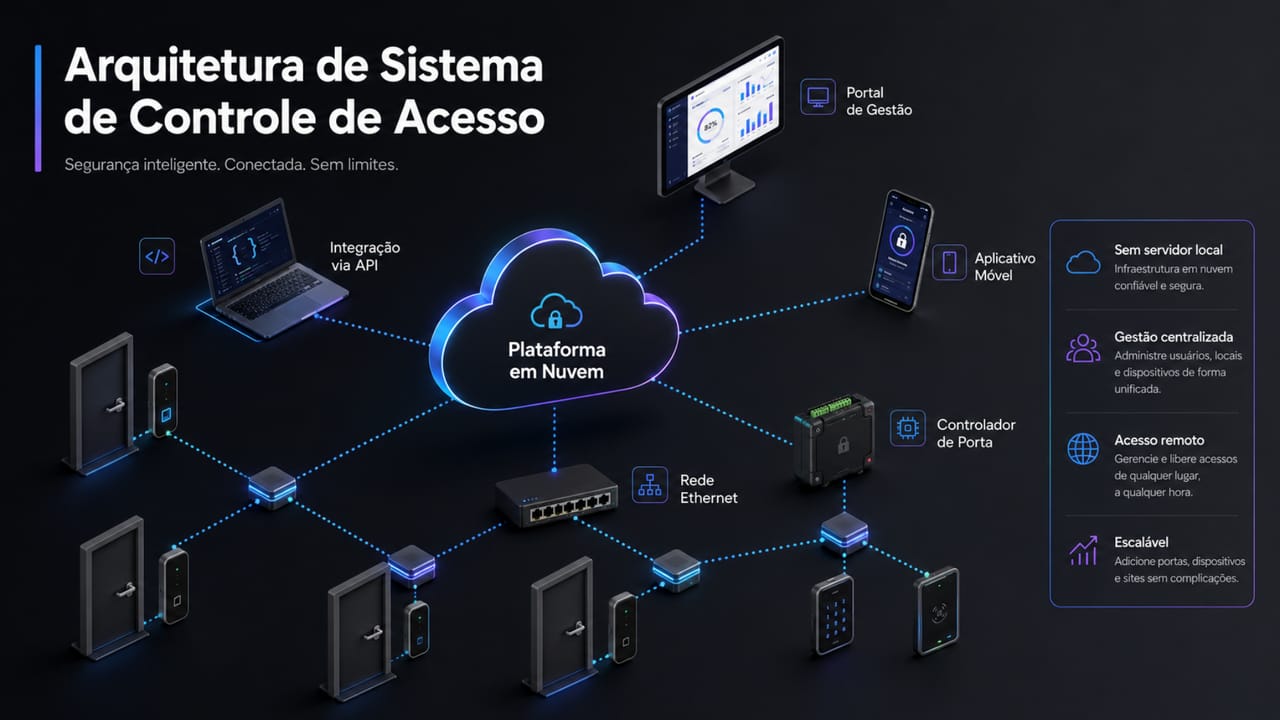
Understand how to design enterprise access-control architectures for multiple sites, integrating identity, controllers, networking, governance, cybersecurity, video, cloud, and operational continuity.
Check it out!
Access control is no longer merely a solution for opening doors, releasing turnstiles, or restricting entry to specific areas. In corporate, industrial, healthcare, logistics, educational, government, and critical-infrastructure environments, access control has become a complex technology architecture integrated with physical security, IT infrastructure, building operations, compliance, and corporate governance.
In simple projects, the system may consist of a few readers, some doors, and local administration. In enterprise projects, the reality is different: multiple sites, thousands of users, visitors, contractors, shifts, critical areas, group-based rules, video integration, communication with HR systems, corporate directories, IAM, SOC, elevators, parking, reports, dashboards, auditing, and high availability.
In this context, designing access control requires an architectural view. The selection of readers, controllers, locks, servers, databases, licenses, and integrations should be the consequence of a technical strategy, not merely an equipment list.
Enterprise platforms such as Lenel OnGuard help illustrate this level of maturity. They represent an enterprise access-control model designed for scale, integration, governance, distributed operation, traceability, and continuity. Just as corporate network architectures require segmentation, redundancy, policies, protocols, and centralized management, modern access-control systems must also be designed as critical infrastructure.
This article presents a technical view of corporate access-control architecture, with a focus on complex, multi-site, and high-criticality environments.
What is a corporate access-control architecture?
A corporate access-control architecture is the organized set of technologies, rules, processes, and integrations that defines who may access a physical environment, where, when, under which conditions, and with what level of traceability.
In practical terms, the system must answer four fundamental questions:
- Who is attempting access?
- Where is access being requested?
- When is the access occurring?
- Under which conditions should access be allowed, denied, recorded, or treated as an exception?
These questions seem simple, but in corporate environments they unfold into a robust architecture. “Who” involves employees, contractors, visitors, service providers, operators, groups, profiles, credentials, HR links, and contract status. “Where” involves doors, rooms, laboratories, data centers, industrial areas, parking facilities, elevators, docks, reception areas, buildings, and remote sites. “When” involves shifts, working hours, holidays, exceptions, credential validity, and temporary access. “Conditions” involve security rules, access levels, risk policies, alarms, integrations, and audit trails.
Therefore, in a corporate architecture, access control is not merely the act of opening or locking a door. It is the mechanism that converts security, identity, and operational policies into automated decisions in the physical environment.
Why are enterprise systems different from conventional access control?
Conventional access-control systems generally serve smaller environments with few doors, low operational complexity, and administration centralized at a single location. They may be sufficient for small offices, stores, residential buildings, or facilities with limited integration requirements.
In enterprise environments, the challenge changes in scale and nature. The system must support growth, standardization, distributed operation, and integration with other critical systems. Complexity is not only the number of doors, but the number of rules, users, sites, permissions, exceptions, integrations, and availability requirements.
Scale
Corporate projects may include hundreds or thousands of readers distributed across multiple buildings, cities, states, or countries. The system must maintain consistency among sites, enable centralized administration, respect local requirements, and consolidate events for operations, auditing, and management.
The user base also grows. Employees, contractors, visitors, temporary teams, service providers, operators, and administrators have different profiles. Each group may have specific permissions, schedules, authorized areas, temporary validity, and approval requirements.
Criticality
Access control in critical environments cannot be treated as an auxiliary feature. It protects people, assets, information, production processes, and sensitive areas.
Typical scenarios include data centers, industrial plants, power facilities, hospitals, logistics centers, laboratories, corporate buildings, financial institutions, public institutions, educational campuses, and critical infrastructure.
In these environments, access-control failures can cause operational, financial, regulatory, reputational, and security impacts.
Integration
The more mature the environment, the less isolated the access-control system should be. In enterprise architectures, it needs to communicate with video systems, HR, corporate directories, IAM, SOC, elevators, parking, building automation, visitor systems, corporate reporting, and analytics platforms.
Integration reduces rework, automates workflows, prevents improper permissions, accelerates investigations, and improves operational response. Without integration, access control tends to become a parallel physical-identity database disconnected from organizational reality.
Governance
In enterprise environments, registering users and enabling doors is not enough. It is necessary to define who may create users, who approves access, who reviews permissions, who removes access after termination, how visitors are handled, how contractors are controlled, how exceptions are audited, and how evidence is produced.
Governance turns access control into a continuous corporate process rather than a one-time installation activity.
Layers of a modern access-control architecture
A corporate access-control architecture can be understood in layers. This approach facilitates design, specification, procurement, implementation, operation, and system evolution.
Physical identity layer
The architecture begins before the door: it begins with identity.
The physical identity layer defines which people are authorized to interact with the environment. It includes employees, visitors, contractors, service providers, suppliers, operators, administrators, and special profiles. Each identity may be linked to an employee number, company, department, function, contract, status, expiration date, photo, document, credential, and activity history.
In corporate systems, identity quality is essential. An outdated, duplicated, or untrusted database compromises the entire system. Therefore, integrations with HR, corporate directories, IAM, or contractor-management systems are relevant in mature architectures.
Credential layer
The credential is the means through which identity is presented to the system. It may be physical, digital, or biometric.
Common options include proximity cards, smart cards, mobile credentials, QR codes, PINs, biometrics, temporary badges, disposable credentials, and visitor credentials.
Credential selection depends on the required security level, people flow, user experience, reader compatibility, operating cost, and governance requirements.
In enterprise environments, credential lifecycle management is also important. This includes issuance, activation, user association, validity, blocking, replacement, loss, return, expiration, auditing, and disposal. Inactive badges, unused credentials, and accumulated permissions are frequent risk sources.
Field-device layer
The field layer consists of physical elements installed at control points. It includes readers, sensors, locks, electromagnetic locks, request-to-exit devices, magnetic contacts, barriers, turnstiles, revolving gates, automatic doors, I/O modules, power supplies, enclosures, panels, and auxiliary devices.
These components should be specified according to environment type, people flow, area criticality, required security level, electrical redundancy, environmental conditions, video integration, and maintenance requirements.
A common mistake in access-control projects is to start by selecting devices. In corporate architectures, the device should be a consequence of the operational function and security policy.
Controller layer
Controllers are central elements of the architecture. They bridge field devices and the management system. In many projects, they store rules locally, process events, control readers, inputs, outputs, and doors, and allow access to continue operating even during temporary communication failures with the server.
In corporate environments, controllers should be evaluated for reader capacity, inputs and outputs, TCP/IP communication, field buses, offline operation, communication security, certificate support, remote updates, password management, reader compatibility, and distributed-architecture support.
In enterprise platforms such as Lenel OnGuard, LenelS2/Mercury controllers are frequently used as references in corporate architectures because of their integration, scalability, and support for distributed environments. The central point, however, is not merely the controller brand but its architectural role: ensuring local decision-making, secure communication, event recording, and reliable integration with the central platform.
Communication layer
Modern access-control systems are networked systems. Controllers, servers, clients, APIs, databases, video services, operator stations, and integrations depend on reliable and secure communications.
This layer involves TCP/IP, VLANs, firewalls, DNS and FQDN, VPNs, encrypted communication, network segmentation, inter-site latency, link availability, access rules between zones, and connectivity monitoring.
In multi-site systems, communication becomes even more important. The design must consider system behavior during link loss, VPN failure, latency degradation, central-server unavailability, or loss of communication with a region.
Cloud and hybrid architectures make this layer even more relevant. FQDN, redundant VPNs, certificates, TLS, and mutual authentication become part of the security and continuity strategy.
Application layer
The application layer includes servers, services, clients, and interfaces responsible for system administration, operation, and integration.
In enterprise systems, this layer may include application servers, communication servers, databases, authentication services, event services, administration clients, web clients, alarm monitoring, credential management, visitor management, reporting, dashboards, APIs, and integration services.
Corporate platforms are increasingly adopting browser clients. This reduces dependence on workstations with locally installed software, facilitates distributed access, simplifies upgrades, and allows different organizational profiles to interact with the system through dedicated interfaces.
Data layer
Access control continuously generates data. Every access attempt, alarm, door opening, denied access, permission change, credential creation, visitor check-in, hardware event, or operator action may become evidence.
The data layer involves databases, logs, events, alarms, transactions, cardholder records, badge history, reports, dashboards, backups, retention, archiving, and auditing.
In critical environments, these data must be integral, available, searchable, and protected. They support investigations, audits, compliance, operational analysis, process improvement, and incident response.
Operational layer
The operational layer is where the system meets the routine of physical security, facilities, reception, SOC, and building administration.
It includes alarm monitoring, interactive maps, contextual video, visual cardholder verification, device status, open/lock actions, lockdown, emergency response, visitor tracking, operational reports, and health dashboards.
A sound architecture should not merely allow access. It should enable efficient operation, fast investigation, and coordinated response.
Integration layer
The more corporate the environment, the more access control moves from an isolated system to a platform integrated with the organization’s operational ecosystem.
Common integrations include VMS and video surveillance, HR, Active Directory, IAM, visitor systems, elevators, parking, BMS, reservation systems, SOC, data warehouses, analytics platforms, ticketing systems, ERPs, and other corporate platforms.
APIs, connectors, and integration services automate workflows, avoid duplicate data entry, reduce human error, and convert physical events into useful organizational data.
Site federation: what changes when access control is no longer local?
One of the most important aspects of enterprise architectures is site federation. As an organization grows, the system stops serving a single facility and begins coordinating multiple physical environments, often with different requirements.
Local system
In a local system, administration, operation, database, and devices are concentrated in a single facility. This model is appropriate for smaller or lower-complexity environments.
Centralized multi-site system
In the centralized multi-site model, several facilities connect to common administration. The organization can standardize rules, consolidate reports, and maintain a corporate view of the environment.
This model requires attention to inter-site connectivity, rule standardization, central administration, local operational autonomy, event consolidation, user management across multiple facilities, site-specific permissions, and contingency for link failures.
Federated or regionalized architecture
In larger organizations, a federated or regionalized architecture may be required. In this model, the system is structured into instances, regions, or administrative domains, balancing central governance and local operation.
This architecture may include a master environment, regions, regional servers, global policies, local rules, data segmentation, scope-based permissions, corporate consolidation, distributed operation, and expansion by site or region.
Platforms such as Lenel OnGuard Enterprise illustrate this pattern because they were designed for environments that need access control at scale, with regions, segments, multiple servers, different administrative profiles, and progressive growth.
Why does federation matter?
Site federation is not only a matter of size. It affects governance, continuity, performance, and security.
A federated architecture can reduce dependence on a single central operation, enable local autonomy at critical facilities, facilitate regional growth, standardize corporate policies, preserve local requirements, improve traceability, enable controlled delegation, support consolidated reporting, and reduce risk during communication failures.
High availability and operational continuity
In corporate access control, availability is not a technical detail. It is an operational requirement.
The design must answer what happens if the primary server fails, if the database becomes unavailable, if a site’s link goes down, whether controllers continue making local decisions, whether events are stored and synchronized later, which services require redundancy, whether a recovery plan exists, and how upgrades will be performed without compromising operation.
In enterprise systems, high availability may involve server redundancy, clustering, resilient databases, event queues, distributed services, health monitoring, backup, disaster recovery, and contingency procedures.
The evolution of platforms such as OnGuard 8.4 shows the importance of this subject. Service improvements, 64-bit architecture, message queues, separate authentication, API performance, event availability, and high-availability features reinforce a clear trend: corporate access control must be treated as a critical system.
High availability, however, is not only about technology. It also depends on documentation, testing, maintenance routines, planned updates, log review, backup validation, and training of the operations team.
Cybersecurity in access-control systems
Physical access control is also an IT system. It includes servers, databases, IP controllers, digital credentials, APIs, web interfaces, integrations, and network communication. Therefore, it also has an attack surface.
Ignoring cybersecurity in physical-security systems is a recurring mistake. A poorly segmented, outdated, or weakly credentialed access-control environment can create risk for the organization.
Typical risks
Common risks include controllers with weak or default passwords, expired certificates, communication without adequate encryption, unpatched servers, legacy clients, excessive permissions, lack of network segregation, unmanaged integrations, shared administrative accounts, insufficient logging and review, lack of hardening, and improper exposure of web interfaces.
Recommended practices
A secure architecture should consider network segmentation, TLS, Mutual TLS, FQDN, digital certificates, controller-password management, strong administrator authentication, least privilege, periodic user review, version updates, patching, logging and auditing, server hardening, remote-access control, and governance of APIs and integrations.
In modern corporate systems, capabilities such as centralized certificate management, mutual authentication between servers and controllers, FQDN support, and alignment with cloud-ready architectures are increasingly relevant.
Cybersecurity should not be added at the end of the project. It should be built into the architecture from the start.
Cloud, on-premises, or hybrid: how should the deployment model be selected?
The choice among local, cloud, or hybrid deployment should be based on technical, operational, and strategic criteria. There is no universally superior model for every scenario.
On-premises architecture
Local deployment may be appropriate when the organization needs direct control over servers, databases, integrations, and infrastructure. This model may suit environments with specific IT requirements, low tolerance for external dependencies, intensive local integrations, or internal policies that require operation within the organization’s own data center.
On-premises architecture, however, requires greater internal responsibility for servers, operating systems, databases, backups, updates, security, redundancy, and support.
Cloud architecture
Cloud architecture can reduce local-infrastructure complexity and transfer part of the maintenance responsibility to the solution provider. In SaaS models, the organization may gain predictability, continuous updates, support, scalability, and reduced dependence on local servers.
For enterprise platforms such as OnGuard Cloud, the architecture may involve AWS hosting, single tenancy, secure VPN connectivity, web or AppStream administration, continuous support, monitoring, and redundancy across availability zones.
This model requires careful analysis of connectivity, latency, link availability, security requirements, integration with local systems, and continuity strategy.
Hybrid architecture
The hybrid model may be appropriate when an organization wants to combine local operation, integration with internal environments, and cloud capabilities. It can also support gradual migration strategies.
Environments with multiple sites, remote facilities, industrial plants, or different regional requirements may benefit from a hybrid approach, provided the architecture is properly planned.
Access governance: where architecture meets compliance
Governance is one of the most important dimensions of corporate access control. A technically advanced system may still be insecure if permissions are poorly managed.
Physical-access governance should define who may register users, who may issue credentials, who approves permissions, who reviews access, how temporary access expires, how contractors are controlled, how visitors are registered, how termination removes access, how exceptions are approved, and how evidence is produced.
Access levels, timezones, and holidays
Access logic is built from identity, location, and time. In a corporate architecture, access levels define which readers or doors may be accessed; timezones define when access is permitted; holidays define calendar exceptions; device groups organize devices into operational groups; lockdown groups support emergency response; and segmentation limits administrative and operational scopes.
These elements are invisible to most users but are essential to security. A poorly configured rule may grant improper access. A rule without review may preserve obsolete permissions. Temporary access without expiration may become permanent.
Periodic review
Periodic review should identify inactive cardholders, unused badges, terminated users, contractors with expired contracts, recurring visitors, permissions incompatible with job roles, expired temporary access, groups with excessive privileges, and administrators who no longer require access.
Reports and dashboards are fundamental to turning governance into a continuous practice.
Visitor and contractor management
Visitors and contractors require special attention in access-control architectures. They do not follow the same lifecycle as employees, but they enter physical environments, receive credentials, interact with controlled areas, and may create operational risks.
A mature architecture should provide preregistration, responsible host, check-in, check-out, document capture, photo, policy acceptance, temporary badge, disposable, physical, or mobile credential, access validity, host notification, evidence records, and visitor reports.
For contractors and service providers, control may go further. It may require association with a contracted company, active contract, insurance, training, certification, safety induction, temporary validity, and approval by a responsible manager.
This type of workflow shows how access control connects with compliance, legal, occupational safety, facilities, and supplier management.
Integration with video, alarms, and security operations
Access control gains operational value when integrated with video surveillance and event-response processes.
An access-denied event, forced door, held-open door, invalid badge, out-of-hours attempt, or entry into a critical area should not merely be recorded in a table. It should be treated as operational information.
Video integration makes it possible to associate events with live images, retrieve related recordings, display video in alarm context, support investigations, visually validate identity, reduce response time, and provide evidence.
Integration with maps, alarms, and operational layouts allows operators to understand where the event occurred, which device is involved, what action should be taken, and what risk is associated.
In environments with SOCs or security control rooms, this integration is essential for turning access control into situational awareness.
Reports, dashboards, and operational intelligence
Access-control systems generate significant volumes of data. These data may be used only for occasional queries or may support an operational-intelligence strategy.
Reports and dashboards can support access audits, permission reviews, incident investigations, visitor analysis, identification of inactive badges, alarm monitoring, area usage, system health, server performance, panel status, backup monitoring, and compliance evidence.
In enterprise environments, reports should not be viewed only as administrative features. They are part of the governance mechanism.
Dashboards also help connect physical security, building management, IT, and leadership. A consolidated view of alarms, access, visitors, devices, and system health enables faster, data-driven decisions.
Criteria for specifying an enterprise access-control architecture
Before selecting equipment or licenses, a corporate access-control project should answer a set of technical and operational criteria.
Key items include current and future reader count, number of sites, need for federation or regionalization, user count, visitor and contractor volumes, credential types, critical areas, event volume, retention requirements, video integration, integration with HR, IAM, or Active Directory, elevator and parking integration, cloud requirements, expected availability, required redundancy, backup policy, cybersecurity requirements, network segmentation, administrative permissions, reporting, auditing, local and central operation, support, lifecycle, upgrade plan, operator training, and continuity planning.
This assessment helps prevent two common errors: undersizing a solution that will not support future operation or oversizing an architecture without alignment to actual risks and needs.
Where do platforms such as Lenel OnGuard fit into this architecture?
Enterprise platforms such as Lenel OnGuard are designed for scenarios in which access control must operate as corporate infrastructure. They make sense when the environment requires scale, integration, governance, distributed operation, auditing, and continuity.
Instead of treating each door as an isolated point, this type of platform organizes access control as an integrated system. The architecture may include multiple editions, progressive growth, regional environments, browser clients, cardholder management, visitors, credentials, reports, dashboards, alarm monitoring, video integration, APIs, cloud, and ongoing support.
The value of such a platform is not only access authorization. It lies in the ability to coordinate physical security across complex environments, connect to corporate systems, support auditing, allow expansion, and sustain critical operations.
For this reason, in corporate access-control projects, Lenel OnGuard can be used as a reference for architectural maturity. It helps demonstrate what differentiates a simple solution from an enterprise platform: the ability to scale, integrate, segment, operate, audit, and evolve.
Conclusion: enterprise access control is critical architecture
Corporate access control should be designed as critical architecture, not as a list of equipment.
Selecting readers, locks, controllers, servers, and licenses is important, but it should follow the definition of requirements, governance, integration, availability, operation, and cybersecurity.
In enterprise environments, access control must address scale, multiple sites, federation, physical identity, credentials, visitors, contractors, alarms, video, APIs, reporting, auditing, cloud, and operational continuity.
Platforms such as Lenel OnGuard demonstrate the level of maturity required for these scenarios. They represent an approach in which access control stops being only a physical barrier and becomes a corporate platform for security, operations, and governance.
For organizations operating critical environments, the question should not merely be “which reader should we install?” The right question is: which access-control architecture can support the organization’s security, operations, and growth?
Do you need to design, modernize, or audit a corporate access-control architecture?
A3A Engenharia works on the diagnosis, specification, integration, implementation, and support of access-control systems for corporate, industrial, and critical environments.
See also our Lenel OnGuard solution for enterprise access control.