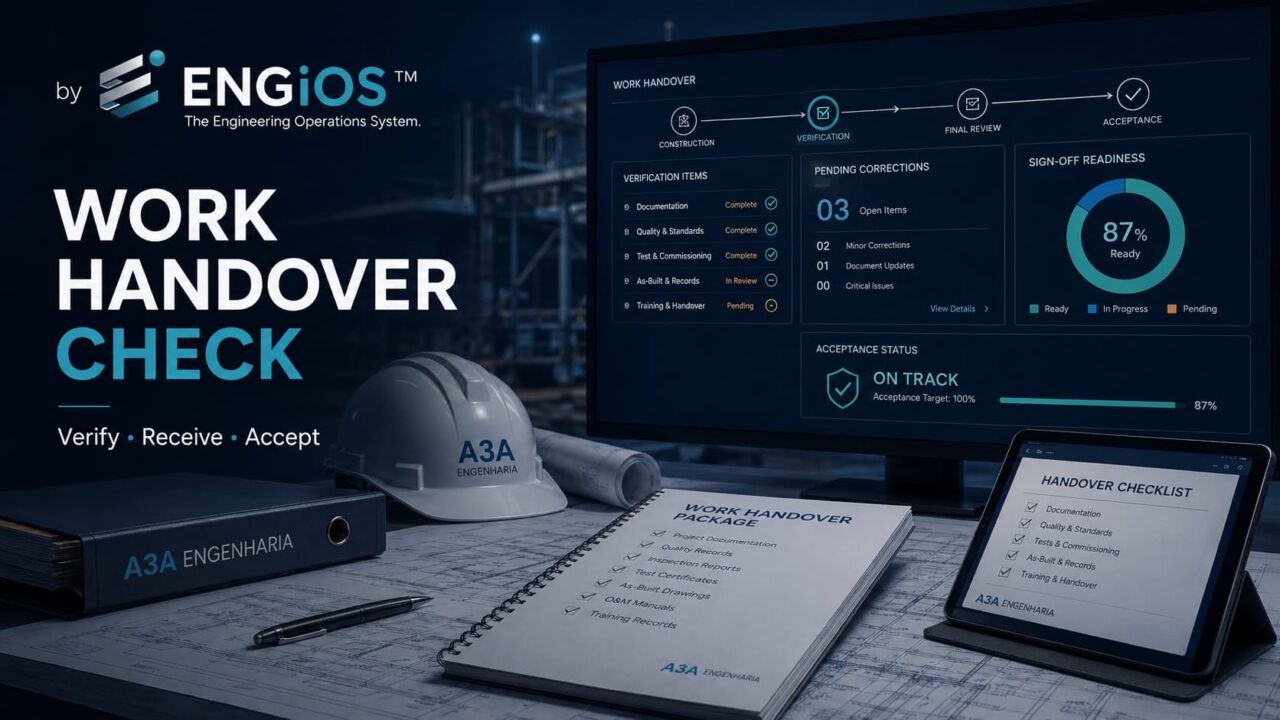
The contractor declared the works complete. See what a public contracting authority should verify in the field, documentation, tests, outstanding items, receipt and technical acceptance before closing the contract.
Check it out!
A contractor’s notice that construction is complete does not, by itself, end the owner’s responsibility to technically verify the delivered scope. For a public-sector contracting authority, the end of physical execution marks the beginning of a critical stage: comparing what was built against the design, specifications, contract, quality criteria, documentation, tests, outstanding items and receipt requirements.
A project may appear complete and still not be ready for receipt. Equipment may be installed, systems may be energized and spaces may already be in use while incorrect documents, tests without evidence, As-Built records inconsistent with the installed condition, open punch-list items or unproven contractual obligations remain.
Therefore, after the contractor declares completion, the right question is not simply “is the work finished?” The question is: is there sufficient technical evidence for the contracting authority to recognize that the scope was executed under the contracted conditions and safely proceed to the applicable receipt and acceptance milestones?
Physical completion is only one of the end-of-work milestones
In the lifecycle of an engineering contract, physical completion, technical completion, provisional receipt, final receipt, acceptance, handover and contractual closeout are related concepts, but they are not equivalent.
Technical Inspection of Engineering Works and Services must verify execution against objective requirements. Engineering Project Closeout broadens this analysis to final documentation, outstanding items, remaining responsibilities and transfer to operations.
A practical way to distinguish these milestones is to identify the dominant control question at each stage:
| Milestone | Control question |
| Physical completion | Has the planned field work been materially executed? |
| Technical verification | Does the executed condition comply with requirements, designs and specifications? |
| Documentation consolidation | Are there reliable records of what was built and tested? |
| Provisional receipt | Have the technical requirements necessary for receipt been verified? |
| Outstanding-item treatment | Have deviations been corrected, accepted with reservations or formally routed? |
| Final receipt | Have the applicable contractual requirements been demonstrated under the governing procurement regime? |
| Handover | Has operations received the asset, information, knowledge and responsibilities needed to assume it? |
| Closeout | Are obligations, records, warranties and remaining responsibilities under control? |
The distinction matters because a contractor may finish its installation activities while the contracting authority still lacks sufficient evidence to recognize technical delivery.
What Law 14.133 requires for the receipt of works and services
Brazilian Law No. 14,133/2021 expressly distinguishes execution from receipt. Article 140 provides, for works and services, for provisional receipt through a detailed record once compliance with technical requirements has been verified. The same article allows total or partial rejection of the object when it does not comply with the contract.
This means that the contractor’s notice does not replace verification by the contracting authority. The Administration must form its conclusion based on the contract and the available evidence.
The Brazilian Federal Court of Accounts (TCU) procurement and contracts guidance emphasizes that technical inspection should assess whether quantity, quality, timing and manner of execution are compatible with the established parameters. It also highlights that inaccuracies and irregularities should be recorded and routed for correction before receipt when they affect technical requirements.
The Complete Guide to Procurement and Contracts for Engineering Works and Services covers the broader public-procurement lifecycle and should be read together with the specific work-closeout procedure.
The first verification should be made against the contracted scope
The contractor’s completion notice is not the same as a receipt decision. The contracting authority must convert the declaration of completion into a verification supported by scope, inspections, tests, documents and outstanding items.
See how Technical Receipt of Engineering Works and Services works
At the end of the work, inspection should not begin by asking which documents the contractor wants to deliver. The starting point is to reconstruct the contracted obligation.
This baseline may be distributed among:
- the tender notice and technical annexes;
- the preliminary technical study, when applicable;
- the Terms of Reference or basic design;
- the detailed design;
- technical specifications;
- bill of quantities;
- design narratives and technical memoranda;
- risk matrix;
- the awarded proposal, when incorporated into the contract;
- the contract and amendments;
- work orders;
- formal responses to clarification requests;
- instructions, approvals and changes formally incorporated during execution.
The review should separate three sets: the original obligations, what was formally changed, and what was merely discussed or executed without valid incorporation into the baseline. Without this distinction, closeout becomes a negotiation based on memory, perception and competing versions of scope.
The Engineering Terms of Reference are especially relevant because execution, inspection, measurement, documentation and receipt requirements should be defined before procurement whenever appropriate to the instrument.
The final inspection should not focus only on finishes and apparent operation
A closeout inspection must verify the condition of the object and its compliance with the design. In a multidisciplinary installation, this includes both visible elements and interfaces that may not be apparent during a superficial inspection.
Depending on the object, the team should compare:
- equipment location and identification;
- executed quantities;
- models and technical characteristics;
- interfaces between systems;
- accessibility for operation and maintenance;
- finish and physical integrity;
- identification, labeling and signage;
- protective and safety devices;
- installation conditions required by design;
- field changes;
- removed or replaced items;
- technical cleanliness and organization;
- previous outstanding items not yet closed.
A visually well-finished project may still conceal configuration, performance, traceability or documentation problems. Visual inspection therefore needs to be combined with test evidence and document review.
Testing and commissioning demonstrate more than simple operation
Turning on equipment and observing a response is not equivalent to proving that the system meets the contracted requirements. Engineering systems may require functional tests, integration tests, measurements, certifications, performance tests, safety verifications and commissioning records.
Engineering Commissioning structures the transition from an installed condition to a demonstrated condition. Depending on the scope, the objective is to verify whether equipment, subsystems, interfaces, sequences, alarms, automation functions and performance respond according to defined criteria.
At work closeout, inspection should ask:
- which tests were mandatory;
- which acceptance criteria were defined;
- who witnessed or approved the tests;
- which instruments were used;
- whether calibration was required;
- which results were obtained;
- which failures occurred;
- which retests were performed;
- whether the final configuration is the same configuration that was tested;
- where the records supporting the conclusion are located.
The Inspection and Test Plan — ITP is one of the tools that helps organize this history during execution, avoiding the need to reconstruct all evidence only at the end.
Correct documentation is part of technical delivery
If the final documentation does not allow the executed condition to be reconstructed, there is a delivery problem even when the installation appears to operate correctly. As-Built records, test records, the Data Book and configuration files need to form a coherent chain of evidence.
See how to structure final documentation and As-Built for closeout
One of the most common conflicts occurs when the contractor treats documentation as secondary because the physical object is already operating. In engineering, this interpretation may be technically inadequate and, when documentation is part of the scope, may also represent incomplete delivery.
Technical Documentation in Engineering is not intended only for archiving. It supports operations, maintenance, future expansions, warranties, audits, safety, asset management and traceability of decisions.
At closeout, the team should verify not only whether a file with a given name exists, but whether it has sufficient quality to fulfill its intended purpose. This involves revision status, authorship, approval, internal consistency, correspondence with the executed condition and traceability.
Examples of documents that may form part of the final package, depending on the contract, include:
- As-Built drawings and diagrams;
- updated design narratives and memoranda;
- equipment and material lists;
- test and inspection reports;
- certificates and inspection records;
- operation and maintenance manuals;
- vendor documents;
- native files and digital configurations;
- warranties;
- training records and attendance lists;
- plans and procedures;
- ART/RRT and other applicable professional responsibility records;
- Data Book or quality dossier;
- outstanding-items matrix;
- receipt records and certificates.
The Engineering Data Book helps organize this chain of evidence, while Engineering Document Control maintains revision, status and traceability throughout the project.
As-Built documentation must represent the condition actually executed
The presence of an “As-Built” stamp does not prove that the document represents the work. The purpose of As-Built documentation is to record the condition actually executed with sufficient reliability for future use.
At closeout, the team should verify whether field changes were incorporated, whether revisions correspond to the final configuration, whether changes made during testing were fed back into the documents and whether the delivered files are mutually consistent.
The Complete Guide to Engineering As-Built Documentation explores the criteria for surveying, reviewing and validating the built condition.
An As-Built discrepancy is especially critical when it affects maintainability. If operators need to open panels, trace circuits, locate assets or reconstruct a future topology and the document records a condition different from what is installed, the documentation has failed its intended purpose.
An outstanding item does not disappear because the schedule reached 100%
Physical progress percentage is a control indicator, not an automatic declaration of compliance. A project may reach 100% on a given schedule and still have outstanding items that require correction or formal treatment.
The Engineering Punch List allows each item to be recorded with an owner, deadline, criticality, closeout evidence and condition for reinspection.
At minimum, it is useful to distinguish:
| Type of outstanding item | Potential effect |
| Blocking | Compromises safety, functionality, compliance or a condition required for receipt |
| Functional | Affects system performance, integration or operation |
| Documentation | Prevents adequate demonstration or use of the delivered condition |
| Quality | Indicates a deviation in material, execution, finish, installation or process |
| Residual | May be addressed later when there is a valid basis, assigned responsibility and control |
Classification should derive from technical and contractual criteria. The objective is not to create an endless list of minor adjustments, but to prevent relevant problems from being hidden by the physical-completion milestone.
An example: the CCTV system is operating, but delivery is still incomplete
Consider a video-surveillance implementation in which all cameras are installed and the VMS displays images normally. From the contractor’s perspective, the fact that the system is operational may create the impression that delivery is complete.
During the contracting authority’s verification, however, inconsistencies appear: final drawings do not match the actual position of some devices, part of the equipment list has not been reconciled, test reports do not clearly identify every point verified, final configurations were not recorded, training evidence is missing and the documentation package does not allow the accepted condition to be fully reconstructed.
In this scenario, the physical installation may have been executed to a good standard and the system may indeed be operating. Even so, that does not prove that all technical and documentation obligations required for delivery have been fulfilled.
The distinction is fundamental:
| Evidence | What it demonstrates |
| Cameras installed | Physical existence of the implementation |
| Images displayed in the VMS | Basic operation at that moment |
| Documented tests | Controlled evidence of required verifications |
| Validated As-Built | Baseline of the executed condition |
| Inventory and configuration | Traceability of the asset and its digital condition |
| Approved documentation | Information completeness according to requirements |
| Outstanding items closed | Treatment of identified issues |
| Formal receipt | Contracting authority decision according to applicable criteria |
This example shows why the statement “it is working” should not end the contracting authority’s analysis.
Provisional receipt must be technically defensible
For Brazilian public contracts governed by Law No. 14,133/2021, provisional receipt of works and services is linked to verification of technical requirements. This requires a documentary basis capable of showing why the responsible official concluded that those requirements were satisfied.
Provisional and Final Receipt in Engineering explains the distinction between the milestones and the risks of anticipating them.
A technically consistent process may consolidate:
- precise identification of the object and stage being received;
- reference documents;
- the inspection performed;
- inspection and test results;
- documents received and their respective status;
- list of outstanding items;
- nonconformities and their treatment;
- limitations or reservations;
- evidence supporting the decision;
- responsible parties and dates.
The receipt record documents the conclusion of this analysis. It does not replace the analysis.
Final receipt should not be confused with the mere passage of time
The specific rules for final receipt depend on the applicable legislation, regulations and contract. Within Brazil’s direct federal public administration, autonomous agencies and public foundations, Decree No. 11,246/2022 details the duties of contract managers and inspectors and, under the regime it governs, assigns final receipt to the contract manager through a detailed record demonstrating compliance with contractual requirements.
Regardless of the administrative structure applicable to the contracting authority, the technical principle remains: there should be a documented transition between the condition presented by the contractor and the condition recognized by the owner.
Final receipt also does not automatically extinguish responsibilities that the law or contract maintains after this milestone. Warranties, correction obligations, professional responsibilities and support conditions therefore need to remain traceable.
Handover verifies whether the organization can assume the asset
Technical Handover in Engineering broadens the question beyond immediate compliance: can the receiving organization operate, maintain, recover, modify and demonstrate the condition of the asset?
This may require:
- reliable final documentation;
- asset data;
- training;
- manuals;
- spares;
- warranties;
- configuration files;
- backups;
- licenses;
- procedures;
- support contacts;
- definition of custody;
- controlled residual outstanding items.
A poorly structured transfer pushes into operations problems that still belong to the implementation phase.
When the contracting authority does not have a sufficient multidisciplinary team
A contract may simultaneously involve electrical systems, automation, telecommunications, electronic security, civil works, HVAC, digital systems, documentation, quality and commissioning. Not every public body has an internal team with enough availability and specialization to examine each discipline in depth throughout the entire lifecycle.
Brazilian Law No. 14,133/2021 allows third parties to be hired to assist and support contract inspectors with information relevant to inspection. This assistance does not transfer the inspector’s exclusive duties to the third party and does not relieve the public official of legal responsibility.
This is where Technical Support for Inspection and Owner’s Engineering can support the contracting authority through analyses, inspections, document review, testing, technical opinions and evidence management.
Engineering Consulting does not decide in place of the public authority. It reduces technical information asymmetry and improves the quality of the information used for decision-making.
When inspection starts late, the cost of correction increases
A recurring problem is calling for specialized analysis only after the contractor reports 100% execution. By then, installations may be closed, teams demobilized, suppliers may already have left the site and documents may need to be reconstructed retrospectively.
More effective technical inspection follows the formation of evidence during the work. Inspections, hold points, nonconformance reports, tests, submittal review, document control and progressive As-Built development reduce the closeout effort.
The TCU itself identifies late appointment or insufficient staffing of the inspection team as a risk because it can lead to late detection of deviations and receipt of objects that are not yet in an adequate condition.
Closeout therefore should not be planned only at closeout. Delivery and acceptance criteria should originate during procurement planning.
If the work is already finished and doubts remain, the technical condition can still be reconstructed
When monitoring during execution was insufficient, the contracting authority can still structure an independent verification. The work should be sized according to criticality, available documentation and access to the installation.
One possible sequence is:
- reconstruct the contractual baseline and requirements;
- inventory the documents required and received;
- inspect and survey the executed condition;
- reconcile design, field condition and As-Built;
- verify inspection and test records;
- define supplementary tests when technically justified;
- classify outstanding items and nonconformities;
- identify responsibilities and correction deadlines;
- monitor corrections and retests;
- consolidate a technical opinion or report to support the receipt decision.
The article Engineering work with quality failures: what to hire to diagnose, correct and regain technical control examines the choice among audit, reinforced inspection, QA/QC, commissioning and Owner’s Engineering when the project already presents problems.
The best time to define delivery is before the tender
Many conflicts at the end of the work originate in gaps created during the preparatory phase. If the contracting authority did not define in advance which documents, tests, formats, responsibilities, measurement criteria and receipt conditions would be required, the final discussion tends to become more subjective.
The appropriate logic is to connect:
public need → preliminary technical study → solution → design/Terms of Reference → tender → qualification → contract → execution → inspection → evidence → receipt.
The preparatory phase under Brazilian Law No. 14,133/2021 requires planning the technical and management considerations capable of affecting the procurement. Technical Support for Tendering and Engineering Proposal Analysis can act at this stage, while Owner’s Engineering and inspection support execution and closeout.
When acceptance criteria are created only after the work is finished, owner and contractor begin negotiating what should have been specified beforehand.
Contracting authority checklist after the work is declared complete
Before proceeding to receipt, an executive checklist may verify:
- contract scope and formalized changes reconciled;
- design and executed condition compared;
- quantities and specifications verified;
- final inspections completed;
- mandatory tests and inspections supported by evidence;
- nonconformities treated;
- punch list classified and controlled;
- As-Built validated;
- final documentation reviewed;
- required Data Book or dossier reconciled;
- manuals and warranties received;
- training completed when applicable;
- licenses, backups and configurations transferred when applicable;
- ART/RRT and professional responsibility records checked according to scope;
- maintenance and operating conditions verified;
- responsibilities for remaining items recorded;
- receipt criteria checked;
- receipt record supported by the evidence.
The checklist does not replace object-specific requirements. Its purpose is to prevent the physical-completion milestone from erasing technical dimensions that remain open.
Final considerations
When a contractor states that the work is complete, the contracting authority needs to convert a completion declaration into a technically substantiated decision. This requires checking not only what is visible in the field, but also requirements, documentation, tests, performance, outstanding items and operating conditions.
In public contracts, receipt has administrative effects and must comply with Brazilian Law No. 14,133/2021, the applicable regulations and the contract. Technical activities should produce clear evidence so that the competent public officials can exercise their duties with an adequate technical basis.
Good practice is to prepare for receipt from the planning phase: define requirements, measurement criteria, documents, tests and responsibilities before procurement; monitor their production during execution; and use the final stage to confirm a condition that has already been controlled throughout the work.
When this did not occur, Engineering Consulting, technical support for inspection, independent QA/QC, commissioning and technical receipt can help reconstruct the situation, classify outstanding items and produce reliable information for the contracting authority’s decision.
When a public body does not have sufficient multidisciplinary availability or specialization, the legislation allows third-party technical assistance to contract inspection, while preserving the powers and responsibilities of public officials.
Learn about Technical Support for the Inspection of Engineering Works and Contracts
Technical references
[1] BRAZIL. Law No. 14,133, April 1, 2021. Public Procurement and Administrative Contracts Law. Available at: https://www.planalto.gov.br/ccivil_03/_ato2019-2022/2021/lei/l14133.htm
[2] BRAZIL. Decree No. 11,246, October 27, 2022. Regulates the activities of contract managers and inspectors within the direct federal public administration, autonomous agencies and public foundations. Available at: https://www.planalto.gov.br/ccivil_03/_ato2019-2022/2022/decreto/d11246.htm
[3] BRAZILIAN FEDERAL COURT OF ACCOUNTS. Procurement and Contracts: TCU Guidance and Case Law. Section 6.1.4 — Technical inspection and provisional receipt. Available at: https://licitacoesecontratos.tcu.gov.br/6-1-4-fiscalizacao-tecnica-e-recebimento-provisorio-2/
[4] BRAZILIAN FEDERAL COURT OF ACCOUNTS. Procurement and Contracts: TCU Guidance and Case Law. Section 4.3 — Terms of Reference. Available at: https://licitacoesecontratos.tcu.gov.br/4-3-termo-de-referencia-tr/
Frequently asked questions
No. The completion notice starts the contracting authority’s verification. Receipt must follow the applicable technical and contractual requirements, the procedures defined in the contract and regulations, and the evidence that the object was executed according to requirements.
Yes. Apparent operation is only one piece of evidence. Incorrect documents, unproven tests, inconsistent As-Built records, outstanding items, configurations not transferred or other contractual obligations may remain.
Depending on the object, scope, designs, executed condition, inspections, tests, documentation, nonconformities, outstanding items and other technical requirements defined in the tender documents, contract and references should be checked.
No. Brazilian Law 14,133 establishes that provisional or final receipt does not exclude civil and professional responsibilities within legal and contractual limits.
Yes. Brazilian Law 14,133 allows third parties to be hired to assist and support inspectors with relevant information. The third party cannot exercise duties exclusive to the inspector, and the engagement does not transfer the public official’s legal responsibility.
The recommended approach is to reconstruct contractual requirements, inventory the documents required and received, compare the executed condition, record outstanding items, require corrections and produce sufficient evidence to support the receipt decision.
Complementary technical materials
Related solutions
Related services
- Technical Support for Inspection of Engineering Works and Contracts
- Technical Receipt of Engineering Works and Services
- Owner’s Engineering
- Engineering Commissioning
Main content on this topic
- Complete Guide to Procurement and Contracts for Engineering Works and Services
- Technical Inspection of Engineering Works and Services
