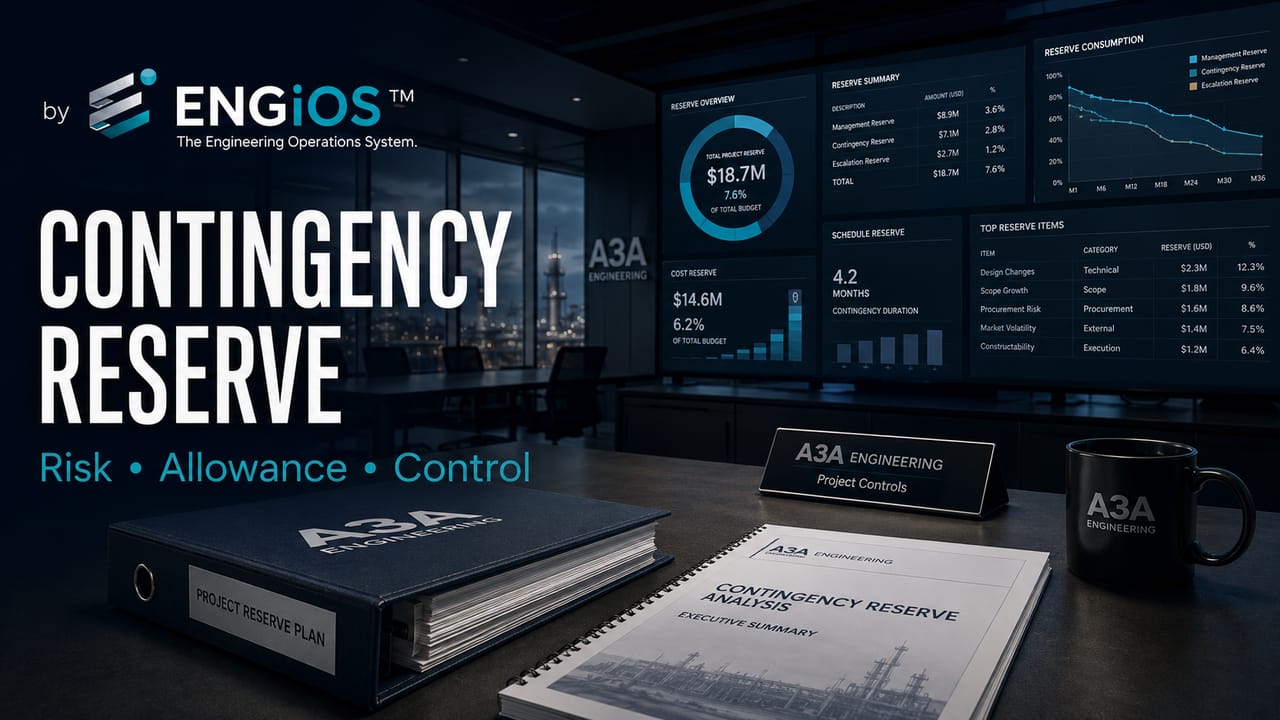
Learn how to size contingency reserves in engineering projects, distinguish contingency from management reserve, and relate risks to cost, schedule, P50, and P80.
Check it out!
A contingency reserve in public works is the portion of the budget intended to financially address uncertainties and risks that remain relevant after defining the scope, design, assumptions, and risk responses. It should not operate as an arbitrary percentage added at the end of a spreadsheet, nor as a generic allowance to cover any future problem. A technically defensible contingency originates from identified risks, quantification criteria, verifiable data or parameters, and a calculation record that makes it possible to reconstruct why that amount was incorporated into the budget.
Under Brazil’s Law No. 14,133/2021, the relationship between risk and price appears objectively: when procurement uses a risk matrix, risks allocated to the parties must be compatible with each party’s management capacity, and their financial effects must be considered in the estimated value when applicable. The Cost Engineering in Public Works Guide, published by Brazil’s Federal Court of Accounts (TCU) in 2026, develops this logic further and treats contingency as part of a cost-engineering architecture rather than as an unsupported margin.
The central point is to separate elements that are often mixed together. The base estimate represents the cost of known scope under the adopted assumptions. Contingency addresses uncertainties and risks compatible with the model and the risk matrix. Management reserve may protect the project against additional exposures under separate governance. Escalation addresses the evolution of prices over time when applicable. Scope change requires its own treatment and should not automatically be financed by contingency. Mixing these components creates double counting, distorts comparisons, and weakens budget auditability.
There is also no universally correct percentage. Applying 5%, 10%, or 15% simply because it is “market practice” may be inappropriate for a public-sector estimate. The amount needs to reflect the actual project profile, design maturity, transferred or retained risks, data quality, and the quantification method. In higher-value projects, probabilistic models may use percentiles such as P50, P70, or P80; these percentiles are not automatically synonymous with overpricing, but rather confidence levels that must be linked to a consistent methodology and an explicit risk decision.
Recent case law reinforces this requirement for substantiation. In Decision 1,218/2026-Plenary, TCU stated that when a portion corresponding to risk assumed by the private party is incorporated into the estimated budget, using expert opinion exclusively to define probability and impact is insufficient: parameterization should seek empirical studies and conclusive historical data when available. This does not eliminate expert judgment; it means technical opinion must be supported by evidence and should not function as the sole basis for a relevant quantitative model.
What changes when contingency is included in a public-works budget
When a budget contains contingency without an explicit connection to risks, allocation, and a calculation record, the reserve stops functioning as a control and becomes a margin that is difficult to defend. The structure must start with risk and arrive at value — never the other way around.
In private projects, the reserve may be managed within corporate structures with internal rules for approval and use. In public works, contingency interacts with transparency, the estimated budget, the risk matrix, competition, the execution regime, oversight, and economic-financial equilibrium.
This changes the question. It is not enough to know “how much to reserve.” It is necessary to demonstrate:
- which risks justify the amount;
- who bears each risk under the contract;
- how probability and impact were obtained;
- which risks are already incorporated into other budget components;
- which method was used to consolidate exposure;
- which confidence level was selected;
- how the amount will be treated during procurement and execution;
- how to prevent contingency from being confused with scope change or deficient design.
The risk allocation matrix in engineering contracts is a central element of this process. It is not merely a legal table of responsibilities: when properly structured, it provides the basis for identifying which events may have an economic effect and which need to be considered in forming the reference price or contracting strategy.
Base estimate, contingency, management reserve, and escalation are not the same thing
| Component | Main function | Example |
| Base estimate | represent the cost of the defined scope under established assumptions | design quantities, cost compositions, productivity, and reference prices |
| Contingency | address identified or modeled uncertainties and risks within the defined boundary | quantity variation, productivity, technical risk, or event included in the model |
| Management reserve | address exposures under higher-level governance that are not part of ordinary contingency | emerging uncertainties or an additional amount defined by project governance |
| Escalation | reflect changes in prices, indices, or exchange rates over time when relevant | sector inflation over a multi-year schedule |
| Scope change | compensate for new scope or a properly characterized material change | addition of a system, area, or requirement not included in the reference scope |
Methods for estimating contingency according to cost engineering
TCU recognizes different families of methods. The choice depends on data availability, design maturity, materiality, and decision complexity. Mathematical sophistication does not compensate for poor assumptions; at the same time, relevant projects should not use simplified methods merely for convenience when the risks justify more robust analysis.
Expert judgment
Experts may assess probability, impact, correlation, and variable behavior when there is insufficient historical data. The problem is not using experts, but using isolated opinion as the sole basis. Decision 1,218/2026-Plenary reinforces that, for risk pricing incorporated into the budget, empirical and historical parameterization should be sought when available.
Guidelines and predefined ranges
Organizations may maintain tables or contingency ranges associated with maturity classes, project types, or stages. This approach becomes stronger when it derives from a comparable historical portfolio and has clear application rules.
Parametric modeling
Parametric models relate contingency to variables that explain exposure: design maturity, complexity, duration, contract type, quantity dispersion, team experience, or history of variances, for example.
Monte Carlo simulation
Monte Carlo simulation in engineering projects uses probability distributions for variables and events, running many scenarios to form a distribution of possible outcomes. Instead of generating a single value, the model makes it possible to observe percentiles and associate the estimate with confidence levels.
P50, P70, and P80: what the percentiles really mean
When a probabilistic model produces a cost distribution, percentiles make it possible to associate the budget with a confidence level. In simplified terms, a P50 value indicates that approximately half of the modeled scenarios fall at or below that cost and half exceed it. P70 represents a higher level of confidence; P80, higher still.
These values should not be treated as universal coefficients. A project’s P70 is not, by definition, “20% higher” than its P50. The distance between percentiles depends on variable dispersion and the risk structure.
Contingency and design maturity
Contingency does not fix an immature design. If the main risk drivers arise from information that can still be produced — surveys, investigations, coordination, or review — the better response may be to reduce uncertainty before tendering.
Design Review — Technical Review and Validation of Engineering Designs
The relationship with iPMP and project maturity is direct: low maturity tends to increase uncertainty regarding solution, quantities, schedule, and risk. Contingency should not, however, be used to justify prematurely procuring a project that is still unable to define the object adequately.
Relationship between contingency, the risk matrix, and the execution regime
Exposure changes according to the distribution of responsibilities. Unit-price contracts, lump-sum contracts, integrated contracting, and semi-integrated contracting have different logics for risk, solution flexibility, and quantity variation. Contingency needs to reflect that architecture rather than automatically importing a model used under another regime.
What Decision 1,218/2026 changes in practice
Decision 1,218/2026-Plenary is especially relevant because it addresses the methodology for pricing risks in the estimated budget. The TCU understanding states that it is irregular to use expert opinion exclusively to establish probability and impact when the portion corresponding to risk assumed by the private party is incorporated into the budget.
The practical consequence is a higher evidence standard. The estimating team should seek historical data, empirical studies, benchmarks, and other bases capable of supporting the parameters. When data are insufficient, the limitation needs to be explicit and expert judgment should be documented more rigorously.
How to avoid double counting risk
Double counting occurs when the same exposure is compensated or reserved in more than one component. To avoid duplication, the team should record where each uncertainty was treated: in the base estimate, in item variability, as a discrete event, in overall contingency, in management reserve, in escalation, in insurance, or in a specific contractual mechanism.
Should contingency be included in BDI?
There is no universal answer that allows all contingency to be automatically placed inside or outside BDI in works and engineering services without analyzing the estimating model and the applicable regime. The technical point is to avoid confusing concepts or duplicating amounts. If BDI already compensates for a given business or contractual risk, project contingency should not reproduce it without justification.
How to document an auditable calculation record
A technically sound reserve can become fragile if nobody can reconstruct the calculation months later. The record should be treated as an engineering deliverable and document the estimate basis, risk register and matrix, parameter sources, quantitative method, results, selected confidence level, approvals, and revision history.
How to procure a risk and contingency analysis
A specialized engagement should go beyond “calculating a contingency percentage.” The scope should define inputs, process, deliverables, and acceptance criteria. It may include review of the base estimate, maturity analysis, consolidation of the risk register and matrix, identification of double counting, definition of quantitative methodology, data validation, probabilistic analysis, sensitivity analysis, calculation records, and a reserve update plan.
Engineering Risk Management materializes this approach by integrating identification, analysis, mitigation, contingency, and governance.
Final considerations
A contingency reserve in public works is not synonymous with an arbitrary margin. It is a cost-engineering component that should originate from identifiable risk, connect with the allocation matrix, respect the execution regime, and have an auditable calculation record.
The best result is not necessarily a larger or smaller contingency. It is an explainable reserve: the team can show which risks it covers, which it does not, why the amount was selected, what confidence level it represents, how it avoids double counting, and how it will be updated throughout the project lifecycle.
Technical references
[1] TRIBUNAL DE CONTAS DA UNIÃO. Engenharia de Custos em Obras Públicas: um guia de perguntas e respostas. Brasília: TCU, 2026.
[2] TRIBUNAL DE CONTAS DA UNIÃO. Acórdão 1.218/2026 — Plenário. Session of May 13, 2026. Available at: https://pesquisa.apps.tcu.gov.br/documento/acordao-completo/Portaria%2520SEGECEX%2520n%25C2%25B0%25207%252F2024/%2520/DTRELEVANCIA%2520desc%252C%2520NUMACORDAOINT%2520desc/2
[3] BRAZIL. Law No. 14,133 of April 1, 2021. Public Procurement and Administrative Contracts Law. Available at: https://www.planalto.gov.br/ccivil_03/_ato2019-2022/2021/lei/l14133.htm
Frequently asked questions
It is the budget amount intended to financially address uncertainties and risks compatible with the project model. It should be based on risks, assumptions, and a quantification method rather than on an arbitrary percentage without a calculation record.
Complementary technical materials
Related services
- Engineering Risk Management: identification, analysis, mitigation, and contingency
- Design Review in Engineering Projects: technical review, interfaces, and design maturity
- Technical Planning for Engineering Procurement