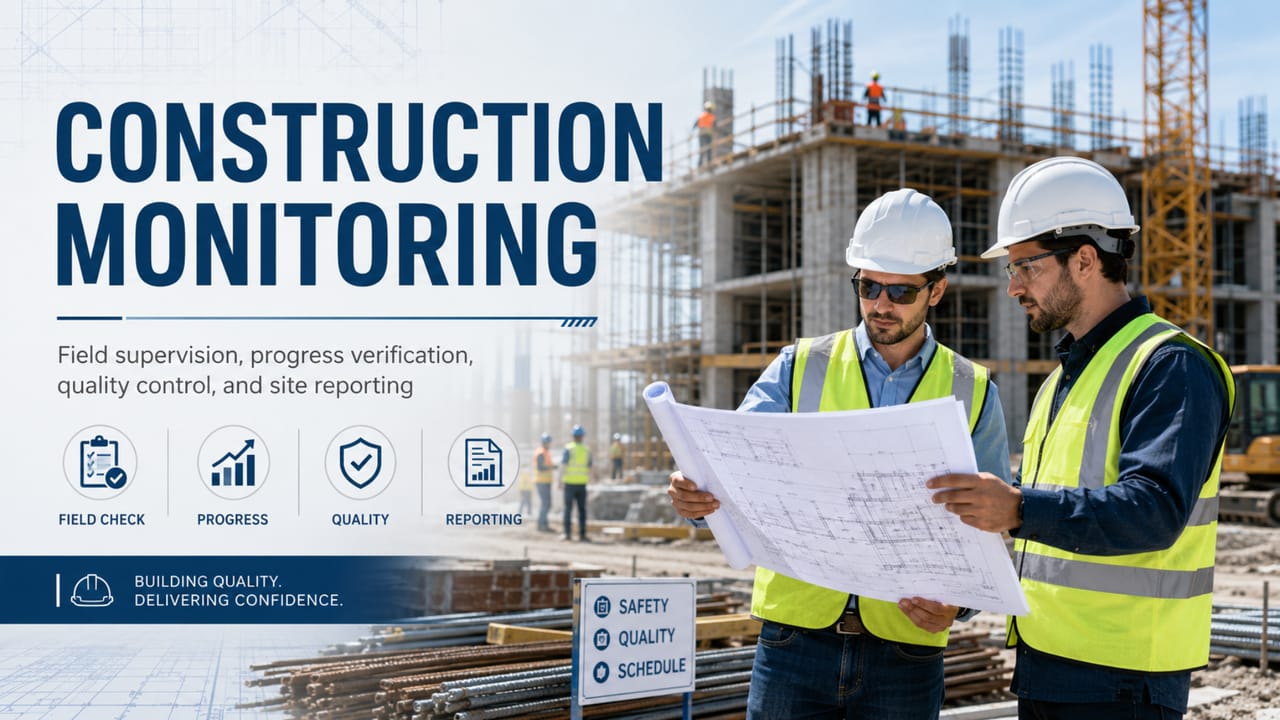
Understand how construction monitoring in engineering integrates technical inspection, the construction daily log, construction measurement, measurement statements, commissioning, outstanding items, and acceptance.
Check it out!
Construction monitoring in engineering should not be treated merely as field presence. In technical contracts, it should integrate technical inspection, the construction daily log, inspection reports, construction measurement, measurement statements, the outstanding-items matrix, commissioning, technical acceptance, and provisional or final acceptance.
This view is especially important when the client needs to protect scope, schedule, quality, documentation, performance, traceability, and technical responsibility. Without structured monitoring, construction may progress physically while remaining weak from documentary, contractual, and operational perspectives.
In practice, construction monitoring functions as a layer of technical control on behalf of the client. It verifies whether execution adheres to the contracted scope, reference documents, submitted measurements, collected evidence, recorded outstanding items, and defined acceptance criteria.
This topic is directly connected to Technical Inspection of Construction Works and Engineering Services, ao Engineering Technical Inspection Report, ao Measurement Statement in Engineering Consulting e ao serviço de Owner’s Engineering.
What is construction monitoring in engineering
Construction monitoring is the activity of verifying, recording, and technically supporting the execution of construction works, a deployment, or an engineering service throughout the contract.
It may involve scope analysis, document checking, monitoring of work fronts, evidence recording, measurement validation, outstanding-item control, commissioning support, risk analysis, and support for technical acceptance.
In a structured contract, construction monitoring helps answer:
- what was executed;
- what was measured;
- which evidence was presented;
- which outstanding items remain open;
- which risks were identified;
- which documents are missing;
- which services depend on testing or commissioning;
- which deliverables can advance to acceptance or handover.
This control reduces dependence on memory, perception, or informal negotiation during execution.
Construction monitoring is not merely a technical visit
The common mistake is to treat construction monitoring as a sequence of site visits. The visit is only a means. The objective is to produce technical verification and traceability.
Field presence creates value only when it results in records, evidence, findings, outstanding-item control, measurement validation, and objective recommendations to the client.
Therefore, construction monitoring should be connected to instruments such as the construction daily log, inspection report, measurement statement, outstanding-items matrix, technical acceptance record, and provisional or final acceptance.
Without this connection, monitoring may become mere observation without technical consequence.
Relationship between construction monitoring and technical inspection
Construction inspection is one of the central functions of technical monitoring.
The technical inspection verifies whether execution complies with scope, design, requirements, documentation, measurement criteria, and acceptance conditions. Construction monitoring organizes this verification over time, allowing the client to follow progress, deviations, outstanding items, and decisions.
In complex contracts, contract inspection is also connected to this process. It requires decisions, measurements, occurrences, and outstanding items to be clearly recorded to support governance, accountability, and technical closeout.
Construction daily log as documentary evidence
The construction daily log is one of the main chronological records of execution. It can document completed activities, teams present, field conditions, interferences, occurrences, releases, delays, mobilized resources, weather, photographic records, and technical observations.
Despite its high search volume, the construction daily log should not be treated merely as a template, spreadsheet, or application. In engineering consulting, it should function as documentary evidence of execution.
When properly used, the construction daily log supports:
- construction monitoring;
- technical inspection;
- inspection reporting;
- construction measurement;
- outstanding-item control;
- delay analysis;
- commissioning;
- technical acceptance;
- provisional and final acceptance.
The construction daily log should feed the technical analysis, not replace the inspection report.
Relatório de technical inspection
The relatório de technical inspection consolidates the analysis of execution.
While the construction daily log records chronological facts, the inspection report technically interprets those records, evaluates compliance, identifies deviations, consolidates evidence, organizes outstanding items, and recommends actions.
In well-structured monitoring, the report should indicate:
- inspected scope;
- reference documents;
- verified activities;
- collected evidence;
- analyzed measurements;
- open or closed outstanding items;
- technical risks;
- recommendations;
- impacts on acceptance or handover.
This document creates a basis for the client’s technical decisions.
Construction measurement, measurement statement, and evidence
The medição de obra não deve ser apenas cálculo de avanço físico-financeiro. Ela precisa ser sustentada por technical inspection, evidências documentais e verificação de aderência ao escopo.
The measurement statement registra serviços executados, etapas concluídas ou entregáveis medidos. The acompanhamento de obra verifica se o que foi medido foi efetivamente executado, se atende ao escopo e se possui evidências suficientes para validação.
This relationship prevents measurement from being treated only as a financial step. In engineering, measurement is also technical control.
The artigo sobre deliverable-based measurement in engineering consulting explores this logic in greater depth for technical and consulting services.
Construction measurement in the context of commissioning
In critical systems, construction measurement needs to consider the context of commissioning.
An installation may be physically complete but not yet tested, integrated, documented, or ready for operation. Therefore, construction monitoring should separate physical execution, measurement, testing, outstanding items, commissioning, and technical acceptance.
The commissioning of critical systems verifies whether systems, subsystems, automation, alarms, integrations, operating flows, documentation, and operating conditions are consistent with the design and the client’s requirements.
Nesse contexto, a medição deve ser analisada com cautela. The serviço pode estar instalado, mas a validação final pode depender de FAT, SAT, testes integrados, documentação e correção de pendências. The conteúdo sobre FAT, SAT, and integrated testing complements this stage.
Outstanding-items matrix and correction control
Construction monitoring without outstanding-item control tends to result in loss of traceability.
The outstanding-items matrix organizes open items by impact, responsible party, deadline, correction evidence, and closeout condition.
During monitoring, this matrix makes it possible to record execution problems, incomplete documentation, scope discrepancies, integration failures, pending tests, nonconformities, and conditional items.
This control is essential for deciding whether the delivery can advance to measurement, commissioning, acceptance with reservations, provisional acceptance, or final acceptance.
Construction monitoring and Owner’s Engineering
The acompanhamento de obra se conecta diretamente ao Owner’s Engineering.
In Owner’s Engineering, the consultant acts on behalf of the owner or client, supporting technical decisions, verifying deliverables, monitoring implementation, evaluating risks, validating measurements, organizing evidence, and supporting acceptance.
This work is relevant when the client needs an independent view of schedule, quality, scope, documentation, integration, commissioning, and performance.
In this context, construction monitoring does not replace the contractor’s responsibilities. It creates a technical-governance layer to protect the client’s interests.
Relationship with technical acceptance and provisional/final acceptance
The acompanhamento de obra deve preparar o caminho para o technical acceptance.
The acceptance criteria definem como a entrega será validada. The technical acceptance formalizes validation of the delivery based on scope, evidence, tests, outstanding items, and documentation.
The termo de technical acceptance records this decision. The provisional and final acceptance formalizes stages of submission, verification, and acceptance of the delivery.
When monitoring is well conducted, technical closeout no longer depends on a late assessment. It becomes the consequence of records accumulated throughout execution.
Risks of monitoring construction without a technical method
Monitoring construction without a method, evidence, and consistent records can create significant risks:
- measurements without sufficient evidence;
- physical progress without equivalent documentation;
- outstanding items without a responsible party;
- technical acceptance subjetivo;
- premature final acceptance;
- difficulty invoking warranties;
- falhas de commissioning;
- conflicts between client and contractor;
- loss of technical history;
- low contractual traceability.
These risks increase in contracts with multiple suppliers, integrated systems, critical environments, public agencies, or accountability requirements.
Como a A3The apoia o acompanhamento técnico de obras
The A3The apoia empresas privadas, indústrias, órgãos públicos e instituições no acompanhamento técnico de obras, implantações e serviços de engenharia.
Essa atuação pode incluir análise de escopo, revisão documental, technical inspection, relatório de fiscalização, validação de medição de obra, revisão de measurement statement, controle de pendências, apoio ao comissionamento, apoio ao technical acceptance e suporte ao recebimento provisório ou definitivo.
This work may be integrated with:
- Owner’s Engineering;
- EPCM;
- Ongoing Engineering Consulting Services;
- Technical Procurement;
- Detailed Design;
- Technical Due Diligence.
The objetivo é permitir que o contratante acompanhe a obra com método, evidências, rastreabilidade documental e responsabilidade técnica.
Recommended complementary content
Para aprofundar acompanhamento de obra, fiscalização, medição e technical acceptance, consulte também:
- Technical Inspection of Construction Works and Engineering Services;
- Engineering Technical Inspection Report;
- Measurement Statement in Engineering Consulting;
- Deliverable-Based Measurement in Engineering Consulting;
- Matriz de Pendências em Engenharia;
- Recebimento Provisório e Definitivo em Engenharia.
Conclusion
Acompanhamento de obra em engenharia é uma atividade de governança técnica. Ele deve integrar fiscalização de obras, diário de obra, relatório de fiscalização, medição de obra, measurement statement, outstanding-items matrix, comissionamento, technical acceptance e recebimento.
When well structured, monitoring protects the client, improves execution quality, reduces conflicts, and creates a documentary basis for technical and contractual decisions.
In engineering consulting, monitoring construction is not merely visiting the site. It means verifying, recording, measuring, identifying findings, validating, and technically supporting decision-making.
Talk to our Engineering Department
Se sua organização precisa de acompanhamento de obra, technical inspection, validação de medições, controle de pendências, comissionamento ou apoio ao aceite e recebimento técnico, fale com o Departamento de Engenharia da A3A.
The A3The apoia empresas privadas, indústrias, órgãos públicos e instituições no acompanhamento técnico de obras e serviços de engenharia com método, evidências e rastreabilidade documental.
Technical references
[1] A3The Consulting Engineering. Complete Guide to Engineering Consulting. Disponível em: https://a3aengenharia.com.br/conteudo/guias-tecnicos/guia-completo-sobre-engenharia-consultiva/.
[2] A3The Consulting Engineering. Procurement of Engineering Consulting with Traceability, Governance, and Cost Engineering. Disponível em: https://a3aengenharia.com.br/conteudo/whitepapers/contratacao-engenharia-consultiva-governanca-rastreabilidade/.
[3] PMI. PMBOK Guide.
[4] AACE International. Recommended Practices for Cost Engineering.
Frequently asked questions
It is the verification and technical recording of the execution of construction works, a deployment, or an engineering service, focusing on scope, evidence, measurements, outstanding items, commissioning, and acceptance.
The acompanhamento organiza a verificação ao longo do contrato. The technical inspection verifica conformidade com escopo, projeto, requisitos, documentação, critérios de medição e condições de aceite.
The diário de obra registra atividades, equipes, ocorrências, condições de campo e evidências, servindo como base documental para fiscalização, medição e relatório técnico.
The acompanhamento verifica se os serviços medidos foram executados conforme escopo e se possuem evidências suficientes para validação do measurement statement.
In Owner’s Engineering, technical monitoring supports the client with an independent view of scope, schedule, quality, measurements, risks, outstanding items, commissioning, and acceptance.
