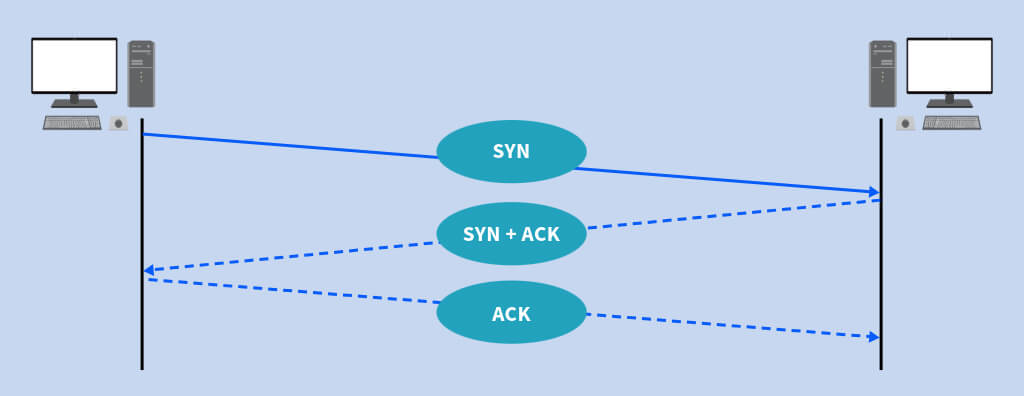
Network protocols are sets of rules and standards that enable communication between devices, defining how data is formatted, transmitted, received, and processed. This article explains their fundamentals, architecture layers, and major protocols.
Check it out!
Network protocols are sets of rules and standards that enable communication between devices. They define how data is formatted, transmitted, received, and processed.
This article explores the fundamental concepts of network protocols, highlighting their importance in standardizing communication systems and ensuring interoperability among different systems.
Read on!
[elementor-template id=”24446″]
What Are Network Protocols?
A network protocol defines the format and order of messages exchanged between two or more communicating entities, as well as the actions taken during the transmission and/or reception of a message or other event.
These protocols are essential to ensure interoperability among devices, allowing different hardware and software systems to communicate efficiently and in an organized manner.
Through a set of standardized rules, network protocols enable data exchange across local area networks (LANs) and wide area networks (WANs), such as the Internet.
Network Architecture Models
To organize the operation of communication networks in a structured way, protocols and the hardware and software components that implement them are distributed across layers.
Each protocol is associated with a specific layer in the network architecture, and each layer provides well-defined services to the layer above it. This hierarchical model organizes communication so that each layer performs specific functions and uses the services of the layer below to carry out its operations.
To provide its services, each layer performs internal operations that may include tasks such as data formatting, flow control, and packet routing, while depending on services provided by the layer directly below, such as the physical transmission of bits. The layer above then uses those services to add further functionality.
OSI Model
The OSI (Open Systems Interconnection) model, proposed by the International Organization for Standardization (ISO) in the late 1970s, is one of the main reference models used to describe communication in computer networks.
It was designed to organize network communication into seven distinct layers, each with well-defined responsibilities and functions:
- Physical Layer;
- Data Link Layer;
- Network Layer;
- Transport Layer;
- Session Layer;
- Presentation Layer;
- Application Layer;
Created before the rise of the Internet, the OSI model provides a solid theoretical basis for designing and understanding networks, facilitating interoperability among systems from different manufacturers and technologies.
TCP/IP Model
O TCP/IP Model é a estrutura fundamental que sustenta o funcionamento da Internet e de redes de computadores em escala global.
Initially developed during the 1970s and 1980s, it was designed to enable communication among heterogeneous networks and ensure interoperability among different systems.
This protocol suite allows data to be transmitted efficiently and reliably regardless of the infrastructure or technologies used in each network segment.
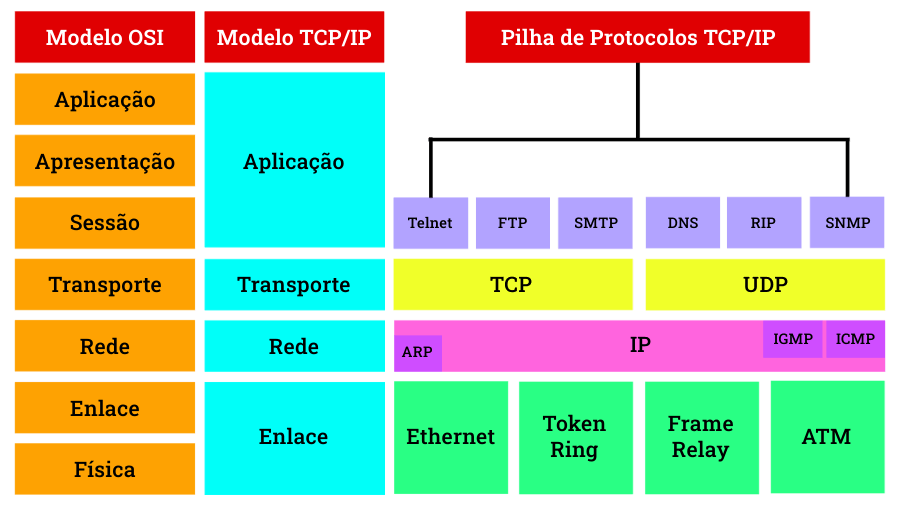
OSI Model e o TCP/IP Model.
The main difference between the OSI and TCP/IP models lies in how they handle certain functions.
In the OSI model, services such as data interpretation, synchronization, and session control are implemented in dedicated layers — the presentation and session layers.
In the TCP/IP model, those functions are not managed by dedicated layers. Instead, they are the responsibility of the application developer, who decides whether capabilities such as compression, encryption, and session control are required and how they should be implemented directly in applications or protocols.
Classification of Network Protocols by Layer
These layers may be implemented in software, hardware, or a combination of both. When the protocols from all layers work together, they form what is known as a protocol stack.
Physical and Data Link Layers
The first layer, commonly discussed as the data link layer, manages data transmission between devices directly connected through a physical medium, whether wired or wireless. In some models, these functions are separated into two layers: the data link layer and the physical layer.
The data link layer combines the physical transmission of bits with logical control that organizes those bits into frames so they can be correctly interpreted by destination devices. It performs several critical functions that support efficient communication within a local network.
One of the main responsibilities of the data link layer is physical addressing, using MAC addresses (Media Access Control) to uniquely identify devices connected to the network.
Another essential function is framing, which encapsulates data into frames. These frames contain not only payload data but also control information such as source and destination addresses and integrity checks, allowing the receiver to interpret the data correctly.
The data link layer also performs error detection using techniques such as checksums and cyclic redundancy checks (CRC) to identify corruption during transmission. Depending on the technology, a frame may be retransmitted or discarded when errors are detected.
Flow control is another important function, regulating the amount of data transmitted so that the receiver can process it correctly and avoid overload conditions that could lead to data loss.
The data link layer also manages media access control, defining when each device can transmit, especially on shared media. These mechanisms coordinate access where multiple devices share the same communication channel, as in wireless networks.
Finally, link-layer technologies organize data into frames sized according to the underlying technology and provide the framing required for correct delivery over the local medium.
Ethernet (IEEE 802.3)
Ethernet is a data-link technology standardized by IEEE under IEEE 802.3. Ethernet defines rules for communication between devices on a local area network (LAN), specifying how data is organized, transmitted, and received over the physical medium.
Ethernet specifies how devices identify one another, how data is encapsulated into frames, and how transmission integrity is checked, in addition to defining media access and error detection mechanisms
The basic transmission unit is the Ethernet frame, which encapsulates payload and control information. It contains several fields that support correct communication between devices.
Ethernet has evolved considerably over the years to increase transmission speed and efficiency. Early versions operated at 10 Mbps; later variants introduced Fast Ethernet (100 Mbps), Gigabit Ethernet (1 Gbps), and subsequently 10 Gbps, 40 Gbps, and 100 Gbps Ethernet.
These updates to IEEE 802.3 allowed Ethernet to meet increasing data-transmission requirements in enterprise networks and data centers. Ethernet can also use different physical media, including copper cabling (twisted pair) and optical fiber, depending on the required speed and distance.
Wi-Fi (IEEE 802.11)
Wi-Fi, standardized under the IEEE 802.11 family, defines specifications for wireless communication in local area networks (WLANs).
Developed through the Institute of Electrical and Electronics Engineers (IEEE), Wi-Fi became the dominant technology for connecting devices without cabling and is widely used in homes, businesses, and public spaces.
It enables communication among devices such as smartphones, laptops, tablets, and access points/routers using radio waves to transmit data.
Like Ethernet, Wi-Fi spans the OSI data link and physical layers. At the data link layer, it handles framing, media access control, and physical addressing; at the physical layer, it defines how radio signals are used to transmit and receive data.
The standard family defines how wireless devices communicate over radio frequencies using techniques such as modulation, signal coding, and power control. Common Wi-Fi bands include 2.4 GHz and 5 GHz, with different propagation, capacity, and interference characteristics.
PPP (Point-to-Point Protocol)
PPP (Point-to-Point Protocol) is a communication protocol used over direct point-to-point links between two network nodes, historically including serial, dial-up, and dedicated data connections.
PPP is standardized by the IETF (Internet Engineering Task Force) in RFC 1661 and was designed to provide datagram encapsulation over point-to-point links, along with mechanisms for link configuration, optional authentication, and error detection.
ARP (Address Resolution Protocol)
ARP (Address Resolution Protocol) supports communication among devices on a local network. Its primary function is to map IPv4 addresses (logical addresses) to MAC addresses (link-layer addresses) on technologies such as Ethernet.
When a device needs to send an IPv4 packet to another node on the same local network, it must know the destination MAC address. ARP maps the known IP address to the link-layer address required to deliver the frame.
The process works as follows: a device first checks whether the destination IP address already has a corresponding MAC address in its ARP table, a local cache of mappings. If not, it sends an ARP Request as a broadcast on the local network asking which node owns the target IP address. The device with that IP responds with an ARP Reply containing its MAC address.
Once the MAC address is obtained, the source can transmit an Ethernet frame to the destination. The IP-to-MAC mapping is temporarily stored in the ARP cache so it can be reused for subsequent communication.
Network Layer
The network layer manages routing and packet delivery across different networks, enabling information to travel from a source device to a destination even when they are on separate networks. This layer is critical in complex environments, especially wide area networks (WANs) and the Internet, where packets may cross multiple intermediate networks.
One of its main objectives is to select routes for packet forwarding across networks. Routers examine network-layer information and forward traffic between interconnected networks.
The network layer enables devices on different physical or logical networks to communicate without being directly connected. When a packet must reach another network, routing determines how it is forwarded across intermediate networks toward the final destination.
IP (Internet Protocol)
IP (Internet Protocol) is the primary protocol associated with the network layer in the OSI model and the Internet layer in the TCP/IP model. It provides logical addressing and packet forwarding across interconnected networks and is fundamental to the operation of the Internet.
IP uses logical addresses to identify network interfaces and destinations. IPv4 uses a 32-bit address space, while IPv6 uses 128-bit addresses, providing a vastly larger address space for modern network growth.
IP packets include headers containing information required for forwarding, including source and destination addresses. In IPv4, the TTL (Time to Live) field limits how many routing hops a packet can traverse before being discarded, preventing indefinite circulation. IPv4 headers also include fields such as packet length and a header checksum.
Fragmentation behavior depends on the IP version and path characteristics. IPv4 routers may fragment packets when permitted, while IPv6 relies on source-side handling and path MTU discovery rather than router fragmentation.
IP is connectionless and does not guarantee reliable delivery or in-order arrival. Reliability, when required, is provided by higher-layer protocols such as TCP (Transmission Control Protocol). Routers use destination IP information and routing tables to forward packets toward their destination.
The hop-limit mechanism prevents packets from circulating indefinitely during routing loops. IP can also be used with IPsec mechanisms to provide authentication, integrity, and confidentiality services where required.
ICMP (Internet Control Message Protocol)
ICMP (Internet Control Message Protocol) is an important supporting protocol at the network layer (Layer 3) used for control, error reporting, and diagnostics in IP networks.
ICMP provides error-reporting and diagnostic messages in IP networks. Routers and hosts use it to communicate conditions related to packet delivery and routing, including unreachable destinations and time-exceeded conditions.
RIP (Routing Information Protocol)
RIP (Routing Information Protocol) is one of the oldest and simplest dynamic routing protocols used in IP networks. It is a distance-vector routing protocol and was historically suited to small networks because of its simplicity, but it is poorly suited to large modern environments because of scalability and convergence limitations.
RIP selects routes primarily using hop count. Each router traversal adds one hop, and routes with fewer hops are preferred. RIP uses a maximum usable metric of 15 hops; a metric of 16 represents an unreachable destination. This limitation is one reason RIP does not scale well to large networks.
RIP is a dynamic routing protocol. Routers exchange routing information periodically, traditionally every 30 seconds, and maintain routing tables containing known networks, next hops, and route metrics.
OSPF (Open Shortest Path First)
OSPF (Open Shortest Path First) is a dynamic routing protocol used in IP networks. It is a link-state routing protocol widely used in enterprise and service-provider environments because of its scalability and convergence characteristics. OSPF is standardized by the IETF (Internet Engineering Task Force) and is an IGP (Interior Gateway Protocol).
Unlike RIP, which uses hop count, OSPF uses a cost metric and computes shortest paths using the Dijkstra shortest-path-first algorithm.
OSPF can divide a routing domain into areas to improve scalability and administration. Area 0 is the backbone area to which other areas connect. Routers exchange link-state information to build a topology database and calculate routes.
BGP (Border Gateway Protocol)
BGP (Border Gateway Protocol) is the routing protocol used to interconnect autonomous systems (AS) on the Internet. It is an interdomain routing protocol used to exchange reachability information among distinct administrative networks, unlike IGPs such as OSPF or RIP that operate within an autonomous system. BGP is fundamental to Internet routing between service providers and large networks.
Unlike routing protocols based primarily on simple metrics, BGP uses a policy-driven approach. Administrators can influence route selection and advertisement using multiple route attributes, making BGP suitable for the complex administrative relationships of the Internet.
BGP establishes peering sessions between routers. BGP peers exchange reachable prefixes and associated attributes, which are evaluated according to routing policy and used to populate routing information for inter-network traffic.
Transport Layer
The transport layer operates above the network layer and provides end-to-end communication services between hosts. Depending on the protocol, it may provide connection management, reliability, ordering, flow control, or lightweight datagram delivery independently of the underlying network infrastructure.
TCP (Transmission Control Protocol)
TCP (Transmission Control Protocol) is one of the most widely used transport-layer protocols. It provides reliable, connection-oriented communication, including sequencing, acknowledgments, retransmission, flow control, and congestion control. These properties make TCP suitable for applications that require ordered and reliable byte-stream delivery.
UDP (User Datagram Protocol)
UDP (User Datagram Protocol) is a transport-layer protocol designed to provide a simple, lightweight datagram service. Unlike TCP, UDP is connectionless: it sends datagrams without establishing a connection and does not guarantee delivery, duplication protection, or ordering.
UDP has lower protocol overhead than TCP and is useful where low latency and application-controlled behavior are more important than transport-layer reliability. UDP itself does not implement TCP-style flow control, congestion control, or retransmission of lost data.
Because UDP does not provide acknowledgments or retransmission at the transport layer, datagrams may be lost, duplicated, or delivered out of order. Applications must tolerate or compensate for these characteristics when necessary.
UDP is commonly used in applications where low latency matters and the application can handle loss or recovery itself. Examples include real-time media, VoIP (Voice over IP), certain video streaming scenarios, online games, DNS, and modern protocols that implement their own reliability mechanisms above UDP.
Application Layer
The application layer is the highest layer in common network architectures and provides network services directly to applications and services. It includes protocols used for functions such as web access, file transfer, name resolution, remote access, messaging, and other application-level communication.
Unlike lower layers that focus on packet delivery, routing, and transport, the application layer provides services directly to applications. It defines application-level exchanges and supports user-facing functions such as browsing websites, sending email, or using messaging services.
Its role is to provide the protocols and services applications need to use the network. Depending on the application protocol, this may include data representation, authentication, access control, encoding, and security mechanisms.
In the TCP/IP architecture, functions associated with session management, synchronization, and data presentation are commonly implemented by application protocols and software rather than by separate dedicated layers.
The application layer forms the practical interface between user applications and network services, abstracting much of the complexity of lower layers. Functions such as loading a web page or sending email are enabled by application-layer protocols and services.
HTTP (HyperText Transfer Protocol)
HTTP (Hypertext Transfer Protocol) is one of the most widely used application-layer protocols and is fundamental to communication on the Web. It defines how clients and web servers exchange requests and responses for resources such as HTML documents, images, APIs, and other content.
HTTP follows a request-response model in which a client sends a request and the server returns a response. HTTP is fundamentally stateless at the application-protocol level; application state such as login sessions is maintained through additional mechanisms such as cookies, tokens, or server-side state.
When a user opens a website, the browser sends HTTP requests to the relevant web server. Responses may contain HTML, images, CSS stylesheets, JavaScript, and other resources required to render the page.
Plain HTTP does not provide transport encryption. HTTPS protects HTTP exchanges using TLS (Transport Layer Security), providing encryption, server authentication, and integrity protection for data in transit.
FTP (File Transfer Protocol)
FTP (File Transfer Protocol) is an application-layer protocol designed for file transfer between a client and server, supporting both upload and download operations.
FTP has historically been used for remote file management and bulk transfers. Because traditional FTP does not encrypt credentials or content, secure alternatives such as SFTP or FTPS are preferred where confidentiality is required.
SMTP (Simple Mail Transfer Protocol)
SMTP (Simple Mail Transfer Protocol) is the standard application-layer protocol used to send email across IP networks. It transfers messages from clients to mail servers and between mail servers.
SMTP is primarily used for message submission and transfer, while mailbox access and retrieval are handled by protocols such as IMAP (Internet Message Access Protocol) or POP3 (Post Office Protocol).
DNS (Domain Name System)
DNS (Domain Name System) is a fundamental application-layer service that resolves human-readable domain names to resource records, including IP addresses. It allows users and applications to locate services by names rather than by memorizing numeric addresses.
The Importance of Network Protocols
Network protocols are fundamental to any communication system, from local networks to the global Internet. They establish the rules and procedures that govern data exchange among devices, from personal computers and smartphones to enterprise servers. Without shared protocols, communication among devices and systems built on different technologies and architectures would not be possible.
Interoperability
One of the main functions of network protocols is to ensure interoperability among devices from different manufacturers and technology stacks. Each device may use different hardware and software, but standardized protocols allow them to communicate effectively. The TCP/IP suite, for example, enables heterogeneous networks to interoperate from small endpoints to large Internet-scale systems.
Protocol standardization allows devices connected through local area networks (LANs) and wide area networks (WANs) to exchange information consistently and efficiently. This becomes increasingly important as the Internet of Things (IoT) and global connectivity expand and billions of devices need to exchange data.
Communication Reliability
Another critical role of network protocols is to provide the level of reliability required by the application. Protocols such as TCP (Transmission Control Protocol) provide sequencing, acknowledgments, retransmission, flow control, and congestion control to support ordered and reliable delivery. These mechanisms address conditions such as packet loss and network congestion.
Simpler protocols such as UDP (User Datagram Protocol) also have an important role where low latency and low overhead matter more than transport-layer reliability, including real-time media and interactive applications. This illustrates how different protocols are suited to different communication requirements.
Efficiency and Organization of Communication
Network protocols organize communication by defining how data is addressed, encapsulated, forwarded, and interpreted. Protocols such as IP (Internet Protocol) provide logical addressing and packet forwarding across multiple interconnected networks, allowing traffic to reach destinations through intermediate routers.
Protocols at different layers also provide mechanisms such as flow control and congestion control, helping endpoints and networks operate efficiently under changing traffic conditions.
Security
Another important aspect is security. Mechanisms such as HTTPS, TLS (Transport Layer Security), and IPsec can protect data in transit through encryption, authentication, and integrity controls. Without appropriate security protocols, network communications are much more exposed to interception and manipulation.
Protocols and extensions such as DNSSEC (Domain Name System Security Extensions) add authenticity and integrity protections to DNS data and help mitigate certain forms of DNS spoofing and redirection.
Scalability
As the Internet and enterprise networks continue to grow, protocol scalability is essential. BGP (Border Gateway Protocol), for example, exchanges routing information among autonomous systems and allows very large networks to interconnect at Internet scale.
Technologies such as IPv6 also address growth by providing a much larger address space than IPv4, supporting the continued expansion of connected devices and services.
Final Considerations
Network protocols are fundamental to the organization, interoperability, security, and reliability of communication among connected devices. They provide the common rules that allow heterogeneous networks and systems to exchange information at global scale and form the foundation of modern digital communication.
Conclusion
In summary, this article presented an overview of major network protocols and their role in efficient and secure digital communication.
There are many network protocols, each designed for specific functions ranging from email and web access to real-time communications and routing across complex networks.
The protocol ecosystem is broad and continuously evolving as network technologies, security requirements, and performance demands change.
Understanding how these protocols operate is essential for IT professionals, network engineers, and developers because protocols define how different systems interoperate and exchange information.
This foundation makes it easier to understand network architecture, troubleshooting, security, and the behavior of modern applications.