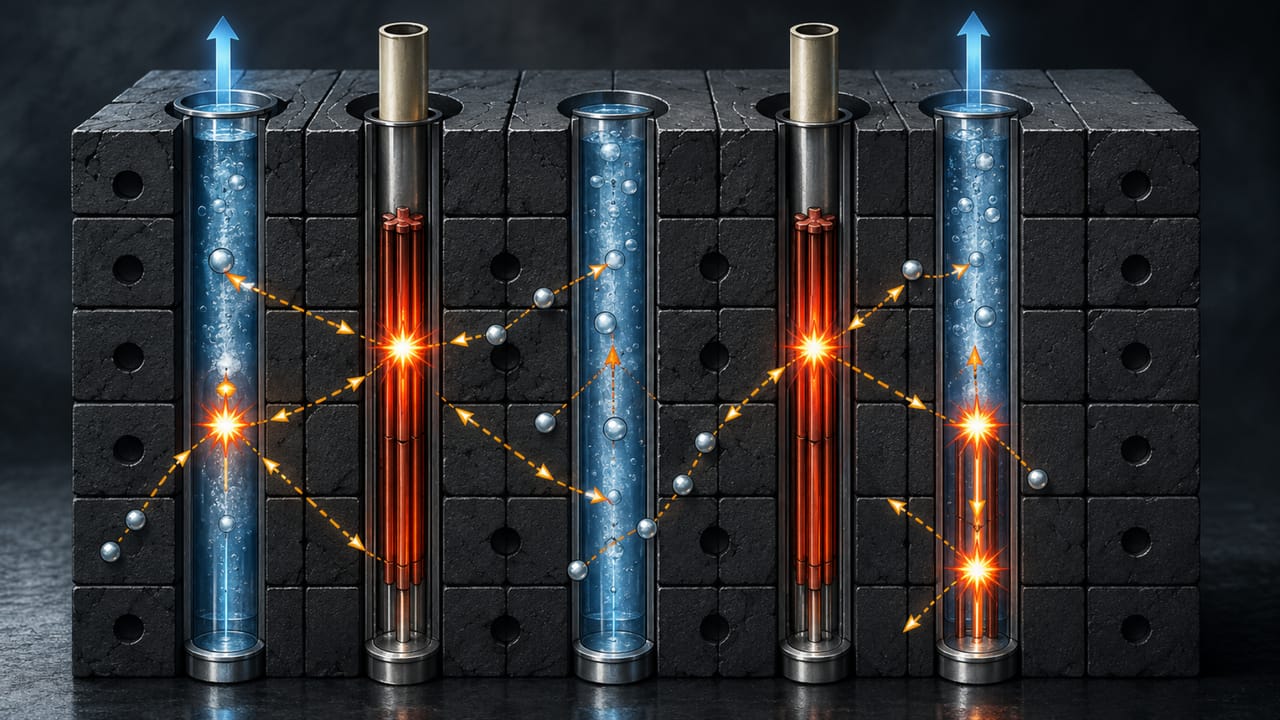
Understand how an increasing steam fraction could raise reactivity in the RBMK, why the effect depended on core state, and what role it played in Reactor 4.
Check it out!
The positive void coefficient was the characteristic by which, in certain RBMK configurations, an increase in the steam fraction inside the channels could raise core reactivity. In direct terms: liquid water absorbed part of the neutrons; steam absorbed less; graphite continued moderating. As a result, more steam could leave more neutrons available for new fissions.
This created the possibility of positive feedback: an increase in power produced more heat; more heat generated more steam; more steam could increase reactivity; and the increase in reactivity raised power again. Instead of damping the disturbance, the system physics could amplify it.
This explanation, however, requires precision. The void effect was not a simple constant and did not mean that any steam bubble would cause the reactor to run away. Its intensity depended on core configuration, the presence of absorbers, fuel burnup, spatial power distribution, and the operating reactivity margin — ORM.
In Reactor 4, the effect became critical because it encountered a core already in an unfavorable state: reduced power, xenon poisoning, many control rods withdrawn, low ORM, distorted power distribution, and a test that simultaneously altered electrical and thermal-hydraulic conditions.
This article explains what “void” meant, why the RBMK could exhibit positive feedback, how the effect varied throughout the core cycle, how the turbine test changed circulation conditions, and why later RBMK modifications confirmed the relevance of the design issue.
What does “void” mean in a nuclear reactor?
In the context of a water-cooled nuclear reactor, “void” does not mean an absolute empty space inside the core. It means the presence of steam, bubbles, or a steam fraction in the coolant.
In the RBMK, water entered through the lower part of the fuel channels, removed heat from the fuel assemblies, and rose through the channel. As it absorbed heat from nuclear fission, part of the water boiled and turned into steam. What left the channels was a water-steam mixture sent to the steam separators.
Thus, when we refer to “void” in the RBMK, we are referring to the partial replacement of liquid water by steam inside the channels.
This replacement mattered because liquid water and steam do not have the same effect on neutrons. Liquid water absorbs more neutrons than steam. Therefore, when liquid water turns into steam, the reactor’s neutron balance changes.
What is the void coefficient?
The void coefficient measures how reactor reactivity changes as the steam fraction in the coolant increases.
In simple terms:
- if more steam reduces reactivity, the void coefficient is negative;
- if more steam increases reactivity, the void coefficient is positive.
This detail changes everything. A negative coefficient tends to produce stabilizing behavior: when power rises and more steam appears, reactivity falls, helping to contain the power increase.
A positive coefficient can produce the opposite effect: when power rises and more steam appears, reactivity increases, causing power to rise even further.
This is why the positive void coefficient was a critical characteristic of the RBMK.
Void coefficient, total void effect, and operating point
The void coefficient describes the sensitivity of reactivity to a change in steam fraction under a given condition. It should not be confused with the total void effect, which represents the accumulated change in reactivity between two coolant states.
This distinction matters because the core response was not linear across the entire operating range. A value measured or calculated at a given power level, fuel composition, and absorber configuration could not automatically be applied to every other regime.
In practice, the same increase in steam could produce different consequences depending on the operating point. Safety assessment therefore needed to consider not only a nominal design property, but also the instantaneous core state, its margins, and the speed of the transient.
SCADA Systems
In critical systems, process trends, operating states, and margins need to be presented contextually, with history and correlation among variables.
What is the difference between a positive and negative void coefficient?
To understand the difference, think of the reactor as a control system.
In a system with negative feedback, a disturbance tends to be counteracted. If power rises too much, some physical effect tends to reduce it. This does not eliminate the need for protection systems, but it helps stabilize behavior.
In a system with positive feedback, a disturbance tends to be amplified. If power rises, some physical effect may cause it to rise even further. This type of behavior requires very strong, fast, and reliable control barriers.
For the void coefficient:
- negative void coefficient: more steam reduces reactivity;
- positive void coefficient: more steam increases reactivity.
The RBMK could exhibit a positive void coefficient under certain operating conditions. This does not mean the reactor was permanently uncontrollable, but some regimes depended heavily on margins, procedures, and monitoring systems capable of recognizing unfavorable states.
Digital Supervision and Control Systems
Supervision of critical systems needs to relate measurements, states, trends, and limits in a way that is understandable to the technical team.
Why does the void coefficient tend to be negative in many reactors?
In many reactors, water performs two central functions: it cools the core and also acts as a neutron moderator.
A moderator is the material that slows the fast neutrons released in fission, making them more effective at causing new fissions in uranium-235. When water is present, it helps maintain the chain reaction under suitable conditions.
If this water begins to boil and turns into steam, its density decreases. With less liquid water, there is less moderation. As a result, fewer neutrons remain in the energy range most favorable to fission. Reactivity tends to fall.
This behavior is stabilizing: more steam tends to reduce the nuclear reaction.
In the RBMK, however, the combination was different.
Why could the effect be positive in the RBMK?
In the RBMK, the main moderator was not water. It was graphite.
Water functioned as coolant and also absorbed some neutrons. But the graphite in the core continued slowing neutrons even when the water turned into steam.
This separation between moderator and coolant is the key to the problem:
- liquid water absorbed some neutrons;
- when water turned into steam, this absorption decreased;
- graphite continued moderating the neutrons;
- more neutrons remained available to cause new fissions;
- reactivity could increase.
In other words, in the RBMK the partial loss of liquid water did not eliminate moderation because graphite remained present. But it reduced neutron absorption by water. The result could be increased reactivity.
This is the essence of the positive void coefficient in the RBMK.
Water, steam, and graphite: the critical combination
The water-steam-graphite combination made the RBMK very different from reactors in which water is both the coolant and the dominant moderator.
In the RBMK:
- graphite slowed the neutrons;
- water removed heat from the fuel channels;
- liquid water also absorbed some neutrons;
- steam absorbed fewer neutrons than liquid water;
- graphite continued moderating even with more steam in the channels.
This architecture could be effective for power production under normal conditions, but it became sensitive under certain conditions, especially when the reactor was operating with a low control margin.
The problem was not the existence of steam itself. The RBMK was a boiling-water reactor; producing steam was part of normal operation. The problem was the effect that an increased steam fraction could have on reactivity in certain core configurations.
The positive feedback chain
The positive void coefficient is dangerous because it can form a positive feedback chain.
The sequence can be described as follows:
- power increases;
- more heat is produced in the fuel;
- more water boils inside the channels;
- the steam fraction increases;
- neutron absorption by water decreases;
- more neutrons remain available;
- reactivity increases;
- power rises even further.
This cycle is the opposite of self-correcting behavior. Instead of damping the disturbance, it can amplify it.
Under normal operation, control systems, margins, and procedures should have prevented this feedback from becoming dominant. In Reactor 4, however, several barriers were already compromised when the test began.
What does INSAG-7 say about the positive void coefficient?
INSAG-7 identifies the positive void coefficient as an important RBMK characteristic and as one of the central factors in the accident sequence.
In the table of design characteristics for RBMK Unit 4, the report lists the reactivity void coefficient at the operating point as positive. The document also records that the dependence of reactivity on coolant density was influenced by the configuration of absorbers in the core.
There is an important point of technical precision: the void coefficient was not a simple, immutable constant under every condition. It depended on core configuration, the presence of absorbers, fuel burnup, ORM, and the operating regime.
INSAG-7 states that during initial core loading, with additional boron-containing absorbers, coolant vaporization in a channel could produce a negative reactivity effect. During normal operation with on-power refueling and a certain reactivity margin, however, an increase in steam quality could produce a positive reactivity increase.
This nuance is essential: the danger was not captured by the simplistic statement “steam always increases power.” The danger was that under certain real RBMK operating conditions, more steam could significantly increase reactivity.
Why did the void coefficient depend on core configuration?
The RBMK core was large, heterogeneous, and changed over time. Fuel was replaced during operation, additional absorbers could be present or absent, xenon varied, the power distribution changed, and control rods occupied different positions.
This means the effect of steam formation depended on the specific core condition. In one configuration, vaporization could have a smaller or even stabilizing effect. In another, it could produce a dangerous increase in reactivity.
This characteristic is critical in engineering: a system should not be evaluated only by average behavior or an ideal scenario. Limit conditions, transients, degraded states, and combinations of variables that can reduce safety margins also need to be assessed.
In Reactor 4, the configuration before the accident was particularly unfavorable: low power, xenon, many rods withdrawn, low ORM, and a test in progress. It was exactly the type of scenario in which the positive void coefficient became more dangerous.
The void effect was not uniform across the core
The RBMK core was very large, with hundreds of channels distributed across different regions. Water flow, steam generation, fuel burnup, xenon concentration, and control-rod position were not identical at every point.
Therefore, total reactor power did not fully describe the reactor state. Two conditions with the same total power could have different axial and radial distributions, with some regions more sensitive to steam formation than others.
The safety problem was not only how much steam existed on average, but where it was forming, how the distribution was changing, and what effective margins remained available in that specific state.
Owner’s Engineering
Independent assessment helps verify whether assumptions, interfaces, and degraded scenarios have been treated consistently throughout the project life cycle.
The role of ORM in the positive void coefficient
ORM, or operating reactivity margin, was the remaining effective capacity of the control system to compensate for reactivity. When ORM was adequate, the reactor had a greater margin to cope with disturbances.
When ORM was low, small changes in steam, temperature, flow, or power distribution could have a much greater effect. The reactor became more sensitive and less tolerant of variations.
In Reactor 4, ORM was below the safe limit before the final sequence. This means the system had little effective capacity to compensate for the positive feedback caused by increasing steam.
For this reason, the positive void coefficient and low ORM need to be analyzed together. The positive void coefficient was the dangerous physical tendency. Low ORM was the loss of margin that made this tendency much harder to contain.
The role of graphite-tipped control rods
The original RBMK control rods had graphite displacers. These displacers existed for reasons of neutron efficiency: they replaced neutron-absorbing water with moderating graphite in certain regions of the channels.
When many rods were withdrawn and ORM was low, emergency insertion began from an unfavorable configuration. The graphite displacer could displace water in regions of the core before the absorber section became dominant.
This mechanism compounded the steam problem. Both involved the same neutron-physics logic: replacing water, which absorbed neutrons, with a condition in which fewer neutrons were absorbed while graphite moderation remained effective.
This relationship is explored in greater depth in Chernobyl: why did RBMK control rods have graphite?. The central point here is that the positive void coefficient, low ORM, and graphite-tipped rods were not isolated problems. They interacted in the same core.
The turbine test and the increase in steam
The test performed at Reactor 4 sought to determine whether the energy generated by the inertia of the slowing turbine would be sufficient to power essential pumps for a few seconds until the emergency diesel generators came online.
At first glance, it appeared to be an electrical test. But INSAG-7 clearly states that it is incorrect to characterize these tests as purely electrical because they involved changes to the supply circuit of major equipment and interventions in normal protections and interlocks.
From the core’s perspective, the test was sensitive because it involved water circulation, pump power supply, steam-valve closure, variations in flow, pressure, temperature, and steam formation. Water at the core inlet was close to boiling, and small hydraulic changes could influence the amount of steam in the channels.
With the reactor at low ORM and subject to a positive void coefficient, the test imposed hydraulic disturbances on a system that was already unstable.
INSAG-7 highlights that the initial test regime had specific thermal-hydraulic characteristics: high coolant flow, low initial steam quality, and water entering the core only slightly below boiling. This reduced the distance between the existing state and a significant change in steam fraction.
During turbogenerator rundown, electrical and process variables no longer evolved independently. Pump supply, circulation, separator levels, pressure, and steam formation were part of the same integrated sequence.
This is one reason the report rejects classifying the test as purely electrical. The change occurred at an interface between disciplines and needed to be evaluated according to the behavior of the complete system, not merely generator performance.
Commissioning and Technical Acceptance
Integrated tests should consider assumptions, interfaces, initial conditions, interruption criteria, and evidence of overall system performance.
Did the positive void coefficient cause the accident by itself?
No. The positive void coefficient was a central factor, but it does not explain the accident by itself.
The accident resulted from a combination of factors:
- RBMK design with a positive void coefficient under certain conditions;
- control rods with graphite displacers;
- low ORM;
- xenon poisoning;
- power recovery with excessive rod withdrawal;
- test conducted under degraded conditions;
- interventions in protection systems and interlocks;
- insufficient technical governance;
- weak safety culture.
The positive void coefficient explains why increased steam could accelerate the nuclear reaction. But the reason this became catastrophic lies in its combination with the other links in the causal chain.
What changed in RBMK reactors after Chernobyl?
The modifications made to RBMK reactors after the accident confirm the importance of the problem.
According to INSAG-7, improvement measures included:
- reduction of the positive void coefficient;
- installation of additional absorbers in the core;
- increase in the required ORM to the range of 43 to 48 rods;
- increase in fuel enrichment to 2.4% uranium-235;
- modification of control rods;
- reduction of rod insertion time;
- implementation of fast-acting emergency protection;
- improved ORM indication on the operator panel;
- restrictions on unsafe operating modes.
These changes show that the positive void coefficient was not merely a theoretical explanation developed after the fact. It was a design characteristic that had to be reduced through concrete engineering measures.
What do the later modifications reveal about the cause of the problem?
The subsequent interventions combined changes to fuel, absorbers, rods, protection speed, margin indication, and operating restrictions. This combination reveals that the vulnerability did not belong to a single component.
The objective was to simultaneously modify the physical response of the core, increase the available reserve, reduce permissive states, and make critical information more visible. In other words, design, automation, procedures, and governance had to be treated as a single safety barrier.
This is a principle applicable to any complex asset: when a risk depends on interaction among subsystems, a local correction may merely shift the problem. Requirements need to be traced through testing, evidence, acceptance criteria, and formal responsibilities.
Requirements, Evidence, and Acceptance Criteria Management
Technical requirements need to remain linked to design decisions, verification, evidence, and the criteria used to authorize operation.
Engineering lesson: positive feedback requires strong barriers
The positive void coefficient is a classic example of positive feedback in a critical system. When a disturbance reinforces itself, the system needs robust barriers to prevent uncontrolled growth.
In engineering, this applies far beyond nuclear reactors. It may appear in electrical, hydraulic, thermal, structural, automation, telecommunications, control, and protection systems.
Several questions are fundamental in any critical system:
- does the system exhibit positive feedback under any condition?
- was this feedback identified during design?
- are there instruments to monitor it?
- are there clear alarms for the operator?
- are there interlocks that prevent operation outside the margin?
- did integrated tests validate degraded scenarios?
- do protection systems act faster than the transient they need to contain?
This is the type of analysis that services such as Owner’s Engineering, commissioning, technical audit, technical due diligence, and FEL help structure on complex projects.
In critical systems, it is not enough to ask whether the system works under normal conditions. It is necessary to ask how it behaves when margins disappear, protections are demanded, variables interact, and transients evolve faster than the operational response.
Conclusion: more steam could mean more power
The positive void coefficient made Reactor 4 dangerous because, under certain RBMK conditions, steam formation could increase reactivity instead of reducing it.
Liquid water absorbed some neutrons. Steam absorbed fewer. Graphite continued moderating. Thus, more steam could leave more neutrons available for new fissions, increasing power and producing even more steam.
This mechanism does not explain Chernobyl by itself, but it explains why Reactor 4’s condition was so unstable. With low ORM, many rods withdrawn, a xenon-poisoned core, graphite displacers on the control rods, and the test in progress, the positive void coefficient became one of the decisive links in the causal chain.
To continue the technical journey, explore iodine and xenon poisoning, the reduction in ORM, the control-rod design, and the sequence from the start of the test to the destruction of Reactor 4.
Technical references
[1] INTERNATIONAL ATOMIC ENERGY AGENCY. The Chernobyl Accident: Updating of INSAG-1. Safety Series No. 75-INSAG-7. Vienna: IAEA, 1992.
[2] SHTEYNBERG, N. A. et al. Causes and circumstances of the accident at Unit 4 of the Chernobyl Nuclear Power Plant. In: INTERNATIONAL ATOMIC ENERGY AGENCY. INSAG-7, Annex I. Vienna: IAEA, 1992.
[3] ABAGYAN, A. A. et al. Causes and circumstances of the accident and measures to improve the safety of plants with RBMK reactors. In: INTERNATIONAL ATOMIC ENERGY AGENCY. INSAG-7, Annex II. Vienna: IAEA, 1992.
[4] UNITED STATES NUCLEAR REGULATORY COMMISSION. Report on the Accident at the Chernobyl Nuclear Power Station. NUREG-1250. Washington, DC: NRC, 1987.
[5] UNITED STATES NUCLEAR REGULATORY COMMISSION. Implications of the Accident at Chernobyl for Safety Regulation. NUREG-1251. Washington, DC: NRC, 1987.
[6] INTERNATIONAL NUCLEAR SAFETY ADVISORY GROUP. Safety Culture. INSAG-4. Vienna: IAEA, 1991.
[7] INTERNATIONAL ATOMIC ENERGY AGENCY. RBMK Reactors. Technical description and safety characteristics of pressure-tube graphite-moderated reactors.
[8] CHERNOBYL NUCLEAR POWER PLANT. Sequence of events at Unit 4 on 25–26 April 1986. Technical chronology compiled from operating records.
[9] MUELLNER, Nikolaus. Three Decades after Chernobyl: Technical and Institutional Lessons. Vienna: University of Natural Resources and Life Sciences.
[10] WORLD NUCLEAR ASSOCIATION. RBMK Reactors and Chernobyl. Technical overview and subsequent safety modifications.
Frequently asked questions
It is the condition in which an increase in the steam fraction of the coolant raises reactor reactivity. In the RBMK, this could occur because steam absorbed fewer neutrons than liquid water while graphite continued moderating.
Void means the presence of steam or bubbles in the coolant, that is, the partial replacement of liquid water by steam inside the fuel channels.
Liquid water absorbed some neutrons, while steam absorbed fewer. Because graphite continued providing moderation, more neutrons could remain available for new fissions.
No. The effect depended on core configuration, absorber presence, fuel burnup, power distribution, and operating reactivity margin.
With low ORM, the reactor had less effective capacity to compensate for reactivity changes and became more sensitive to an increasing steam fraction.
No. It was a central factor, but it acted together with low ORM, xenon, graphite-displacer control rods, test conditions, and failures in technical governance.
The test altered power supply, circulation, and thermal-hydraulic conditions in a system already operating with reduced margins and water near boiling at the core inlet.
Measures were adopted to reduce the void effect, increase operating margins, modify control rods, accelerate protection action, improve parameter indication, and restrict unsafe regimes.
Complementary technical materials
Solutions
- SCADA Systems
- Digital Supervision and Control Systems
- Requirements, Evidence, and Acceptance Criteria Management
Engineering services
Chernobyl series