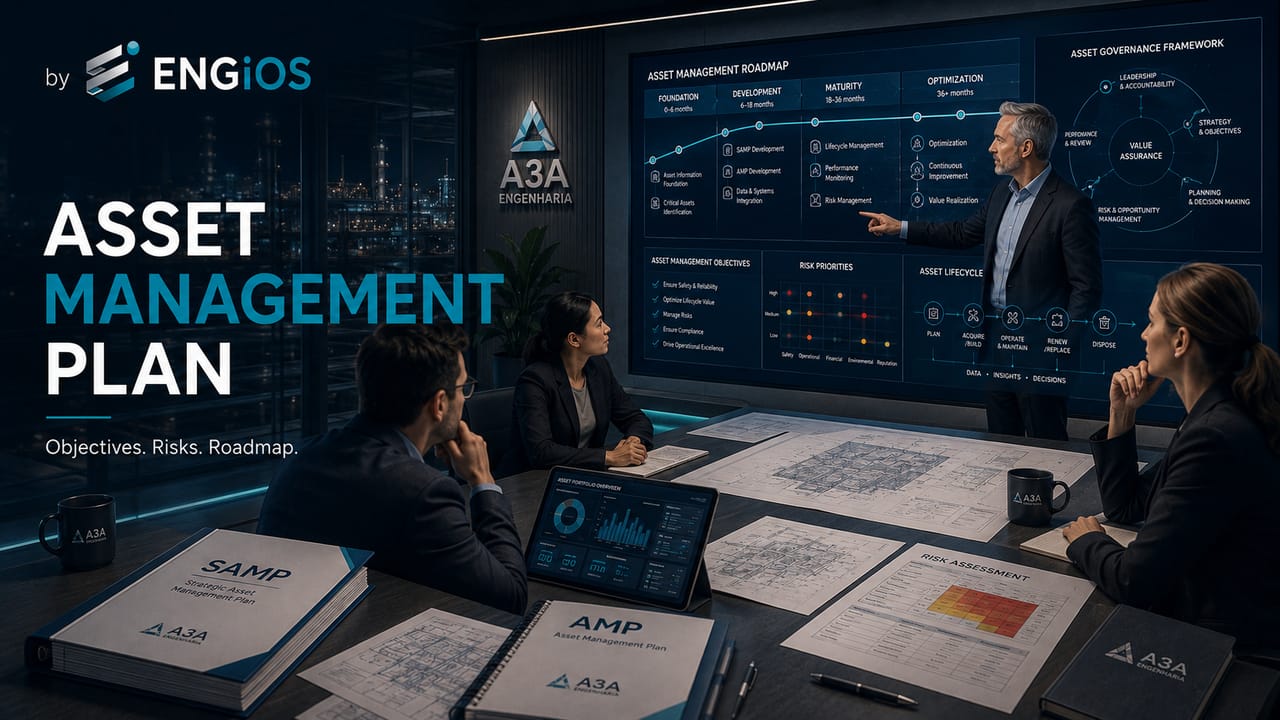
Asset Management Plan aligned with ISO 55001: SAMP, AMP, objectives, criticality, risks, CAPEX, roadmap, indicators, and lifecycle governance.
Check it out!
An Asset Management Plan translates organizational objectives into decisions, priorities, resources, and actions applicable to the asset portfolio. It should not be treated as a maintenance list or as a document produced only to comply with a standard: its value lies in establishing how the organization intends to obtain value from assets, which risks need to be addressed, which objectives will be pursued, and how lifecycle decisions will be governed.
ABNT NBR ISO 55001:2024 reinforces this logic by distinguishing the Strategic Asset Management Plan — SAMP — from Asset Management Plans — AMPs. The SAMP establishes strategies and approaches for decision-making, alignment, and implementation of asset management; AMPs translate objectives into actions, resources, responsibilities, schedules, methods, and evaluation criteria.
In organizations intensive in infrastructure, equipment, and systems, this architecture prevents maintenance, CAPEX, operations, projects, and finance from making disconnected decisions. The plan creates a traceable line between corporate objective, expected value, criticality, risk, performance, investment, and lifecycle action.
What Is an Asset Management Plan?
In the terminology of ABNT NBR ISO 55000:2024, an Asset Management Plan — AMP is documented information that specifies the activities, resources, costs, and timescales required for an individual asset or grouping of assets to achieve the organization’s asset management objectives.
This means an Asset Management Plan should answer, in a structured way:
- which assets or systems are in scope;
- which objectives need to be achieved;
- which risks and opportunities are relevant;
- what performance is required;
- which actions will be executed;
- which resources and competencies will be required;
- who will be responsible;
- when the actions will occur;
- which financial and non-financial impacts exist;
- how results will be measured;
- when the plan will be reviewed.
The mere existence of an asset register, maintenance schedule, or CAPEX budget does not, by itself, constitute an AMP.
SAMP vs. AMP: What Is the Difference?
The distinction between these two levels is one of the most important aspects of implementing asset management coherently.
| Element | SAMP — Strategic Asset Management Plan | AMP — Asset Management Plan |
| horizon | strategic and medium/long term | tactical and operational according to the asset or portfolio |
| focus | strategies, criteria, objectives, and decision approach | actions, resources, costs, schedules, and execution |
| scope | management system and asset portfolio | specific asset, class, system, or grouping |
| question | how will the organization manage its assets to realize value? | what will be done to achieve the defined objectives? |
| connection | organizational plan, policy, objectives, decision framework | SAMP, budget, maintenance, projects, contracts, and operations |
ABNT NBR ISO 55001:2024 requires the SAMP to determine strategies and approaches for decision-making and implementation, while AMPs must be established to achieve asset management objectives.
A SAMP without AMPs becomes intent. AMPs without a SAMP become a collection of actions without strategic direction.
The plan must connect strategy to execution. Organizational objectives, policy, SAMP, asset management objectives, AMP, budget, and evidence should form a traceable decision chain.
The Asset Management Alignment Chain
A mature architecture can be represented as:
organizational objectives → asset management policy → SAMP → asset management objectives → AMP → execution → measurement → review
Each level should maintain traceability to the previous one.
If the organization has an objective to increase operational continuity at a critical facility, for example, the policy can establish risk and value principles; the SAMP can prioritize critical systems and establish decision criteria; an asset management objective can define minimum availability; the AMP can provide for redundancy, renewal, spare parts, maintenance review, and monitoring; execution produces evidence; and indicators verify whether availability actually improved.
This chain prevents projects from being approved merely because budget is available or maintenance from being expanded without demonstrating contribution to objectives.
The Starting Point: Context and Stakeholders
ISO 55001:2024 begins the asset management system with understanding the organization’s context and stakeholder needs.
For the plan, this means mapping factors such as:
- business strategy and priorities;
- legal and regulatory requirements;
- contractual commitments;
- safety requirements;
- environmental and energy targets;
- capacity growth or reduction;
- capital constraints;
- technology obsolescence;
- availability of competencies;
- supply chain;
- climate change where relevant;
- expectations of customers and internal users.
The plan must reflect the real environment in which assets generate value. The same technology may require different strategies in a continuous-process industrial plant, an administrative building, or a Data Center.
Defining the Asset Portfolio and Hierarchy
Before planning, it is necessary to know what is being managed.
The portfolio defines the assets within the scope of the management system. The hierarchy organizes relationships among sites, systems, subsystems, equipment, and components.
An excessively detailed structure increases registration effort without improving decisions. A structure that is too superficial prevents failures, costs, risks, and plans from being associated at the correct level.
A useful hierarchy should at least allow the organization to:
- assign function and criticality;
- consolidate costs;
- record condition and failures;
- associate maintenance plans;
- identify system dependencies;
- locate documents and data;
- track investments and replacements.
The level of decomposition should be defined by the decision that needs to be made.
Asset Management Objectives
ABNT NBR ISO 55001:2024 establishes that asset management objectives should align with organizational objectives, focus on value realization, be measurable where practicable, and be monitored, communicated, and updated.
Weak objectives are generic formulations such as “improve maintenance” or “reduce costs.” Better objectives indicate the result and boundary.
Examples:
- reduce unplanned downtime of the utility system by 30% within 24 months;
- eliminate critical assets without a defined recovery strategy by the end of the budget cycle;
- reduce exposure to automation obsolescence classified as high or critical within three years;
- increase minimum data coverage for critical assets to 95%;
- reduce specific energy consumption of the HVAC system by 12% while maintaining performance requirements.
The indicator does not replace the objective, but it makes it possible to verify whether the action produced a result.
Criticality and Risk Within the Plan
ISO 55001:2024 requires processes to identify, analyze, and quantify risks associated with assets and determine asset criticality for achieving asset management objectives.
In practice, criticality helps determine where to concentrate analysis, resources, and controls.
An AMP can use criticality to differentiate:
- maintenance depth;
- redundancy requirements;
- spare-parts inventory;
- inspection frequency;
- renewal priority;
- monitoring level;
- operational contingency;
- data and documentation requirements.
The method is explored in greater depth in Asset Criticality Analysis.
Decision-Making Framework
One of the relevant changes in ISO 55001:2024 is the explicit treatment of the asset management decision-making framework. The organization should define the value it intends to obtain from assets, establish criteria, and select appropriate methods, processes, and tools.
This is fundamental to avoiding contradictory decisions across functions.
A framework can establish criteria for comparing alternatives considering:
- safety and compliance;
- operational risk;
- required performance;
- CAPEX and OPEX;
- lifecycle cost;
- implementation schedule;
- availability and reliability;
- maintainability;
- sustainability;
- obsolescence;
- future flexibility;
- data quality and confidence.
Depending on the decision, Life Cycle Cost — LCC, RAM analysis, risk matrices, multicriteria analysis, or other methods may be used.
Criteria come before alternatives. The decision framework should be defined before comparing projects, suppliers, or investments, avoiding adjustment of weights after the preferred solution is already known.
How to Turn Assessment Into a Roadmap
An Asset Management Plan often begins with an assessment of the current state. The mistake is to turn every gap into an immediate action without prioritization. A robust roadmap combines the importance of the asset or system, magnitude of risk, contribution to objectives, urgency, dependencies, required resources, operational window, data maturity, and financial and non-financial impacts.
| Wave | Objective | Examples of initiatives |
|---|---|---|
| 1 — Immediate risk control | Reduce exposures that cannot wait for full system maturity | critical risks, legal requirements, missing contingencies, high-consequence failures |
| 2 — Information and process stabilization | Create a reliable basis for decisions and execution | hierarchy, asset register, criticality, taxonomy, documentation, plans, indicators, and governance |
| 3 — Performance optimization | Improve reliability, maintenance, and efficiency based on evidence | RCM, RAM, condition monitoring, spare parts, and reliability engineering |
| 4 — Renewal and transformation | Reposition the portfolio for the future horizon | retrofits, replacements, automation, digitalization, energy efficiency, and CAPEX programs |
The waves do not need to be completely sequential. A critical retrofit may begin while the organization structures its asset register; the point is to preserve dependencies and avoid starting digital transformation on poorly defined assets or attempting statistical optimization before elementary risks are controlled.
A roadmap is not a wish list. The sequence must reflect risk, dependencies, execution capability, and expected value — starting with what controls real portfolio exposures.
Minimum Structure of an AMP
There is no single universal template, but an AMP needs to contain enough information to connect context, objective, risk, decision, execution, and review. A practical structure can be organized as follows:
| Block | Expected content |
|---|---|
| Scope and portfolio | assets, systems, boundaries, interfaces, and inclusion criteria |
| Context and requirements | organizational objectives, stakeholders, and legal, contractual, technical, and operational requirements |
| Condition and performance | current state, capacity, reliability, availability, efficiency, obsolescence, and history |
| Criticality, risks, and opportunities | classification, failure scenarios, residual exposure, contingencies, and improvement opportunities |
| Objectives | expected results, indicators, targets, and time horizons |
| Lifecycle strategies | maintain, monitor, repair, refurbish, recommission, modernize, replace, or decommission |
| Action plan | activities, projects, maintenance, studies, acquisitions, and required changes |
| Resources and responsibilities | budget, people, competencies, suppliers, tools, and accountable parties |
| Data and documentation | register, drawings, As Built, manuals, records, CMMS/EAM, BIM, models, and evidence |
| Monitoring and review | indicators, review frequency, change triggers, and governance |
The depth of each block should be proportional to the impact of the decisions. An AMP for a critical system may require risk modeling, LCC, RAM, and a detailed contingency strategy; a low-consequence asset grouping may be treated with a simpler structure. The value lies in sufficient information to decide and control, not in document length.
Simplified AMP Example for a Critical Electrical System
Consider a power supply system with aging panels, discontinued components, and high criticality.
The assessment identifies:
- physical condition still acceptable;
- satisfactory historical availability;
- scarce replacement parts;
- incomplete As Built documentation;
- estimated replacement lead time exceeding 20 weeks;
- no standby unit for some components;
- high risk of prolonged recovery after failure.
A condition-only view could conclude that “no intervention is required.” The AMP, however, considers lifecycle and risk.
The objective may be to reduce exposure to prolonged downtime within two years.
Actions may include:
1. complete documentation and asset register; 2. validate criticality of panels and loads; 3. acquire transitional spare parts; 4. develop retrofit engineering; 5. establish a testing and maintenance plan; 6. schedule phased replacement; 7. define contingency until modernization; 8. measure residual risk after each stage.
The plan does not automatically determine that “everything should be replaced.” It structures an interim strategy and a justifiable renewal pathway.
Condition Alone Does Not Determine the Decision
An asset in good condition may have high risk due to obsolescence, lack of support, or criticality. A degraded asset may have low priority if it has redundancy, easy replacement, and low consequence.
Lifecycle decisions therefore combine at least:
- condition;
- criticality;
- performance;
- reliability;
- maintainability;
- support and obsolescence;
- cost;
- risk;
- business horizon.
This is one of the central principles of the article Asset Management: Lifecycle, Value, Risk, and Performance.
Integration Between AMP and Maintenance
Maintenance plans are part of the lifecycle strategy, but they do not replace the AMP.
Maintenance engineering addresses how to preserve functions and control failure modes. The AMP also decides when maintenance is no longer the best strategy and refurbishment, modernization, or replacement becomes necessary.
For example, increasing preventive maintenance on obsolete equipment may reduce some failure modes but not solve unavailability caused by lack of spare parts. The Asset Management Plan must recognize this limitation.
See Maintenance Engineering and RCM.
Integration With CAPEX
The AMP is a structured source for building the CAPEX pipeline.
Instead of projects arising only from ad hoc requests by departments, the plan can generate initiatives based on risk, condition, capacity, obsolescence, and lifecycle strategy.
Each initiative can carry:
- related asset management objective;
- risk it intends to address;
- consequence of not executing it;
- recommended horizon;
- alternatives considered;
- investment estimate;
- impact on OPEX;
- dependencies and operational window;
- benefit indicators.
This traceability improves CAPEX Management and reduces projects disconnected from the asset strategy.
Required Data and Information
Plan quality depends on confidence in the information. This does not mean waiting for a perfect database before starting.
Useful data include:
- identification and hierarchy;
- location;
- manufacturer, model, and version;
- relevant dates;
- function and capacity;
- criticality;
- condition;
- failure history;
- maintenance;
- costs;
- availability;
- spare parts;
- obsolescence;
- technical documents;
- warranties and contracts;
- system dependencies.
For critical assets with poor data quality, the AMP itself can establish actions to improve information as part of risk reduction.
CMMS, BIM, and Digital Twin can support information management, but they do not replace decision criteria.
Responsibilities and Governance
Every plan needs to define ownership.
A responsibility matrix may involve:
| Role | Typical responsibility |
| senior management | approve direction, SAMP, and strategic resources |
| asset manager | coordinate objectives, plans, and review |
| engineering | technical criteria, studies, and lifecycle decisions |
| maintenance | strategies, condition, history, and execution |
| operations | service requirements, constraints, and performance evidence |
| finance | budgetary and economic alignment |
| procurement | contracts, suppliers, and lead times |
| HSE/compliance | safety, environmental, and compliance requirements |
Governance needs to establish forums and decision levels. Not every asset replacement requires executive approval; not every deferral of a critical risk can be decided at the operational level.
Plan Indicators
Indicators should track both execution of actions and the results achieved by the assets. The two levels need to be read together: completing activities on schedule does not represent success if availability, risk, cost, or service performance do not improve.
| Type | Examples | Use |
|---|---|---|
| Execution | percentage of actions completed, budget adherence, renewal milestones, asset-register coverage, plans reviewed, criticality updated | verify whether the AMP is being implemented as planned |
| Outcome | availability, critical failures, residual risk, lifecycle cost, exposure to obsolescence, energy consumption, compliance, service performance | verify whether actions produced the expected value and performance |
An organization may complete 100% of its actions and still fail to achieve the asset management objective. In that case, the review should question assumptions, action effectiveness, data quality, and even the plan design itself — not merely demand new dates.
Triggers for AMP Review
The plan should not remain frozen until the next annual cycle. Relevant changes may require an earlier review.
Typical triggers include:
- critical failure;
- change in demand or capacity;
- asset acquisition or disposal;
- new legal requirement;
- technology change;
- obsolescence declared by the manufacturer;
- accelerated deterioration;
- change in energy price;
- new financial constraint;
- performance below target;
- significant change in risk.
ISO 55001:2024 also requires changes with the potential to affect objectives to be addressed in a planned manner.
Asset Management Implementation Roadmap
For organizations that do not yet have a mature system, implementation can be organized into a pragmatic sequence that delivers value before attempting to cover the entire portfolio.
- Define scope and objectives: select priority facilities, classes, or systems and establish which problems asset management needs to solve.
- Map portfolio and criticality: build a hierarchy sufficient for decision-making and classify relevant assets.
- Assess gaps: evaluate condition, performance, risk, maintenance, data, obsolescence, documentation, and governance.
- Establish decision criteria: define how lifecycle, CAPEX, maintenance, and risk alternatives will be evaluated.
- Develop SAMP and objectives: translate organizational objectives into asset management strategy and objectives.
- Develop AMPs: create plans by portfolio, system, class, or priority grouping.
- Integrate budget and execution: connect actions with CAPEX, OPEX, maintenance, procurement, projects, and contracts.
- Measure and review: monitor results, update assumptions, and continuously improve.
The organization does not need to solve the entire portfolio at once. Starting with the highest-risk and highest-value assets makes it possible to test criteria, correct the data model, and consolidate governance before scaling the approach. Maturity should grow together with the ability to make better decisions, not merely with the number of documents produced.
Common Errors When Developing Asset Management Plans
The main problems include:
- turning the AMP into a maintenance plan;
- producing a generic document without concrete assets and decisions;
- defining objectives without indicators;
- classifying criticality without changing priorities;
- ignoring financial constraints;
- separating CAPEX from asset management;
- failing to record assumptions;
- depending on software to define processes;
- failing to establish responsibilities;
- treating condition as the only replacement criterion;
- building a roadmap without risk and dependencies;
- failing to review the plan after relevant events.
Another mistake is attempting to copy another company’s model. The SAMP and AMPs need to reflect the organization’s own context, portfolio, value, and risks.
When to Commission Support for Structuring the Plan
Specialized support tends to be useful when the organization has a large installed base, multiple disciplines, recurring CAPEX decisions, fragmented data, critical assets, obsolescence, recurring failures, or a need to implement a management system aligned with ISO 55001.
The work can begin with an assessment and roadmap without requiring full implementation of the management system in a single stage.
The expected result is a usable decision architecture: prioritized portfolio, criteria, objectives, plans, responsibilities, actions, and evidence capable of guiding maintenance, engineering, operations, and investments.
Learn about Engineering Asset Management →
Technical references
[1] ABNT. NBR ISO 55000:2024 — Asset management — Terminology, overview and principles. Rio de Janeiro: ABNT, 2024.
[2] ABNT. NBR ISO 55001:2024 — Asset management — Management systems — Requirements. Rio de Janeiro: ABNT, 2024.
[3] ISO. ISO 55000:2024 — Asset management — Vocabulary, overview and principles. Geneva: ISO, 2024.
[4] ISO. ISO 55001:2024 — Asset management — Asset management system — Requirements. Geneva: ISO, 2024.
Frequently asked questions
It is documented information defining the activities, resources, costs, timescales, and responsibilities required to achieve asset management objectives for an asset or grouping of assets.
The SAMP establishes the organization’s asset management strategy and approach; the AMP translates objectives into actions, resources, responsibilities, schedules, and methods applicable to assets or portfolios.
No. A maintenance plan is one possible part of the strategy. The AMP also addresses risk, performance, renewal, CAPEX, obsolescence, data, resources, and other lifecycle decisions.
Scope, assets, objectives, risks, criticality, actions, resources, responsible parties, schedules, costs, lifecycle methods, indicators, documented information, and review frequency.
Prioritization should combine contribution to objectives, criticality, risk, urgency, dependencies, resources, operational windows, and financial and non-financial impacts.
No. Poor data quality can be recorded as a risk and addressed within the plan itself, prioritizing the highest-impact assets and decisions first.
Complementary technical materials
Related solutions
- Requirements, Evidence, and Acceptance Criteria Management
- Technical Knowledge and Lessons Learned Management
- Field Applications, Inspection, and Technical Data Collection
Related engineering services
- Engineering Asset Management
- Reliability and Availability Engineering
- Maintenance Engineering
- Systems and Facilities Recommissioning
Related technical content
- Asset Management: Lifecycle, Value, Risk, and Performance
- ISO 55000 and Asset Management
- Asset Criticality Analysis
- Life Cycle Cost — LCC
- RAM Analysis
- CAPEX Management in Engineering Projects
- CMMS and Maintenance Management
Guides, frameworks, and references
