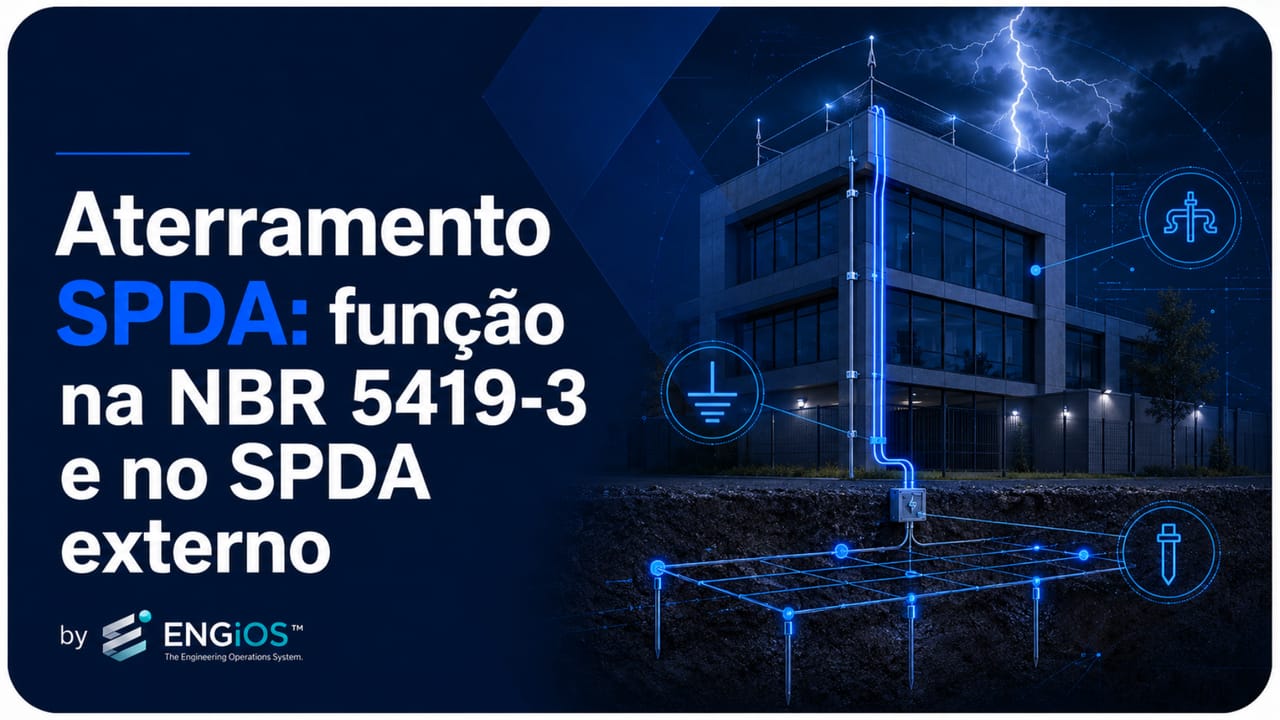
LPS grounding according to NBR 5419-3: understand its role in the external LPS and its integration with down conductors, equipotential bonding, SPDs and technical documentation.
Check it out!
LPS grounding is the external LPS subsystem responsible for receiving the current conducted by the down conductors and contributing to its dissipation into the earth. Under ABNT NBR 5419-3:2026, it is part of a system formed by the air-termination, down-conductor and grounding subsystems and should not be analyzed as a rod or grid isolated from the rest of the lightning protection system.
Its effectiveness depends on continuity of the current path, coordination with equipotential bonding, the condition of connections, interfaces with metallic parts and internal systems, and LPS documentation. The 2026 edition of NBR 5419-3 reinforces that verifying LPS effectiveness does not depend on an isolated grounding resistance value.
This article specifically addresses the function of grounding within the LPS and its interface with down conductors, equipotential bonding, inspection and documentation. Grounding design, grounding grids and grounding reports have their own scopes and should not be confused with this standards-based focus.
LPS grounding is not the same as grounding design
This article is not intended to replace content on grounding design, grounding grids, grounding reports or grounding measurements. Those topics have their own pages because they address different searches and intents.
Here, the focus is standards-based: to explain how LPS grounding appears within NBR 5419-3, how it connects to the down conductors of the external LPS, how it depends on equipotential bonding, and how it should be assessed in inspections, documentation and lightning protection system upgrades.
Technical note: this content is technical and interpretive in nature and does not reproduce tables, formulas or protected excerpts from ABNT NBR 5419. For application in design, reports, inspections or upgrades, the current version of the standard should be consulted from an official source or licensed standards collection, such as ABNT, with analysis by a qualified professional.
What is the role of LPS grounding in NBR 5419-3?
Within the logic of NBR 5419-3, grounding is the subsystem that receives the current conducted by the down conductors and contributes to its dissipation into the soil. It is not an isolated element: it is part of the physical path of lightning current.
This path begins at the air-termination subsystem, continues through the down conductors and reaches the grounding subsystem. Therefore, the standards-based function of grounding cannot be analyzed without considering continuity among these three elements.
For this reason, when NBR 5419-3 is applied to a design or inspection, grounding must be assessed as part of the external LPS, not merely as a separately measured item.
LPS grounding does not replace air-termination or down conductors
A common mistake is to treat grounding as if it alone solved lightning protection. This is not aligned with the logic of NBR 5419.
LPS grounding depends on a coherent physical system:
- air-termination to intercept lightning strikes at technically defined points;
- down conductors to conduct current to the ground;
- grounding to receive and dissipate that current;
- equipotential bonding to reduce hazardous potential differences;
- SPDs and internal protection measures when electrical and electronic systems must be protected.
Therefore, LPS grounding is essential, but it is not the entire LPS. It must be designed and assessed as part of the complete system.
LPS grounding in NBR 5419-3 and risk assessment
NBR 5419-3 addresses the physical solution of the external LPS, but the need for protection and the applicable protection level are related to the LPS risk assessment.
This means grounding should not be defined solely by construction habit. The solution must make sense in relation to the building, the protection level, identified risks, down conductors, natural components, internal systems and technical documentation.
When a building is still at the stage of determining whether protection is required, the correct starting point is the assessment presented in When does a building need an LPS?.
Interface between down conductors and LPS grounding
The connection between down conductors and grounding is a critical point in the application of NBR 5419-3. If this interface is not continuous, accessible, documented and technically compatible, the current path may be compromised.
In inspections of existing buildings, common issues include:
- down conductors without traceable connection to grounding;
- buried connections without documentation;
- sections modified during renovations;
- points inaccessible for inspection;
- corrosion at connections;
- lack of demonstrated continuity;
- discrepancies between the installed system and available documentation.
These are not merely construction details. They affect the ability to demonstrate technical compliance and make reports, maintenance and upgrades more difficult.
Relationship between LPS grounding and equipotential bonding
Equipotential bonding is one of the aspects that most clearly distinguishes a standards-based approach from a generic grounding approach. In lightning protection, conducting current to earth is not enough; hazardous potential differences among metallic parts, exposed conductive parts, structures, panels, piping, electrical systems and technical infrastructure must also be reduced.
For this reason, grounding associated with the LPS should be analyzed together with equipotential bonding bars, interconnections, metallic exposed conductive parts, electrical panels, cable trays, piping, metal structures and internal systems.
The content on electrical equipotential bonding examines potential equalization in greater depth. In this article, the focus is its role within the logic of NBR 5419.
LPS grounding, SPDs and the internal LPS
Although NBR 5419-3 is associated with the external LPS, LPS grounding also has a direct relationship with internal protection measures, especially when the building contains sensitive electrical and electronic systems.
Proper operation of SPDs depends on integration with grounding and equipotential bonding. Therefore, a well-executed external LPS may still be incomplete if internal interfaces are not properly addressed.
This connects Part 3 of NBR 5419 with the protection of internal systems, addressed in the context of internal LPS measures, SPDs, lightning protection zones, cabling, telecommunications, CCTV, automation, IT and sensitive equipment.
What should an inspection assess in LPS grounding?
In a technical inspection, grounding should not be assessed only by the presence of rods or by an isolated measurement. The analysis must consider the full set of evidence demonstrating continuity, integration and traceability.
Points commonly assessed include:
- compatibility between design and installation;
- connection points between down conductors and grounding;
- electrical continuity of the system;
- existence and condition of accessible connections;
- documentation of buried parts;
- corrosion or physical damage;
- integration with equipotential bonding;
- interface with SPDs and electrical panels;
- measurement records when applicable;
- need for maintenance, upgrades or supplemental documentation.
The LPS inspection and technical documentation should consider these elements in the actual condition of the building.
After understanding the role of grounding in the LPS, the next step is to verify the actual condition of the installation.
When there are doubts about continuity between down conductors and grounding, equipotential bonding, SPDs, measurement records or existing documentation, the assessment can proceed to an LPS inspection, LPS technical report or document review.
Grounding measurement within the standards context
Grounding measurement is an assessment tool, but it does not replace technical analysis of the system. A report that records only one value, without relating the result to the installation, continuity, down conductors, equipotential bonding and documentation, is incomplete.
Within the logic of NBR 5419, measurements should be interpreted as part of a broader diagnosis. They help assess the condition of the system, but must be accompanied by physical verification, document review and technical interpretation.
When the objective is to assess grounding as a specific service, the most appropriate content is Grounding Report: technical measurement, ART, LPS and documentation. Here, the focus remains on the role of grounding within NBR 5419-3.
Common mistakes when interpreting grounding in NBR 5419
The most common mistakes are:
- treating grounding as a topic separate from the external LPS;
- assessing only grounding resistance;
- ignoring continuity between down conductors and grounding;
- failing to document buried connections;
- overlooking equipotential bonding;
- installing SPDs without assessing the grounding reference;
- assuming isolated rods solve the entire system;
- failing to coordinate grounding with the risk assessment;
- assessing the system without design documentation, ART or technical records;
- failing to distinguish a standards article from a service, report or design page.
The result is an incomplete understanding of lightning protection.
How A3A applies this standards-based approach
A3A Engenharia assesses LPS grounding within the complete framework of NBR 5419. The analysis considers the relationship among air-termination, down conductors, grounding, equipotential bonding, SPDs, inspection and technical documentation.
The scope may include:
- risk assessment;
- LPS design;
- grounding design;
- verification of down conductors and connections;
- continuity assessment;
- equipotential bonding analysis;
- interface with SPDs and internal systems;
- technical reports;
- LPS inspection;
- documentation for maintenance and upgrades.
This approach avoids treating grounding as an isolated component and strengthens the technical traceability required in corporate, industrial, public, educational and healthcare buildings, condominiums, warehouses and environments with critical electronic systems.
Need to turn an LPS grounding assessment into a design, technical report or upgrade?
Based on the technical assessment, A3A Engenharia can support LPS Design, Grounding Design, LPS Technical Reports, inspections, technical documentation and upgrades according to the building scope.
Conclusion
LPS grounding in NBR 5419-3 should be understood as part of the external LPS, not as a generic electrical-installation topic. Its function is to form part of the physical path of lightning current, in continuity with the air-termination and down-conductor subsystems, and integrated with equipotential bonding, SPDs, inspection and technical documentation.
This focus reduces cannibalization with existing content on grounding grids, grounding design and grounding reports. At the same time, it strengthens the NBR 5419 standards subcluster by explaining how the standard structures lightning protection as an integrated system.
Technical references
[1] ASSOCIAÇÃO BRASILEIRA DE NORMAS TÉCNICAS. ABNT NBR 5419-3:2026 — Lightning protection — Part 3: Physical damage to structures and life hazard. Rio de Janeiro: ABNT, 2026. Available at: ABNT Catalog.
[2] ASSOCIAÇÃO BRASILEIRA DE NORMAS TÉCNICAS. ABNT NBR 5410 — Low-voltage electrical installations. Rio de Janeiro: ABNT. Available at: ABNT Catalog.
[3] ASSOCIAÇÃO BRASILEIRA DE NORMAS TÉCNICAS. ABNT NBR 5419-4:2026 — Lightning protection — Part 4: Electrical and electronic systems within structures. Rio de Janeiro: ABNT, 2026. Available at: ABNT Catalog.
Frequently asked questions
In NBR 5419-3, grounding is part of the external LPS and receives the current conducted by the down conductors, contributing to its dissipation into the soil in integration with air-termination, down conductors, equipotential bonding and technical documentation.
No. The grounding grid article addresses grid design and application criteria. This content has a standards-based focus: it explains how grounding fits into the logic of NBR 5419-3 within the external LPS.
No. A grounding report is a technical measurement and assessment service. This article focuses on the role of grounding in lightning protection according to the standards logic of NBR 5419.
Measurement is important, but by itself it does not prove compliance. Continuity, connections, down conductors, equipotential bonding, documentation, inspection and system integration must also be assessed.
Equipotential bonding reduces potential differences among metallic parts, exposed conductive parts, panels, piping, structures and internal systems, and is essential for grounding to function within an integrated lightning protection system.
Additional technical materials
Related solutions
- Lightning Protection
- Grounding and Equipotential Bonding
- Surge Protective Devices
- Surge Protection Measures
- Low-Voltage Electrical Installations
Engineering services
- LPS Design
- Grounding Design
- LPS Technical Report
- LPS Inspection and Technical Documentation
- LPS Maintenance and Upgrades
- Grounding Report and Technical Measurement
NBR 5419 and LPS cluster
- NBR 5419: LPS, risk assessment, grounding, SPDs and technical documentation
- NBR 5419-2: risk assessment in LPS designs
- When does a building need an LPS?
- External LPS: air-termination, down conductors and grounding in NBR 5419-3
- NBR 5419-4: internal LPS, SPDs and protection of electrical and electronic systems
- LPS Design: example, NBR 5419, risk assessment and ART
Grounding, equipotential bonding and SPDs
- Grounding Grid: design criteria, LPS and equipotential bonding
- Equipotential Bonding or Potential Equalization
- SPD: surge protection, NBR 5410, LPS and grounding
- SPD Coordination
- SPDs for Data Lines, CCTV, Automation and Telecommunications
- Grounding Measurement: technical report, ART, NBR 5419 and NBR 5410