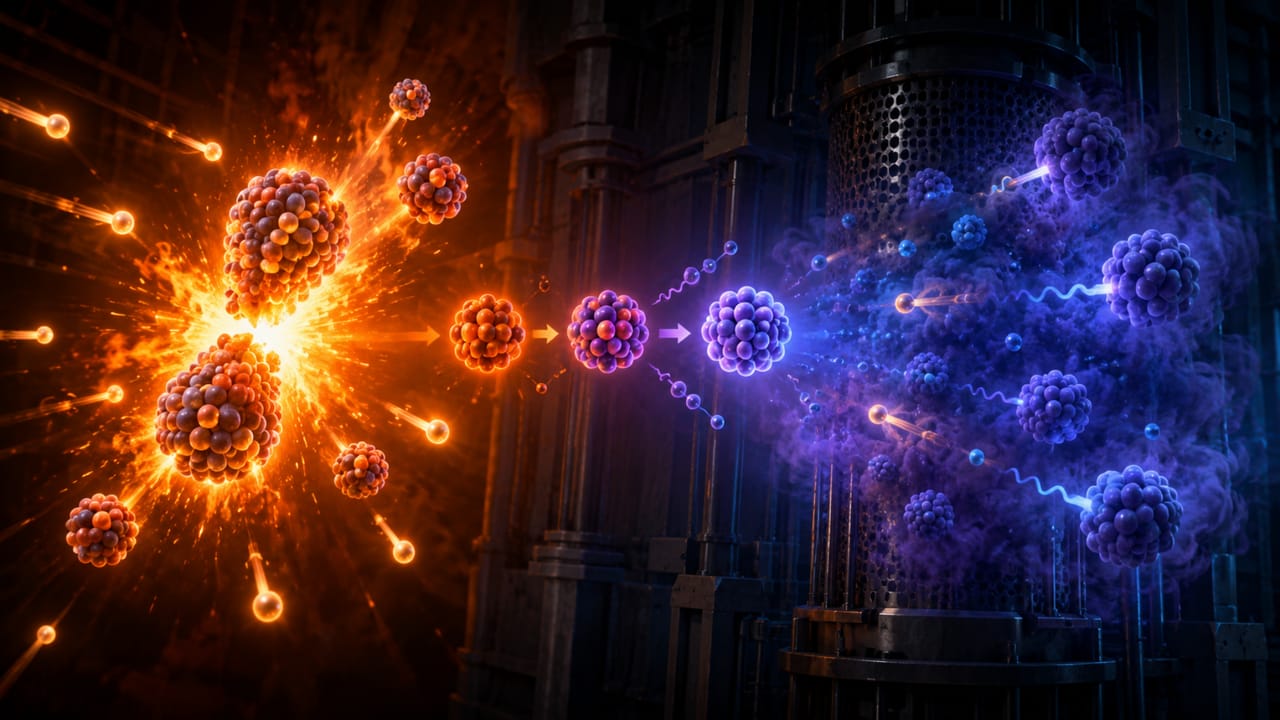
Understand how iodine-135 and xenon-135 affected Chernobyl Unit 4, why core poisoning reduced reactivity, and how this led to rod withdrawal, low ORM, and loss of control margin.
Check it out!
Xenon poisoning was one of the factors that made Unit 4 difficult to recover and control before the April 26, 1986 test. After the prolonged power reduction and the unplanned drop from approximately 500 MWt to 30 MWt, neutron flux decreased while accumulated iodine-135 continued producing xenon-135.
The term “poisoning” may sound unusual, but it is technical. In a nuclear reactor, some fission products absorb neutrons very efficiently. When this happens, they reduce core reactivity and make it harder to maintain or recover power.
In the case of Chernobyl Unit 4, two elements are essential to understanding this process: iodine-135 and xenon-135. Iodine-135 was produced as a fission product and decayed into xenon-135. Xenon-135, in turn, absorbed neutrons and acted as a strong neutron poison.
Xenon did not cause the accident by itself. It was not the final trigger of the explosion. But it was an important link in the chain: it made Unit 4 difficult to control, contributed to excessive withdrawal of control rods, reduced the ORM — operational reactivity margin, and left the core vulnerable to the other accident factors.
What is core poisoning?
In a nuclear reactor, the chain reaction depends on neutrons. When neutrons strike uranium-235 nuclei, they can cause new fissions, releasing heat and new neutrons. This process sustains reactor power.
But not all available neutrons cause fission. Some are absorbed by structural materials, water, control rods, or fission products present in the fuel.
When a fission product absorbs many neutrons, it reduces the number of neutrons available to sustain the chain reaction. For this reason, it is called a neutron poison.
Slow variables must also be treated as part of the operating state.
Concentrations, trends, delays, and gradual changes can alter process margin without producing an instantaneous failure. SCADA systems help consolidate history, trends, alarms, and operating context so the real state is not assessed from a single momentary reading.
Xenon-135 is one of the most important neutron poisons in reactor operation. It does not appear as a visible mechanical failure. It acts within the neutron balance, reducing reactivity and altering core response.
Where do iodine-135 and xenon-135 come from?
During uranium fission, the atomic nucleus splits into smaller fragments. These fragments are called fission products. Among them is iodine-135.
Iodine-135 is important because it decays into xenon-135. The simplified sequence is:
- uranium fission produces fission products;
- iodine-135 is formed among these products;
- iodine-135 decays into xenon-135;
- xenon-135 absorbs neutrons;
- by absorbing neutrons, xenon reduces core reactivity.
This chain is essential to understanding why the Unit 4 story does not begin only at the moment of the test. The core state had already been changing because of previous power conditions, iodine production, and subsequent xenon formation.
Why is xenon-135 so important?
Xenon-135 is important because it absorbs neutrons very efficiently. Operationally, it competes with uranium-235 for available neutrons.
When a neutron is absorbed by uranium-235, fission may occur, producing heat and releasing new neutrons. When a neutron is absorbed by xenon-135, it no longer contributes to the chain reaction.
For this reason, xenon acts as a neutron brake inside the core. It is not a shutdown button or a mechanical barrier. But it reduces reactivity and can make the reactor difficult to operate under certain conditions.
When xenon concentration is high, the operator must compensate for this reactivity loss. In many cases, this may involve withdrawing control rods or waiting for the poisoning to decrease naturally. At Chernobyl, that compensation became part of the problem.
The balance at stable power
During stable operation, xenon is present but tends to be manageable.
While the reactor operates at constant power, fission continues producing iodine-135. That iodine decays into xenon-135. At the same time, xenon-135 is consumed by neutron absorption.
A dynamic balance forms:
- fission produces iodine-135;
- iodine-135 generates xenon-135;
- xenon-135 absorbs neutrons;
- part of the xenon is consumed by the reactor’s own neutron flux;
- xenon concentration tends to stabilize for that power regime.
The problem appears when power changes significantly, especially when it falls and then operators try to recover power quickly.
Why does xenon create a delayed response?
The xenon effect does not follow the power displayed on the panel instantaneously. The core carries an inventory of fission products formed during the preceding hours. When power changes, production of new products, iodine-135 decay, and xenon-135 consumption evolve at different rates.
For this reason, a power reduction does not immediately produce maximum poisoning. For some time, existing iodine continues forming xenon while the lower neutron flux reduces xenon consumption. Xenon concentration can continue increasing after the initial power change.
This behavior makes time a process variable. Two operations at the same power may represent different states if they were preceded by different histories of generation, reduction, shutdown, or recovery. The instantaneous megawatt reading alone does not describe the neutron state of the core.
In Unit 4, the reduction begun on April 25 was interrupted at the request of the electrical grid and remained for hours in an intermediate condition before being resumed at 23:10. INSAG-7 records that later analyses had to explicitly consider iodine–xenon kinetics to reconstruct the evolution of power, ORM, and the axial field.
This history is detailed in From 500 to 30 MWt: Why Unit 4 Power Fell.
Supervision of critical processes must correlate current state, history, and trend.
Digital Supervision and Control Systems can integrate process variables, states, events, alarms, and historical records to support decisions that depend on the asset’s time evolution.
Explore the Digital Supervision and Control Systems solution
What happens when power falls?
When reactor power falls, neutron flux also falls. With fewer neutrons circulating through the core, xenon-135 is consumed more slowly.
But iodine-135 that had already been produced before the power drop continues decaying into xenon-135. In other words, the reactor consumes less xenon while still producing xenon from accumulated iodine.
The sequence is:
- power falls;
- neutron flux decreases;
- xenon is burned more slowly;
- existing iodine continues decaying into xenon;
- xenon concentration rises;
- core reactivity falls;
- the reactor becomes harder to recover.
This is xenon poisoning. It creates a kind of internal resistance to power recovery.
Operationally, this can be dangerous because attempts to overcome the poison may consume safety margins.
How did the xenon transient evolve in Unit 4?
The evolution did not begin only in the early hours of April 26. According to the chronology consolidated in INSAG-7, the power reduction began at 01:06 on April 25. At 07:10, ORM had already fallen to 13.2 equivalent rods. At 14:00, the test was postponed at the request of the electrical grid controller, and the unit remained for hours at intermediate power.
At 23:10, the reduction resumed. At 00:28, during the transfer between automatic control ranges, thermal power fell from approximately 500 MWt to 30 MWt. After a pause, recovery began, and around 01:03 power was stabilized near 200 MWt.
During this interval, xenon concentration and neutron-flux distribution continued changing. Later simulations reproduced in INSAG-7 show that the axial field underwent strong deformation during the transient. Before the accident, the distribution showed two maxima, with nonuniform behavior among the upper, central, and lower core regions.
Why was spatial distribution important?
The RBMK core was very large. Its approximate height was 7 meters and its diameter 11.8 meters. Under disturbed conditions, distant regions could respond in a partially decoupled way. This means that apparently stable total power did not guarantee a homogeneous internal distribution.
Xenon could reduce reactivity more strongly in certain regions while others remained relatively more active. Rod compensation also did not produce a spatially uniform effect. The result was a system whose true state could not be adequately represented by a single global power value.
This distinction is central: the problem was not only “how much” power the reactor produced, but where that power was concentrated, which regions were poisoned, and how much effective control remained in each part of the core.
Complex assets must be analyzed as distributed systems, not only through aggregate indicators.
Owner’s Engineering provides independent review of assumptions, interfaces, margins, risks, and decision criteria throughout the lifecycle, reducing dependence on simplified readings or analyses restricted to a single discipline.
Why was this critical in Unit 4?
In preparation for the Chernobyl test, Unit 4 power was reduced. Operation at reduced power was prolonged because of a request from the electrical grid. Later, during the transfer from local control to the main automatic controllers, an unplanned power drop to about 30 MWt occurred.
This moment was decisive. With power very low, xenon played a stronger role in the loss of reactivity. To recover power, operators withdrew many control rods.
This process is analyzed in detail in Chernobyl: Why Did Unit 4 Power Fall from 500 MWt to 30 MWt?. The focus here is the physical consequence: xenon made the core difficult to control and pushed operation into a low-margin configuration.
The reactor returned to around 200 MWt before the test. But producing power again did not mean returning to a safe condition. Recovery occurred with many rods withdrawn and ORM below the safety limit.
Xenon did not explode the reactor, but it pushed operation to the limit
It is important to make a technical distinction: xenon-135 reduces reactivity. Therefore, in isolation, it is not an accelerator of the nuclear reaction. It was not the mechanism that directly drove the final Unit 4 power increase.
The problem was the operational response needed to compensate for its effect. To overcome the neutron poison and recover power, many rods were withdrawn. This withdrawal reduced the operational reactivity margin.
Thus, xenon should not be seen as the sole cause of the accident, but as an intermediate link:
- it reduced reactivity;
- made power recovery more difficult;
- led to excessive rod withdrawal;
- consumed ORM;
- left the core more vulnerable to the positive void coefficient and graphite-displacer rods.
Degraded conditions need limits, interruption criteria, and verifiable evidence.
When performance recovery consumes margins provided by design, the process should require a new assessment and technical acceptance. Structured management of requirements and evidence reduces decisions based only on pressure to maintain schedule or production.
Explore the Requirements, Evidence, and Acceptance Criteria Management solution
Relationship between xenon and ORM
The relationship between xenon and ORM is one of the keys to understanding the Unit 4 sequence.
ORM, or operational reactivity margin, indicated the remaining effective capacity of the control system to compensate reactivity. When many rods are withdrawn to recover power, this margin decreases.
In Unit 4, the attempt to compensate for xenon consumed ORM. INSAG-7 records that, before the final sequence, later reconstructions estimated ORM at values far below the safety limit: 1.9 equivalent rods in one calculation and 6 to 8 in another. Under either interpretation, the margin was below the safety limit.
This point is explored further in Chernobyl: What Was ORM and Why Did the Reactivity Margin Condemn Unit 4?.
The synthesis is simple: xenon reduced reactivity; rod withdrawal compensated for that loss; the compensation consumed the safety margin.
Relationship between xenon and graphite-displacer control rods
Xenon also connects to the graphite-control-rod problem.
The old RBMK control rods had graphite displacers. These displacers existed to conserve neutrons during normal operation by replacing absorbing water with moderating graphite in certain channel regions.
With many rods withdrawn, emergency insertion began from an unfavorable position. The graphite displacers could displace water in lower core regions before the absorber section dominated the effect, producing a local increase in reactivity.
Xenon helped create the condition that required many rods to be withdrawn. Rod withdrawal made the design flaw more dangerous during emergency insertion.
This subject is addressed in Chernobyl: Why Did RBMK Control Rods Contain Graphite?.
Relationship between xenon and the positive void coefficient
Xenon also connects to the positive void coefficient.
After rods were withdrawn to compensate for xenon, the reactor had low ORM. With little control margin, the core became much more sensitive to increasing steam in the channels.
In the RBMK, under certain conditions, more steam could mean more reactivity. Liquid water absorbed some neutrons; steam absorbed fewer; graphite continued moderating. Thus, an increase in steam fraction could raise power.
This mechanism is explained in Chernobyl: What Is the Positive Void Coefficient and Why Did It Make Unit 4 So Dangerous?.
The causal chain is clear: xenon led to rod withdrawal; rod withdrawal reduced ORM; low ORM increased vulnerability to the positive void coefficient.
What did the instrumentation show about the state of the core?
The RBMK had thousands of data points, internal and external detectors, recording systems, and calculation programs. This did not mean, however, that all critical parameters were continuously, integrally, and immediately understandable.
INSAG-7 records that the centralized SKALA system calculated key parameters in cycles of several minutes. ORM calculation was not a direct instantaneous console indication: it depended on data acquisition and processing. In other descriptions in the report, this cycle could require approximately 10 to 15 minutes.
The diagnostic recording program collected hundreds of signals but did not directly record all parameters needed to reconstruct reactor state. Among the 211 rods of the control and protection system, only selected positions appeared in the fast records. System restarts also produced gaps during the hour before the accident.
There was another problem as well: the system did not present a complete view of spatial power distribution at low power. External detectors could not adequately represent the axial and regional behavior of the large core. Thus, the operator could see global power without seeing, with the same clarity, the internal deformation caused by the xenon transient.
Why are time synchronization and sequence of events important?
Part of the electrical test parameters was recorded by an additional oscillography system. These records were not fully synchronized with reactor parameters. After the accident, the lack of a common time base made comparison among electrical events, control states, and process variables more difficult.
In today’s critical facilities, telecommunications designs, industrial networks, time synchronization, historians, and sequence-of-events records must be conceived as part of diagnostic capability. Data volume creates value only when source, quality, timestamp, and context are reliable.
Why not wait for xenon to decrease?
Under strong xenon poisoning, a safe operational alternative may be to wait for decay and the so-called core depoisoning process. INSAG-7 itself mentions depoisoning curves in the context of procedures related to reactivity margin.
In practice, this means waiting until the core’s neutron condition again allows power recovery with adequate margin. This wait may delay operation, testing, and generation schedules, but it preserves safety.
In Unit 4, the test had been postponed during the day at the request of the electrical grid controller, and the unit was already in a prolonged operating sequence. The test was resumed under unfavorable conditions, with reduced power, xenon, withdrawn rods, and low ORM.
This is a technical-governance point: when a physical condition compromises safety margin, the correct decision may be to stop, wait, recalculate, and replan. Continuing merely to meet the schedule can turn a difficult condition into a dangerous one.
The turbine test encountered an already vulnerable core
When the turbine test began, Unit 4 was not merely at low power. It was in a low-margin condition, with abnormal power distribution and a core that had been driven into a configuration that was difficult to control.
The test sought to determine whether the inertia of the slowing turbogenerator could power essential pumps for a few seconds until the diesel generators came online. But, as INSAG-7 emphasizes, it is incorrect to treat this test as purely electrical. It involved power supply to major equipment, protections, interlocks, water circulation, and reactor thermal-hydraulic conditions.
The test acted on an already vulnerable system. Xenon had helped consume control margin; ORM was low; the positive void coefficient made increasing steam dangerous; and the control rods had a design capable of inserting positive reactivity during the first moments of insertion.
This combination shows why the accident should not be explained by a single cause. Chernobyl was a chain of technical, operational, and organizational factors that aligned.
Engineering lesson: recovering performance must not consume safety margin
The xenon story in Unit 4 provides a strong lesson for critical systems: recovering performance must not mean consuming the safety margin that protects the system.
At Chernobyl, the attempt to recover power in the presence of xenon poisoning required rod withdrawal. This withdrawal allowed power to rise, but reduced ORM. The system returned to operation with little effective capacity to respond to disturbances.
This logic applies to many engineering fields. An electrical system may operate overloaded. A hydraulic system may meet flow demand with little margin. An automation system may maintain production with alarms inhibited. A critical network may operate at the limit of latency or redundancy. In all these cases, apparent operation can hide a loss of robustness.
For this reason, practices such as Owner’s Engineering, commissioning, technical audits, technical due diligence, and FEL are essential in complex assets. They help identify critical margins, test degraded scenarios, validate interlocks, document limits, and protect the owner from fragile technical decisions.
Conclusion: xenon was a silent link in the causal chain
Xenon poisoning was not the sole cause of the Chernobyl accident. But it was a silent and decisive link in the causal chain.
Iodine-135 produced by fission decayed into xenon-135. Xenon absorbed neutrons and reduced reactivity. When power fell, xenon had a greater influence on core behavior. To recover power, many rods were withdrawn. As a result, ORM fell below the safety limit.
The reactor returned to power, but not to a robust condition. It was vulnerable to the positive void coefficient, graphite-displacer rods, the turbine test, and inadequate protection response.
This is the importance of xenon in the Chernobyl story: it did not directly accelerate the final reaction, but it helped push Unit 4 into a configuration in which effective control had already been lost.
In the next article in the series, we connect these links to the turbine test: why an apparently electrical test had nuclear, hydraulic, operational, and technical-governance implications.
Testing in critical systems must demonstrate behavior, margins, and recovery capability.
A3A structures plans, procedures, criteria, records, and punch-list matrices to validate integrated systems before acceptance and entry into operation.
Technical references
[1] INTERNATIONAL ATOMIC ENERGY AGENCY. The Chernobyl Accident: Updating of INSAG-1. Safety Series No. 75-INSAG-7. Vienna: IAEA, 1992.
[2] SHTEYNBERG, N. A. et al. Report by a Commission to the USSR State Committee for the Supervision of Safety in Industry and Nuclear Power. In: IAEA. INSAG-7, Annex I. Vienna, 1992.
[3] ABAGYAN, A. A. et al. Causes and Circumstances of the Accident at Unit 4 and Measures to Improve the Safety of Plants with RBMK Reactors. In: IAEA. INSAG-7, Annex II. Vienna, 1992.
[4] UNITED STATES NUCLEAR REGULATORY COMMISSION. Report on the Accident at the Chernobyl Nuclear Power Station. NUREG-1250. Washington, DC: USNRC, 1987.
[5] UNITED STATES NUCLEAR REGULATORY COMMISSION. Implications of the Accident at Chernobyl for Safety Regulation of Commercial Nuclear Power Plants in the United States. NUREG-1251. Washington, DC: USNRC, 1987.
[6] INTERNATIONAL NUCLEAR SAFETY ADVISORY GROUP. Safety Culture. Safety Series No. 75-INSAG-4. Vienna: IAEA, 1991.
[7] WORLD NUCLEAR ASSOCIATION. RBMK Reactors. London: WNA.
[8] MUELLNER, Nikolaus. Three Decades after Chernobyl: Technical or Human Causes? Technical analysis of the accident and the RBMK design.
[9] CHERNOBYL NUCLEAR POWER PLANT. Historical and technical documentation on Unit 4 and the accident sequence.
[10] A3A ENGENHARIA. Sequence of Events: Chernobyl Unit 4. Technical source collection used to compare the operating log, recorded events and later reconstructions.
Frequently asked questions
It is the reduction in reactivity caused by accumulation of xenon-135, a fission product that absorbs neutrons very efficiently.
Iodine-135 decays radioactively into xenon-135. Therefore, even after a power reduction, the xenon inventory can continue increasing for some time.
There is not enough basis to treat xenon as the sole cause of the initial drop. Its better-established role was making subsequent power recovery more difficult.
Because it absorbed some of the neutrons needed to sustain the chain reaction, requiring additional compensation from the control system.
Power recovery involved withdrawing more control rods, which reduced the available operational reactivity margin.
Not immediately. Some of it decays naturally, while remaining iodine-135 continues producing new xenon for several hours.
Compensating for poisoning required rod withdrawal, contributing to very low ORM and reducing the core’s tolerance to further disturbances.
No. It was an enabling condition within a chain that also involved low power, reduced ORM, positive void, rod design, AZ-5, operating decisions, and governance.
Supplementary technical materials
Solutions
- SCADA Systems
- Digital Supervision and Control Systems
- Requirements, Evidence, and Acceptance Criteria Management
Engineering services
Chernobyl series