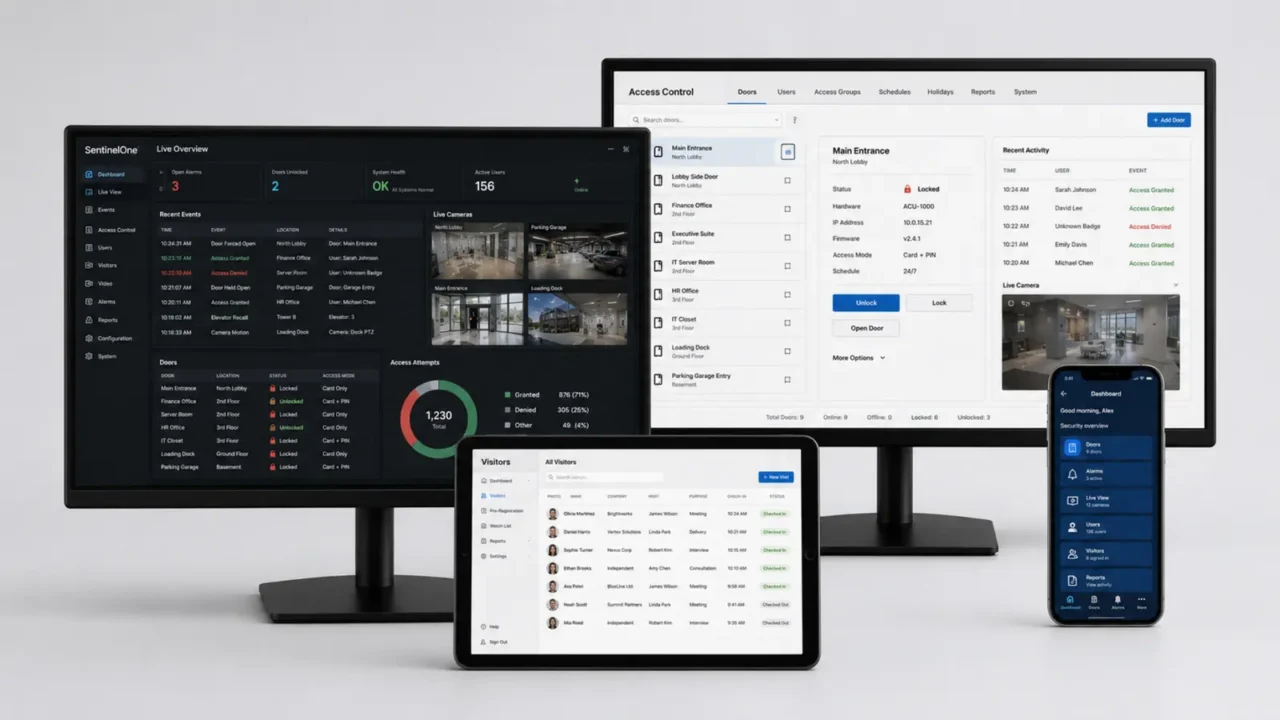
Understand how Lenel OnGuard structures an enterprise access control architecture for multiple sites, credentials, visitors, alarms, video, integrations, cloud, and governance.
Check it out!
Lenel OnGuard is one of the most recognized platforms in the global corporate access control market. Unlike solutions focused only on isolated doors, readers, or turnstiles, OnGuard was designed for environments in which access control must operate as critical physical security infrastructure, with scale, governance, integration, availability, and traceability.
In organizations with multiple sites, thousands of users, visitors, contractors, critical areas, video integration, connections to corporate systems, and audit requirements, access control stops being merely an operational subsystem and becomes part of the company’s security, IT, facilities, and compliance architecture.
This is where enterprise platforms such as Lenel OnGuard stand out. They make it possible to structure access control as a corporate platform, integrating physical identities, credentials, controllers, servers, databases, access policies, events, alarms, video, visitors, reports, dashboards, APIs, cloud, and distributed operations.
To understand OnGuard’s value, it is important to first view access control as architecture. In enterprise environments, the challenge is not simply allowing or denying entry. The challenge is to coordinate, at scale, who may access, where they may access, when they may access, under what conditions, with what evidence, and with what level of operational continuity.
This article presents a technical view of Lenel OnGuard as an enterprise platform for corporate access control, multiple sites, and integrated security.
What is Lenel OnGuard?
Lenel OnGuard is an integrated access control and physical security platform developed by LenelS2, a Honeywell ecosystem brand. It is designed for corporate and critical environments that require a scalable, integrated, and governable solution to manage physical access, credentials, users, visitors, alarms, events, integrations, and security operations.
OnGuard can be used across different organizational profiles, from mid-sized corporate environments to enterprise architectures distributed across multiple facilities. The platform supports different editions, expansion paths, and deployment models, including on-premises, cloud, and hybrid architectures.
More than software for registering people and doors, OnGuard should be understood as a corporate physical security platform. It organizes access control within an architecture composed of identities, credentials, readers, controllers, servers, databases, rules, events, alarms, reports, dashboards, APIs, and integrations with external systems.
This approach is especially relevant for companies that need to standardize access policies, manage multiple facilities, integrate physical security with IT, operate real-time events, and produce reliable audit evidence.
Why is OnGuard a reference in enterprise access control?
OnGuard has become a reference in enterprise access control because it was designed for scenarios in which conventional solutions tend to be insufficient. In complex corporate projects, the main challenges are not only the number of doors, but also administrative scale, governance, integrations, operational continuity, and the system’s ability to evolve.
Scalability
An enterprise access control system must grow with the organization. This includes growth in readers, sites, users, cardholders, visitors, operators, integrations, events, reports, and policies.
OnGuard addresses this need through different editions and architectures, such as ADV, PRO, and Enterprise, allowing the solution to be sized according to the scale, criticality, and complexity of the environment. This growth logic matters because access control rarely remains static. New facilities, new areas, new shifts, new integrations, and new audit requirements arise throughout the organization’s lifecycle.
Instead of limiting the project to a local installation, OnGuard makes it possible to design a scalable architecture capable of supporting progressive expansion and distributed environments.
Governance
In corporate environments, security depends not only on technology, but also on the quality of governance.
OnGuard supports access governance by enabling management of cardholders, badges, access levels, timezones, holidays, groups, visitors, system users, administrative permissions, reports, and audit trails.
This is essential to avoid common problems such as accumulated access rights, active credentials for terminated users, contractors with expired access, visitors without proper records, excessive permissions, lack of evidence, and absence of periodic reviews.
An enterprise platform must enable the organization to answer questions such as who has access to a given area, why that access was granted, who approved or changed the permission, when the credential was last used, which users are inactive, which visitors entered the environment, which events require investigation, and which exceptions were recorded.
Integration
Corporate access control should not operate in isolation. In mature environments, it must integrate with video systems, HR, Active Directory, IAM, SOC, elevators, parking, visitor systems, reservation systems, data warehouses, and analytics platforms.
OnGuard provides integration capabilities and an ecosystem that allow the platform to connect with different corporate systems. The OpenAccess API, for example, is an important component for integrations, automation, and data extraction in enterprise architectures.
This type of integration increases the value of the system because it turns access control into an operational platform. Access events can trigger video, feed reports, generate indicators, support investigations, update permissions, and reflect identity changes originating from corporate systems.
Critical operations
Enterprise systems must support continuous operations. This includes alarm monitoring, maps, contextual video, device status, lockdown, dashboards, reports, system health, high availability, technical support, and lifecycle management.
OnGuard provides capabilities for this type of operation, with dedicated clients and modules for monitoring, credentials, visitors, reports, dashboards, behavior configuration, hardware management, and system-health monitoring.
In critical environments, the question is not merely whether the door opened. The question is whether the system can operate, record, audit, respond, integrate, and remain available despite growth, failures, upgrades, and organizational changes.
Lenel OnGuard architecture: overview of the layers
Lenel OnGuard can be understood as a layered architecture. This perspective makes platform specification, implementation, integration, and support easier.
Identity and cardholder layer
The foundation of any access control system is physical identity. In OnGuard, this layer involves the management of cardholders, visitors, contractors, service providers, operators, and other profiles that need to interact with controlled areas.
Each person can be associated with information such as name, photo, ID document, company, department, role, credentials, badges, access levels, activity history, custom fields, and segmentation. In corporate environments, this database must be accurate, current, and, whenever possible, integrated with authoritative sources such as HR systems, corporate directories, or identity platforms.
The quality of this layer is decisive. A technically advanced system can still remain vulnerable if the people database is disorganized, duplicated, or disconnected from the users’ actual lifecycle.
Credential layer
A credential is the means by which a physical identity presents itself to the system. In OnGuard, credential management can involve badges, cards, mobile credentials, badge printing, photos, custom data, credential status, and usage history.
In enterprise architectures, managing the credential lifecycle is as important as initial issuance. Active, inactive, expired, lost, replaced, or recently unused credentials must be controlled. Temporary credentials for visitors, service providers, and contractors must also be managed.
OnGuard Credentials, as a browser-based client, represents this operational modernization by enabling management of cardholders, badges, access levels, mobile credentials, badge printing, and management filters without necessarily relying on traditional local clients for every activity.
Permissions layer
The permissions layer turns identity into an access rule. It defines which people may access which areas, at what times, under which conditions, and with which restrictions.
In OnGuard, this logic involves access levels, timezones, holidays, groups, segmentation, and management workflows. In practical terms, permission results from the combination of identity, place, and time.
This is one of the most sensitive layers of the architecture. A misconfigured permission may allow improper access to critical areas. A temporary permission without expiration can become a permanent risk. Missing reviews may preserve obsolete access after role changes, contract changes, or termination.
Capabilities such as Access Manager and Cardholder Self Service help distribute access management with greater governance. Managers can review, approve, deny, or adjust requests while the organization maintains rules and decision trails.
Controller and device layer
The field layer consists of readers, doors, sensors, locks, inputs, outputs, panels, and controllers. In the OnGuard ecosystem, LenelS2/Mercury controllers are often used in corporate architectures because of their integration with the platform and support for distributed environments.
Controllers play a fundamental role because they process events, control field devices, and can maintain rules locally to ensure operation even during temporary communication failures with the server.
In enterprise environments, the hardware layer must be evaluated in terms of capacity, availability, security, and maintainability. This includes readers per controller, inputs and outputs, TCP/IP communications, field buses, certificate support, remote updates, password management, offline operation, and integration with the central architecture.
The OnGuard Hardware client reinforces this dimension by enabling remote management of controllers, passwords, and certificates, supporting security, compliance, and large-scale operational requirements.
Communications layer
Communications are the backbone of the architecture. Servers, controllers, clients, APIs, databases, video, integrations, and remote sites depend on reliable and secure networks.
In OnGuard architectures, communications may involve TCP/IP, FQDN, VPNs, TLS, Mutual TLS, certificates, network segmentation, firewalls, DNS, inter-site links, cloud, and integration with IT environments.
This layer is especially critical in multi-site and cloud architectures. The design must consider latency, link availability, communication loss, local controller operation, event synchronization, redundancy, and cybersecurity.
Support for FQDN, Mutual TLS, and certificate management reinforces the trend toward alignment between physical access control, Zero Trust architecture, and IT security practices.
Server and services layer
The server and services layer sustains the platform. It may include application servers, databases, communication services, authentication, event delivery, reports, dashboards, APIs, hardware services, and high-availability components.
In recent versions, OnGuard has been evolving its architecture to meet enterprise requirements, including improvements in dedicated services, API performance, availability, event delivery, support for 64-bit architectures in selected components, and observability capabilities.
This evolution matters because, in complex corporate environments, access control generates a large volume of transactions and must serve multiple consumers: operators, administrators, integrations, dashboards, reports, data warehouses, and external applications.
Operations layer
The operations layer connects the system to the security routine. It allows operators to monitor alarms, review events, view maps, watch video, check device status, perform actions, and respond to incidents.
OnGuard Monitor is an example of this layer. It provides a browser-based experience for alarm, video, status, and event monitoring, with features such as maps, live and recorded video, custom layouts, monitoring zones, cardholder verify, lockdown groups, and device interaction.
In critical operations, this layer is essential to reduce response time and turn access events into situational awareness.
Reports and dashboards layer
Reports and dashboards transform access data into operational intelligence, audit evidence, and management support.
OnGuard Reporting & Dashboards makes it possible to view, filter, export, schedule, and customize reports and indicators. In enterprise environments, this is important for monitoring events, cardholders, badges, users, permissions, alarms, visitors, and transactions.
Reports should not be viewed only as administrative tools. They are part of the governance mechanism. Without reports, the organization struggles to review access, investigate incidents, demonstrate compliance, and identify deviations.
Integration layer
The integration layer is one of the reasons OnGuard differentiates itself in enterprise environments. The system can connect to VMS, video platforms, HR, IAM, Active Directory, elevators, parking, visitor systems, data warehouses, analytics platforms, and custom solutions.
The OpenAccess API and integration ecosystem allow OnGuard to function as a platform rather than an isolated system. This is especially important for organizations that want to automate onboarding and termination, synchronize user databases, trigger video from events, consolidate indicators, or integrate access control into the SOC.
OnGuard ADV, PRO, and Enterprise: how the platform grows with the organization
One important characteristic of OnGuard is the ability to adapt the architecture to the size and complexity of the organization. The ADV, PRO, and Enterprise editions address different scale and expansion requirements.
OnGuard ADV
OnGuard ADV is suitable for corporate environments with intermediate scale, a need for professional access control, and the potential for controlled growth. It can serve organizations that need robust capabilities but do not yet require a full enterprise architecture.
This type of edition usually makes sense for companies with one main facility, a moderate number of readers, a limited number of clients, and a need for progressive expansion.
OnGuard PRO
OnGuard PRO serves larger environments with greater expansion demands, more readers, greater operational flexibility, and broader growth requirements. It is suitable for organizations that have moved beyond the local-system model and need a higher-capacity platform.
In many projects, PRO represents an important step for companies that want to standardize corporate access control and prepare the architecture for future integrations, new facilities, or greater operational complexity.
OnGuard Enterprise
OnGuard Enterprise is designed for multi-site, regional, federated, or highly critical environments. It makes sense when the organization needs master/regional architecture, multiple regions, segmentation, distributed operations, corporate consolidation, and the ability to expand at scale.
This edition is especially relevant for companies with headquarters and branches, industrial plants, distributed facilities, national or international operations, multiple administrators, segmented databases, and a need for central governance combined with local autonomy.
The choice among ADV, PRO, and Enterprise should be based on architectural requirements, not merely price or the initial number of doors. The design must consider future growth, sites, users, readers, integrations, operations, auditing, availability, and lifecycle.
Site federation in OnGuard: central control with distributed operations
Site federation is one of the main reasons to consider an enterprise access control platform. In organizations with multiple facilities, the challenge is to balance corporate standardization with local operations.
A federated architecture makes it possible to structure the system in administrative and operational layers, with global policies, local rules, data segmentation, regional servers, scoped permissions, and corporate event consolidation.
Within OnGuard Enterprise, this logic can be applied to create an architecture in which headquarters maintains central governance while regional facilities preserve operational capacity and controlled autonomy.
This model is relevant because it avoids two problematic extremes. The first is treating each facility as an isolated system, which makes auditing, standardization, and integration difficult. The second is centralizing everything without considering local operations, creating excessive dependence on links, central teams, and processes detached from site realities.
Federation allows access control to reflect the organization’s actual structure. Critical sites can retain local operation, smaller facilities can be centrally administered, regions can have defined autonomy, and corporate leadership can maintain a consolidated view.
Browser clients: OnGuard operational modernization
OnGuard’s evolution toward browser-based clients represents an important change in access control operations. Instead of relying exclusively on Windows applications installed on specific workstations, different user profiles can access system functions through web interfaces focused on specific tasks.
This approach improves operational distribution, reduces local update complexity, and allows different areas of the organization to participate in access governance.
OnGuard Credentials
OnGuard Credentials is designed for managing cardholders, badges, access levels, mobile credentials, photos, lists, filters, and badge printing. It enables common credentialing activities through a browser-based interface.
This capability is important in environments with large user volumes, frequent changes, a need to review inactive cardholders, and credential issuance or update processes.
OnGuard Access Manager
OnGuard Access Manager supports access-rights management. It allows users to view access levels, associated cardholders, permissions, and access requests, and can work together with self-service workflows.
This capability is especially useful for organizations that want to decentralize part of permission management, allowing area managers to participate in approving or reviewing access without losing central governance.
OnGuard Visitor
OnGuard Visitor supports visitor management by allowing organizations to create visits, associate hosts and co-hosts, perform check-in, capture photos, issue badges, assign temporary credentials, and record documents or accepted policies.
In corporate environments, visitor management is critical because visitors are not part of the normal HR lifecycle, yet they still access physical areas, interact with people, and may circulate through sensitive spaces.
OnGuard Monitor
OnGuard Monitor provides browser-based operational and monitoring capabilities. It allows users to monitor alarms, device status, maps, live video, recorded video, cardholder verify, lockdown groups, and customized operational layouts.
This type of interface is important for security operations centers, reception areas, supervisors, and teams that need to respond quickly to physical events.
OnGuard Behaviors
OnGuard Behaviors concentrates operational configuration functions such as timezones, holidays, access levels, device groups, and lockdown groups.
These elements represent the invisible logic of access control. They define when, where, and under which rules access will be allowed or denied.
OnGuard Hardware
OnGuard Hardware enables remote management of controllers, including passwords and certificates. In enterprise environments, this is fundamental for compliance with IT and cybersecurity policies.
The ability to manage TLS certificates, mutual authentication, controller passwords, and web access helps align physical access control with modern information-security practices.
OnGuard Reporting & Dashboards
OnGuard Reporting & Dashboards makes it possible to transform system events and data into reports, indicators, and visualizations. The organization can track cardholders, badges, events, access activity, alarms, users, and operational data.
This layer supports auditing, investigation, risk management, periodic review, and decision-making.
Integration with video, alarms, and electronic security
Access control and video surveillance are complementary systems. Access control records the event; video provides visual context. When integrated, they enable more efficient operations and more accurate investigations.
OnGuard can integrate access events with video platforms, including environments with Milestone XProtect, LenelS2 NVR, and Honeywell solutions. This integration allows users to view live video, review recorded video, associate events with images, export evidence, and support operational response.
Events that benefit from video integration include access denied, forced door, door held open, out-of-schedule attempts, invalid credential use, entry into critical areas, lockdown activation, visual cardholder validation, and incidents at reception or security posts.
Video integration also strengthens SOC operations. Operators stop analyzing isolated events and begin working with context: who attempted access, where, when, through which door, with which credential, and with which associated image.
OpenAccess API and corporate integrations
In enterprise environments, the value of access control increases when its data and events connect to the corporate ecosystem.
The OpenAccess API allows OnGuard to integrate with external systems, automate workflows, publish events, feed analytics platforms, and connect access control to corporate processes.
Possible integrations include HR systems, Active Directory, IAM, visitor systems, elevators, parking, data warehouses, analytics platforms, SOC, reservation systems, custom applications, and workflow automation.
A typical example is integration with HR or IAM. When an employee is hired, transferred, or terminated, the access control system can automatically reflect that change, reducing manual work and the risk of human error.
Another example is integration with elevator and parking systems. The same credential can guide building flows, release garage access, restrict floors, and record operational events.
In more mature projects, access events can also feed corporate dashboards, investigation systems, data lakes, and analytics tools.
Cybersecurity in OnGuard: TLS, FQDN, certificates, and Zero Trust architecture
Physical access control systems are increasingly connected to IT infrastructure. For this reason, cybersecurity is no longer a secondary issue in electronic security projects.
OnGuard incorporates capabilities aligned with this evolution, including support for FQDN, TLS, Mutual TLS, certificate management, authentication policies, secure controller communications, and compliance-oriented features.
Secure communication with controllers
Communication between servers and controllers must be protected. In critical environments, it is not enough for the controller to function; communications must be reliable, authenticated, and secure.
The use of certificates, TLS, and Mutual TLS increases trust between architecture components, reducing risks associated with insecure communications, interception, device spoofing, or improper exposure.
FQDN and cloud-ready architectures
Support for Fully Qualified Domain Names is relevant to modern architectures, especially in cloud, hybrid, and Zero Trust-aligned environments. Rather than relying only on traditional fixed addressing, the architecture can better adapt to distributed environments controlled through DNS and IT security policies.
Remote hardware management
The ability to centrally manage controller passwords, certificates, and web access improves field-layer governance. In large environments, physically visiting every panel for operational or security adjustments may be impractical.
Remote management reduces effort, accelerates compliance, and helps keep the controller fleet aligned with security policies.
Privacy, policy, and auditing
Beyond technical security, the platform can also support organizational policies, document presentation, policy acceptance, and report generation. This connects access control with governance, compliance, and privacy.
In an enterprise architecture, cybersecurity is not an appendix to the project. It must be considered from network design and controller selection through certificate definition, user policies, IT integration, and the update lifecycle.
OnGuard Cloud: evolution toward access control as a service
OnGuard is also evolving toward cloud deployment models. This approach responds to a market trend: reducing local infrastructure complexity, simplifying updates, improving scalability, and transferring part of the operational responsibility to a managed architecture.
OnGuard Cloud is a single-tenant SaaS option hosted on AWS. This approach combines OnGuard platform capabilities with typical cloud benefits such as availability, elasticity, updates, monitoring, and reduced dependence on local servers.
Relevant elements of an OnGuard Cloud architecture include AWS hosting, a single-tenant model, secure VPN connectivity, primary and backup VPNs, redundancy across Availability Zones, web clients, Amazon AppStream for administrative applications, continuous support and monitoring, updates and patching, and reduced local maintenance.
The choice among cloud, on-premises, and hybrid models should consider connectivity, criticality, IT requirements, local integrations, availability, governance, security, and total cost of ownership.
The central point is that cloud access control should not be viewed simply as “a server outside the company.” It must be designed as a secure, redundant, connected architecture aligned with operations.
System health, support, and lifecycle
Deploying an enterprise access control system is only the beginning. Critical environments require support, updates, monitoring, documentation, and continuous improvement.
OnGuard WATCH
OnGuard WATCH is a tool for analyzing and monitoring system health. It provides visibility into performance, servers, databases, versions, backups, panel counts, readers, cardholders, badges, visitors, services, logs, and area utilization.
This type of capability matters because enterprise systems generate large volumes of data and depend on multiple components. Monitoring platform health helps identify problems before they affect operations.
In distributed environments, health dashboards are especially relevant for teams that need to monitor multiple facilities, regions, or servers.
SUSP and the update lifecycle
The Software Upgrade and Support Plan, known as SUSP, covers support, version upgrades, patches, documentation, training, hardening guides, technical support, test environments, professional services, and platform evolution.
In critical systems, keeping old versions without support, patches, or upgrade planning increases technical and operational risk. For this reason, lifecycle management must be part of the architecture from the beginning.
Enterprise projects need to plan for a test environment, backup plan, compatibility review, integration analysis, maintenance windows, rollback plans, client updates, operator training, post-upgrade validation, and updated documentation.
Proper support ensures that the platform remains secure, compatible, performant, and aligned with organizational needs.
When should Lenel OnGuard be considered in a project?
Lenel OnGuard should be considered when access control needs to go beyond a local installation and take on a strategic role in the organization’s physical security.
The platform is particularly suitable for scenarios such as companies with multiple facilities, complex corporate environments, industrial plants, data centers, hospitals, financial institutions, critical infrastructure, environments with many contractors, organizations with strong audit requirements, projects requiring integration with VMS, HR, IAM, or SOC, environments requiring high availability, organizations with cloud or hybrid strategies, customers seeking global standardization, systems requiring progressive growth, and operations that require central governance with local autonomy.
The decision should consider not only the current number of readers, but also projected growth, area criticality, governance model, required integrations, platform lifecycle, cloud strategy, cybersecurity requirements, and audit needs.
In enterprise projects, choosing an access control platform is an architectural decision. The question is not only which system serves the current installation, but which platform will be able to support the organization over the coming years.
How A3A Engenharia works on Lenel OnGuard projects
Implementing a platform such as Lenel OnGuard requires more than product knowledge. It requires an engineering, architecture, integration, infrastructure, operations, and governance perspective.
A3A Engenharia works on corporate access control projects, supporting organizations in activities such as assessment of the existing architecture, requirements gathering, topology definition, specification of controllers, readers, and devices, analysis of sites and critical areas, definition of on-premises, cloud, or hybrid models, integration with CCTV, VMS, HR, IAM, elevators, and parking, credential and visitor governance, preparation of technical documentation, procurement support, implementation monitoring, commissioning, functional tests, FAT, SAT, integrated validation, and lifecycle support planning.
This approach makes it possible to treat OnGuard as an enterprise architecture platform rather than merely software or a list of licenses.
Conclusion: OnGuard as a reference architecture for enterprise access control
Lenel OnGuard stands out because it treats access control as a corporate platform rather than an isolated door system.
Its architecture makes it possible to structure complex environments with multiple sites, centralized governance, distributed operations, browser clients, video integration, APIs, cloud, reports, dashboards, visitors, credentials, and continuous support.
In enterprise access control projects, platform selection must consider not only what the system does today, but also how it will grow, integrate, audit, operate, and protect the organization over time.
For this reason, OnGuard is a reference for organizations that need to manage physical security with the same level of maturity applied to corporate networks, critical systems, and IT infrastructure.
The main question should not simply be “which system opens doors?” The right question is: which platform sustains the organization’s access control architecture, integrated security, and physical-security governance?
Do you need to specify or modernize a Lenel OnGuard architecture?
A3A Engenharia supports organizations in the assessment, design, specification, integration, implementation, and lifecycle support of corporate access control systems based on Lenel OnGuard.