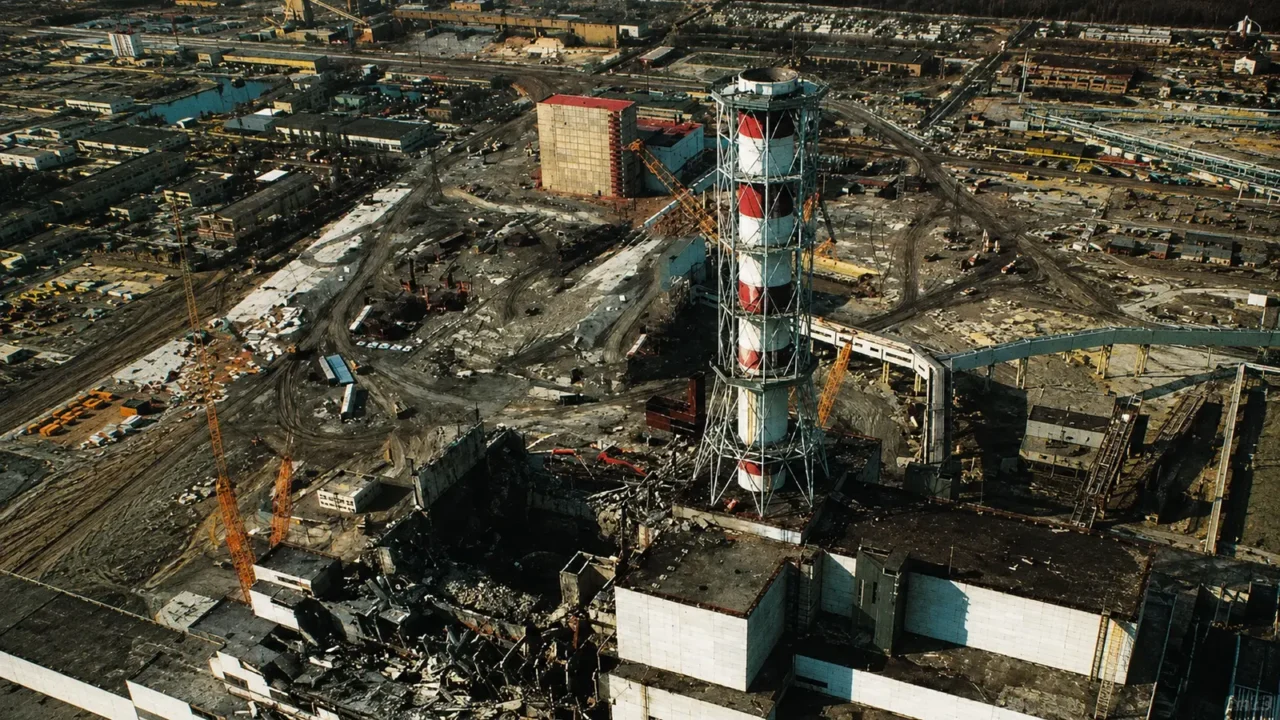
Understand why Chernobyl cannot be reduced to human error and how design, regulation, communication, safety culture, and governance failures combined.
Check it out!
The accident at Reactor 4 of the Chernobyl Nuclear Power Plant is often summarized in an apparently simple question: was it human error or a design failure?
The technical answer is more complex. Chernobyl cannot be reduced to a single cause. The sequence that destroyed Reactor 4 involved operational decisions, dangerous characteristics of the RBMK design, insufficient safety culture, poor communication among technical organizations, pressure for operational continuity, and governance weaknesses.
Perhaps a better question, therefore, is: how could a critical system allow so many barriers to fail in sequence?
This article deepens the governance axis of the Chernobyl series. In previous articles, we explained what happened at Chernobyl, how the RBMK reactor worked, the chronology of the night of the accident, why AZ-5 did not prevent the explosion, and why the power drop to 30 MWt remains technically inconclusive.
Now we will look at the accident as a case of engineering, risk management, and technical governance.
A systemic analysis must distinguish at least five layers: physical mechanisms, which explain how the transient developed; operational decisions, which defined reactor state; design decisions, which determined margins and protection responses; organizational controls, which should have prevented unacceptable conditions; and institutional governance, responsible for turning technical knowledge into requirements, corrections, and stop authority.
Governance, therefore, is not a physical cause competing with the void coefficient or the rods. It is the layer that should ensure known risks are communicated, recorded, treated, and prevented from reaching operations.
The Crucial Question: Was It Human Error?
In major engineering accidents, the search for a single culprit is often emotionally satisfying but technically weak. Critical systems rarely fail because of one isolated act. They fail when multiple protection layers cease to perform their function.
At Chernobyl, there were inappropriate operational actions, procedural violations, and decisions made under increasing risk. But stopping the analysis there distorts the problem.
INSAG-7, the International Atomic Energy Agency report that updated the initial analysis of the accident, changed the weight of this interpretation. The initial narrative, heavily focused on operational error, was revised to incorporate design failures, communication deficiencies, weak safety culture, and institutional limitations.
This shift is essential: Chernobyl was not merely the story of operators conducting a test poorly. It was the story of a system that allowed a critical test to proceed with degraded margins, incomplete information, and insufficient safety barriers.
Requirements, Evidence, and Acceptance-Criteria Management
Critical risks must be converted into traceable requirements, verifiable limits, evidence of compliance, and formal stop criteria.
The Initial Narrative: The Weight Placed on Operators
Immediately after the accident, the explanation presented internationally emphasized an unlikely combination of violations of instructions and operating rules. This interpretation appeared in the context of INSAG-1, prepared from Soviet information available shortly after the accident.
The problem is that, at that time, much technical information was still incomplete, difficult to access, or interpreted within an institutional narrative that favored operational blame.
As analyses advanced, especially after new Soviet data and three-dimensional reactor-physics studies became available, it became clearer that the accident could not be explained solely by operator actions. The RBMK had characteristics that created severe risks under certain conditions, and some of these characteristics were not fully understood, communicated, or corrected.
This does not eliminate operational responsibility. But it changes the framing: operators made errors within a system that already carried deep technical and institutional vulnerabilities.
What Did INSAG-7 Change in the Interpretation of Chernobyl?
INSAG-7 is a central document because it revises the initial interpretation of the accident. It recognizes that an explanation based only on operational violations was insufficient and gives greater weight to design and safety factors.
Among the points highlighted are:
- the RBMK positive void coefficient;
- deficiencies in the design of control and protection rods;
- the initial positive effect of emergency shutdown;
- the low operational reactivity margin, ORM;
- poor understanding of ORM’s safety significance;
- lack of convenient ORM indication for operators;
- lack of adequate integration of ORM into the protection system;
- communication failures among designers, operators, regulators, and responsible organizations.
The document also states directly that many analyses came to associate the severity of the accident with defects in the design of the control and safety rods, combined with RBMK physical characteristics that allowed large positive void coefficients.
This is a turning point. The question is no longer only “why did the operators continue?” but also: why did the design allow such a dangerous configuration, and why did the protection system not prevent it from being reached?
The revision also demonstrates the importance of technical independence. Accident investigations need to confront records, models, procedures, design decisions, and institutional responsibilities without assuming that the first available explanation is definitive.
Technical Auditing
Independent audits verify compliance, evidence, interfaces, risks, and gaps among what was designed, documented, installed, and actually operated.
Design Failure: When Performance and Safety Conflict
The RBMK was a high-power reactor designed for large-scale electricity generation. From a performance perspective, some choices made sense within a logic of neutron efficiency, baseload operation, and energy production.
But some of those choices created dangerous safety tradeoffs. The best-known example is the control-rod design with graphite displacers. As discussed in the article on AZ-5, these displacers helped avoid parasitic neutron absorption by water in control channels when the rods were withdrawn. During normal operation, this solution favored reactor efficiency.
The problem is that, under certain conditions, the first movement of rod insertion could replace water with graphite before the absorber section acted effectively. Because water absorbed some neutrons and graphite moderated neutrons, this replacement could locally increase reactivity.
In practice, a performance-oriented solution created transient behavior incompatible with the safety function. The “brake” should not depend on the system being in a favorable condition before it begins braking.
This is an engineering lesson applicable to any critical infrastructure: operational optimization must never degrade the safety barrier under limiting conditions.
ORM: A Critical Variable That Was Not Treated as a Protection Barrier
ORM, the operational reactivity margin, was a fundamental variable in the RBMK. It did not simply represent the physical number of rods inserted in the core, but a calculated control margin expressed as the equivalent number of fully inserted rods.
According to INSAG-7, at rated power and under stable conditions, ORM should have been between 26 and 30 equivalent rods. If it fell to 15, the reactor should have been shut down immediately. Before the actual start of the test, later calculations indicated values far below this limit, on the order of 6 to 8 equivalent rods, depending on the reconstruction used.
The critical point is that ORM was not conveniently available to the operator and was not adequately incorporated into the protection system. In addition, its safety significance was poorly understood. It was seen mainly as a margin for maneuvering and controlling power distribution, when in fact it strongly influenced reactor behavior in relation to the positive void coefficient and rod insertion.
From a technical-governance perspective, this is serious. A variable that defines system safety cannot merely be a difficult-to-calculate parameter without clear indication and without effective integration into automatic protections.
In modern critical systems, the rule should be clear: if a variable is critical to safety, it needs to be visible, understood, recorded, auditable, and capable of activating protection barriers.
It also needs to be presented in context. An instantaneous value without history, data quality, trend, operating state, and relationship with other margins can create false confidence. Information governance begins at instrumentation, passes through calculation, and ends in how the data guide decisions.
SCADA Systems
Historians, alarms, trends, data quality, and sequence of events turn scattered variables into traceable operational information.
Institutional Pressure: Energy, Schedule, and Target Culture
Chernobyl must also be understood within the context of the Soviet Union, the Cold War, and an institutional culture strongly oriented toward production targets, hierarchy, and demonstration of technological capability.
This does not mean that the political context alone caused the accident. It did not. But it helps explain the environment in which technical decisions were made.
On the night of the accident, the test was delayed because the electrical grid still needed the unit’s generation. Reactor 4 was not operating in an isolated laboratory; it was operating within a real power system, with demand, dispatch, pressure for availability, and the need for energy continuity.
This delay is documented. The broader influence of political pressure and target culture, however, should be treated as institutional context rather than as a recorded direct order to cause the accident. Rigor requires separating what appears in operating records from what is inferred from organizational structure and the later pattern of communication.
In addition, the Soviet environment made it more difficult to challenge hierarchies, expose design flaws, interrupt critical activities, or publicly acknowledge technical limitations. INSAG-7 highlights communication failures and the lack of clear lines of responsibility among designers, engineers, manufacturers, constructors, operators, and regulators.
This is the governance point: when an organization values delivery, production, or plan fulfillment above technical safety, barriers become dependent on the individual courage of someone saying “stop.” In critical systems, that is unacceptable.
Concealment, Risk Communication, and Late Learning
Another essential element is communication. After the accident, information was handled slowly, incompletely, and with political sensitivity. This affected the public response, international perception, and technical reconstruction of the sequence of events.
But poor communication did not begin after the explosion. It was already present beforehand in the way critical information about the RBMK design, the positive emergency-shutdown effect, and the importance of ORM was transmitted, understood, or incorporated into operations.
INSAG-7 records that the positive rod-insertion effect had previously been identified in another RBMK at the Ignalina plant in 1983. There was an indication that design changes would be made to correct the problem, but the measures were not implemented sufficiently before the Chernobyl accident.
This is one of the hardest lessons of the case: a known defect, when not treated as a priority, ceases to be only a technical problem and becomes a governance failure.
Was There Punishment? Yes, but Accountability Was Limited
This point needs to be handled carefully. After the accident, operators and local managers were criminally prosecuted. The initial public narrative placed considerable weight on actions by the plant team.
But that accountability did not exhaust the problem. Later technical analysis showed that design failures, safety culture, institutional communication, and governance played central roles. In other words, punishing people involved in operations did not mean that the institutional system responsible for the vulnerabilities had been fully held accountable from the outset.
This distinction matters in any accident analysis: individual accountability may be necessary, but it is insufficient when the system as a whole created the conditions for failure.
Governance Failure: Who Had Authority to Stop?
The central question in critical systems is not only “who did it?” but also “who could stop it?”
At Chernobyl, several governance questions arise:
- who approved the test program?
- who assessed its nuclear implications, not only its electrical aspects?
- who validated the safety criteria?
- who had authority to abort the test when power fell to 30 MWt?
- who ensured ORM remained within a safe limit?
- who communicated the risk of the positive AZ-5 effect to operators?
- who should have prevented operation in a prohibited configuration?
- who integrated design, operations, safety, and regulation?
When these answers are unclear, safety depends on improvisation. And improvisation is incompatible with critical systems.
PMBOK, in its principle-based approach, reinforces the importance of governance, accountability, stakeholders, planning, quality, risks, complexity, and adaptation to context. Applied to critical systems, this means technical decisions need clear owners, acceptance criteria, approval trails, risk management, and formal authority to stop unsafe activities.
Chernobyl shows what happens when engineering, operations, politics, regulation, and management do not form a safe decision-making system.
In a robust arrangement, stop authority cannot depend only on the immediate operational hierarchy. There must be independent review, segregation between those who produce evidence and those who accept it, escalation criteria, and institutional protection for conservative safety decisions.
Owner’s Engineering
Owner’s Engineering creates an independent layer among owners, designers, suppliers, and operations to review assumptions, risks, interfaces, and acceptance criteria.
The Test Was Not “Merely Electrical”
One of the most important points in INSAG-7 is its criticism of classifying the test as purely electrical. The rundown test involved power to the main pumps, power circuits, protection systems, and interlocks. It therefore had direct nuclear-safety implications.
This is a classic interface failure: an activity that appears to belong to one technical discipline affects another critical discipline. In complex projects, many accidents originate precisely at interfaces.
In a modern project, a test of this type would require a risk matrix, multidisciplinary analysis, safety validation, abort criteria, scenario simulation, commissioning plan, formal approval, and detailed recording of preconditions.
When an activity that affects nuclear safety is treated merely as an electrical test, governance has failed before the test begins.
In addition, an approval does not remain valid indefinitely. A shift change, several hours of delay, altered power level, reduced margins, or unavailable systems require renewed verification of preconditions. Proceeding on the basis of authorization issued for another scenario turns the test plan into a formality.
Commissioning and Technical Acceptance
Integrated tests require verified preconditions, a responsibility matrix, abort criteria, synchronized records, and evidence-based acceptance.
What Does Chernobyl Teach About Consulting Engineering?
Chernobyl is an extreme case, but its lessons apply to modern critical systems. Substations, data centers, power plants, operation centers, hospitals, industrial networks, and telecommunications systems also depend on design, operations, supervision, testing, documentation, and governance.
In all these environments, it is not enough for the system to work in normal operation. It must respond correctly during transitions, partial failures, loss of power, mode changes, degraded operation, and emergencies.
This is where practices such as Owner’s Engineering, FEL, EPCM, commissioning, technical auditing, and technical due diligence come into play.
These practices help the asset owner ask questions that must be answered before operation:
- which variables are critical to safety?
- are those variables visible and recorded?
- do tests cover real operating transitions?
- have protection systems been validated under degraded conditions?
- have interfaces among disciplines been reviewed?
- who can stop an unsafe activity?
- are risks documented and formally accepted?
- has operations received sufficient training?
These questions are as important as calculations, drawings, or equipment.
From Chernobyl to Today’s Critical Infrastructure
The Chernobyl discussion also connects with modern supervision and control systems. In substations and critical facilities, solutions such as SCADA in the power sector, remote assistance in substations, disconnect-switch monitoring, and telecommunications design for substations exist precisely to increase operational visibility, record events, enable diagnosis, and support safe decisions.
But supervision technology alone does not solve governance. Data must be interpretable. Alarms need hierarchy. Protections need to act automatically when critical limits are violated. Operators need to understand what the variables mean. Managers need to respect stop criteria.
Critical-system safety results from technical architecture and organizational culture. One without the other is insufficient.
So, Was Chernobyl Human Error, Design Failure, or Governance Failure?
It was a combination of all three — but the expression “human error” must be used carefully.
There were inappropriate operational decisions. Limits were violated. The test continued under dangerous conditions. But there was also a reactor with hazardous design characteristics, a protection system with an adverse initial response under certain conditions, a critical safety variable with poor visibility, insufficient procedures, and communication failures among technical organizations.
Above all, there was a governance failure: the system did not prevent a dangerous condition from being reached, did not make critical variables sufficiently visible, did not correct known vulnerabilities urgently, and did not establish clear authority to stop the risk.
Therefore, the most robust technical conclusion is:
Chernobyl was a systemic failure of engineering, operations, and governance. Human error existed, but it does not explain the accident by itself. The design created vulnerabilities; operations brought the reactor to a critical condition; and governance structures failed to prevent known risks, degraded margins, and continuation decisions from combining.
Conclusion: The Main Failure Was Systemic
The central lesson from Chernobyl is not merely that operators can make mistakes. The lesson is that critical systems must be designed, tested, operated, and governed with the understanding that people make mistakes, pressures exist, signals are misinterpreted, and degraded conditions occur.
A safe system does not depend on human perfection. It creates barriers so mistakes do not become catastrophes. It makes critical variables visible. It prevents prohibited configurations. It tests transitions. It records decisions. It corrects known vulnerabilities. It gives real authority to stop unsafe activities.
Chernobyl shows the cost when this does not happen.
For consulting engineering, this is the central point: in critical projects, safety is not an item to be checked at the end. Safety is an architecture of decisions, requirements, tests, responsibilities, and governance from the beginning.
To continue the learning journey, the reader can review the RBMK architecture and proceed to the modifications implemented in RBMK reactors after the accident, when recognized risks were finally converted into changes in design, protection, and operating rules.
Technical References
[1] INTERNATIONAL ATOMIC ENERGY AGENCY. The Chernobyl Accident: Updating of INSAG-1. Safety Series No. 75-INSAG-7. Vienna: IAEA, 1992.
[2] SHTEYNBERG, N. A. et al. Causes and circumstances of the accident at Unit 4 of the Chernobyl Nuclear Power Plant. In: INTERNATIONAL ATOMIC ENERGY AGENCY. INSAG-7, Annex I. Vienna: IAEA, 1992.
[3] ABAGYAN, A. A. et al. Causes and circumstances of the accident and measures to improve the safety of plants with RBMK reactors. In: INTERNATIONAL ATOMIC ENERGY AGENCY. INSAG-7, Annex II. Vienna: IAEA, 1992.
[4] UNITED STATES NUCLEAR REGULATORY COMMISSION. Report on the Accident at the Chernobyl Nuclear Power Station. NUREG-1250. Washington, DC: NRC, 1987.
[5] UNITED STATES NUCLEAR REGULATORY COMMISSION. Implications of the Accident at Chernobyl for Safety Regulation. NUREG-1251. Washington, DC: NRC, 1987.
[6] INTERNATIONAL NUCLEAR SAFETY ADVISORY GROUP. Safety Culture. INSAG-4. Vienna: IAEA, 1991.
[7] INTERNATIONAL ATOMIC ENERGY AGENCY. RBMK Reactors. Technical description and safety characteristics of pressure-tube graphite-moderated reactors.
[8] CHERNOBYL NUCLEAR POWER PLANT. Sequence of events at Unit 4 on 25–26 April 1986. Technical chronology compiled from operating records.
[9] MUELLNER, Nikolaus. Three Decades after Chernobyl: Technical and Institutional Lessons. Vienna: University of Natural Resources and Life Sciences.
[10] PROJECT MANAGEMENT INSTITUTE. A Guide to the Project Management Body of Knowledge — PMBOK Guide. 7th ed. Newtown Square: PMI, 2021.
Frequently Asked Questions
There were inappropriate operational decisions, but they do not explain the accident in isolation. INSAG-7 gives significant weight to design failures, communication, safety culture, and governance.
The positive void coefficient, rod design, poor ORM visibility, and insufficient protections allowed a vulnerable configuration to be reached.
The document revised the narrative initially focused on operators and placed greater emphasis on deficiencies in design, communication, regulation, and safety culture.
Not as a single cause. The institutional context influenced priorities, transparency, hierarchy, and the ability to challenge decisions, but the accident resulted from the interaction of technical and organizational factors.
Unclear responsibilities, known risks left untreated, lack of effective stop authority, weak acceptance criteria, and poor communication among design, operations, and regulation.
Because it changed pump power supply, interlocks, protections, and thermal-hydraulic conditions directly related to core safety.
Yes. The phenomenon had been identified in another RBMK in 1983, but it was not converted in time into complete design, protection, and procedure corrections.
Safety requires technical architecture, governance, independent review, reliable data, formal stop criteria, and integrated validation of interfaces.
Additional Technical Materials
Solutions
- Requirements, Evidence, and Acceptance-Criteria Management
- Sistemas SCADA
- Digital Supervision and Control Systems
Engineering Services
Chernobyl Learning Journey