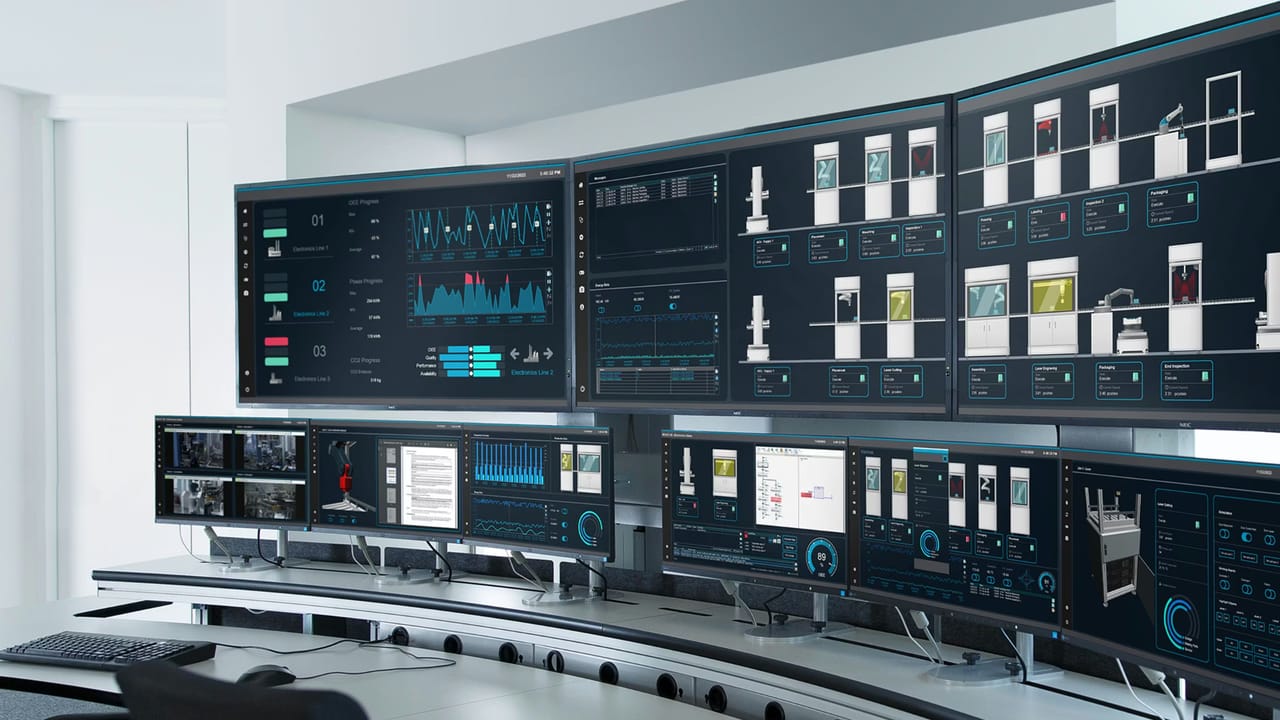
Understand how SCADA works in the power sector: substation architecture, IEDs, RTUs, SSCL, telemetry, alarms, telecommands, SOE, protocols, design, and commissioning.
Check it out!
SCADA in the power sector is the supervision, control, and data-acquisition infrastructure that connects field equipment, automation systems, telecommunications networks, and operation centers. In substations, it transforms measurements, states, alarms, and events into operational information and enables controlled execution of telecommands.
Although often associated with supervisory software, a complete SCADA system includes IEDs, RTUs, local supervision and control systems, concentrators, gateways, servers, operator stations, time synchronization, and links to remote control centers.
What Is SCADA
SCADA stands for Supervisory Control and Data Acquisition. The term refers to the set of resources that collect process information, process quality attributes, present states to operators, record historical data, and enable remote commands according to defined rules.
In the power sector, SCADA must handle distributed installations, different operating levels, availability, event sequencing, and integration among protection, automation, and telecommunications. Synoptic screens are only the visible layer of a chain that begins in the field and ends at the operation center.
SCADA Functions in the Power Sector
The core function is to provide observability, traceability, and operational intervention capability. Functions normally associated with SCADA include:
- acquisition of telemetry measurements;
- collection of status indications;
- processing of quality attributes;
- generation and prioritization of alarms;
- recording of events and historical data;
- sequence of events;
- telecommand;
- time synchronization;
- data distribution to operation centers.
At operation centers, SCADA can feed EMS, DMS, or ADMS platforms that add network-analysis, contingency, restoration, and decision-support functions.
SCADA in substations requires engineering beyond software.
The solution must coordinate IEDs, RTUs or SSCL, the point list, protocols, telecommunications, synchronization, alarms, commands, historical data, and integration with the operation center.
SCADA, Supervisory Systems, Automation, and SDSC
The concepts are related but not equivalent.
Supervisory system is a broad term for platforms that present variables, states, alarms, and commands.
SCADA is oriented toward acquisition and control of distributed processes, usually communicating between remote installations and operation centers.
Substation automation encompasses protection, control, interlocking, measurement, supervision, and communication. SCADA is part of this architecture but does not replace relays or local logic.
SDSC is the Digital Supervision and Control System at installation level. Depending on the architecture, it may combine RTU, SSCL, gateway, and local supervisory functions.
SCADA Architecture in Substations
A typical architecture includes the following layers:
| Layer | Main elements |
| Process | Circuit breakers, disconnectors, transformers, sensors, and auxiliary contacts |
| Protection and control | IEDs, relays, controllers, and bay units |
| Acquisition | RTU, SSCL, gateways, and concentrators |
| Local network | Switches, fiber, Ethernet networks, and synchronization |
| Local supervision | Servers, workstations, screens, alarms, and historical data |
| Telecommunications | Routers, WAN, optical networks, and redundant paths |
| Operation center | Central SCADA, EMS, DMS, and historian systems |
The design must define where each item of data is acquired, where it receives its time stamp, which processing is permitted, how quality is preserved, and which system is responsible for each function.
IED, RTU, SSCL, and Gateways
The IED performs protection, control, measurement, or monitoring functions and can provide data to the supervisory system.
The RTU provides the interface between the installation and the operation center, collecting information, receiving telecommands, and communicating with remote systems.
The SSCL integrates supervision and control at local level and may perform the RTU function depending on the adopted architecture.
The gateway converts or interconnects protocols. Conversion must preserve states, scales, quality attributes, time stamps, and point semantics.
Telemetry Measurements and Status Indications
Telemetry measurements may include voltage, current, active power, reactive power, frequency, tap position, temperatures, and auxiliary-service variables.
Engineering must control unit, sign, scale, resolution, transformation ratio, accuracy class, and treatment of invalid values.
Digital indications represent positions and conditions such as circuit breaker open or closed, disconnector open or closed, equipment available, protection operated, loss of communication, and local or remote mode.
Nomenclature must be consistent among the single-line diagram, equipment, screen, point list, and operation center.
Telecommands and Interlocks
A telecommand may involve selection, validation of permissives, authorization, issuance of the order, local execution, return status, and recording of the result.
SCADA must not bypass electrical, mechanical, or functional interlocks. The command matrix must document origin, destination, action, permissives, blocks, expected return, supervision time, and failure treatment.
Alarms and Sequence of Events
Not every state change should generate an alarm. An alarm philosophy should define priority, activation condition, delay, acknowledgment, suppression, grouping, and operator message.
SOE, Sequence of Events, records changes with time stamps to reconstruct incidents chronologically. It is essential for analyzing protection operations, circuit-breaker openings, teleprotection, reclosing, and failures.
The value of SOE depends on acquisition at the source, a reliable time stamp, and preservation of that time stamp during transmission.
Data Quality and Age
SCADA should indicate whether information is valid, stale, substituted, out of scan, under test, or affected by loss of communication.
Data age is the time between the occurrence in the process and reception at the destination. It includes acquisition, processing, and transmission.
The deadband defines the minimum variation required to transmit a new measurement by exception. An integrity scan periodically confirms the complete state of the database.
For installations covered by ONS Grid Procedures, Submodule 2.12 establishes specific requirements for supervision, control, quality, data age, SOE, and testing. These parameters must be applied according to the scope of the document itself.
Time Synchronization
Synchronization makes it possible to correlate events from IEDs, RTUs, servers, telecommunications equipment, and remote systems.
The architecture may use GNSS, PTP, NTP, IRIG-B, or other compatible mechanisms. The design must define the primary source, alternate source, distribution, accuracy, holdover, alarms, and behavior during loss.
Communication and Protocols
Data interconnection includes all resources between the acquisition or command-application point and the operation center. It may involve RTUs or SSCL, concentrators, routers, firewalls, point-to-point links, WAN networks, fiber, and carrier equipment.
Protocols found in the power sector include IEC 60870-5 families, DNP3, Modbus, and services under IEC 61850.
Interoperability depends on the implemented profile, addressing, data types, scales, quality, time stamps, commands, and scans. Submodule 2.15 complements telecommunications requirements in applications within its scope.
Redundancy, Segmentation, and Cybersecurity
Availability depends on the entire chain. Single points of failure may exist in the RTU, gateway, switch, DC supply, fiber, router, WAN link, time synchronization, database, or operation center.
VLANs support logical separation but do not create physical independence. When a function requires independent paths, switches, fibers, power supplies, and routes must also be analyzed.
Cybersecurity should cover asset inventory, least privilege, remote-access control, change logging, firmware management, protection of engineering workstations, backup, segmentation, and supplier management.
Integration with IEC 61850
In IEC 61850 architectures, SCADA can receive data modeled by IEDs and communication services from the automation system.
- MMS can be used for supervision, measurements, states, and commands;
- GOOSE is used for fast messages between devices;
- SCL files describe devices, communication, and engineering;
- SCADA must map the data to screens, alarms, historical data, and remote centers.
ABNT NBR IEC 61850-10 available in the consulted database addresses conformance testing and can support structuring validation activities.
SCADA Design for Substations
The design must start from operational requirements and actual interfaces, not merely from platform selection.
Typical stages include:
1. field survey; 2. identification of existing systems; 3. definition of supervision and control functions; 4. preparation of the point list; 5. architecture definition; 6. protocol selection; 7. definition of screens, alarms, and historical data; 8. redundancy analysis; 9. synchronization definition; 10. integration and migration planning; 11. definition of tests and acceptance criteria.
Point List, Screens, and Documents
The point list should record asset identification, description, type, source, destination, protocol, address, unit, scale, priority, time stamp, quality, screen, and historian.
In programs involving several substations, standardization of symbols, nomenclature, colors, navigation, alarms, and reports reduces errors and facilitates training, operation, and maintenance.
Deliverables may include:
- supervision and control philosophy;
- functional architecture;
- physical and logical topology;
- point list;
- telecommand matrix;
- alarm matrix;
- protocol matrix;
- specification of RTUs, SSCL, gateways, and servers;
- synchronization and availability requirements;
- screen standard;
- migration plan;
- FAT and SAT procedures;
- point-to-point test script;
- acceptance criteria;
- backups and as-built documentation.
Modernization, FAT, and SAT
Modernization projects may involve legacy RTUs, serial protocols, outdated databases, relays from different generations, and non-standardized screens.
The survey should map points, addresses, logic, telecommands, alarms, historical data, interfaces with remote centers, dependencies with protection, communication routes, and power supplies.
FAT verifies hardware, redundancy, database, screens, alarms, historical data, protocols, commands, synchronization, communication failures, backup, and restore.
SAT confirms the installed system. Point-to-point testing verifies each signal from origin to intended destinations, validating text, state, scale, quality, time stamp, and evidence.
Acceptance must demonstrate the performance of the integrated system.
FAT, SAT, and point-to-point tests must validate signals, telecommands, alarms, synchronization, redundancy, communication failures, recovery, and evidence traceability.
Learn about the Commissioning and Technical Acceptance service
Owner’s Engineering and Acceptance Criteria
In contracts involving multiple suppliers, Owner’s Engineering controls interfaces, documents, protocols, responsibilities, point lists, command matrices, test criteria, pending items, and final documentation.
Acceptance should demonstrate tested points, verified scales, preserved quality, events with consistent timing, prioritized alarms, commands with correct return status, tested redundancy, restored backups, and updated documentation.
Common Errors
- treating SCADA as a simple software purchase;
- failing to control the point list;
- ignoring quality attributes;
- not testing failures and contingencies;
- confusing supervision with protection;
- generalizing ONS requirements;
- modernizing without mapping legacy systems;
- accepting screens and points without point-to-point testing.
How to Contract Design, Integration, and Commissioning
The procurement scope should state the number of installations, existing equipment, operation centers involved, protocols, approximate point count, agent requirements, and migration conditions.
The scope may include survey, basic and detailed design, specifications, database, screens, parameterization, integration, procurement support, supervision, FAT, SAT, point-to-point testing, assisted operation, Owner’s Engineering, and final documentation.
Conclusion
SCADA in the power sector is an integrated engineering system. Its performance depends on consistency among field equipment, IEDs, RTUs or SSCL, networks, protocols, synchronization, servers, the operation center, and test procedures.
A reliable solution begins with clear operational requirements, preserves data quality and traceability, and ends with point-to-point testing and as-built documentation.
Technical References
[1] OPERADOR NACIONAL DO SISTEMA ELÉTRICO. Grid Procedures — Submodule 2.12: Minimum requirements for supervision and control for operation. Revision 2025.02.
[2] OPERADOR NACIONAL DO SISTEMA ELÉTRICO. Grid Procedures — Submodule 2.15: Minimum requirements for telecommunications.
[3] ASSOCIAÇÃO BRASILEIRA DE NORMAS TÉCNICAS. ABNT NBR IEC 61850-10: Communication networks and systems for power-system automation — Part 10: Conformance testing. Rio de Janeiro, 2018.
Frequently Asked Questions
It is the set of supervision, control, and data-acquisition resources connecting field equipment, automation, telecommunications, and operation centers.
No. The solution includes IEDs, RTUs, SSCL, gateways, networks, servers, synchronization, telecommunications, and databases.
UTR and RTU collect data and receive commands. SSCL integrates supervision and control at installation level.
No. SCADA supervises and controls, but protection functions remain in the appropriate equipment.
It is the document listing measurements, states, alarms, events, and commands, including source, destination, address, scale, quality, and test criteria.
It is the time-stamped sequence of events used to reconstruct operations and incidents chronologically.
It can use IED data models and services such as MMS and SCL files. GOOSE has a specific purpose for device-to-device communication.
Points, scales, states, quality, alarms, events, telecommands, protocols, synchronization, redundancy, backups, and integration with remote centers.
No. Each Submodule has its own scope. Agent standards and contractual requirements must also be considered.
To control interfaces, documents, responsibilities, test criteria, pending items, and acceptance in systems involving multiple suppliers.
Additional Technical Materials
Solutions
- Digital Supervision and Control Systems (SDSC)
- SCADA Systems
- Remote Assistance and Operational Monitoring for Substations
Engineering Services
- Telecommunications Design
- Systems Integration
- Commissioning and Technical Acceptance
- Owner’s Engineering
Additional Technical Materials