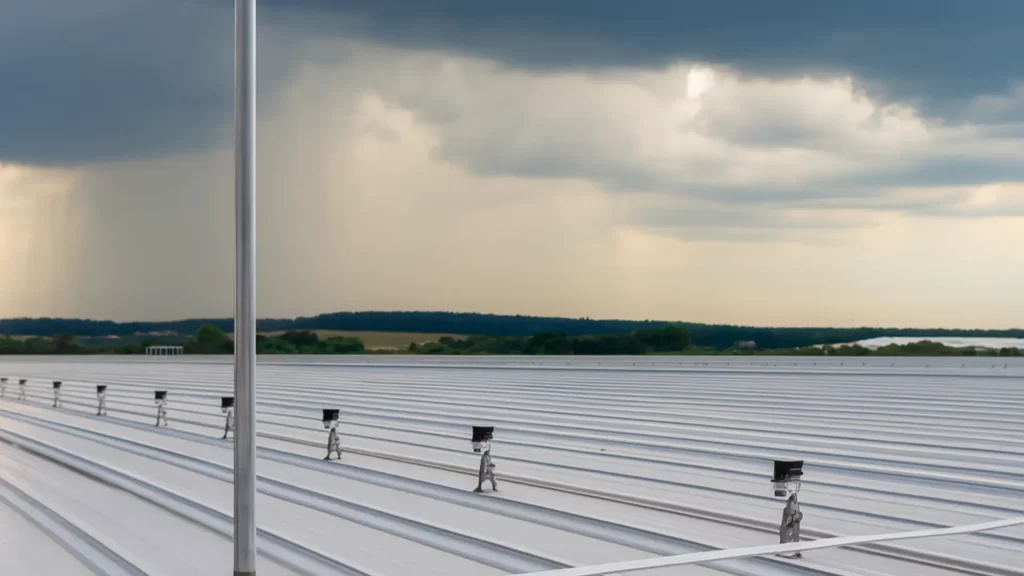
Understand what a lightning rod is, how an SPDA/LPS works, air-termination methods, Franklin rods, Faraday cages, grounding, SPDs, NBR 5419, inspection, and design.
Check it out!
Lightning rod is the common term used for the set of measures intended to protect a structure against the effects of lightning. In Brazilian engineering, the more precise term is SPDA — Sistema de Proteção contra Descargas Atmosféricas, equivalent to a Lightning Protection System (LPS).
The system does not indiscriminately “attract lightning.” Its function is to intercept a lightning discharge at points defined by the design, conduct the current through intended paths, and disperse it in a controlled manner, reducing risks to people, the structure, installations, and equipment.
A complete SPDA/LPS is not limited to the visible air terminal on the roof. It includes air termination, down conductors, grounding, equipotential bonding, surge-protection measures, documentation, inspection, and maintenance.
The need for and configuration of protection depend on the building characteristics, risk assessment, adopted protection level, and integration with internal electrical and electronic systems. Therefore, there is no single lightning-protection solution that applies identically to every structure.
Lightning Rod, Lightning Protection, and SPDA: Which Term Should Be Used?
In practice, searches for lightning rod, lightning protection, and similar terms usually express the same intent: understanding how to protect a building against lightning. The difference lies in the technical scope of the terminology.
Lightning rod is the common term. SPDA is the technical term used in Brazilian engineering designs, specifications, reports, inspections, and documentation. In an actual project, the design does not size only an isolated rod; it addresses the entire system, including air terminals, down conductors, grounding, equipotential bonding, SPDs, and inspection criteria.
Therefore, when someone asks “does this building need a lightning rod?”, the technical answer depends on an assessment according to NBR 5419 and, in particular, the risk assessment according to NBR 5419-2.
Need to determine whether the building requires lightning protection?
A3A Engenharia evaluates SPDA requirements based on technical assessment, risk, building use, internal systems, grounding, SPDs, and existing documentation. Request a technical assessment.
How Does a Lightning Protection System Work?
The operation of a lightning-protection system should be understood in stages.
The first stage is air termination. The air-termination system is responsible for intercepting the lightning discharge at points defined in the design. This may be accomplished through Franklin-type air terminals, conductor meshes, natural components of the structure, or other solutions defined by the SPDA design.
The second stage is current conduction. After interception, the lightning current must be conducted to the grounding system through down conductors that are properly positioned, sized, and connected.
The third stage is dissipation through grounding. SPDA grounding must be coordinated with the building and equipotential bonding, reducing hazardous potential differences and allowing current to flow into the earth in a controlled manner. For more detail, see the article on SPDA grounding.
The fourth stage is protection of internal systems. Even with an external SPDA, surges can reach electrical installations, CFTV, automation, telecommunications, access control, and IT infrastructure. Therefore, the design should consider SPDs, SPD coordination, and NBR 5419-4.
When Does a Building Need Lightning Protection?
The need for lightning protection should not be determined solely by building height or a visual impression of exposure. The correct approach is to perform a technical assessment and determine the need for protection in accordance with NBR 5419.
A building may require an SPDA because of factors such as occupancy, height, location, lightning exposure, building use, presence of people, risk of economic loss, operational continuity, sensitive electronic systems, storage of special materials, or requirements from insurers, audits, and regulatory authorities.
The article When Does a Building Need an SPDA? explores this decision in more depth and explains why the requirement should be addressed technically rather than merely as the purchase or installation of a component.
Types of Lightning Protection and Air-Termination Systems
When discussing types of lightning protection, it is common to think only of the Franklin air terminal. In SPDA design, however, the central issue is the air-termination system. The solution may involve point air terminals, conductor meshes, natural components, structural SPDA, and geometric protection criteria.
Franklin Air Terminal
The Franklin air terminal is one of the best-known forms of air termination. It is commonly associated with a metal rod installed at an elevated point of the building. In technical designs, however, the Franklin air terminal must be evaluated together with height, protection zone, number of down conductors, current path, grounding, and protection class.
This topic requires specific analysis because it involves technical decisions related to the Franklin air terminal, Franklin lightning rod, Franklin-type air terminal, Faraday cage, and air-termination system. For more detail, see Franklin Air Terminal in SPDA: lightning rods, Faraday cage, and air-termination system.
Lightning protection is not just a rod on the roof.
An SPDA design must integrate air termination, down conductors, grounding, equipotential bonding, SPDs, NBR 5419, NBR 5410, ART, technical documentation, and inspection criteria. Learn about SPDA Design.
Faraday Cage and Air-Termination Mesh
The Faraday-cage approach in an SPDA is associated with a conductor mesh installed on the roof and exposed portions of the structure, creating a distributed air-termination system. It is particularly relevant for buildings with large roof areas, complex geometries, or a need for more distributed protection.
Instead of relying on a single interception point, the mesh solution organizes lightning interception across several conductive elements coordinated with down conductors and grounding.
Structural SPDA and Natural Components
Structural SPDA uses metallic components or reinforcement within the structure itself, when technically applicable, as part of the protection system. This type of solution requires careful analysis, documentation, and coordination with structural, electrical, and grounding designs.
Rolling Sphere Method
The rolling sphere method is one of the criteria used to evaluate protection zones in an SPDA. It helps determine whether a given area of the building is protected by the air-termination system. Because the topic has its own technical complexity, see the dedicated article on the rolling sphere method in SPDA.
Lightning Protection, NBR 5419, and the Parts of the Standard
NBR 5419 should be understood as a set of criteria for risk assessment, design, installation, inspection, and maintenance of lightning protection.
NBR 5419 provides the overall framework. NBR 5419-2 addresses risk assessment and management. NBR 5419-3 covers the external SPDA, including air termination, down conductors, and grounding. NBR 5419-4 addresses protection of internal electrical and electronic systems.
This division matters because lightning protection is not limited to the visible component installed on the roof. A complete system must integrate the external SPDA, internal protection measures, grounding, equipotential bonding, SPDs, and technical documentation.
Lightning Protection, SPDs, and Surge Protection
A common mistake is to assume that a lightning-protection system automatically protects all internal electronic equipment. The external SPDA reduces risks associated with a direct lightning strike to the structure, but surge protection requires complementary measures.
Surge Protective Devices should be specified according to the electrical installation, presence of SPDA, equipment categories, grounding, equipotential bonding, and power and signal lines.
In environments with CFTV, automation, telecommunications, access control, and IT, it is also necessary to evaluate SPDs for data lines, CFTV, automation, and telecommunications. When an integrated solution is required, the page on surge-protection measures explains the relationship among SPDs, grounding, equipotential bonding, SPDA, and internal systems.
Internal systems also need surge protection.
CFTV, access control, automation, telecommunications, IT, and electrical panels require SPDs, equipotential bonding, and coordination with the SPDA. See surge-protection measures.
Inspection, Maintenance, and Documentation of Lightning Protection
A lightning-protection system installed without documentation, ART, technical design narrative, drawings, inspection records, or periodic verification should not be treated as a reliable system.
SPDA inspection evaluates air terminals, down conductors, connections, corrosion, electrical continuity, grounding, equipotential bonding, SPDs, documentation, and compliance with applicable criteria. In existing buildings, inspection also helps identify nonconformities and define an upgrade plan.
For this type of need, see the services for SPDA inspection and technical documentation, SPDA technical report, and SPDA maintenance and upgrades.
Lightning Protection and SPDA Design
A lightning-rod project should be treated as an SPDA design. It defines protection criteria, risk assessment, air-termination system, down conductors, grounding, equipotential bonding, SPDs, construction details, technical specifications, ART, and handover documentation.
In corporate, industrial, institutional, and critical buildings, the design must be coordinated with electrical installations, infrastructure, telecommunications, electronic security, automation, CFTV, and building operations.
A3A Engenharia provides SPDA design, grounding design, inspection, technical documentation, reports, and upgrades to existing systems, treating lightning protection as part of a complete building-protection solution.
Technical References
[1] ASSOCIAÇÃO BRASILEIRA DE NORMAS TÉCNICAS. ABNT NBR 5419 — Proteção contra descargas atmosféricas. See the current series in the ABNT Catalog.
[2] INTERNATIONAL ELECTROTECHNICAL COMMISSION. IEC 62305 — Protection against lightning. See the official series in the IEC Webstore.
[3] ASSOCIAÇÃO BRASILEIRA DE NORMAS TÉCNICAS. ABNT NBR 5410 — Instalações elétricas de baixa tensão. See the current edition in the ABNT Catalog.
Frequently Asked Questions
Lightning rod is the common term for a lightning-protection system. Technically, the complete system is an SPDA and includes air termination, down conductors, grounding, equipotential bonding, SPDs, documentation, and inspection.
A lightning rod is commonly associated with the visible air terminal on the roof. SPDA is the complete system, including air terminals, down conductors, grounding, equipotential bonding, surge protection, design, technical reports, and maintenance.
The need should be established through technical assessment and risk analysis in accordance with NBR 5419, considering building exposure, occupancy, use, height, location, operational continuity, and associated risks.
They are solutions related to the SPDA air-termination system. A Franklin air terminal is a point air-termination solution; a Faraday-cage approach uses a distributed conductor mesh on the structure.
No. The external SPDA reduces risks associated with direct lightning strikes, but protecting internal electrical and electronic systems requires SPDs, grounding, equipotential bonding, and coordination of surge-protection measures.
An SPDA design must be prepared by a legally qualified professional, with the required technical responsibility, ART, and documentation compatible with the building and applicable standards.
