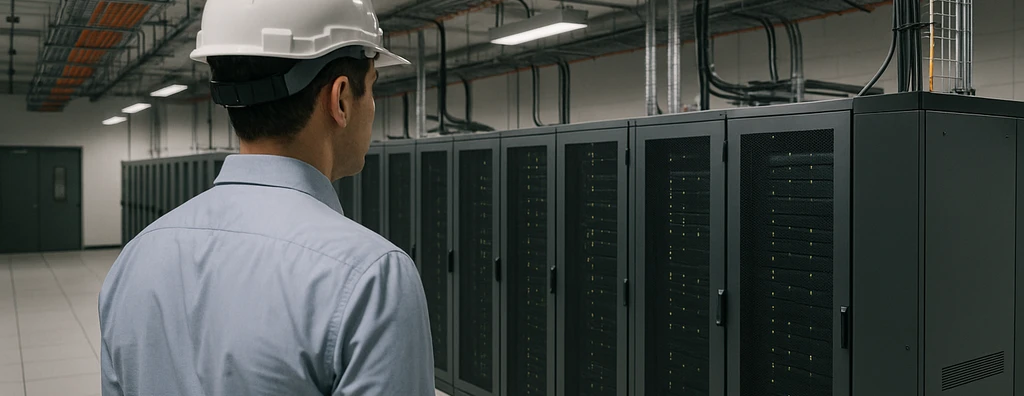
Understand the difference between CPD and Data Center, compare power, cooling, network, and security requirements, and learn when to modernize, build, or migrate the infrastructure.
Check it out!
CPD and Data Center can describe similar environments, but the terms are not necessarily equivalent and do not, by definition, represent two fixed quality levels. CPD — Data Processing Center — is the traditional designation for the environment that concentrates an organization’s computing resources, networks, and support systems. Data Center is the broader international term for facilities designed to support information technology through physical infrastructure, power, cooling, telecommunications, security, automation, operations, and management.
In practice, the relevant difference is not limited to the name, floor area, or number of racks. It appears in the requirements for availability, capacity, redundancy, maintenance, security, expansion, monitoring, and continuity. A compact CPD may support critical operations and require rigorous controls. Likewise, calling a room a “Data Center” does not prove that its architecture eliminates single points of failure or meets a formal classification.
This article compares CPD and Data Center, explains when the terms overlap, shows how requirements change between infrastructures, and presents criteria for deciding whether to upgrade the existing environment, build a new facility, adopt colocation, distribute workloads across Edge Data Centers, or migrate part of the services to the cloud.
Quick answer: What is the difference between CPD and Data Center?
| Aspect | CPD | Data Center | What actually needs to be verified |
| Use of the term | Traditional designation, common in internal corporate environments | International and broader designation | Actual scope of the facility and defined requirements |
| Purpose | Concentrate an organization’s processing, storage, and connectivity | Support proprietary or third-party digital services at different scales | Workload criticality and impact of downtime |
| Scale | Often smaller, but not necessarily | Can range from a technical room to a hyperscale campus | IT power, number of racks, density, and expansion |
| Availability | May range from basic infrastructure to resilient architecture | Usually has formalized continuity and maintenance requirements | Topology, paths, redundant capacity, and operations |
| Standards and classification | May adopt the same references applicable to Data Centers | Directly addressed by standards such as ISO/IEC 22237 and ANSI/TIA-942 | Applicable standards, certification objective, and demonstrated compliance |
| Operations | Often integrated with internal IT and facilities teams | May have specialized operations, NOC, procedures, and SLAs | Skills, procedures, monitoring, and incident response |
| Evolution | Can be modernized and continue to be called a CPD | Can be deployed as new infrastructure or as an evolution of the existing environment | Technical outcome, not merely a change in terminology |
The objective conclusion is: CPD primarily identifies the function of processing and concentrating data; Data Center emphasizes the integrated facility that supports that function. Engineering decisions should be based on requirements and risks, not on the label adopted.
Why are CPD and Data Center frequently confused?
The confusion occurs because both environments house servers, storage systems, switches, routers, racks, and other IT resources. In many Brazilian organizations, “CPD” is still used for the main technical room, even when it already has UPS, generator backup, dedicated cooling, access control, fire detection, monitoring, and redundant links.
There is also a simplified narrative in which every CPD is assumed to be small and basic, while every Data Center is assumed to be large, highly redundant, and certified. This interpretation is inadequate. Size, quality, and availability are different dimensions. A facility can be small and critical; it can be large and still have weaknesses; it can adopt good practices without pursuing certification; or it can evolve in stages according to risk and available investment.
The use of the term Data Center grew with the consolidation of distributed computing, the internet, virtualization, cloud computing, 24×7 services, colocation providers, and international technical references dedicated to data facilities. However, the terminology change does not eliminate the need to diagnose the actual condition of each environment.
What is a CPD?
CPD stands for Data Processing Center. It is the physical environment intended to concentrate computing, storage, communication, and support resources required for an organization’s digital activities. Traditionally, the CPD is located within a corporate, industrial, public, healthcare, educational, or commercial building and primarily serves internal users and systems.
The article CPD: what it is, how it works, and which systems make up the infrastructure explores this definition, its architecture, and its subsystems in greater depth. The key point is that CPD does not, by itself, mean improvised infrastructure. Criticality may require uninterruptible power, precision cooling, environmental control, structured cabling, physical security, early fire detection, monitoring, and formal procedures.
In smaller environments, some functions may share building resources. The CPD may use the main substation, corporate generator, central HVAC system, or building security system. This integration can be appropriate, provided that capacity, load priority, failure modes, and responsibilities are clearly assessed.
What is a Data Center?
A Data Center is the physical and operational facility prepared to house, power, cool, connect, protect, and monitor information technology resources. The infrastructure includes the building, power, environmental control, telecommunications, security, fire protection, automation, management, documentation, and operations.
The ISO/IEC 22237 series addresses Data Centers through concepts, reference models, classification, construction, power, environmental control, telecommunications, security, and management. ANSI/TIA-942-C also structures requirements for Data Center infrastructure.
The article Data Center: what it is, how it works, and which systems make up the infrastructure provides a broad reference for the main topic. In this comparison, the focus is on understanding when a CPD already has equivalent characteristics, when it needs modernization, and when another strategy is more appropriate.
The choice between a CPD, an owned Data Center, Edge, or colocation starts with the requirements. The architecture should reflect criticality, capacity, availability, growth, site risks, operations, and investment throughout the life cycle.
Is a CPD an outdated version of a Data Center?
Not necessarily. Historical evolution explains part of the distinction, but it does not create a universal rule. The term CPD emerged in a context of centralized processing and remained embedded in the vocabulary of many organizations. The term Data Center became predominant in global markets, providers, cloud services, and international technical references.
A CPD can undergo electrical, thermal, physical, and operational modernization and still be called a CPD by the organization. The result may be technically equivalent to a small enterprise Data Center. Conversely, a room newly labeled “Data Center” may lack redundancy, documentation, monitoring, or maintenance conditions compatible with its criticality.
Therefore, the analysis should separate three dimensions:
- terminology: how the organization names the environment;
- architecture: how systems, paths, capacities, and interfaces were designed;
- required performance: which events the facility must withstand and how that performance will be demonstrated.
Technical comparison between CPD and Data Center
| Dimension | Traditional CPD | Structured Data Center | Engineering question |
| Scope | Primarily supports internal systems | May support one organization, multiple customers, distributed services, or platforms at scale | Which workloads and services depend on the facility? |
| IT power | Usually smaller and concentrated | Can range from low power to tens or hundreds of megawatts | What is the current, projected, and per-rack load? |
| Electrical architecture | May share building systems | Tends to have dedicated paths and resources according to criticality | Which failures and maintenance activities can interrupt the loads? |
| Cooling | May use a dedicated or shared system | Defined by heat load, density, expansion, and availability | Does capacity remain adequate during failures and maintenance? |
| Telecommunications | Often has centralized corporate connectivity | May require multiple carriers, routes, and entrance areas | Are the links truly independent? |
| Physical security | May integrate with building security | Usually uses zones, controls, records, and barriers compatible with risk | Who can access each area and how is the event evidenced? |
| Fire and environment | May use building systems with local supplements | Combines prevention, detection, compartmentation, suppression, and integrated logic | Does the plan protect people, assets, and continuity? |
| Monitoring | May rely on separate tools | Tends to integrate BMS, electrical supervision, DCIM, alarms, and asset management | Can the team see capacity, degradation, and failures before impact? |
| Operations | Internal team and variable procedures | Formalized processes, SLAs, changes, maintenance, and incident response | Is there capacity to operate the designed architecture? |
| Documentation | May have fragmented records | Requires a source of truth, as-built documentation, inventory, logic, tests, and history | Is the actual condition reflected in the documents? |
| Expansion | Often grows in response to immediate demand | May adopt modules, reserves, limits, and capacity triggers | What growth was planned and what is each system’s limit? |
| Certification | Not inherent to the term | May pursue design, construction, or operational certifications | Which standard and scope need to be formally demonstrated? |
The table describes trends, not an automatic classification. Each facility must be assessed through surveys, documents, measurements, tests, and risk analysis.
Does size determine whether an environment is a CPD or Data Center?
No. Floor area, number of racks, and power are important for sizing, but they do not independently determine the nature of the infrastructure. An environment with two racks may support industrial control systems, operational telecommunications, electronic health records, payments, public safety, or essential corporate services. Small scale does not reduce the impact of a failure.
Likewise, a room with dozens of racks may have grown without planning, sharing panels, cooling, paths, and single points of failure. Large physical scale does not prove resilience.
The analysis should relate criticality, capacity, topology, maintenance, operations, and consequence. The objective is not to fit the environment into a commercial category, but to define requirements proportional to risk.
Can a small CPD be mission-critical infrastructure?
Yes. Mission-critical describes the importance of the service and the impact of downtime, not the size of the room. A small CPD may support systems whose shutdown affects production, safety, customer service, billing, communications, or regulatory obligations.
In such cases, factors to be assessed include:
- maximum tolerable downtime;
- dependencies among power, cooling, network, storage, and applications;
- contingency and recovery procedures;
- ability to perform maintenance without interruption;
- spare parts and manufacturer support;
- local and remote monitoring;
- documentation, training, and responsibilities;
- risks related to the environment, building, and location.
The strategy may combine local upgrades, selective redundancy, replication at another site, colocation, cloud, backup, and Disaster Recovery. Not every requirement needs to be resolved within the same room.
How do requirements change between a CPD and a Data Center?
Location, building, and physical infrastructure
In an internal CPD, site selection may be constrained by the existing building. Even so, access, water risk, proximity to wet areas, dust, vibration, fire, interference, floor loads, equipment transportation, cable routes, and expansion potential must be assessed.
In a dedicated Data Center, the analysis may include the site, natural hazards, power availability, telecommunications, water, access, perimeter security, logistics, surrounding areas, and phased deployment. ISO/IEC 22237-2:2024 addresses construction, site selection, environmental risks, configuration, access, physical protection, fire, and water.
Electrical power and continuity
CPDs often share the power service, transformers, generators, or panels with other building loads. The priority is to understand the entire chain: source, transformation, protection, UPS, batteries, generation, transfer, distribution, and rack power supply.
Data Centers may adopt dedicated paths, multiple systems, N, N+1, 2N topologies, or other combinations. However, duplicating equipment does not automatically eliminate single points of failure. Busways, controls, auxiliary systems, fuel, cooling, grounding, and maintenance also need to be considered.
The Power for Critical Infrastructure solution connects availability, power quality, protection, generation, UPS, batteries, and distribution to workload requirements.
Cooling and environmental control
Sizing should be based on heat load and the actual behavior of the equipment, not only on room area. An acceptable average temperature does not rule out hot spots, recirculation, low airflow, or distribution failures.
In existing CPDs, modernization may include hot- and cold-air segregation, rack rearrangement, sealing openings, additional sensors, capacity expansion, and equipment replacement. In Data Centers, thermal architecture is integrated with layout, density, redundancy, expansion, and efficiency.
The Data Center Cooling solution allows capacity, airflow distribution, containment, control, monitoring, and availability to be addressed as a system.
Telecommunications, cabling, and external connectivity
Corporate CPDs may concentrate the building’s main distribution, backbone, and connectivity with other sites. Data Centers may use distribution areas, redundant pathways, multiple carriers, and topologies adapted to density and availability.
Independence must be both physical and logical. Two links contracted from different carriers may share ducts, poles, boxes, entrance rooms, or equipment. The design needs to verify routes, demarcation points, capacity, identification, certification, and documentation.
ABNT NBR 14565 and structured cabling, the fiber-optic guide, and the article on fiber-optic backbone provide further detail on passive infrastructure and its acceptance criteria.
Physical security, fire protection, and environmental events
Security should organize perimeters, zones, authorizations, visitors, records, CFTV, intrusion detection, and response. The level of control depends on risk, assets, people, operations, and contractual or regulatory requirements.
Fire protection should integrate prevention, detection, alarm, compartmentation, evacuation, suppression, operating logic, and maintenance. Water, smoke, dust, leaks, condensation, and unauthorized access can also interrupt services without directly damaging servers.
ISO/IEC 22237-6:2024 addresses physical security, unauthorized access, intrusion, fire, and internal and external environmental events.
Monitoring, automation, and DCIM
A critical environment needs to make power, temperature, humidity, leakage, cooling, UPS, batteries, generators, security, and capacity visible. Alarms should have a priority, recipient, response time, and associated procedure.
DCIM — Data Center Infrastructure Management relates assets, racks, power, capacity, and environmental conditions. NetBox, Zabbix, BMS, SCADA, and specialized systems can perform complementary functions depending on the architecture.
Operations, maintenance, documents, and governance
Designed infrastructure only delivers availability when it is operated accordingly. Procedures for switching, maintenance, changes, access, incident response, escalation, and restoration need to be defined and practiced.
Documentation should include diagrams, drawings, lists, logic, configurations, identification, test reports, maintenance plans, inventory, and history. An environment may have good architecture and still present high risk if the team does not know the actual state of the systems.
Before modernizing, the actual condition must be diagnosed. Surveys, documents, measurements, capacity analysis, single points of failure, and operational risks guide the upgrade plan.
Availability, Redundancy, and Tier: What Changes?
Availability results from the combination of architecture, capacity, maintenance, operations, component quality, failure response, and external dependencies. Redundancy is one mechanism for improving this outcome, but it must be analyzed by path and by function.
The Uptime Institute Tier classification uses increasing criteria related to capacity components and distribution paths. It should not be reduced to an equipment checklist or generic availability percentages. It is also incorrect to formally declare a facility Tier-rated merely by analogy with its architecture.
CPDs can adopt principles of concurrent maintainability, redundancy, and elimination of single points of failure without pursuing certification. Data Centers may use other references, such as ANSI/TIA-942-C or ISO/IEC 22237, depending on the project objectives.
The correct question is not only “which Tier do we want?”, but:
- which services need to remain available;
- which events and maintenance activities must be supported;
- which failures are acceptable;
- what the recovery time is;
- which dependencies remain outside the Data Center;
- how performance will be tested and demonstrated.
When Does a CPD Need Modernization?
Modernization should be considered when the infrastructure no longer keeps pace with system criticality, capacity, or life cycle. Recurring signs include:
- electrical load near the limit or distribution without selectivity and documentation;
- UPS, batteries, generators, or cooling systems without adequate support;
- growth in racks and equipment without capacity planning;
- hot spots, air recirculation, or limited thermal visibility;
- single paths for power, telecommunications, or cooling;
- links, panels, and cables without identification or traceable certification;
- access control, fire protection, and monitoring incompatible with the risk;
- maintenance activities that require complete shutdown;
- documents that diverge from the actual installation;
- recurring incidents or dependence on informal knowledge;
- difficulty increasing density, power, or connectivity;
- incompatibility between the existing room and future requirements.
Modernizing does not mean replacing everything at once. The plan may prioritize critical risks, restore documentation, reorganize loads, install monitoring, create selective redundancy, and deploy new systems in stages.
Modernize, Build, Use Colocation, or Migrate to the Cloud?
The decision should compare technical and economic alternatives across the life cycle. The main options are:
| Alternative | When it tends to be appropriate | Points of attention |
| Modernize the existing CPD | Suitable location, recoverable capacity, and possibility of phased intervention | Building limitations, coexistence with operations, and construction risk |
| Build a new owned Data Center | Need for control, specific requirements, scale, long-term horizon, and investment feasibility | CAPEX, schedule, site, power, permits, team, and operations |
| Use colocation | Need to accelerate deployment, procure infrastructure, and retain owned equipment | SLA, connectivity, space, power, responsibilities, and recurring costs |
| Deploy an Edge Data Center | Latency, local processing, regional continuity, or proximity to users and assets | Distributed operations, security, maintenance, and connectivity |
| Migrate workloads to the cloud | Compatible applications, elasticity, and digital-services strategy | Architecture, costs, connectivity, provider dependency, and governance |
| Adopt a hybrid model | Workloads with different requirements and need to combine environments | Integration, identity, security, data, observability, and continuity |
Cloud computing does not eliminate physical Data Centers. It transfers part of the infrastructure to environments operated by providers. The article Cloud computing in practice explains this dependency.
The right alternative should be defined before detailed design. FEL and feasibility studies make it possible to compare modernization, construction, colocation, Edge, and cloud considering risks, CAPEX, OPEX, schedule, and life cycle.
Decision Matrix: Existing CPD or New Data Center?
| Criterion | Questions for decision-making |
| Criticality | Which processes stop? What is the financial, operational, safety, or regulatory impact? |
| Capacity | Do power, cooling, space, and connectivity support the load and growth? |
| Location | Is the environment exposed to water, fire, access, vibration, dust, or external risks? |
| Availability | Which failures and maintenance activities must occur without interruption? |
| Expansion | Can growth be implemented without compromising operations? |
| Life cycle | Which equipment is obsolete and how long will the environment remain in use? |
| Intervention | Can construction work, testing, and migrations be performed safely? |
| Connectivity | Are sufficient carriers, routes, and capacity available at the site? |
| Costs | What is the total cost to upgrade, build, procure, or migrate? |
| Operations | Does the organization have the team, procedures, and governance to operate the solution? |
| Schedule | When does the new capacity need to be available? |
| Strategy | Which workloads should remain on-premises, move to colocation, or migrate to the cloud? |
The matrix does not replace studies, but it prevents the decision from being dominated by a single factor, such as initial price, available space, or technology preference.
How to Modernize or Migrate Without Interrupting Operations?
Operational environments require transition planning. The intervention must recognize that power, cooling, networks, and applications have different dependencies. A seemingly simple change can alter paths, capacity, addressing, protection, alarms, and procedures.
A typical plan includes:
1. Survey and baseline: confirm physical condition, documents, loads, capacities, configurations, and dependencies. 2. Workload classification: separate criticality, windows, existing redundancy, and rollback strategy. 3. Transition architecture: define temporary systems, coexistence, alternate paths, and deployment sequence. 4. Detailed design: consolidate diagrams, logic, lists, procedures, interfaces, and test criteria. 5. Preparation: validate equipment, configurations, communications, team, tools, and contingencies. 6. Phased migration: execute controlled batches, record results, and preserve rollback capability. 7. Integrated testing: verify power, cooling, communications, alarms, security, applications, and recovery. 8. Documentation update: reflect the final condition and transfer knowledge to operations.
The migration must consider more than servers. Telecommunications routes, addressing, storage, backups, security systems, automation, and monitoring can also determine the window and risk.
How to Develop a Modernization Project or New Data Center?
1. Diagnosis and requirements
The initial stage identifies loads, criticality, capacity, growth, risks, location, operations, constraints, and objectives. Requirements should be measurable and linked to acceptance criteria.
2. Alternatives and feasibility study
Upgrade, construction, colocation, Edge, cloud, and hybrid-architecture scenarios are compared. The analysis should include investment, operating costs, schedule, risks, life cycle, and expansion strategy.
3. Conceptual and basic design
Defines architecture, areas, capacities, redundancy, paths, interfaces, phases, and assumptions. This stage stabilizes decisions before equipment is purchased or construction begins.
4. Detailed design and procurement
Consolidates calculations, diagrams, drawings, design narratives, specifications, lists, logic, procedures, and tests. Scope, responsibilities, milestones, submittals, and measurement criteria need to remain clear.
5. Implementation and interface management
Execution must control coordination, manufacturing, installation, quality, changes, documentation, risks, and coexistence with operations. Power, HVAC, telecommunications, security, fire protection, and automation must be treated as integrated systems.
6. Commissioning, migration, and acceptance
Tests verify equipment, systems, and integrations. Failure simulations, source transfer, autonomy, thermal capacity, alarms, communications, security, and procedures help demonstrate compliance with requirements.
The owner needs to maintain an integrated view throughout the entire cycle. Owner’s Engineering connects requirements, alternatives, designs, contracts, interfaces, implementation, tests, and acceptance to the project objectives.
Why Is Commissioning Decisive?
An infrastructure can be fully installed and still not be ready for operation. Commissioning verifies whether equipment, systems, logic, and procedures work together and produce the evidence required for acceptance.
Possible tests include:
- installation, identification, and documentation inspections;
- energization, protection, and power quality;
- UPS and battery autonomy according to scope;
- generator start-up and transfer;
- cooling behavior under load and failure conditions;
- alarm management, communications, and system integration;
- detection, security, and interlocks;
- links and cabling certification;
- maintenance and component-loss simulations;
- operating, contingency, and restoration procedures.
The test level should be defined in the design and procurement process. Leaving criteria until the end increases disputes, rework, and the risk of accepting a facility without sufficient evidence.
Technical acceptance requires criteria, tests, and evidence. Commissioning verifies equipment, systems, and integrations before operations begin and reduces the transfer of outstanding issues to the owner’s team.
Example: Evolution of a Corporate CPD
Consider a CPD with eight racks, two cooling units, a single UPS, the building generator, one dedicated panel, and two internet links. The environment has grown over several years and supports ERP, telephony, security systems, files, and internal applications.
The first impression may suggest simply purchasing a second UPS. However, the diagnosis identifies that both links enter through the same shaft, the cooling units share the same power supply, the generator prioritizes other loads, rack circuits are undocumented, and panel maintenance requires a complete shutdown.
Modernization needs to address the whole system. A phased plan can restore diagrams and inventory, install metering and sensors, reorganize circuits, create an alternative power supply, segregate telecommunications routes, adjust cooling, implement alarms, and migrate part of the applications to another site or colocation.
The organization may continue to call the resulting environment a CPD. Technically, however, it begins operating with requirements, controls, and evidence compatible with its criticality. The improvement lies not in changing the name, but in reducing risks and maintaining services.
Common Mistakes When Comparing CPD and Data Center
Assuming every CPD is outdated
The term is traditional, but the facility may have been modernized and may have sound architecture. The diagnosis should assess systems and operations.
Claiming every Data Center has high availability
The designation does not prove redundancy, concurrent maintainability, testing, or certification.
Using only the number of racks as a criterion
Criticality, power, density, dependencies, and failure impact are more relevant than the isolated rack count.
Confusing redundancy with duplication
Duplicated equipment may share power, controls, piping, routes, or the same environment and fail due to the same event.
Migrating to the cloud without analyzing connectivity and continuity
The cloud transfers infrastructure but increases dependence on networks, identity, security, governance, and application architecture.
Designing disciplines separately
Power, cooling, telecommunications, security, fire protection, and automation have interfaces that need to be coordinated.
Purchasing equipment before stabilizing requirements
The solution may become oversized, incompatible, or unable to meet maintenance and growth requirements.
Leaving testing and documentation until the end
Late criteria make procurement, commissioning, acceptance, operations, and accountability more difficult.
How Can A3A Engenharia Support the Project?
A3A Engenharia can support organizations that need to assess an existing CPD, compare alternatives, or develop new data infrastructure. Services may include surveys, diagnostics, feasibility studies, requirements, multidisciplinary designs, specifications, procurement, coordination, Owner’s Engineering, inspection, commissioning, and acceptance.
The workstreams can integrate Data Centers, Power for Critical Infrastructure, Data Center Cooling, DCIM, cabling, connectivity, security, fire protection, and monitoring.
The objective is to transform business needs and operational risks into technical requirements, coordinate interfaces, and produce evidence that the implemented solution meets its intended use.
Conclusion
CPD and Data Center should not be differentiated solely by size, age, or terminology. Both can concentrate IT resources; what changes is how the infrastructure was planned, integrated, operated, and demonstrated in relation to criticality.
A CPD can be modernized and achieve a high level of resilience. A Data Center can adopt different scales and models. The decision to upgrade, build, use colocation, deploy Edge, or migrate to the cloud requires analysis of requirements, capacity, availability, location, costs, schedule, and operations.
The best solution is the one that reduces relevant risks, supports growth, and enables maintenance, monitoring, testing, and incident response within the owner’s objectives.
Technical references
[1] INTERNATIONAL ORGANIZATION FOR STANDARDIZATION. ISO/IEC 22237-1:2021 — Information technology — Data centre facilities and infrastructures — Part 1: General concepts. Geneva: ISO, 2021.
[2] INTERNATIONAL ORGANIZATION FOR STANDARDIZATION. ISO/IEC 22237-2:2024 — Information technology — Data centre facilities and infrastructures — Part 2: Building construction. Geneva: ISO, 2024.
[3] INTERNATIONAL ORGANIZATION FOR STANDARDIZATION. ISO/IEC 22237-3:2021 — Information technology — Data centre facilities and infrastructures — Part 3: Power distribution. Geneva: ISO, 2021.
[4] INTERNATIONAL ORGANIZATION FOR STANDARDIZATION. ISO/IEC TS 22237-5:2018 — Information technology — Data centre facilities and infrastructures — Part 5: Telecommunications cabling infrastructure. Geneva: ISO, 2018.
[5] INTERNATIONAL ORGANIZATION FOR STANDARDIZATION. ISO/IEC 22237-6:2024 — Information technology — Data centre facilities and infrastructures — Part 6: Security systems. Geneva: ISO, 2024.
[6] INTERNATIONAL ORGANIZATION FOR STANDARDIZATION. ISO/IEC TS 22237-7:2018 — Information technology — Data centre facilities and infrastructures — Part 7: Management and operational information. Geneva: ISO, 2018.
[7] INTERNATIONAL ORGANIZATION FOR STANDARDIZATION. ISO/IEC TS 22237-31:2026 — Information technology — Data centre facilities and infrastructures — Part 31: Key performance indicators for resilience. Geneva: ISO, 2026.
[8] TELECOMMUNICATIONS INDUSTRY ASSOCIATION. ANSI/TIA-942-C — Telecommunications Infrastructure Standard for Data Centers. Arlington: TIA, 2024.
[9] UPTIME INSTITUTE. Tier Standard: Topology. Seattle: Uptime Institute, current edition.
[10] ASHRAE. Thermal Guidelines for Data Processing Environments. Atlanta: ASHRAE, current edition.
[11] ASSOCIAÇÃO BRASILEIRA DE NORMAS TÉCNICAS. ABNT NBR 14565 — Cabeamento estruturado para edifícios comerciais. Rio de Janeiro: ABNT, current edition.
[12] ASSOCIAÇÃO BRASILEIRA DE NORMAS TÉCNICAS. ABNT NBR 5410 — Instalações elétricas de baixa tensão. Rio de Janeiro: ABNT, current edition.
Frequently asked questions
The terms may describe similar environments, but they are not necessarily equivalent. CPD is the traditional designation for a data processing center. Data Center is a broader international concept for the integrated facility that supports IT resources.
No. CPDs are often smaller, but size does not define the classification. Criticality, power, architecture, availability, operations, and expansion are more relevant criteria.
Yes. If the supported systems are essential to operations, safety, customer service, production, or regulatory obligations, even a small CPD may require high availability and rigorous controls.
Not necessarily. The environment can be modernized in stages. In other cases, limitations related to the site, power, cooling, or expansion may make it more appropriate to build, use colocation, or migrate workloads.
A Data Center is the physical infrastructure that supports equipment and digital services. Cloud is a model for delivering computing resources that uses Data Centers owned by the organization or by providers.
When capacity, availability, security, documentation, maintenance, or expansion no longer keep pace with workload criticality, or when equipment and systems approach end of life.
Tier is the Uptime Institute topology classification system. The classification considers capacity components and distribution paths and should not be assigned solely based on the presence of specific equipment.
Not for every project. The need depends on contracts, regulation, commercial strategy, and owner objectives. Even without certification, requirements and tests should be formally defined.
No. The provider supplies part of the infrastructure, but the customer still needs to design connectivity, racks, contracted power, equipment, security, migration, operations, and SLA criteria.
The choice should compare criticality, capacity, location, availability, growth, schedule, investment, operating costs, capabilities, and application architecture.
Additional technical materials
Fundamentals, comparison, and infrastructure models
- CPD: what it is, how it works, and which systems make up the infrastructure
- Data Center: what it is, how it works, and which systems make up the infrastructure
- Complete guide to digital data storage
- Cloud computing in practice: how it works and why it depends on infrastructure
Power, availability, and electrical protection
- NBR 5410: low-voltage electrical installations
- Power for Critical Infrastructure
- Power Quality
- Low-Voltage Electrical Installations
Cooling, environment, and fire protection
- Data Center Cooling
- Thermal Monitoring of Critical Environments
- HVAC System Automation
- Fire Prevention and Protection
Networks, cabling, and physical infrastructure
- ABNT NBR 14565 and structured cabling
- Complete fiber-optic guide
- Fiber-optic backbone
- Network Design: stages, architecture, and technical documentation
- Network rack: organization, components, and best practices
Management, monitoring, and continuity
- Data Center Infrastructure Management (DCIM)
- NetBox: IPAM, DCIM, and Source of Truth
- Zabbix: infrastructure, network, and critical-environment monitoring
- Backup and Disaster Recovery
