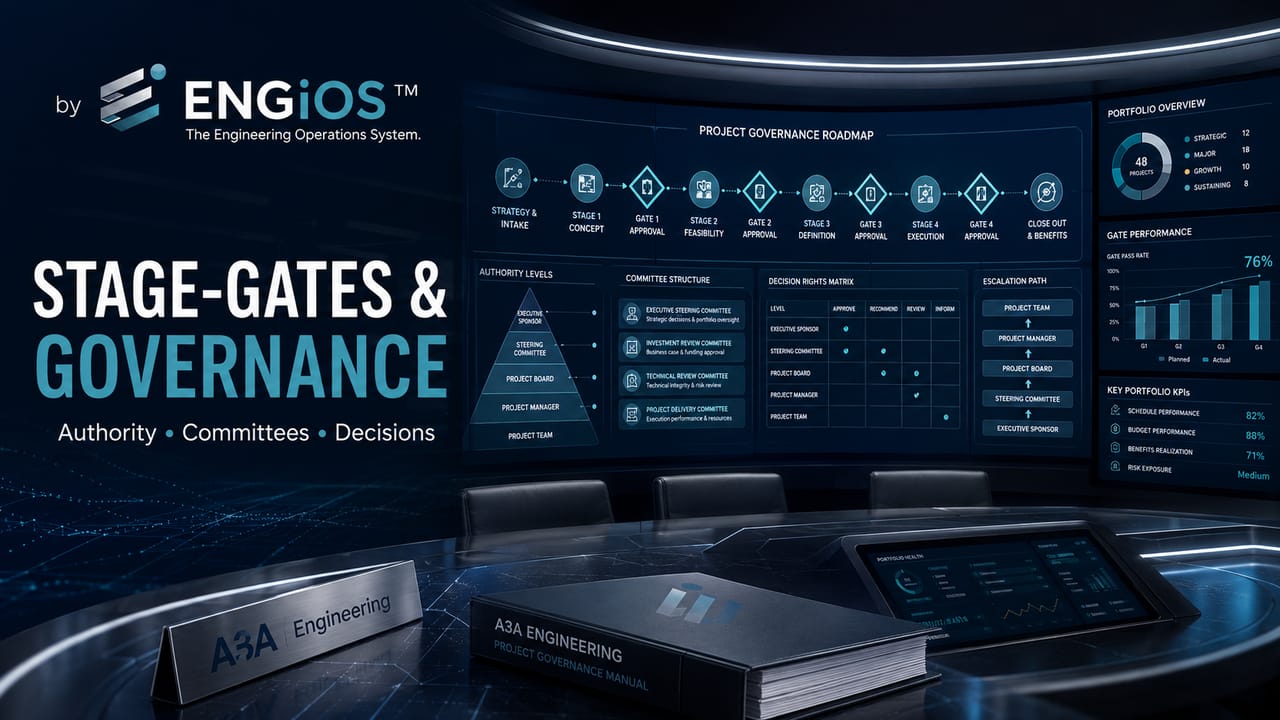
How to structure decision governance in engineering projects using authority levels, committees, tolerances, stage-gates, assurance, exceptions, and traceable decisions.
Check it out!
Project decision governance is the part of governance that defines decision rights, authority levels, forums, tolerances, escalation criteria, and the evidence required to approve, condition, stop, or redirect a project. In engineering, it determines who may accept risks, authorize changes, release phases, and assume technical, contractual, or financial commitments.
This content is deliberately specific: it addresses the project’s decision architecture — sponsor, committees, authority matrix, stage-gates, exceptions, assurance, and decision trail. It is not intended to replace a broader view of governance processes, Project Controls, and Owner’s Engineering throughout the lifecycle.
In multidisciplinary projects, the most critical failure often occurs when responsibility and authority do not align. Decision governance reduces this ambiguity by establishing objective limits for the project manager, PMO, technical disciplines, contracts, procurement, Owner’s Engineering, sponsors, and governance bodies.
What Is Decision Governance in Engineering Projects?
Decision governance is the application of structures, roles, and mechanisms that define how a decision originates, who has authority to make it, what evidence supports it, and how its execution is supervised. For an integrated view of governance processes throughout the lifecycle, including Project Controls and Owner’s Engineering, the site maintains dedicated content; here the focus is on authority levels, committees, stage-gates, tolerances, exceptions, and decision traceability.
ISO 21505 addresses governance of projects, programs, and portfolios in the context of governing bodies, executives, sponsors, committees, portfolio owners, and PMOs. This perspective is important because governance is not limited to the project manager.
In practice, governance establishes:
- who decides;
- what they decide about;
- based on what evidence;
- within what limits;
- in which forum;
- how often;
- how conflicts are escalated;
- how decisions are recorded;
- how outcomes are supervised.
Governance and Project Management: What Is the Difference?
The distinction prevents the manager from being held responsible for decisions that belong to executive governance and prevents the committee from improperly interfering in day-to-day management.
| Governance | Management |
| defines direction and authority | organizes and leads the work |
| establishes criteria and tolerances | plans and controls deliverables |
| approves or conditions relevant decisions | prepares analyses and recommendations |
| oversees performance and risks | handles deviations within delegated authority |
| defines accountability | executes plans and coordinates teams |
| decides on continuity and priority | manages the approved project |
The PMO can support governance through methods, information, gates, and reports, but does not necessarily have final authority over the investment.
Why Do Engineering Projects Require Specific Governance?
Engineering projects combine technical, commercial, financial, and operational decisions. An apparently localized change may affect safety, interfaces, contracts, schedule, CAPEX, asset performance, and commissioning.
Governance needs to consider, among other points:
- technical and regulatory requirements;
- professional responsibilities;
- interfaces among disciplines;
- suppliers and contractors;
- contracts and claims;
- safety and operational risks;
- engineering changes;
- documentation and traceability;
- acceptance criteria;
- transition to operations.
Without a clear decision system, technical conflicts may remain open until they become rework or contractual claims.
What Are the Main Governance Roles?
Roles vary by organization, but they need to be explicit.
Governing Body or Executive Leadership
Defines strategic direction, approves relevant investments, establishes limits, and oversees the set of initiatives.
Sponsor
Is responsible for connecting the project to organizational objectives. Should remove high-level impediments, secure resources, and make or escalate decisions consistent with their authority.
Steering Committee
Brings together representatives with authority to assess performance, risks, changes, priorities, and conditions. The committee should not become an operational status meeting.
PMO
Structures governance processes, consolidates information, administers forums and gates, verifies adherence, and prepares comparable analyses.
Project Manager
Integrates the work, prepares recommendations, and decides within assigned tolerances.
Owner’s Engineering or Independent Assurance
Critically assesses evidence maturity, risk consistency, and the project’s actual condition in defense of the owner.
Technical Teams and Contractors
Produce deliverables, analyses, and evidence that support decisions.
What Are Decision Authority Levels?
Governance is not a status meeting. It exists to define authority, limits, criteria, and accountability before a critical decision reaches the project.
Learn About A3A Engenharia’s Engineering Project Management Service
Authority levels are formal limits of decision power. They determine who may decide on a given matter and up to what level of impact.
Examples of matters subject to authority limits:
- budget approval;
- acceptance of residual risk;
- scope change;
- schedule extension;
- use of contingency;
- extraordinary contracting;
- change to a critical requirement;
- approval of a technical exception;
- conditional acceptance;
- suspension or cancellation.
Authority levels should be clear enough to avoid two extremes: immaterial decisions escalating to executive leadership and strategic decisions being made at the operational level.
How to Structure an Authority Matrix?
An authority matrix relates decision type, impact, responsible party, approver, and recording method.
| Decision | Range or condition | Typical authority | Minimum evidence |
| Low-materiality change | within tolerance | project manager | impact analysis |
| Significant change | changes the baseline | sponsor/committee | approved change request |
| Critical risk | above threshold | committee/executive leadership | analysis and recommended response |
| Use of contingency | within the rule | defined authority | justification and forecast |
| Phase gate | criteria met | gate owner/committee | readiness package |
| Technical exception | critical requirement | technical authority | technical opinion and residual risks |
The RACI Matrix in Engineering Projects organizes responsibilities for execution, approval, consultation, and information, but does not replace formal authority definition.
How Do Project Committees Work?
Committees are decision forums, not merely status-update meetings.
An effective committee needs:
- a mandate;
- defined composition;
- a calendar;
- a focused agenda;
- information prepared in advance;
- required decisions;
- recording of votes or approvals where applicable;
- conditions;
- owners;
- deadlines;
- an escalation mechanism.
Meeting material should highlight exceptions and decisions. Bringing dozens of pages of reporting without indicating what needs to be decided reduces the effectiveness of the forum.
What Is the PMO’s Role in Governance?
The PMO turns governance principles into operational routines.
It may administer:
- methodology;
- committee calendar;
- gate criteria;
- authority matrix;
- decision templates;
- decision register;
- metrics;
- portfolio management;
- tolerance monitoring;
- compliance audit;
- risk consolidation;
- lessons learned.
The Engineering Project Management Office may assume different levels of control and support according to organizational maturity.
What Are Governance Tolerances?
Tolerances define ranges within which the team can act without escalating every variance.
Tolerances may exist for:
- schedule;
- costs;
- scope;
- risk;
- quality;
- resources;
- benefits.
A project that remains within tolerance can be managed by the team. When the trend indicates that the limit may be exceeded, governance needs to be activated before the decision becomes late.
This concept avoids micromanagement and creates real accountability at the appropriate level.
How to Integrate Governance and Risk?
Risk is governed only when criteria exist for acceptance, escalation, and response.
Governance should define:
- risk appetite and limits;
- critical categories;
- authority to accept residual risk;
- escalation criteria;
- review frequency;
- connection to contingencies;
- decision records.
The risk management in engineering projects provides the analytical process; governance defines who decides when exposure exceeds the project’s capacity.
How to Integrate Governance and Change?
Changes require a process that separates request, analysis, decision, and incorporation.
Governance needs to establish:
- who may request;
- who analyzes impacts;
- which disciplines participate;
- which authority approves;
- how schedule and cost are treated;
- when the baseline is updated;
- how contractors are notified;
- how the decision is recorded.
Changes approved informally in meetings without document control create technical and contractual risk.
How Do Stage-Gates Strengthen Governance?
An effective gate requires evidence, criteria, and an authority capable of approving, conditioning, or preventing advancement. Without this, the gate becomes merely a formal meeting.
Learn About A3A Engenharia’s Technical Engineering Consulting
Stage-gates create formal moments to assess maturity and decide whether to continue.
A gate may verify:
- scope and requirements;
- engineering maturity;
- estimates;
- schedule;
- risks;
- contracting strategy;
- licenses;
- constructability;
- supplier readiness;
- execution capacity;
- benefits;
- conditions from the previous phase.
The article on stage-gates in engineering projects details phases, criteria, and gates.
What Is Project Assurance?
Project assurance is an independent or semi-independent assessment function intended to increase confidence in project condition and in the quality of information used by governance.
It may review:
- plan maturity;
- schedule reliability;
- estimates;
- risks;
- changes;
- contracts;
- gate readiness;
- team capability;
- data quality;
- alignment with the business case.
Assurance does not replace management. Its role is to challenge assumptions and provide an additional perspective for decision-makers.
How Does Owner’s Engineering Participate in Governance?
In Owner’s Engineering, the governance function gains a technical layer that protects the owner’s interests.
The consultant may:
- review contractor deliverables;
- assess technical risks;
- analyze change impacts;
- verify compliance with requirements;
- challenge recovery plans;
- review acceptance criteria;
- support gates;
- produce technical opinions for decision-making.
This is relevant when the contractor has incentives that differ from the owner’s objectives.
How Does Governance Relate to Contracts?
The organization’s internal authority needs to be consistent with contractual responsibilities.
Governance should understand:
- owner obligations;
- contractor obligations;
- compensable events;
- notice periods;
- acceptance criteria;
- change mechanisms;
- warranties;
- insurance;
- liability limits;
- dispute-resolution forums.
A technical decision may create contractual consequences. Therefore, Engineering, Contracts, and PMO need to operate in an integrated manner.
How Does Governance Relate to Portfolios and Programs?
Projects do not exist in isolation.
In portfolio management, governance decides investment priority, balance, capacity, and continuation. In program management, it oversees interdependencies and benefits that extend beyond a specific project.
The Project Portfolio Management and Engineering Program Management detail these levels.
How to Use Dashboards in Governance?
Dashboards should prepare decisions, not replace analysis.
The Project and PMO Dashboard can consolidate trends, exceptions, and tolerances so the committee can identify where deeper discussion is needed.
An executive dashboard needs to indicate:
- current condition;
- trend;
- limit;
- impact;
- owner;
- required decision.
Without these elements, the dashboard becomes merely visual reporting.
How to Record Governance Decisions?
Decisions need to be traceable.
A record should contain:
- identifier;
- date;
- forum;
- context;
- alternatives considered;
- decision;
- authority;
- conditions;
- owners;
- deadline;
- supporting documents;
- impacts on baseline, risks, or contracts.
This history protects the organization from loss of context and enables later audit.
How to Handle Exceptions?
Not every decision fits the standard process. Exceptions need to exist, but they should be formalized.
A technical or management exception should record:
- affected requirement or rule;
- justification;
- risks;
- compensating measures;
- validity period;
- approving authority;
- closure condition.
An exception without a deadline or control tends to become a new informal standard.
How to Define Governance Metrics?
Metrics should assess the quality of the decision system, not only operational performance.
Examples:
- average decision time;
- overdue decisions;
- open gate conditions;
- critical risks without formal acceptance;
- changes above authority limits without approval;
- percentage of decisions with complete evidence;
- projects without an active sponsor;
- issues escalated late;
- adherence to the gate calendar;
- decisions reopened because of insufficient information.
The Project Metrics and PMO KPIs can be used to structure this measurement layer.
How to Implement Project Governance in 10 Steps?
- Define governance objectives and principles.
- Identify project types and classes.
- Establish governing bodies, sponsors, and forums.
- Define the authority matrix and tolerances.
- Structure decision and escalation processes.
- Create stage-gate criteria.
- Integrate risks, changes, contracts, and metrics.
- Structure records and the audit trail.
- Test the model in pilot projects.
- Review the framework based on actual implementation and lessons learned.
The model should be proportional. Simple projects do not need the same governance structure as a high-CAPEX multidisciplinary project.
Common Errors in Project Governance
Committee without Authority
The meeting discusses problems, but no one has the authority to decide.
Implicit Authority Levels
Decisions depend on personal relationships and vary by context.
PMO Held Accountable without a Mandate
The office enforces standards but lacks the mandate to require compliance.
Excessive Escalation
Operational matters escalate to executive leadership and slow the flow.
Decisions without Evidence
Approval occurs based on perceptions, without risk or impact analysis.
Symbolic Gates
The project advances despite unmet criteria and without formal conditions.
Confusion between Governance and Micromanagement
The committee interferes with tasks that belong to the manager and teams.
Lack of a Decision Trail
Months later, no one can explain why an exception was approved.
Governance in Engineering Consulting
Engineering Consulting can support organizations that need to structure or strengthen governance without creating bureaucracy disconnected from technical reality.
The work may include diagnosis, role definition, authority matrix, committee charters, stage-gates, assurance criteria, dashboards, risk and change processes, as well as independent support for owner decisions.
The Project, Program, and Portfolio Governance solution connects these capabilities in a single framework.
Final Considerations
Project governance is the system that defines who decides, with what authority, using what evidence, and within what limits. It creates the accountability environment needed for management to function coherently.
In engineering, this system needs to integrate technical, contractual, financial, and operational decisions. Roles, authority levels, committees, tolerances, gates, risks, changes, assurance, and records need to function as parts of the same architecture.
When governance is clear, the project gains decision speed without losing control. When it is ambiguous, the organization alternates among paralysis, micromanagement, and informal decisions that increase risk and hinder accountability.
In projects with multiple contractors, the owner needs an independent view to challenge assumptions, validate risks, and support decisions with technical evidence.
Technical References
[1] INTERNATIONAL ORGANIZATION FOR STANDARDIZATION. ISO 21500:2021 — Project, programme and portfolio management — Context and concepts. Geneva: ISO, 2021. Available at: https://www.iso.org/standard/75704.html
[2] INTERNATIONAL ORGANIZATION FOR STANDARDIZATION. ISO 21502:2020 — Project, programme and portfolio management — Guidance on project management. Geneva: ISO, 2020. Available at: https://www.iso.org/standard/74947.html
[3] INTERNATIONAL ORGANIZATION FOR STANDARDIZATION. ISO 21505:2017 — Project, programme and portfolio management — Guidance on governance. Geneva: ISO, 2017. Available at: https://www.iso.org/standard/63578.html
[4] PROJECT MANAGEMENT INSTITUTE. Project Management Offices: A Practice Guide. Newtown Square: PMI, 2025. Available at: https://www.pmi.org/standards/pmo
[5] PROJECT MANAGEMENT INSTITUTE. A Guide to the Project Management Body of Knowledge (PMBOK Guide). 8th ed. Newtown Square: PMI, 2025. Available at: https://www.pmi.org/standards/pmbok
Frequently Asked Questions
It is the system of direction, authority, oversight, and accountability that defines who decides, on which matters, using what evidence, and within what limits.
Governance establishes direction, authority, criteria, and oversight. Management plans, coordinates, and controls work within that environment.
The sponsor connects the project to organizational objectives, secures support and resources, and makes or escalates decisions consistent with their authority.
They are formal authority limits that define who may approve changes, risks, use of contingency, exceptions, contracts, and other relevant decisions.
The PMO can structure processes, information, gates, and governance forums, but final authority normally belongs to sponsors, committees, or governing bodies.
It is a formal decision point where project maturity is assessed against criteria to approve advancement, approve with conditions, defer, or stop the next phase.
It is an independent or semi-independent assessment function that increases confidence in project condition and in the quality of information used for decision-making.
The framework should be proportional to project size, risk, and complexity, with clear authority levels, tolerances, a small number of effective forums, and objective escalation criteria.
Complementary Technical Materials
Related Solutions
- Project, Program, and Portfolio Governance
- Engineering PMO Implementation and Structuring
- Contract, Scope, and Deliverables Management
Related Services
Main Content on the Topic
- PMO: What It Is, Types, Functions, and How to Structure a Project Management Office
- Stage-Gates in Engineering Projects
- Processes and Governance in Engineering Projects
