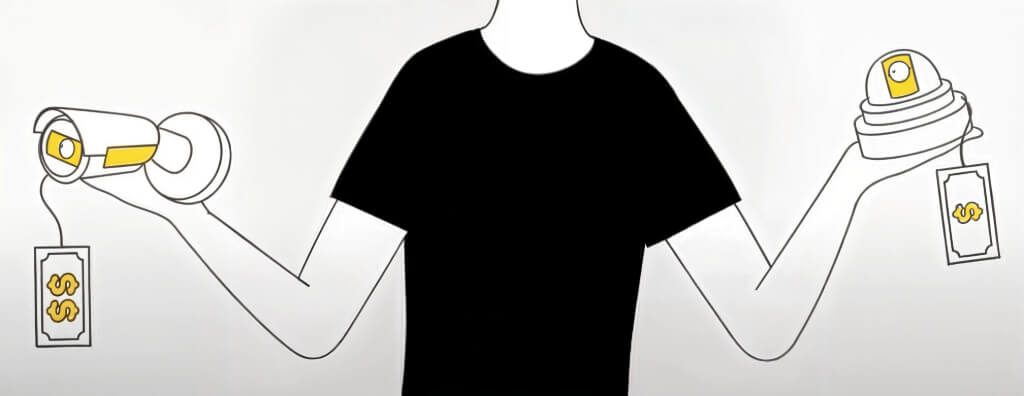
When planning the acquisition or deployment of a video surveillance system, the focus often falls on the initial investment—the price of cameras, servers, and installation services. However, these amounts represent only a fraction of the effective cost involved in operating the system throughout its useful life. […]
Check it out!
When planning the acquisition or deployment of a video surveillance system, the focus often falls on the initial investment—the price of cameras, servers, and installation services. However, these amounts represent only a fraction of the effective cost involved in operating the system throughout its useful life.
In this article, we present a technical view of everything that makes up the Total Cost of Ownership (TCO) of a Video Surveillance System, detailing its relevance in determining the solution’s final cost and its importance as a technical and economic decision criterion during the procurement or technology replacement phase.
Read on.
[elementor-template id=”24446″]
What is TCO?
Total Cost of Ownership, known as TCO, is a financial indicator that considers all costs associated with the acquisition, operation, maintenance, and eventual decommissioning of a system throughout its life cycle.
TCO makes it possible to accurately measure the cumulative financial impact of the deployed solution, going beyond the initial investment (CAPEX) and incorporating all operating and corrective expenses (OPEX), as well as costs resulting from failures, upgrades, downtime, and technological obsolescence.
From a technical standpoint, TCO should be treated as a central parameter in the decision-making process, especially when comparing design alternatives.
Analyzing the acquisition price alone is not sufficient to determine the true cost of a system.
Average equipment operating life
In a continuously operating surveillance system, the average operating life of key components—such as IP cameras, PoE switches, and storage servers—can range from 7 to 10 years under appropriate installation and operating conditions.
This interval should be used as a reference for technical feasibility analysis, depreciation planning, and financial projections associated with the system life cycle.
During this period, several factors can affect operating costs, including energy consumption, maintenance requirements, firmware updates, and individual equipment replacements.
Any cost analysis that disregards this operating cycle tends to distort comparisons between solutions and compromise the project’s long-term sustainability.
The Three Cost Levels
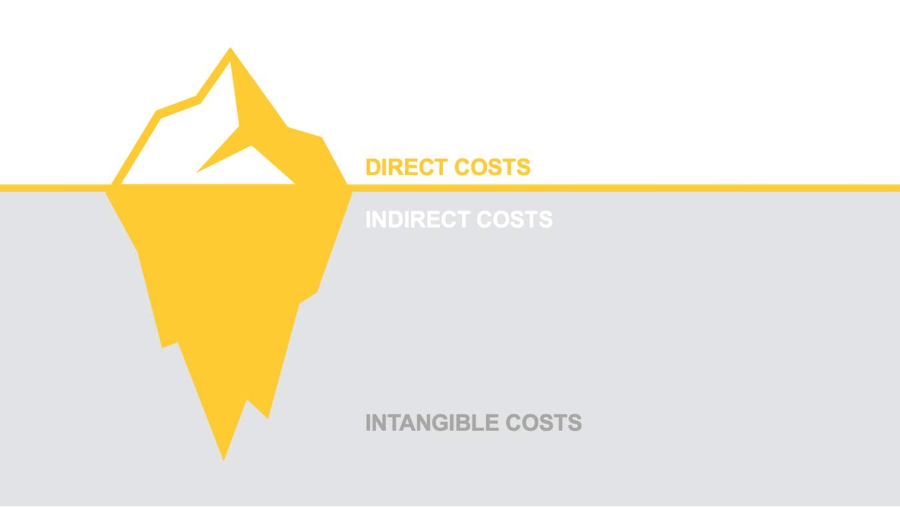
A consistent Total Cost of Ownership (TCO) analysis requires consideration of three distinct categories of costs associated with the operation of surveillance systems:
- Direct costs;
- Indirect costs;
- Intangible costs;
Direct Costs
These are the most evident costs and are usually considered in the initial budget.
They are directly associated with the acquisition and deployment of the system:
- Engineering Services: preparation of detailed design, feasibility studies, and documentation.
- Capture and recording equipment: IP cameras, servers, and storage units.
- Network and communications infrastructure: PoE switches, structured cabling, connectors, and network outlets.
- Software licensing: video management software (VMS), video analytics, administration tools, and systems integration.
- Installation and commissioning services: specialized technical labor, operational testing, and initial configuration.
Indirect Costs
These represent recurring or occasional operating expenses that are not usually included in the initial budget but have a significant financial impact over time:
- Electricity consumption: power for cameras, servers, switches, and HVAC systems.
- Preventive and corrective maintenance: component replacement, adjustments, inspections, and periodic technical services.
- System operation: personnel dedicated to monitoring, event analysis, and incident response.
- Training and qualification: updating technical and operational teams, especially for systems with advanced features.
- HVAC for technical environments: air conditioning for server rooms and racks, required to maintain equipment thermal stability.
- Contingency supplies: minimum stock of spare parts and reserve units for prompt replacement in case of failure.
Intangible Costs
These are unpredictable or difficult to quantify directly, but they can cause critical impacts, including operational and reputational impacts:
- Unplanned outages: hardware failures, network downtime, or unmitigated power failures.
- Security system failures: lack of recording at critical moments, loss of evidence, or detection failures.
- Exposure to cyber risks: intrusions, ransomware, image manipulation, or unauthorized access to the system.
- System reengineering: the need to revise or replace parts of the design due to technical incompatibilities, functional limitations, or obsolescence.
- Impacts on core operations: interruption of activities, loss of productivity, or exposure to legal and contractual risks resulting from system failure.
Why Is TCO So Important?
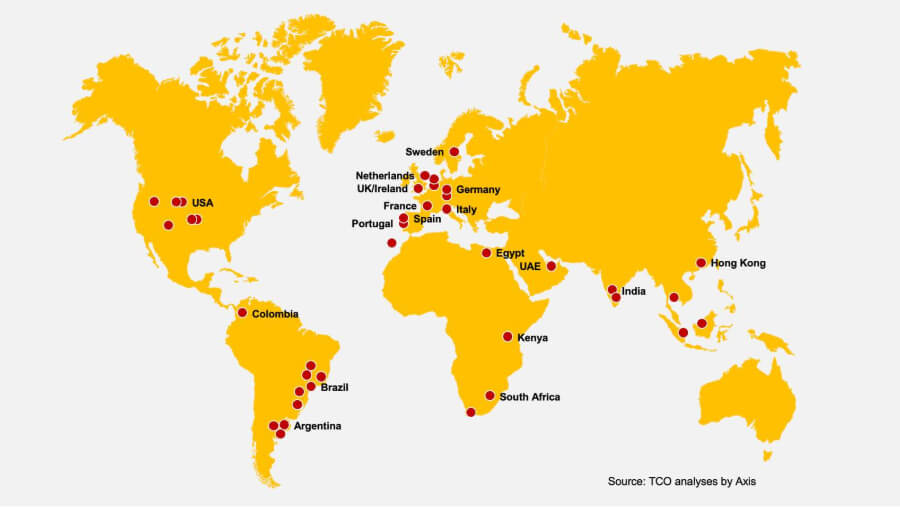
Studies conducted by Axis Communications show that approximately 70% of the costs of a surveillance system occur after installation.
This means that the project’s true financial impact accumulates over time—and that poorly planned decisions during the initial phase can become costly in the future.
Solutions that prioritize only the lowest acquisition cost (CAPEX) often result in a considerable increase in operating costs (OPEX), due to higher energy consumption, greater demand for corrective maintenance, shorter component life, and low storage and processing efficiency.
In addition, inadequate choices during the design phase can create technical limitations, compromise scalability, and require rework or reengineering—which further increases total cost over the solution’s life cycle.
Therefore, TCO should be treated as a central indicator when comparing different system architectures, providing a basis for technical decisions that seek a balance among performance, durability, and maintenance cost over the medium and long term.
Factors that directly influence TCO
The total cost of ownership of a surveillance system is affected by a range of technical variables that should be considered from the concept phase onward. The main factors that directly influence TCO throughout the system’s useful life are highlighted below:
Processing and storage
The efficiency of compression algorithms, combined with control of bit rate, frames per second, and image resolution, directly influences storage sizing, the number of servers required, and data network capacity.
Poorly configured solutions or solutions without adequate optimization generate excessive IT infrastructure and energy costs.
Energy efficiency
Analyzing the system’s total electrical load—including cameras, switches, servers, and HVAC systems—is essential to avoid oversizing.
Selecting equipment with lower energy consumption helps reduce recurring operating costs and eases demand on power supplies, UPS systems, and generators.
Resilience and robustness
Equipment with mechanical impact resistance (IK10 or higher) and weather protection ratings (IP66/67) provides greater durability in exposed environments, reducing corrective maintenance requirements and increasing system availability.
Selecting devices designed for industrial operation helps prevent unplanned downtime and reduces premature replacement rates.
Technical support and update cycle
System sustainability is directly linked to device software and security update policies.
Equipment that does not receive ongoing support tends to become obsolete sooner, increasing replacement costs and exposing the system to operational and cyber risks.
Cost per switch port
In PoE (Power over Ethernet) architectures, cost per switch port should be carefully analyzed, especially when high-performance industrial switches are used.
This variable directly affects the network infrastructure budget and should be sized considering the actual device density per switch, PoE/PoE+ requirements, and topology redundancy.
The Importance of Commissioning an Engineering Design
Commissioning a specialized technical design is a fundamental step in ensuring the feasibility, operational efficiency, and financial sustainability of a surveillance system.
The absence of a design, or the adoption of solutions based only on generic specifications or isolated commercial decisions, often results in oversizing, incompatibilities, operational failures, and a significant increase in total cost of ownership (TCO).
In addition to providing technical support for decision-making and procurement, the design also directly contributes to reducing operating costs, extending system life, and standardizing infrastructure, making future maintenance and expansions easier.
Therefore, the technical design should not be treated as an additional cost, but as an indispensable component for the success and durability of the system as a whole.
Conclusion
Choosing a high-quality surveillance system does not mean higher overall expenditure—it can mean savings over time. TCO is the metric that shifts decisions from the lowest purchase price toward the best overall investment.
TCO analysis is essential for any project, especially for critical, medium-sized, or large systems. The true cost of a solution is not limited to the hardware acquired, but also reflects its ability to operate with stability, security, and predictability over the years.
The absence of a detailed design defining scope, performance criteria, and sizing according to actual operating conditions compromises the technical coherence of deployment and tends to generate operating cost overruns, rework, and future scalability limitations.
The recommended approach involves integrated technical planning, coordinating network architecture, physical infrastructure, storage requirements, energy consumption, and the maintenance plan.
Defining these parameters before acquisition helps ensure technical compliance of the supply, rationalizes investment, and preserves system integrity throughout its intended useful life.
