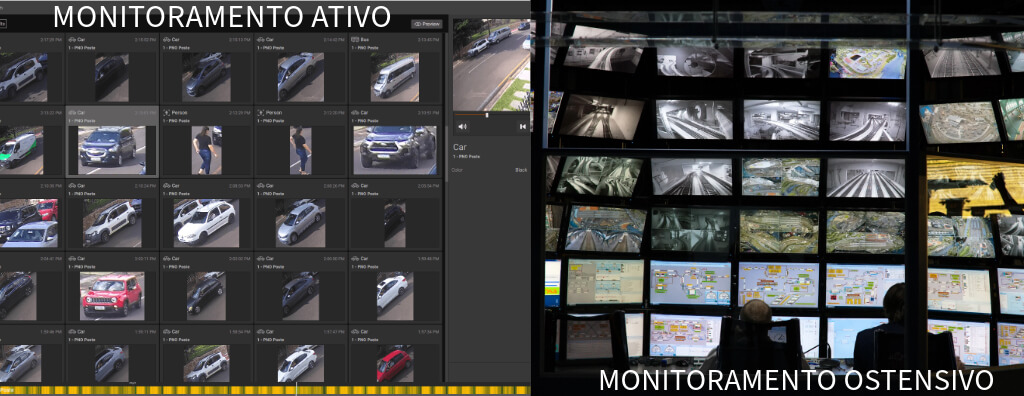
Understand the differences among overt, active, proactive, and intelligent monitoring and how CCTV, VMS, analytics, metadata, forensic search, alarms, and monitoring centers turn video into operational response.
Check it out!
Overt monitoring and intelligent monitoring are not opposing strategies or automatic substitutes for one another. The first uses the visible presence of cameras, signage, lighting, guards, and other elements to increase the perception of control and produce a deterrent effect. The second organizes cameras, sensors, software, metadata, rules, procedures, and operators to detect relevant events, qualify and prioritize them, and produce a traceable response.
In practice, a mature operation combines both approaches. A camera can be clearly visible to deter an intrusion attempt while also generating an analytics event if someone crosses a virtual line outside the permitted schedule. The VMS can correlate that event, present it to the operator, associate it with video, trigger higher-quality recording, move a PTZ, generate an alarm, and initiate a response procedure. The system’s value lies not only in the camera, but in the complete chain from risk perception to detection, decision, and action.
It is also important to distinguish three terms often used as synonyms. Active monitoring describes an operation in which events receive timely treatment and response. Intelligent monitoring describes an architecture in which software, rules, analytics, and metadata help transform signals and video into actionable information. Proactive monitoring seeks to anticipate or interrupt a situation before it produces the unwanted consequence. The same system can be overt, active, intelligent, and proactive in different proportions.
The decisive difference, therefore, is not “ordinary camera versus AI camera.” It is how the system was designed to respond to operational requirements: what must be perceived, what evidence is required, which events demand attention, who decides, what response is authorized, and how the outcome will be recorded.
What Is Overt Monitoring and What Is Its Function?
Overt monitoring is a strategy in which surveillance measures are deliberately visible. Visible cameras, security lighting, monitored-area signage, barriers, guard posts, patrol vehicles, towers, intercom systems, and other elements can communicate that observation and response capabilities are present.
Its first effect is deterrence. This is different from saying the system is necessarily reactive. An overt camera can operate with real-time analytics; likewise, a discreet camera may depend entirely on later review. Overt presence mainly describes the visibility of the security measure, while activity, automation, and intelligence describe how information is handled.
The overt model is particularly useful at access points, perimeters, parking areas, circulation areas, loading docks, commercial environments, and locations where the perception of surveillance is part of the protection strategy. A camera can simultaneously support prevention, documentation, operator awareness, and evidence production.
The limitation appears when an organization confuses the presence of cameras with monitoring capability. Devices installed without operational requirements, coverage criteria, image-quality requirements, retention, fault supervision, procedures, and response responsibility can create a perception of security without ensuring that an incident will be detected or handled.
Therefore, the correct analysis does not ask only how many cameras exist. It asks what each camera must enable the operation to do: detect presence, observe behavior, recognize a known person, identify characteristics, read a license plate, confirm an alarm, track movement, or reconstruct an event afterward.
What Characterizes Intelligent Monitoring
Intelligent monitoring is an architecture in which video infrastructure participates in an event- and information-oriented system. Cameras, sensors, and systems produce data; the VMS or another platform receives those signals; rules provide context; analytics qualify part of the content; alarms prioritize what requires attention; operators execute procedures; and records preserve the decision history.
ABNT NBR IEC 62676-1-1 treats a video-surveillance system as a set involving capture, transmission, storage, presentation, system management, security, interfaces, and data. The standard also distinguishes events, alarms, event-triggered actions, notifications, responses, metadata, video-content analysis, integrity, and system logs. This terminology helps avoid the simplified view that all “intelligence” resides inside the camera.
An intelligent system may use edge processing, server-side analytics, native VMS resources, third-party integrations, or a combination of these layers. The choice depends on scale, latency, bandwidth, computing capacity, interoperability, privacy requirements, forensic-search needs, and continuity strategy.
Intelligence also does not eliminate the operator. In critical applications, the role tends to shift from “continuously watching hundreds of images” to validating events, interpreting context, executing procedures, and making decisions within an authority matrix. Well-designed automation reduces operational noise; poorly designed automation simply produces more alarms.
The objective is not to replace people with algorithms, but to direct human attention toward situations more likely to require judgment.
Overt vs. Intelligent Monitoring: Key Differences
The comparison is most useful when based on operational function rather than product marketing.
| Criterion | Overt monitoring | Intelligent monitoring |
| Primary objective | Make surveillance perceptible and produce deterrence | Transform events and video into prioritized, actionable information |
| Visibility of the measure | Usually high | Can be overt or discreet |
| Detection | May depend on human observation or simple sensors | May combine analytics, sensors, rules, and correlation |
| Operator | Often monitors video and incidents | Receives prioritized events and executes procedures |
| Automation | Not a requirement | A possible tool, not an end in itself |
| Metadata | May not be used | Increase search, correlation, and analysis capability |
| Retrospective search | Normally based on time, camera, and manual observation | May use attributes, events, objects, classes, and filters |
| Response | May occur after manual observation | Can be driven by events, alarms, and procedures |
| Evidence | Video recording | Video + events + metadata + logs + operational records |
| Primary risk | Perception of coverage without real response capability | Excessive automation, false alarms, and undue reliance on algorithms |
The most effective system is not necessarily the most automated. In a corporate reception area, overt surveillance and access control may address much of the risk. On an extensive industrial perimeter, however, relying on operators watching mosaics of dozens of cameras may be inadequate; perimeter detection, video analytics, and alarm-driven operation can be decisive.
Engineering should choose the combination according to risk, mission, and operational capability.
From Camera to Response: What Makes Monitoring Truly Intelligent
If the design starts with a camera list, operations tend to become subordinate to equipment. A more robust approach is to define risk, scenario, image quality, events, response, retention, integration, and acceptance criteria first, then select the technology that supports those requirements.
Structure These Requirements in an IP CCTV and Video Surveillance Design
The central element of intelligent monitoring is the event-handling chain. Detecting something is not enough. The design must define what happens after detection and how the operation avoids becoming fragmented across screens, alarms, and disconnected systems.
A functional architecture can be represented as follows:
The operational requirement comes before the technology. It establishes what must be observed, which conditions matter, what confidence level is required, and what response will be taken. The camera or sensor collects the data. Analytics can convert it into a detection. The VMS receives video, events, and metadata. Rules contextualize time, zone, the state of other systems, or risk profile. An alarm is presented to the operator with instructions, evidence, and priority. The response may involve communication, dispatch, lighting activation, opening an audio channel, PTZ movement, controlled access blocking, or simply recording the event.
The final stage is equally important: the system must preserve logs, video, metadata, and decisions to support investigation, auditing, and continuous improvement. Without this, the organization knows that an alarm occurred but cannot reconstruct why it was generated, who handled it, or what action was taken.
This logic is consistent with the event-and-response concepts in ABNT NBR IEC 62676-1-1 and with the way current VMS platforms structure rules, events, actions, and alarms.
Active, Proactive, and Intelligent Monitoring Are Not the Same
Active monitoring normally describes an operation with the ability to act while an event is occurring rather than only reviewing recordings afterward. This can happen with or without artificial intelligence. An operator who receives a door-contact event, automatically opens the associated camera, and executes a procedure is working in an active model even without video analytics.
Intelligent monitoring adds computational qualification, correlation, prioritization, and structured search. Intelligence may reside in the device, VMS, analytics server, PSIM layer, or at multiple points in the architecture.
Proactive monitoring seeks to reduce the interval between an indication and the response. One example is detecting unauthorized dwell in an area before an access attempt occurs; another is recognizing an approach to a perimeter and directing a PTZ before the person reaches the physical barrier. Operations can then intervene through audio, lighting, dispatch, or another defined procedure.
It is important not to turn “proactive” into a promise of infallible prediction. Analytics operate on signals, models, and rules. They can increase the likelihood of earlier awareness, but they do not eliminate uncertainty, occlusion, environmental changes, classification errors, or unexpected behavior.
For this reason, the design must document performance limits and acceptance criteria instead of assuming that the term “AI” guarantees results.
Video Analytics: From Motion Detection to Scene Understanding
Video analytics processes live or recorded images to detect defined objects, activities, events, or patterns. ABNT NBR IEC 62676-1-1 itself uses the concept of video content analysis in relation to operational requirements, reinforcing that analytics should exist to address a system need.
Early widely used applications relied heavily on pixel changes and motion detection. They remain useful in some scenarios but are sensitive to vegetation, rain, shadows, reflections, insects, lighting changes, and other scene variations. Current computer-vision models can classify objects and maintain temporal tracking, enabling categories such as person and vehicle and additional attributes when supported by the equipment.
This enables applications such as:
- line crossing by a person or vehicle;
- entry into or exit from a zone;
- dwell beyond a defined time;
- counting and occupancy;
- direction of travel;
- vehicle classification;
- detection of abandoned or removed objects, where supported;
- event generation from combinations of class, region, and schedule;
- support for later searches by objects and attributes.
However, analytics should not be specified only by the function name. Scene, camera height and angle, distance, pixel density, target speed, lighting, occlusion, contrast, background, weather, frame rate, compression, and processor capacity must be evaluated. An algorithm that performs excellently in a frontal, well-lit scene may behave very differently under backlighting, rain, or oblique viewing.
The correct process includes scenario definition, acceptance testing, and tuning. Excessive sensitivity causes alarm fatigue; insufficient sensitivity increases the chance of missed events. In both cases, the problem may involve engineering, configuration, or operations — not necessarily the algorithm alone.
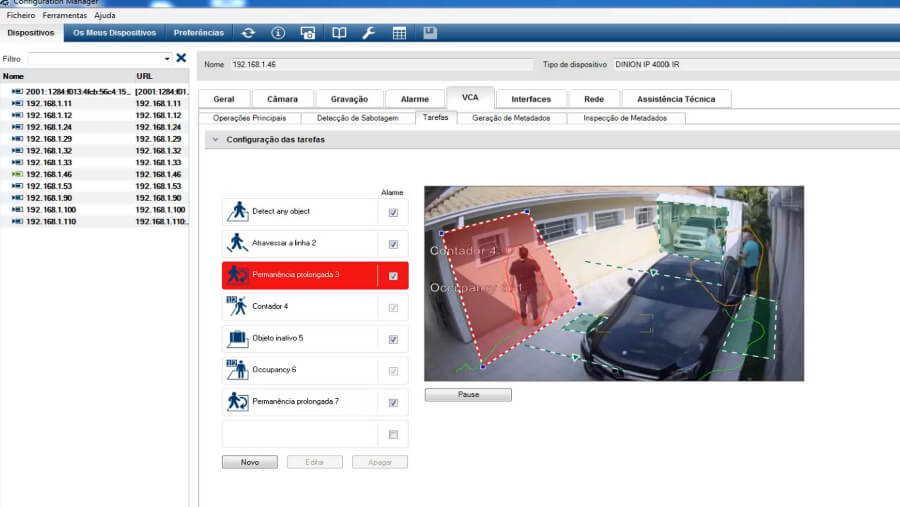
More detail on operation and application criteria is available in Video Analytics: Technical Principles and Impacts on the Transformation of Monitoring Systems e no Complete Guide to Video Analytics.
Metadata: The Layer That Turns Video into Searchable Information
Video is a visual stream; metadata is structured information associated with that stream. In a VSS, it may represent time, location, device identification, detected objects, classes, attributes, position, trajectory, and other information generated from or associated with the scene.
Current Axis documentation for Scene Metadata describes real-time object-tracking data, consolidated object information, and snapshots, transported through mechanisms such as RTSP, MQTT, and APIs. The operational benefit is direct: the system no longer depends only on “watching” video and can query, filter, and correlate information about what was observed.
In an architecture with a compatible VMS, metadata can support searches for people, vehicles, location, or other supported attributes. Milestone XProtect documentation, for example, distinguishes metadata search from simple recording playback and supports metadata generated by the device itself or by integrated processing systems.
The main benefit appears in three areas. First is real-time situational awareness, because an event can carry additional context. Second is investigation, because hours of video can be filtered by criteria. Third is historical analysis, in which patterns of flow, occupancy, or recurrence can support operational decisions, provided the purpose and handling of the data are compatible with privacy and data-protection policies.
Metadata should not be treated as “absolute truth.” It is produced by sensors and algorithms. Classes, attributes, and reliability vary among devices, versions, scenes, and conditions. The design must document which metadata is relevant, how it is transported, where it is stored, how long it remains available, and which applications can consume it.
Forensic Search: Investigating by Content Instead of Watching Hours of Video
Forensic search is one of the most visible benefits of intelligent monitoring. Instead of navigating only by camera, date, and time, the operator can restrict an investigation to events or objects matching defined criteria, reducing the amount of video that must be reviewed manually.
Depending on the solution and available metadata, filters may include object class, color, direction, region, speed, vehicle type, license plate, person attributes, time, location, and combinations of these elements. Actual capability must be verified on the selected platform; there is no universal set of attributes available in every VMS or camera.
A classic example is searching for a vehicle of a given color that crossed an area within a time window. Without metadata, the investigator may need to review multiple cameras for hours. With consistent metadata, the platform narrows the result set and allows candidates to be visually confirmed.
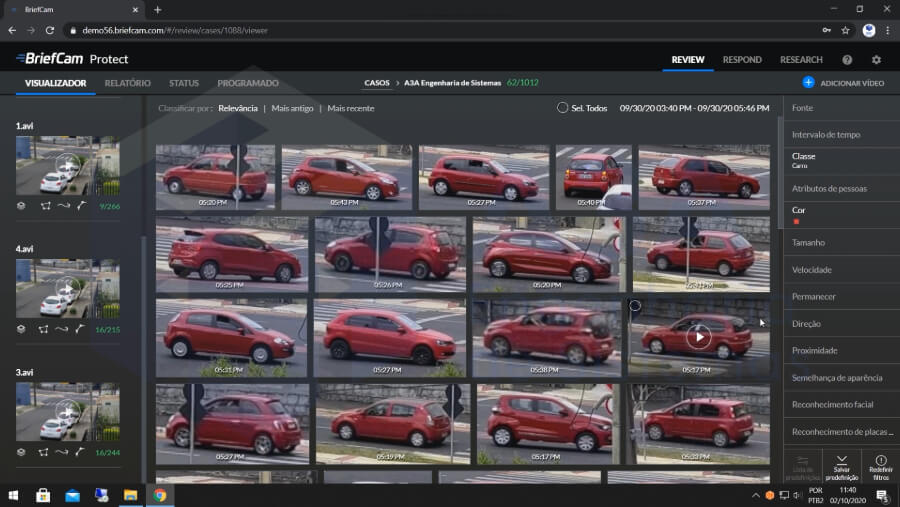
This process does not eliminate human validation. Color can vary with lighting, white balance, and compression; objects may be partially occluded; classifications may be incorrect. Intelligent search accelerates investigation, but final evidence still requires video review and appropriate data preservation.
O artigo Forensic Video Search: Methods, Algorithms, and Practical Implementation aprofunda essa camada investigativa.
Machine Learning and Artificial Intelligence: What Actually Happens in the System
An older version of this article described machine learning as if a camera necessarily “learned and improved by itself over time.” That description is inaccurate for many video-surveillance products. In many devices, machine-learning models are trained beforehand by the manufacturer and perform inference on the device. The camera uses the model to classify or track objects but does not necessarily retrain the model in production.
Some solutions support adaptation, calibration, scene learning, or model updates, but this depends on the specific architecture. The design should therefore distinguish three concepts: model training, inference, and operational configuration. The presence of a neural network or AI accelerator does not mean the device is continuously learning.
In practice, artificial intelligence can improve motion filtering, person and vehicle classification, attribute detection, tracking, specialized recognition, and pattern interpretation. Value appears when this information is incorporated into operations. A bounding box drawn around a person produces no benefit by itself; value arises when the correct event reaches the correct operator with appropriate priority, context, and procedure.
Version governance must also be considered. Firmware, model, or parameter updates can change detection behavior. Critical systems should record configuration, version, change date, and retest criteria when an update can affect relevant functions.
The intelligence of a monitoring system, therefore, is not the sum of purchased AI features. It is the ability to turn those features into demonstrable operational performance.
VMS, Rules, Events, Actions, and Alarms
The VMS is the management layer responsible for organizing devices, video, recordings, permissions, events, and operations. In enterprise systems, its role goes far beyond displaying cameras on a screen.
Milestone XProtect documentation provides a useful distinction. An incident is something that happens in the real world. An event is the representation recognized by the system. An action is something a rule instructs the system to execute as a consequence of the event. An alarm is the structured mechanism for drawing the attention of relevant people to the incident. This separation helps design active monitoring without turning every detection into an indiscriminate alarm.
Imagine a door opening outside business hours. The door contact generates an event. A rule can increase the recording rate of a nearby camera, position a PTZ, present video to the operator, and generate an alarm with instructions. If access control indicates a valid credential and the time falls within an authorized window, another rule can reduce criticality or record the occurrence without dispatch.
This is where integration begins to produce operational intelligence. The system does not need to concentrate all logic in a single software platform, but it must ensure that relevant events can cross the required interfaces without compromising the integrity of source systems.
O artigo Integration of VMS, PSIM, SCADA, and BMS in Operations Centers aprofunda a diferença entre integração funcional e a tentativa inadequada de transformar todos os subsistemas em uma única plataforma.
Integration with Access Control, Perimeter, Audio, and Other Systems
Intelligent monitoring depends on controlled integration among video, events, access control, sensors, and procedures. Engineering must define interfaces and responsibilities without turning integrations into dependencies that weaken source systems.
Intelligent monitoring gains value when video is contextualized by other signals. Access control can indicate who attempted to open a door; perimeter sensors can indicate a physical breach; intercom and IP audio can support verification and intervention; radar can provide position and trajectory; fire systems can direct cameras toward alarm areas; and building systems can provide context about power, lighting, or access to technical areas.
Integration should begin with use cases. “Integrate everything” is a poor specification. The design must state which event will be received, what information must accompany it, which system remains the authoritative source of the data, which action may be executed, and who has authority to command it.
In electronic security, this avoids integrations that create excessive dependency among platforms. A VMS can receive an access-control event without becoming responsible for maintaining the credential database. A PSIM can orchestrate procedures without replacing the protection logic of a controller. The principle is to integrate information and operations while preserving the primary function of each system.
This design also affects cybersecurity. APIs, service accounts, certificates, network ports, authentication, segmentation, logs, and version updates must be included in the design. The greater the integration, the larger the surface that must be governed.
Monitoring Center: People, Processes, and Technology
The center should be designed as an operational environment: workstations, visualization, ergonomics, video wall, communications, priorities, contingency, and decision flow need to work as a single sociotechnical system.
A monitoring center is not merely a room with monitors. It is the operational structure where events are received, qualified, prioritized, handled, and recorded. Performance depends simultaneously on technology, ergonomics, processes, training, authority levels, communication, and continuity.
Operators should not be required to continuously watch hundreds of cameras in static mosaics waiting for something to happen. Human attention is limited. Event-driven systems seek to present the camera, context, and procedure when a relevant condition exists. This reduces the need for continuous visual surveillance without eliminating human supervision.
The architecture should define alarm queues, priorities, acknowledgment times, escalation conditions, simultaneous incident handling, workstations, user profiles, action logging, telephony or radio, integration with field teams, and contingency procedures.
Failures in the infrastructure itself must also be handled. Video loss, server unavailability, storage failure, communication loss, network degradation, and power failure should generate known and actionable states. A system that detects intrusions but does not report that ten cameras went offline has a serious operational gap.
A arquitetura completa é aprofundada em Monitoring Center: Architecture, Systems, and Design Requirements e em CCTV Monitoring Room: Layout, Ergonomics, and Technology Architecture.
Video Wall: Visualization Supports Decisions; It Is Not Synonymous with Intelligence
The video wall remains relevant in control centers because it provides a shared surface for situational awareness. It can display maps, priority cameras, alarms, dashboards, external systems, ongoing incidents, and content shared among operators and supervisors.
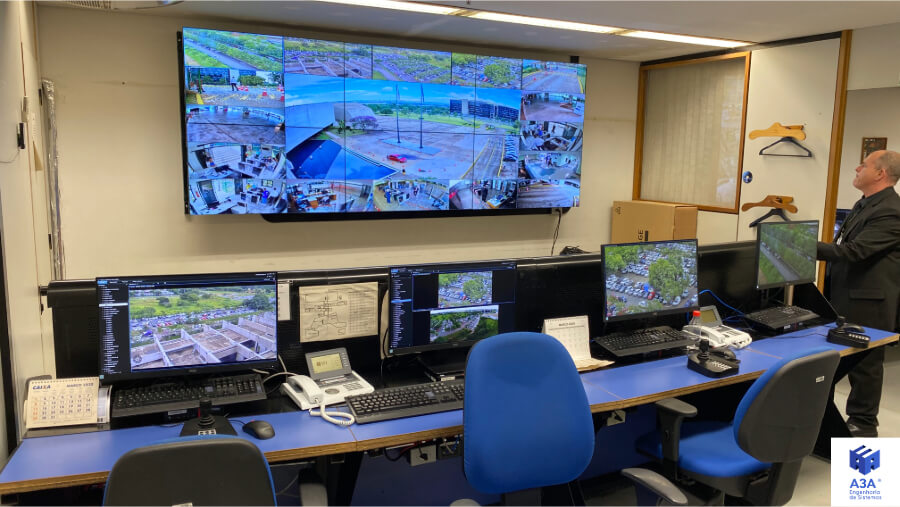
However, filling a wall with dozens of camera feeds does not make monitoring intelligent. The correct question is: what information needs to be shared by the entire team, and under what circumstances? Lower-priority cameras can remain on individual workstations, while critical events, maps, incidents, and coordinated views are promoted to the shared display.
Resolution, number of displays, LCD or Direct View LED technology, processor, controller, and distribution topology should be sized from content requirements and viewing distances, not merely from available wall area.
In modern architectures, the VMS can change layouts according to rules and events. This allows a critical incident to temporarily replace routine content with related cameras, maps, and data. When the incident ends, visualization returns to the predefined operational state.
Os critérios de engenharia são detalhados nos artigos Video Wall Sizing: 2×2, 3×2, 3×3, Resolution, and Design Criteria e Video Wall Controller and Processor: Sources, Layouts, Resolution, and Redundancy.
Does Electronic Monitoring Replace On-Site Security Personnel?
The question arises frequently because electronic monitoring and human security perform partially overlapping but non-equivalent functions. Cameras can continuously observe defined points, maintain recordings, generate metadata, and produce alarms without fatigue. People can interpret ambiguity, adapt decisions to context, approach individuals, and perform physical actions that a video system cannot.
Engineering should therefore define the best allocation of tasks. An intelligent system can reduce purely visual patrols, reduce the number of screens that require continuous attention, and direct teams toward specific events. This does not mean every organization can eliminate on-site security. The required physical presence depends on risk, applicable law, external response time, site characteristics, and consequences of failure.
An efficient strategy generally avoids unnecessary duplication. If an area has reliable video analytics, perimeter sensing, and remote response, it may not be necessary to keep a guard permanently watching that camera. Conversely, a reception area with heavy people flow may require human presence for service, screening, authority, and immediate response.
The objective is to design an operation in which technology and people complement one another, with clear responsibilities and measurable indicators.
How to Design an Intelligent Monitoring System
The design should begin with risk and operational requirements, not an equipment list. The IEC 62676 series itself uses this concept as a basis for VSS specification. The operational requirement transforms a security need into verifiable parameters.
A robust engineering sequence includes:
- Identify assets, areas, processes, and threat scenarios.
- Define what needs to be detected, observed, recognized, or identified.
- Define the expected response for each event class.
- Determine coverage, field of view, image quality, and environmental conditions.
- Define recording, retention, export, and evidence integrity.
- Design networking, power, storage, servers, and time synchronization.
- Select analytics and metadata according to use cases.
- Define the VMS architecture, events, rules, alarms, and integrations.
- Design the monitoring center, workstations, visualization, and communications.
- Define cybersecurity, access profiles, and logs.
- Create operational procedures and an escalation matrix.
- Define acceptance tests, failure scenarios, and performance criteria.
This process avoids a common mistake: selecting cameras with many features and then searching for applications for them. In consulting engineering, each feature should be justified by a requirement, operating condition, or continuity strategy.
O IP CCTV and Video Surveillance Design concentra essa disciplina, incluindo cobertura, VMS, armazenamento, rede, integração e critérios de aceite.
Image Quality Remains the Foundation of an Intelligent System
AI does not compensate for an inadequate image. If the target occupies too few pixels, is out of focus, is occluded, appears under backlighting, or is recorded with compression incompatible with the intended purpose, analytics performance and forensic usefulness will be impaired.
For this reason, intelligent monitoring depends on the same image-formation chain addressed by IEC 62676: capture, encoding, transmission, handling, storage, decoding, and presentation. Each stage can preserve or degrade the available information.
The purpose must determine the required density and quality. Detecting that something entered an area is a different task from recognizing characteristics of a person or identifying a license plate. Lens selection, resolution, position, lighting, and exposure should reflect this difference.
The scene must also be evaluated over time. A camera calibrated during the day may later face nighttime reflections, headlights, rain, fog, or seasonal vegetation. Commissioning should test representative conditions and document limitations.
Intelligence begins with the quality of the input data.
Availability, Redundancy, and Fault Supervision
An event-driven system must be reliable. If analytics works but the network between camera and server is unstable, the alarm may not arrive. If recording depends on a single storage system and it fails, investigation is compromised. If the monitoring center loses power and no contingency exists, operational response disappears exactly during a crisis.
ABNT NBR IEC 62676-1-1 includes concepts of failure, failover, redundancy, integrity, and interconnection monitoring. In critical projects, these concepts should be translated into architecture: redundant power supplies where justified, UPS systems, communication paths, server failover, protected storage, device-health monitoring, and degraded-operation procedures.
High availability does not mean duplicating everything. It means identifying functions whose loss is incompatible with the mission and designing proportional mechanisms to maintain or recover those functions within acceptable times.
The transition must also be tested. A secondary server that has never assumed load during testing is not sufficient evidence of failover. Likewise, a redundant link should be tested through actual loss or a controlled simulation of the primary path.
O tema é aprofundado em High Availability in 24×7 Operations Centers: Redundancy, Failover, and Continuity.
Privacy, LGPD, and Logical Security
Intelligent monitoring expands the ability to extract information from video and therefore increases the need for governance. Recordings, license plates, faces, trajectories, attributes, and correlations may involve personal data depending on the context. Processing purpose, legal basis, access, retention, sharing, and protection should be evaluated by the responsible organization.
From a technical perspective, the principle of least privilege should guide accounts and profiles. Operators do not necessarily need the ability to change configuration; investigators may require export access; administrators have different functions; integrations should use dedicated, auditable credentials.
Privacy masks, encryption, authentication, logs, network segmentation, firmware updates, certificates, configuration backups, and export controls should be part of the architecture where applicable. The objective is to prevent a system designed to protect assets from becoming a new attack surface.
Data governance must also appear in procedures. Who can export video? How long is an export retained? How is chain of custody recorded? Which metadata remains searchable? Who can change an analytics rule? These decisions should not remain implicit.
Intelligent monitoring requires more governance, not less.
Indicators for Measuring Whether Monitoring Actually Works
An operation can have hundreds of cameras and still not know whether the system delivers results. Indicators help turn perception into management, provided they are selected according to the mission.
Useful metrics may include:
| Indicator | What it reveals |
| Availability of critical cameras | Continuity of observation capability |
| Recording availability | Ability to preserve evidence |
| Alarms per period | Volume received by operations |
| Non-relevant alarm rate | Configuration quality and alarm-fatigue risk |
| Event → alarm time | Detection-chain latency |
| Acknowledgment time | Monitoring-center attention capacity |
| Response time | Procedure performance after validation |
| Alarms per operator | Operational workload |
| Escalated events | Frequency of situations requiring higher escalation levels |
| Untreated device failures | Maturity of VSS self-supervision |
| Average investigation time | Search and evidence-access efficiency |
| Retests after change | Configuration and quality control |
There is no universal acceptable value for each indicator. Limits should be defined from risk, procedures, and organizational capability. A response time acceptable in a corporate parking area may be inadequate for critical infrastructure.
KPIs também não devem incentivar comportamento ruim. Reduzir o tempo de reconhecimento clicando automaticamente em todos os alarmes melhora a métrica e piora a segurança. Indicatores precisam ser combinados com qualidade de tratamento e auditoria de amostras.
Applications of Intelligent Monitoring
The architecture can be applied across different sectors, but use cases vary significantly.
In industrial environments, it is common to combine perimeter protection, access control, restricted areas, asset security, monitoring of auxiliary processes, and integration with response teams. In large sites, event-driven detection reduces dependence on continuous observation.
In corporate buildings, video can be correlated with access control, reception, elevators, loading docks, parking, and technical areas. Priorities usually include security, investigation, flow, and incident response.
In retail, loss prevention, behavior, queues, occupancy, and investigation can share the same capture infrastructure, provided purpose, privacy, and data access are properly governed.
In cities and public safety, the challenge increases with scale, geographic dispersion, connectivity, interagency integration, and event volume. Cameras, LPR/ANPR, metadata, GIS, dispatch, and integrated centers can form a situational-awareness platform, but the architecture should avoid dependence on a single technology layer.
O conteúdo Urban Video Surveillance: Architecture for Smart Cities and Public Safety trata especificamente dessa escala.
In critical infrastructure, availability, cybersecurity, change control, and degraded operations become more important. The system must remain useful during partial failures, maintenance, and events affecting power or telecommunications.
How to Migrate from Traditional to Intelligent Monitoring
Modernization does not require complete replacement of the installed base. In many cases, the system can evolve in stages, preserving cameras and infrastructure that still meet requirements and concentrating investment where measurable operational gains exist.
A typical strategy begins with inventory and diagnosis. Cameras, lenses, resolutions, firmware, network, recording, storage, VMS, licenses, existing events, integrations, workstations, video wall, recurring failures, and procedures must be understood. Without a baseline, modernization risks replacing technology without improving operations.
Use cases are then prioritized. Perimeters, critical access points, parking areas, high-value zones, or locations with large investigative workloads can receive analytics and metadata first. Results are validated through a pilot using objective criteria before expansion.
Modernization can also occur at the VMS layer. Cameras that already provide adequate video can gain value when integrated into a platform with rules, alarms, maps, profiles, search, and health monitoring. In other cases, the limitation lies in the device itself and requires replacement.
The process should consider coexistence, phased migration, and rollback to avoid operational interruption. The article Modernizing an Operations Center Without Interrupting Operations detalha essa lógica de transição.
Commissioning and Acceptance: Proving the System Responds as Designed
Commissioning intelligent monitoring must test more than live video. The complete chain of critical functions must be demonstrated.
A test plan may include:
- verification of coverage and image quality;
- validation of time and synchronization;
- recording, playback, retention, and export;
- video loss and fault supervision;
- generation of analytics events;
- false/non-relevant alarm rate under defined scenarios;
- time and zone rules;
- automatic display of related cameras;
- PTZ movement where specified;
- integration with access control and other systems;
- notifications and escalation;
- failover of critical components;
- recovery after loss of power or communications;
- user permissions and profiles;
- logs and action traceability;
- forensic search and evidence retrieval;
- operational procedures and training.
Tests must state the initial condition, action, expected result, tolerance, evidence, and acceptance criterion. “It worked” is not a sufficient technical criterion.
IEC 62676-4:2025 updates international application guidelines for planning, design, installation, testing, commissioning, and maintenance of VSS. In a Brazilian project, normative applicability should be analyzed together with national standards, contract requirements, and project-specific requirements.
O serviço de Engineering Commissioning pode ser utilizado como camada independente de verificação quando a criticidade ou a governança do projeto exigir evidência formal antes do aceite.
Recurring Errors in Intelligent Monitoring Projects
The first error is believing that increasing the number of cameras automatically increases security. More cameras also mean more bandwidth, storage, licenses, maintenance, failure points, and operational workload. Coverage must be justified by the mission.
The second is generating alarms for every detection. If every movement produces a notification, the monitoring center learns to ignore the system. Rules must consider object, area, time, direction, persistence, state of other sensors, and criticality.
The third is relying on analytics without validating the scene. A perimeter-detection function installed with an unsuitable angle or insufficient lighting can appear sophisticated while producing poor results.
The fourth is treating the video wall as the center of the project. The display wall is an interface. Operations, requirements, events, data architecture, procedures, and continuity must be defined first.
The fifth is ignoring failures in the system itself. Offline cameras, full storage, unavailable servers, time drift, and degraded links need to be as visible as relevant security events.
The sixth is automating responses with physical impact without governance. Locking doors, activating barriers, controlling lighting, or sending messages requires safety analysis, responsibility, and failure-state definition. Not every action suitable for a commercial demonstration should be automated in real operations.
The seventh is failing to record changes. Analytics, rules, and filters are engineering configurations. If someone changes sensitivity or a region of interest without control, the tested system is no longer the system actually being operated.
The eighth is purchasing “AI” without defining indicators. Technology must be evaluated by the operational result it delivers, not by the number of marketing terms in the datasheet.
Final Considerations
Overt monitoring remains relevant because deterrence is part of a security strategy. Intelligent monitoring adds another layer: it transforms video, sensors, metadata, rules, people, and procedures into an operational chain driven by events and evidence.
The best architecture normally does not choose one or the other. It combines visibility where deterrence is useful, detection where continuous human attention is impractical, automation where rules are stable, human intervention where ambiguity exists, and structured investigation where evidence must be retrieved quickly.
The system should be designed from operations toward technology. Risk, mission, requirements, response, and acceptance criteria come first. Cameras, lenses, analytics, VMS, network, storage, video wall, and integration come afterward.
When this order is reversed, the organization may end up with a sophisticated collection of equipment. When it is respected, the organization develops genuine monitoring capability.
Intelligent functions should only be considered delivered when the real chain of events, alarms, visualization, integration, response, failover, and evidence has been demonstrated against predefined criteria.
Structure Testing and Acceptance with Engineering Commissioning
Technical References
[1] ASSOCIAÇÃO BRASILEIRA DE NORMAS TÉCNICAS. ABNT NBR IEC 62676-1-1:2019 — Video surveillance systems for use in security applications — Part 1-1: System requirements — General. Rio de Janeiro: ABNT, 2019. Technical basis consulted in the institutional collection. International reference available at: https://webstore.iec.ch/en/publication/7347
[2] INTERNATIONAL ELECTROTECHNICAL COMMISSION. IEC 62676-4:2025 — Video surveillance systems for use in security applications — Part 4: Application guidelines. Geneva: IEC, 2025. Available at: https://webstore.iec.ch/en/publication/83425
[3] AXIS COMMUNICATIONS. AXIS Scene Metadata — actionable insights through scene analysis. Available at: https://www.axis.com/pt-br/products/axis-scene-metadata
[4] AXIS COMMUNICATIONS. AXIS Scene Metadata — Developer Documentation. Available at: https://developer.axis.com/analytics/axis-scene-metadata/
[5] MILESTONE SYSTEMS. XProtect VMS — Metadata Search integration. Available at: https://doc.milestonesys.com/int/pdf/latest/en-US/metadatasearch-integration.pdf
[6] MILESTONE SYSTEMS. XProtect VMS — Rules and events. Available at: https://doc.milestonesys.com/2025r2/ar-SA/standard_features/sf_mc/sf_mcnodes/sf_5rulesandevents/mc_rulesandeventsexplained_rulesandevents.htm
Frequently Asked Questions
Overt monitoring uses the visible presence of cameras, security personnel, and other elements as part of deterrence. Intelligent monitoring uses events, rules, analytics, metadata, VMS, and procedures to qualify situations and guide responses. An operation can combine both approaches.
No. Active monitoring describes an operation capable of handling events and responding in a timely manner. Intelligent monitoring describes the structured use of software, rules, analytics, and data to improve detection, prioritization, investigation, and decision-making. A system can be active without AI and can include AI without having a truly active operation.
Generally, no. Analytics can reduce the amount of video that must be watched continuously and prioritize events, but ambiguous situations, response, escalation, and decision-making usually require human judgment, especially in critical applications.
It is structured data associated with video, such as time, location, device identification, detected objects, classes, attributes, position, or trajectory. Metadata can make video searchable and support alarms, correlation, and investigation.
Forensic search uses recordings, events, and, when available, metadata to filter large volumes of video using criteria such as time, area, object class, color, direction, vehicle, or other supported attributes. Results still require visual validation.
No. A video wall is a shared visualization layer. Intelligence depends on operational requirements, VMS architecture, events, rules, integrations, procedures, people, and response capability. A large camera mosaic without prioritization can actually increase cognitive load.
Depending on the mission, useful indicators may include camera and recording availability, non-relevant alarms, event-to-alarm time, acknowledgment time, response time, workload per operator, untreated failures, and investigation time.
The recommended path is to survey the installed base, define priority use cases, validate image quality and networking, introduce analytics and metadata where they add value, review the VMS, structure rules and alarms, create procedures, and test the complete chain before expanding the solution.
Additional Technical Materials
Related Solutions
Related Services
- IP CCTV and Video Surveillance Design
- Integrated Electronic Security Design
- Audiovisual Systems Design
- Engineering Commissioning
Main Content on the Topic
- Monitoring Center: Architecture, Systems, and Design Requirements
- CCTV Monitoring Room: Layout, Ergonomics, and Technology Architecture
- Complete Guide to Video Analytics
Related Technical Content
- Video Analytics: Technical Principles and Impacts on the Transformation of Monitoring Systems
- Video Analytics with Artificial Intelligence: The Transformative Role of Metadata in Monitoring
- Forensic Video Search: Methods, Algorithms, and Practical Implementation
- High Availability in 24×7 Operations Centers
- Urban Video Surveillance: Architecture for Smart Cities and Public Safety
