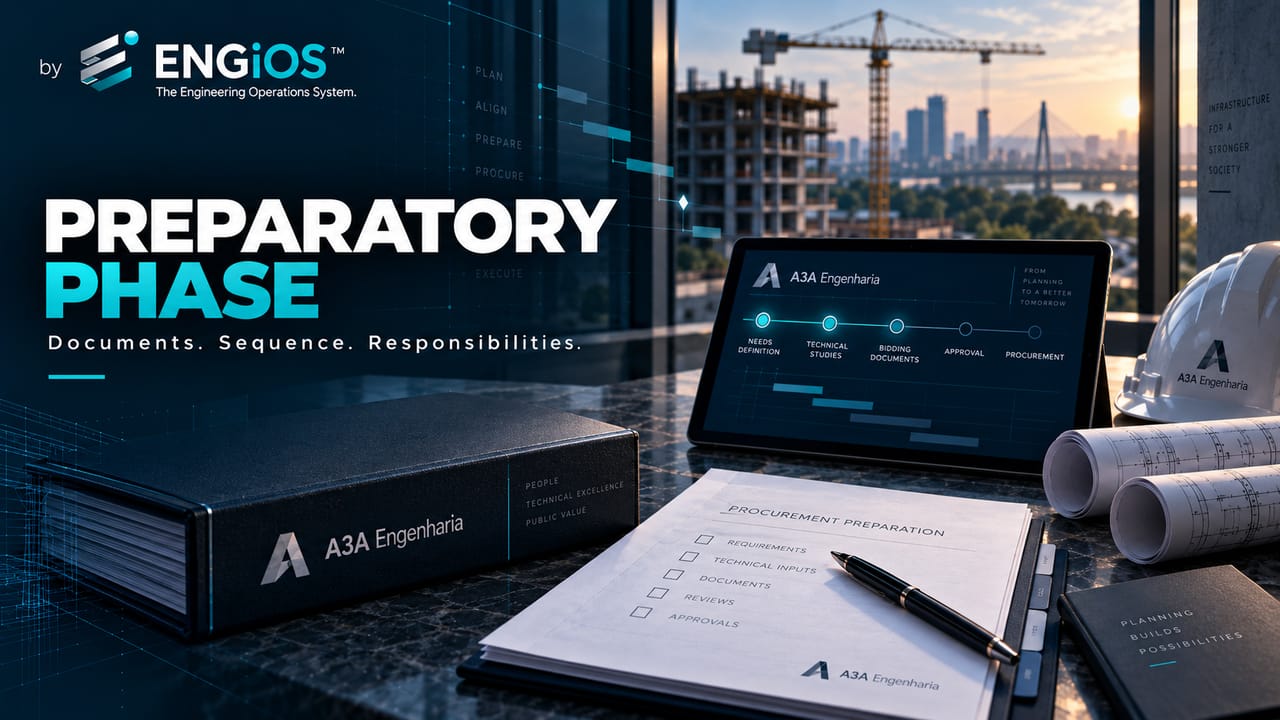
Learn how to structure the preparatory phase of public works procurement under Law 14.133 and AGU/MGI guidance: DFD, ETP, risks, designs, Terms of Reference, estimate, regime, tender documents, contract, and controls.
Check it out!
The preparatory phase of procurement is the set of activities that transforms an administrative need into a procurement that is technically defined, economically estimated, legally instructed, and ready for competition. In construction and engineering services, it is not limited to preparing Terms of Reference or tender documents: it includes formalizing the demand, organizing the team, conducting preliminary studies, managing risks, defining the scope, developing designs, preparing the estimate, documenting technical justifications, selecting the execution regime, drafting documents, and carrying out checks that demonstrate the Administration knows what it intends to procure and under which conditions.
Law 14.133/2021 treats planning as a principle and devotes Article 18 to the preparatory phase. The Standardization Instrument for Construction and Engineering Services Procurement Procedures, prepared by AGU and MGI, organizes this work into a twenty-chapter sequence running from planning through closure of the procurement instruction. These chapters do not correspond one-for-one to “twenty documents”: some represent decisions, checks, or process stages. The instrument is useful precisely because it shows that engineering procurement is a chain of interdependent evidence.
The practical objective of the preparatory phase is to reduce uncertainty before competition begins. The later an inconsistency in scope, design, quantity, estimate, responsibility, or risk is discovered, the more costly it tends to be to correct. A technically consistent procurement file allows the tender documents to reflect the real need, bidders to formulate comparable proposals, and inspection, measurement, acceptance, and potential contract changes to be assessed against a known baseline.
Why the preparatory phase is critical in construction and engineering services
Public works are highly interdependent scopes. The selected solution affects the design; the design affects quantities; quantities form the estimate; design maturity influences the execution regime; the regime changes the allocation of responsibilities and risks; and all of this must appear consistently in the Terms of Reference, tender documents, and contract.
For this reason, the preparatory phase should not be treated as a collection of independent forms. It works best as a system of traceable decisions. The Basic Design under Law 14.133, for example, cannot be analyzed in isolation from the Preliminary Technical Study (ETP), reference estimate, execution regime, and risk matrix. Likewise, an apparently adequate specification may create competitive restrictions or measurement ambiguity if it is not aligned with the rest of the documentation.
This sequence is not merely formal. If the process advances with an unvalidated assumption, later documents tend to reproduce the inconsistency. It is common to find well-written tender documents for a technically incomplete scope, a detailed estimate built on weak quantities, or a sophisticated risk matrix attempting to allocate risks created by design deficiencies that should have been resolved before procurement.
What Article 18 of Law 14.133 requires in the preparatory phase
When the need has not yet been sufficiently converted into requirements, alternatives, and decision criteria, there is a risk of specifying a solution too early. The Preliminary Technical Study should structure this transition before the scope is finalized.
Preliminary Technical Study (ETP) for Construction and Engineering Services
Article 18 establishes that the preparatory phase is characterized by planning and must align the procurement with the annual procurement plan, where one exists, and with budget laws. It also requires consideration of technical, market, and management dimensions capable of affecting the procurement.
In practice, this requires answering a sequence of connected questions: what public need must be addressed; which solution is technically appropriate; which alternatives were considered; what scope will be procured; what level of design maturity is required; how much it costs; how it will be executed; how it will be measured; which risks need to be allocated; which qualification requirements are proportionate; and which evidence will support inspection and acceptance.
For engineering, these answers need to be materialized in technically verifiable documents. It is not enough to state that a particular solution is “more advantageous”; the assumptions supporting that decision need to be demonstrated. It is not enough to state a schedule; its compatibility with execution sequencing, mobilization, critical supplies, permits, and interfaces must be verified. It is not enough to estimate a total value; traceability must be maintained among scope, designs, quantities, cost compositions, and prices.
The AGU/MGI IPP sequence for construction and engineering services
The Standardization Instrument organizes the subject into twenty chapters: planning phase; Demand Formalization Document; designation of the planning team; Preliminary Technical Study; risk management; statements of budget availability and adequacy; designation of the procurement officer and support team; technical definitions; Statement of Relevant Technical Justifications; preliminary design; Terms of Reference; Basic Design; Detailed Design; draft tender documents; draft contract; where applicable, the Price Registration System and draft minutes; procurement authorization; AGU checklist; Integrated Investment Project Registry; and closure.
This structure should be read functionally. Some items are standalone documents; others are acts, decisions, or controls. The value of the sequence lies in preventing the Administration from treating procurement as though it began with the tender documents while overlooking the technical decisions that should precede them.
Demand formalization
The Demand Formalization Document records the origin of the need. It should make it possible to understand the institutional problem, who is requesting the procurement, the expected outcome, and why the procurement is necessary.
In public works, a weak DFD often creates a chain of problems: unstable scope, frequent changes in priorities, solutions conceived before the problem is defined, and difficulty justifying later changes. The document does not need to replace technical studies, but it should state the need clearly enough that the Preliminary Technical Study does not begin with a preselected solution.
Procurement planning team
The team needs competencies compatible with the scope. In engineering, this rarely means only one official responsible for the administrative file. Depending on complexity, competencies in design, estimating, planning, operations, maintenance, safety, sustainability, permitting, technology, contracts, and risk management may be required.
A Procurement Planning Team should have clear roles: who validates requirements, who consolidates interfaces, who is responsible for the estimate, who reviews documentation, who approves decisions, and who maintains change traceability.
Preliminary Technical Study
The Preliminary Technical Study is where the Administration demonstrates the problem and evaluates the solution. It should precede final specification of the scope. In engineering, this means studying solution alternatives, site restrictions, existing infrastructure, performance requirements, environmental and planning constraints, interfaces, risks, and lifecycle impacts.
A Preliminary Technical Study that merely describes the chosen solution loses its purpose. The document should demonstrate why that configuration is appropriate and which assumptions will be carried into subsequent phases.
Risk management
Risk is not synonymous with deficient planning. Risk management in public procurement, documented in a risk matrix or risk register, should address relevant uncertain events; it should not be used to transfer to the contractor responsibility for information the Administration should know.
The preparatory phase needs to distinguish genuine risk from design gaps. Unforeseeable interferences may be risks; absence of a basic survey, where technically required, is an information deficiency. This distinction is central to preventing claims, amendments, and disputes.
Budget availability and adequacy
Procurement needs to align with financial capacity and institutional planning. For construction, this involves more than reserving a budget line: the physical-financial schedule, expected disbursements, contract duration, funding sources, and any conditions associated with grants or transfers need to be coherent.
A project with a technically correct estimate may still become unfeasible if the flow of funds is incompatible with execution.
Technical definitions
This is where the need begins to be converted into verifiable requirements. The Technical Specification for Construction and Engineering Services should define performance, interfaces, materials, execution criteria, testing, and acceptance without improperly restricting competition.
Vague requirements produce incomparable bids. Excessively prescriptive requirements may restrict equivalent solutions. The balance lies in defining the required performance and, where prescription is indispensable, demonstrating its technical justification.
Preliminary Design, Basic Design, and Detailed Design are not interchangeable documents
Law 14.133 assigns different functions to these levels of design development. The selected execution regime directly affects who prepares each deliverable and at what stage.
O Preliminary Design under Law 14.133 is particularly relevant to integrated contracting, in which the Administration does not prepare the Basic Design in advance. This increases the importance of the quality of parameters, boundary conditions, and performance requirements defined in the preliminary design.
Under regimes in which the Basic Design is the Administration’s responsibility, it needs sufficient maturity to characterize the project, allow evaluation of cost, methods, and schedule, and reduce uncertainties incompatible with procurement. The Detailed Design develops the solution to the level required for full execution and, except for the statutory integrated-contracting exception provided by the Law itself, construction should not proceed without it.
The correct sequence does not mean producing documents in silos. Preliminary Design, Basic Design, and Detailed Design need continuity of requirements, assumptions, and decisions.
Terms of Reference remain necessary in construction and engineering services
When scope, design, quantities, estimate, and Terms of Reference were produced by different workstreams, the formal existence of each document does not guarantee consistency. An integrated technical review before tender publication can identify open interfaces and requirements without acceptance criteria.
Technical Review of Terms of Reference for Construction and Engineering Services
One point emphasized by AGU’s own model-document page is that, under Law 14.133, the former association of Terms of Reference exclusively with auction procedures, leaving Basic Design for other procurement methods, is no longer appropriate. Basic Design now performs a specifically engineering function, while the Terms of Reference bring together legal-administrative and procurement elements.
This means the Terms of Reference should not duplicate the Basic Design but connect it to the contractual model. They should address scope, execution, management, measurement, payment, selection criteria, responsibilities, obligations, acceptance, and other elements required by the procurement process.
A revisão do Terms of Reference for public works should verify whether administrative clauses are compatible with the technical documents. Terms of Reference may state that measurement will occur by stages while the spreadsheet and schedule were structured by unit-price items; they may require performance not included in the design; or impose a schedule incompatible with execution planning.
Statement of Relevant Technical Justifications: the technical decision trail
The TJTR occupies an important position in the AGU framework because it consolidates justifications frequently examined in legal reviews of construction and engineering services. It does not replace the Preliminary Technical Study, Basic Design, Terms of Reference, or risk matrix. Its function is to make explicit the technical decisions that need to be reasoned in the procurement record.
Topics that may require justification include the choice of execution regime, packaging or division into lots, qualification criteria, site visits, specific requirements, treatment of the estimate, professional responsibilities, and other decisions whose appropriateness depends on the circumstances of the specific procurement.
The essential rule is to avoid generic justifications. Stating that a requirement is adopted “to ensure quality” does not demonstrate why it is necessary, proportionate, and linked to the scope. The reasoning needs to connect technical condition, risk, decision, and consequence.
Execution regime: a decision that reorganizes the entire process
Law 14.133 provides seven regimes for indirect execution of construction and engineering services. This choice should not be made at the end merely to complete the tender documents. It affects design maturity, measurement methodology, responsibility for developing the solution, and risk allocation.
The team should justify why the selected regime is compatible with quantity accuracy, the level of design definition, the intended result, the measurement method, and the Administration’s capacity to manage the contract.
The reference estimate needs to originate from the technical documents
The estimate is a result of scope definition, not an independent spreadsheet. The Public Works Estimate Spreadsheet should accurately reflect the services, materials, quantities, and criteria defined in the designs and technical memoranda.
The quantity calculation record is an essential part of this traceability. Without it, the total price may appear technically grounded, but the Administration cannot demonstrate the origin of the quantities or properly review scope changes.
The consistency check should answer:
- is each spreadsheet item provided for in the technical documents;
- has every service required for execution been considered;
- do quantities have verifiable calculation records;
- do cost compositions reflect compatible methods and productivity;
- are the base date and price sources documented;
- are BDI, labor burdens, and other components free from duplication;
- do the schedule and estimate use the same scope structure.
Draft tender documents and contract: converting engineering into verifiable obligations
The tender documents are the interface between planning and competition. They should transform technical decisions into clear rules for all bidders. The contract, in turn, needs to preserve those rules throughout execution.
A good draft does not correct a poor design. But a good design can also be undermined by poorly structured clauses. The Tender Documents for Construction and Engineering Services should be checked against technical requirements, execution regime, measurement, evaluation criteria, qualification requirements, and the risk matrix.
In the contract, particular attention should be paid to the scope, regime, measurement and payment criteria, schedules, party obligations, change management, guarantees, acceptance, price adjustment, and risk-treatment mechanisms.
AGU checklist: completeness control, not a substitute for analysis
The checklist helps identify missing documents and formal issues before legal review. However, checking “yes” does not prove technical quality.
A document may be present and still be insufficient. A Basic Design may exist without defining interfaces; a risk matrix may exist without addressing relevant events; an estimate may exist without calculation records; and Terms of Reference may exist with incompatible measurement criteria.
For this reason, verification should combine two levels:
- process completeness — the deliverable exists, is signed, approved, and at the correct revision;
- technical consistency — the content is sufficient, consistent with the other documents, and verifiable.
CIPI and Obrasgov at the close of the procurement instruction
The IPP includes the Integrated Investment Project Registry among the final elements of its framework. Today, governance of this information is related to Obrasgov.br and CIPI, which organize data on infrastructure investments.
O cadastro não substitui a documentação de engenharia. Ele depende dela. O artigo sobre Obrasgov and CIPI in Public Works shows how to connect project identification, values, chronology, and execution status to the documentary source supporting each data point.
How to perform an integrated review before publishing the tender documents
An effective review should not be performed document by document without cross-checking. The better method is to review interfaces.
Scope vs. design
Verify whether everything promised by the scope appears in the set of designs, technical memoranda, and specifications.
Design vs. quantities
Confirm whether quantities derive from drawings, models, surveys, and measurable criteria.
Quantities vs. estimate
Check cost compositions, units, prices, labor burdens, BDI, and base date.
Estimate vs. schedule
Confirm that disbursement follows the execution sequence and that there is no concentration incompatible with physical progress.
Design vs. execution regime
Assess whether design maturity is compatible with the chosen allocation of responsibilities.
Regime vs. measurement
Check whether the payment system follows the logic of the regime and the requirements of Article 46.
Risks vs. contract
Verify whether identified risks have compatible ownership, treatment, and contractual consequences.
Qualification requirements vs. scope
Confirm that experience and professional-responsibility requirements are limited to what is necessary and are justified.
Who is responsible for each part of the preparatory phase
Responsibility should not be confused with single authorship. The preparatory phase is multidisciplinary. The requesting unit is responsible for the need; the planning team coordinates the deliverables; qualified professionals are responsible for technical documents within their professional attributions; the estimate needs an identified responsible professional and calculation records; authorities approve decisions according to governance; procurement officers conduct the selection process; and legal counsel performs legality control without replacing technical judgment.
A discussão sobre ART, RRT, and TRT in Public Works is useful here: administrative signature, managerial approval, and professional technical responsibility are different layers of control.
Signs that the process is not yet ready for procurement
The preparatory phase should be stopped and corrected when there are objective signs of insufficient maturity, such as:
- discrepancies among design, technical memorandum, and spreadsheet;
- quantities without calculation records;
- performance requirements without acceptance criteria;
- an updated estimate without review of the base date of related documents;
- an execution regime selected without justification;
- a risk matrix used to transfer survey deficiencies;
- a schedule not linked to productivity and interfaces;
- required permits or prior approvals still undefined;
- unidentified technical responsibilities;
- Terms of Reference and contract with different measurement rules;
- qualification requirements without demonstrated relation to relevant portions of the scope;
- conflicting versions of the same document circulating in the process.
Publishing tender documents under these conditions merely shifts discovery of the problem to a stage when bidders, proposals, obligations, and contractual expectations already exist.
How to procure technical support for the preparatory phase
When the Administration does not have a sufficiently multidisciplinary team, it may engage specialized technical support while preserving the decision-making authority of public officials. The support should be procured through a verifiable scope, not as a generic replacement for the administrative function.
An appropriate scope may include diagnosis of existing documentation, consolidation of requirements and interfaces, review of the Preliminary Technical Study and technical assumptions, design development or review, calculation records and quantities, preparation of the reference estimate, risk analysis, review of Terms of Reference, tender documents and attachments, a consistency matrix among documents, and support for technical clarifications.
Deliverables should indicate methodology, documents analyzed, criteria, findings, recommendations, responsible parties, and closure evidence. Measurement can be linked to approved deliverables, avoiding remuneration solely for effort without a verifiable result.
Acceptance criterion for the preparatory phase itself
A practical way to determine whether the procurement instruction is mature is to verify whether a technically competent third party can reconstruct the reasoning of the process without relying on informal team knowledge.
That third party should be able to understand:
- what the need was;
- which alternatives were evaluated;
- why the solution was selected;
- what the scope is and where its boundaries lie;
- which requirements need to be met;
- which documentation defines the solution;
- how the quantities were obtained;
- how the price was formed;
- which risks were identified and allocated;
- why the execution regime was selected;
- how the works will be measured and paid;
- which documents and tests demonstrate acceptance;
- who is responsible for each technical decision.
If these answers depend on informal meetings or undocumented knowledge, the process is not yet fully auditable. The Public Works Management Guide extends this logic across the complete investment lifecycle, while the Whitepaper: 7 Maturity Gates for Public Engineering Investments organizes decision criteria, evidence, and gating conditions that need to be satisfied before advancing between stages.
Final considerations
The preparatory phase is the point at which the Administration has the greatest ability to reduce risk at the lowest cost. After tender publication, material changes require rework, may affect equal treatment, and may require republication. After contract award, the same deficiency can turn into a scope change, delay, claim, public works stoppage or a dispute over responsibility.
The AGU/MGI model is valuable because it presents procurement as an integrated sequence. Demand formalization, team, Preliminary Technical Study, risks, technical definitions, justifications, designs, Terms of Reference, estimate, tender documents, contract, checklist, and registry should not merely be documents present in the file. They need to form a coherent technical narrative in which every decision is supported by evidence and every contractual obligation has an identifiable origin.
For public works, the closing question should not simply be “are all documents attached?”. The more useful question is: does the documentation allow the Administration to procure, contract, inspect, measure, and accept the scope without relying on hidden assumptions or contradictory interpretations? When the answer is yes, the preparatory phase has fulfilled its function of turning planning into an executable and controllable procurement.
If the process contains all documents but still cannot demonstrate why the execution regime, measurement method, qualification requirements, and responsibilities were chosen, the procurement file is documentarily complete but technically vulnerable. Review of the tender documents and attachments should test these decisions as a system.
When the need is to connect this preparatory phase to the preceding and subsequent stages of the investment, the Engineering for Public Investments solution integrates maturity, Preliminary Technical Study, design, estimate, risks, procurement, inspection, and acceptance within a single engineering journey.
Technical Review of Tender Documents and Attachments for Engineering Procurement
Technical references
[1] BRASIL. Lei nº 14.133, de 1º de abril de 2021. Public Procurement and Administrative Contracts Law. Disponível em: https://www.planalto.gov.br/ccivil_03/_ato2019-2022/2021/lei/l14133.htm
[2] BRASIL. Advocacia-Geral da União; Ministério da Gestão e da Inovação em Serviços Públicos. Standardization Instrument for Construction and Engineering Services Procurement Procedures. Brasília, 2023. Disponível em: https://www.gov.br/agu/pt-br/composicao/cgu/cgu/modelos/licitacoesecontratos/procedimentos-de-contratacao-de-obras-e-servicos-de-engenharia
[3] BRASIL. Advocacia-Geral da União. Model Documents under Law No. 14.133/2021 for auction and competitive procurement. Disponível em: https://www.gov.br/agu/pt-br/composicao/cgu/cgu/modelos/licitacoesecontratos/14133/pregao-e-concorrencia
Frequently asked questions
It is the planning stage in which the Administration transforms a need into a procurable scope by defining the solution, requirements, designs, estimate, risks, execution regime, measurement conditions, draft documents, and other elements required before tender publication.
Not exactly. The table of contents of the Standardization Instrument for Construction and Engineering Services contains twenty chapters or items, but not all correspond to standalone documents. It includes acts, decisions, controls, and process stages in addition to technical and administrative documents.
No. Under Law 14.133, Basic Design performs a technical engineering function, while the Terms of Reference organize legal-administrative and procurement-model elements. The documents should be consistent and complementary.
When there are material inconsistencies among scope, designs, quantities, estimate, schedule, risks, execution regime, measurement criteria, responsibilities, or qualification requirements.
Technical documents should be prepared or assumed by professionals with compatible professional attributions and technical responsibility where applicable. Administrative approval and professional responsibility are distinct controls.
Yes. The support may include diagnostics, studies, designs, estimating, document review, risk analysis, and technical support, provided that decision-making powers belonging to the Administration remain with the responsible public officials.
Complementary technical materials
Related services
- Preliminary Technical Study (ETP) for Construction and Engineering Services
- Engineering Basic Design
- Technical Review of Terms of Reference for Construction and Engineering Services
- Technical Review of Tender Documents and Attachments for Engineering Procurement