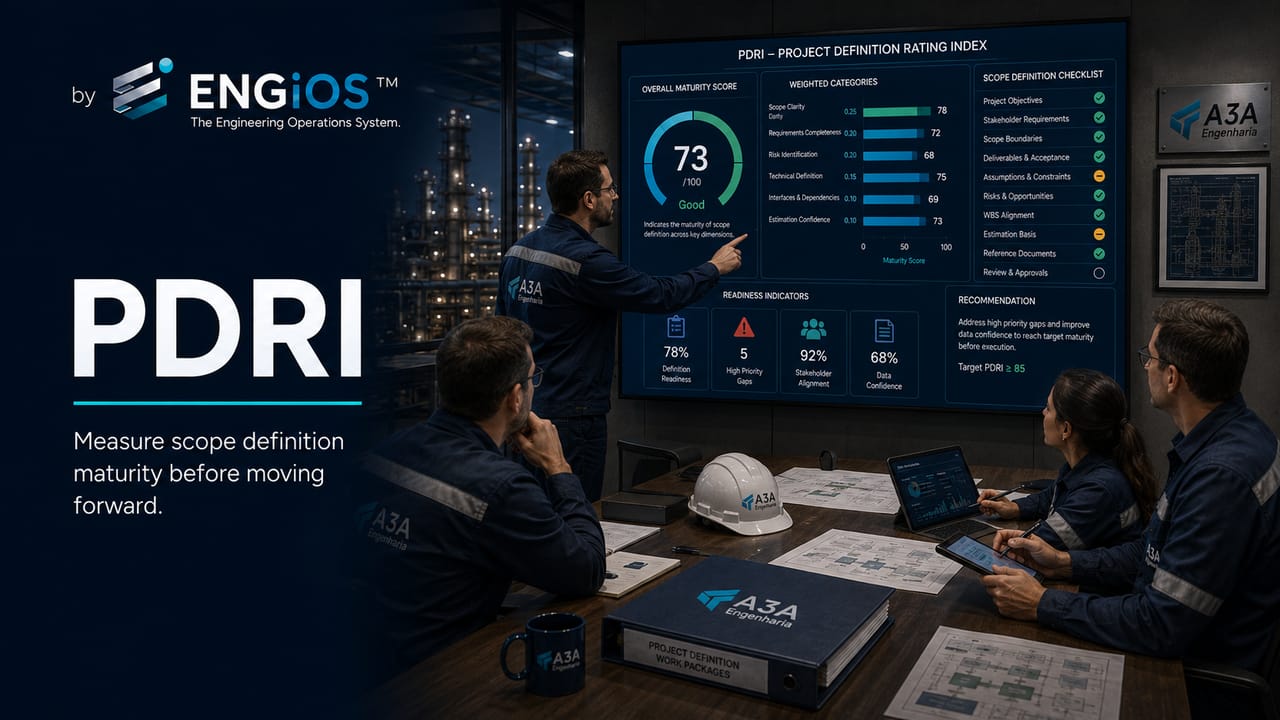
Understand PDRI — Project Definition Rating Index — in engineering: scope maturity, Front End Planning, scoring, Stage-Gate, gaps, evidence, and decision-making.
Check it out!
PDRI — Project Definition Rating Index — is a methodology developed by the Construction Industry Institute (CII) to assess the level of project definition before stages involving greater technical and financial commitment. Instead of simply asking whether “the project is ready,” PDRI structures the analysis by scope elements, assigns weights to what remains undefined, and produces a score that helps the team identify Front End Planning gaps, align stakeholders, and prioritize actions before moving forward.
PDRI does not replace feasibility studies, Conceptual Design, FEED, risk management, or Stage-Gate. It functions as an assurance layer over these activities: it measures how mature the resulting definition is and where uncertainties remain that could affect cost, schedule, operational performance, procurement, or execution.
CII maintains specific versions for industrial projects, buildings, infrastructure, mining, and smaller projects. The core logic is common: the better the project basis is defined before detailed design and construction, the greater the delivery predictability tends to be. The score should be used as a decision and alignment tool, not as a bureaucratic grade to “approve” a project without technical discussion.
What PDRI actually measures
PDRI measures the maturity and completeness of project definition. It organizes elements that need to be sufficiently clarified before the project assumes commitments that are harder to reverse.
This includes issues related to the decision basis, project requirements, technical definition, execution strategy, site conditions, interfaces, schedule, costs, risks, and other dimensions that vary according to the PDRI family used.
The principle is simple: a small gap in a secondary item does not represent the same risk as an undefined strategic premise, capacity, location, operational requirement, or design basis. That is why elements receive different weights.
PDRI is not a conventional checklist
A checklist answers whether a given item was remembered. PDRI seeks to assess how well that item is defined and how relevant its lack of definition is to project risk.
| Conventional checklist | PDRI |
| item exists or does not exist | item receives a definition level |
| all items tend to appear equivalent | elements have different weights |
| focus on compliance | focus on maturity and definition risk |
| binary result | consolidated result and gaps by element |
| one-time use | repeated application throughout Front End Planning |
This difference turns PDRI into a management tool. The objective is not to fill out a spreadsheet, but to create a structured technical discussion about what still needs to be resolved.
Origin of the Project Definition Rating Index
CII began developing PDRI for industrial projects in the 1990s, seeking to create a non-proprietary tool to improve pre-project planning. The original research linked better scope definition to more predictable cost, schedule, and operational performance.
The first industrial version was published in 1996. Since then, the institute has developed and updated families for buildings, infrastructure, and other project types. Industrial Version 5.0, published in 2019, incorporated the PDRI MATRS — Maturity and Accuracy Total Rating System — approach for large and complex industrial projects.
The U.S. Department of Energy also incorporated the concept into its DOE G 413.3-12A guide, updated in 2023, to support Front-End Planning and numerical assessment of scope-definition maturity before capital-project baselines are established.
PDRI within Front End Planning
PDRI is most meaningful when embedded in a Front End Planning process. The article on FEL — Front End Loading shows why decisions made before execution have a disproportionate impact on project outcomes.
During this phase, the team needs to turn a business need into a definition mature enough to justify investment, select an alternative, develop engineering, structure procurement, and authorize execution.
PDRI functions as a maturity check for this process. Rather than assuming that activity progress means maturity, the team measures what has actually been defined.
The difference between planning progress and actual maturity
A project may have dozens of documents and still remain immature. The number of deliverables does not mean that critical decisions have been made.
There may also be an appearance of maturity because schedules, estimates, and layouts have already been produced while capacity assumptions, operational criteria, interfaces, or existing conditions remain uncertain.
PDRI exposes this type of asymmetry. Element-by-element assessment forces the team to discuss content, not merely document presence.
PDRI families
CII developed specific versions because relevant elements vary according to project type and scale.
Available families include:
- PDRI for industrial projects;
- PDRI for buildings;
- PDRI for infrastructure;
- PDRI for small industrial projects;
- PDRI for small infrastructure projects;
- PDRI for mining.
The tool selected needs to reflect the nature of the project. Applying an unsuitable list simply because “it is PDRI” weakens the result.
Industrial PDRI
Industrial PDRI was the original family. CII research started with industrial capital projects and structured definition elements relevant to process facilities, utilities, and complex projects.
The current version published by CII is Industrial 5.0, from 2019, emphasizing maturity and accuracy for large, complex projects.
It is useful in environments where process, technology, capacity, site, execution, and operations assumptions need to be coordinated before major commitments.
PDRI for Buildings
The Building version was later developed to reflect the characteristics of commercial, institutional, and similar building projects.
Issues such as the space program, architectural criteria, operations, site, codes, building systems, and user requirements have different importance from those in an industrial plant.
Therefore, adaptation is not just a matter of changing terminology; the structure of elements and weights needs to reflect the factors that actually determine maturity for that project type.
PDRI for Infrastructure
PDRI Infrastructure was created to address the gap in infrastructure projects. CII presents this version as part of the trilogy of tools for large capital projects, alongside Industrial and Building.
Infrastructure has its own challenges: corridors, interferences, right-of-way, public stakeholders, permitting, geotechnical conditions, territorial interfaces, operations, and segmented implementation.
A mature analysis needs to consider these characteristics before detailed engineering and procurement are consolidated.
Small projects also need proportional definition
CII developed specific versions for small industrial and infrastructure projects. The reason is important: smaller projects represent a large volume of initiatives in many portfolios and often receive less planning rigor because each individually has lower CAPEX.
This behavior creates accumulated exposure. An organization may control its large projects very well while wasting resources on dozens of small projects started with poorly defined scope.
The solution is not to apply the same bureaucracy as megaprojects, but to use an assessment proportional to complexity.
How the scoring logic works
The PDRI score is built from the definition level of individual elements and weights derived from CII research. In general, the greater the relevant lack of definition, the greater the scoring penalty.
Therefore, a lower score represents better project definition. Interpretation should follow the specific PDRI version and its benchmarks.
The final number is useful, but most of the value lies in the breakdown: which elements are driving the score upward and why.
A high score does not automatically mean a bad project
An assessment performed early will naturally show more undefined items. That is not a failure; it is a snapshot of the current stage.
The problem appears when the team tries to move toward a commitment that is incompatible with the observed maturity. A high score in an early phase can guide work. The same score immediately before procurement or construction may indicate significant exposure.
PDRI should therefore be interpreted together with the point in the project lifecycle.
The maturity curve matters more than a single score
Applying PDRI repeatedly makes it possible to observe progress. The project should reduce undefined items as studies, decisions, and engineering advance.
If the score remains practically unchanged between assessments, the team may be producing documents without resolving critical elements. If it improves very quickly, it is also worth investigating whether real maturity occurred or whether there was merely optimistic reclassification.
The trend by category and element is often more informative than a single score.
PDRI as an alignment tool
CII highlights PDRI not only as a measurement tool, but also as a communication forum among the owner, designers, engineering, operations, and contractors.
When representatives from different functions assign very different definition levels to the same element, the divergence itself is important information. It reveals misalignment about project status.
The facilitator should explore the cause: unshared information, a requirement not yet approved, different assumptions, contractual interpretation, or excessive confidence in preliminary data.
The assessment should be multidisciplinary
PDRI applied by a single person loses much of its alignment function. The definition of a complex project is distributed across functions.
Business functions know objectives and economic assumptions. Operations knows use and maintenance needs. Engineering knows technical maturity. Procurement understands sourcing strategy and the market. Project Controls knows the baseline, estimate, and schedule. HSE, quality, legal, and external stakeholders can also affect critical elements.
The session needs to bring together the functions required to discuss each element based on facts.
Independent facilitation improves quality
The facilitator should not steer the team toward a predetermined score. The role is to clarify criteria, seek evidence, record disagreements, and avoid shortcuts.
Projects under pressure to meet a gate date may be subject to bias: the team knows that a better score facilitates approval and may interpret gaps optimistically.
Independent technical facilitation reduces this risk, especially when the result will support an investment or procurement decision.
The score should not replace technical judgment
No score can represent every unique aspect of a project. A single critical element may justify not proceeding even when the total score appears acceptable.
Imagine a project with good overall definition but without confirmed electrical availability, a fundamental permit, validated core technology, or site access. The aggregate score does not eliminate the critical nature of these conditions.
Governance needs to combine the score, critical elements, risks, and gate conditions.
Critical elements need to be highlighted separately
A good practice is to flag elements that act as blockers. This prevents serious deficiencies from being diluted in the total result.
The project may use additional criteria: unresolved legal requirements, unapproved capacity decisions, unvalidated process assumptions, undefined land ownership, external interfaces without agreement, or intolerable risks without mitigation.
These blockers should appear explicitly in the executive recommendation.
When Front End Planning advances without an independent view of maturity, documents can create an appearance of definition before requirements, assumptions, and interfaces are actually consolidated. A structured assessment makes it possible to decide what still needs to mature before engineering is converted into contractual commitment.
Structure the project’s technical definition with FEED before procurement and implementation
PDRI and Stage-Gate
O Stage-Gate in engineering projects organizes decision gates between phases. PDRI can provide structured evidence for some of these gates.
The distinction is important: Stage-Gate defines when the organization decides to advance; PDRI helps measure one dimension of readiness for that decision.
Governance may establish reference ranges, but it should not use PDRI as the sole criterion. Economic feasibility, risks, strategy, resources, permitting, and portfolio alignment are still required.
PDRI and Conceptual Design
O Conceptual Design develops the solution to a level sufficient to compare alternatives, consolidate the basis, and guide subsequent stages.
PDRI does not replace this work. It asks whether the elements that should be defined at that point are actually mature.
If the concept still depends on unresolved essential assumptions, the assessment will reveal those gaps.
PDRI and FEED
The FEED in Engineering deepens definition before procurement and implementation. In industrial projects, PDRI and FEED are particularly complementary.
FEED generates engineering, criteria, estimates, and execution bases. PDRI assesses whether the definition has reached sufficient maturity to support the next decision.
An organization can use PDRI assessments before, during, and at the end of FEED to track scope maturation.
PDRI and cost estimating
Cost estimating depends on the quality of definition. The more assumptions remain undefined, the greater the uncertainty and the greater the reliance on allowances, contingencies, and hypotheses.
PDRI helps explain why two estimates at the same nominal stage may have different confidence levels. A more mature project has a more consistent technical basis for quantities, productivity, execution strategy, and procurement.
This does not turn PDRI into an estimating method. It is a maturity indicator that should be considered together with estimate class and risk analysis.
PDRI and schedule
Schedules also depend on definition. Engineering sequence, permits, long-lead procurement, field interfaces, commissioning, and operational constraints can only be modeled properly when assumptions are known.
A detailed schedule built on immature scope creates apparent precision. Dates may have decimal precision in software while still being supported by fragile assumptions.
PDRI helps reveal where the schedule baseline still depends on unconsolidated information.
PDRI and risk management
PDRI logic itself is linked to definition risk. Poorly defined elements are potential sources of change, rework, delay, or additional cost.
This does not replace the risk-analysis process in engineering projects. The risk register should address events, causes, consequences, probability, impact, and response.
PDRI offers another lens: where lack of maturity is creating the conditions for these risks to exist.
From score to action plan
A PDRI session only creates value when it results in actions. Each relevant poorly defined element needs an owner, action, deadline, dependency, and expected evidence.
| Gap | Action | Owner | Closure evidence | Impact on gate |
| undefined operational requirement | workshop with operations | engineering/owner | approved requirement | blocker |
| incomplete site condition | supplementary survey | engineering | validated report | high |
| pending procurement strategy | define packaging | procurement | approved strategy | medium/high |
| external interface without agreement | formalize responsibility | PM/contracts | signed matrix/interface | high |
The next assessment should verify whether the gap was actually resolved, not merely whether the action was marked complete.
Objective evidence is better than perception
When assessing an element, the team should ask what evidence supports the assigned level. Is a decision formally approved? Was the survey validated? Does the requirement have an owner? Is the interface documented? Did the study consider alternatives?
This behavior reduces the gap between “we think it is defined” and “we can demonstrate that it is defined.”
In auditable projects or projects with multiple contracts, this distinction is essential.
PDRI as Project Assurance
Project Assurance seeks to provide independent confidence that the project is being prepared and governed in a manner consistent with its objectives and risks.
PDRI fits this context because it provides a structured assessment before irreversible commitments. It can be applied by the project team, PMO, Owner’s Engineering, or a third party.
Its value increases when the assessment is not treated as a self-declaration by the delivery team.
In projects with multiple packages and suppliers, the greatest exposure often lies in the whole: open interfaces, different assumptions, and decisions that no single contractor controls. An independent maturity assessment helps the Owner prevent these gaps from being transferred to procurement and execution.
Use Owner’s Engineering to review maturity, interfaces, and readiness before critical gates
PDRI in Owner’s Engineering
In projects with multiple suppliers, the Owner needs to preserve the view of the complete definition. Each contractor knows its package, but interface gaps may remain between them.
A Owner’s Engineering can coordinate maturity sessions, consolidate evidence, and verify whether owner requirements have been converted into adequate bases for procurement and execution.
PDRI makes this assessment less subjective and facilitates prioritization of gaps before package issuance.
PDRI in multi-package contracts
When a project is split into packages, maturity needs to be assessed both globally and at the level of each relevant package.
A power package may be ready while automation depends on requirements that are still undefined. A civil package may partially start while equipment interfaces remain open.
The decision does not necessarily have to be “the entire project proceeds or the entire project stops.” A selective-advance strategy may be used provided interface and change risks are controlled.
The risk of using PDRI to justify a decision already made
An assessment loses credibility when it is performed only to produce the score required for a gate. This can happen due to schedule pressure, annual budget constraints, or commercial commitments.
Warning signs include missing critical stakeholders, optimistic scoring without evidence, superficial discussion of high-weight items, and actions being closed immediately before the session without adequate documentation.
Under these conditions, PDRI stops being assurance and becomes a formality.
Scores should not be “negotiated”
It is legitimate to discuss interpretation of an element. It is not legitimate to adjust a score simply because the total exceeded an internal target.
When there is disagreement, the team should record the condition and seek evidence. If uncertainty remains, the score should reflect the current reality.
The objective is to improve the project, not the spreadsheet.
PDRI and investment decisions
Investors and sponsors need to understand not only expected return, but also the maturity level of the basis supporting CAPEX, schedule, and benefits.
A Business Case may be economically attractive and technically immature. In that situation, the decision may be to fund further definition instead of authorizing full execution.
PDRI helps distinguish “the project appears desirable” from “the project is sufficiently defined for the next commitment.”
PDRI and contractual scope maturity
Before a tender, scope quality influences proposal comparability. Gaps transfer risk into supplier contingencies or reappear as change orders and claims.
The Scope of Work in Engineering defines obligations, deliverables, and interfaces. PDRI assesses whether the broader project basis has sufficient maturity to structure that SOW safely.
For this reason, PDRI can function as a filter before procurement.
How to conduct a PDRI session
Preparation begins with selecting the appropriate version, defining the stage being assessed, identifying participants, and collecting key documents.
During the session, each element is discussed in light of existing evidence. Disagreements are recorded. The facilitator consolidates the score, key gaps, and actions.
Then the team needs to turn the result into a closure plan and define when the next assessment will occur.
Recommended participants
Composition depends on the project, but it should normally cover sponsor/business, project management, engineering, operations/maintenance, project controls, cost, procurement/contracts, construction, HSE, and other critical stakeholders.
Not everyone needs to participate in every minute, but elements need to be assessed by people who know their actual status.
A session without operations, for example, may overestimate the maturity of maintainability and startup requirements.
Document preparation
Before the session, it is useful to organize an evidence package. It may include the Business Case, requirements, ConOps, layouts, site studies, estimates, schedule, risk matrix, procurement strategy, execution plans, interfaces, permits, and relevant technical studies.
The objective is not to attach everything to PDRI. It is to allow the discussion to be supported by traceable information.
Recording session decisions
In addition to the score, the report should record assumptions, points of disagreement, blockers, key gaps, actions, and the gate recommendation.
Without this context, an isolated score loses meaning. Months later, no one will know why a given element received a certain level or what risk was associated with it.
Traceability also allows assessments to be compared over time.
Successive applications
PDRI is more powerful when applied multiple times. An initial assessment can establish a maturity baseline. Intermediate assessments track gap closure. A final assessment supports the decision to proceed.
CII recommends application points appropriate to project size and complexity. In tools for small projects, for example, the institute distinguishes between early review and final review in Front End Planning.
The organization can adapt the cadence without losing the logic of progressive monitoring.
Internal benchmark
After applying PDRI across several projects, a company can build its own historical database.
This makes it possible to compare project types, identify elements that systematically remain immature, and correlate maturity with changes, schedule deviations, contingency consumption, or startup performance.
The internal benchmark should not replace the tool’s fundamentals; it complements external references with organizational reality.
PDRI and lessons learned
If certain elements repeatedly receive poor scores, there is a systemic cause. The organization may involve operations too late, procure insufficient surveys, delay procurement-strategy definition, or lack a clear owner for interfaces.
Aggregated analysis turns PDRI into a process-improvement instrument, not merely a tool for individual projects.
The PMO can use this information to revise templates, gates, and responsibilities.
Limitations of PDRI
PDRI does not predict the future with certainty. It also does not replace competent engineering, estimates, risk analysis, diligence, governance, or executive judgment.
A good score can coexist with significant external risks. A mature project may face regulatory change, market events, or unforeseen conditions.
The tool primarily measures definition maturity within its framework. Its interpretation should respect that scope.
PDRI is not synonymous with Project Readiness
PDRI is one way to assess project preparedness, with a strong focus on definition and Front End Planning. Project Readiness is a broader concept.
An initiative may have well-defined scope and still not be ready for a given gate because resources, permits, contracts, materials, area release, execution plans, organizational capability, or startup conditions are missing.
The article on Project Readiness explores this multidimensional analysis and shows how to combine technical, organizational, contractual, and operational maturity.
When to apply PDRI
The tool adds the most value when the cost of advancing with gaps is significant. Large capital projects are obvious candidates, but small repetitive projects can also benefit from proportional versions.
It is especially useful before final FEED, investment authorization, procurement launch, execution-baseline establishment, or mobilization, depending on the governance model adopted.
Timing should allow action: assessing when there is no longer time to close gaps reduces the benefit.
Final considerations
PDRI turns the subjective question “is the project well defined?” into a structured maturity assessment. By breaking scope into weighted elements, the methodology helps reveal gaps, align stakeholders, and direct work before the organization assumes commitments that are difficult to reverse.
Its greatest value is not in the final score. It lies in showing where the project still depends on fragile assumptions, unresolved decisions, and insufficient information — and in converting those gaps into verifiable actions.
Applied within Front End Planning, Stage-Gate, and Project Assurance, PDRI improves decision quality. It does not eliminate risk, but it reduces the likelihood that the organization advances without understanding how much of the project remains undefined.
Technical references
[1] CONSTRUCTION INDUSTRY INSTITUTE. Project Definition Rating Index (PDRI) Overview. Austin: CII. Disponível em: https://www.construction-institute.org/pdri-overview
[2] CONSTRUCTION INDUSTRY INSTITUTE. PDRI: Project Definition Rating Index — Industrial Projects, Version 5.0. IR113-2. Austin: CII, 2019. Disponível em: https://www.construction-institute.org/pdri-project-definition-rating-index-industrial-projects-version-5-0
[3] CONSTRUCTION INDUSTRY INSTITUTE. PDRI: Project Definition Rating Index — Infrastructure Projects, Version 4.0. IR268-2. Austin: CII, 2013. Disponível em: https://www.construction-institute.org/pdri-project-definition-rating-index-infrastructure-projects-version-4-0
[4] CONSTRUCTION INDUSTRY INSTITUTE. PDRI: Project Definition Rating Index — Building Projects, Version 4.0. IR155-2. Austin: CII, 2013. Disponível em: https://www.construction-institute.org/pdri-project-definition-rating-index-building-projects-version-4-0
[5] U.S. DEPARTMENT OF ENERGY. DOE G 413.3-12A — Front-End Planning and Project Definition Rating Index for Nuclear and Non-Nuclear Construction Projects. Washington, DC: DOE, 2023. Disponível em: https://www.energy.gov/documents/front-end-planning-and-project-definition-rating-index-nuclear-and-non-nuclear
Frequently asked questions
PDRI is the Project Definition Rating Index, a Construction Industry Institute methodology for assessing project-definition maturity through weighted scope and Front End Planning elements.
No. In general, a higher score represents a greater level of lack of definition. Exact interpretation should follow the specific PDRI version and the stage at which the assessment is performed.
No. FEL and FEED develop project definition. PDRI assesses the maturity and gaps of that definition and can be applied throughout those stages.
Yes, as one item of maturity evidence for the decision. It should not be the sole criterion because risks, feasibility, resources, permits, strategy, and other conditions also need to be assessed.
The team should be multidisciplinary and include functions relevant to the project, such as sponsor, management, engineering, operations, cost, planning, procurement, construction, HSE, and other critical stakeholders.
PDRI strongly focuses on scope-definition maturity and Front End Planning. Project Readiness is broader and may also include resources, contracts, permits, construction, logistics, organizational capability, commissioning, and operations.
Additional technical resources
Core content on the topic
- FEL: the stage that prevents construction from becoming a legal, financial, and operational problem
- FEED in Engineering: what it is, stages, and deliverables
- Stage-Gate in engineering projects: phases, criteria, and decision gates
Related technical content
- Conceptual Design in Engineering: what it is, stages, and deliverables
- Scope of Work (SOW) in Engineering
- Risk Analysis in Engineering Projects
