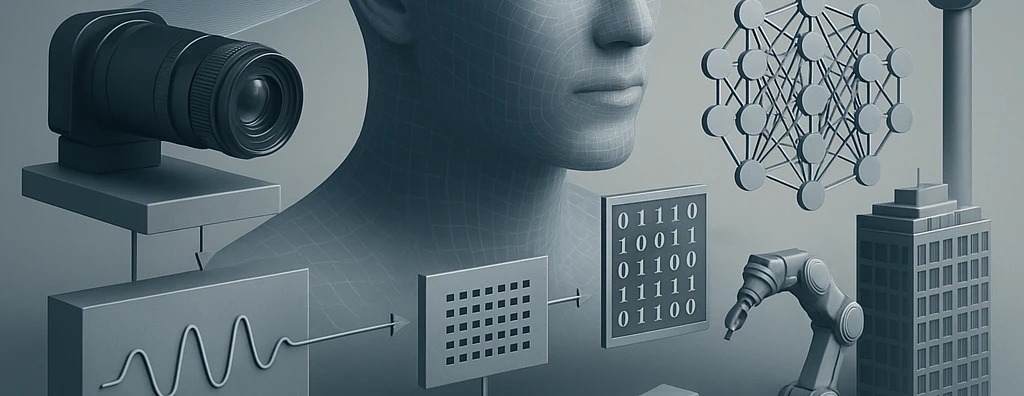
Computer Vision is a multidisciplinary field of engineering and information technology dedicated to the automatic processing and interpretation of digital images and videos. This article covers mathematical and computational foundations, image-processing architectures, classical and modern algorithms, current challenges, and technical recommendations.
Check it out!
Computer Vision is a multidisciplinary field of engineering and information technology dedicated to the automatic processing and interpretation of digital images and videos by computational systems.
In this article, we address the mathematical and computational foundations of computer vision, image-processing architectures, classical and contemporary algorithms, current industry challenges, and technical standards and recommendations for project implementation. The objective is to provide a solid foundation for engineers, integrators, and project managers who want to understand, specify, or implement solutions based on computer vision and intelligent video analytics.
Read on.
[elementor-template id=”24446″]
Computer Vision Fundamentals: Principles and Key Concepts
Computer vision involves the study and development of algorithms that enable computers to interpret visual content from the real world. Its main motivations include replicating and extending human visual-perception capabilities through sensors, digital cameras, and robust mathematical structures.
Key foundations include:
- Image formation: modeling the physical processes of light capture, the geometric properties of optical systems, and the digitization of information.
- Geometric representation and transformation: analysis and manipulation of points, lines, surfaces, and volumes, as well as the application of 2D and 3D transformations to align and normalize visual data.
- Light-signal processing: use of filtering, contrast enhancement, histogram equalization, and spectral analysis through Fourier transforms and wavelets, which are essential to prepare data for higher-level stages.
The mathematical foundation is based on linear algebra, statistics, information theory, signal analysis, and numerical methods. Understanding digital-image formation mechanisms is essential for designing robust systems that can adapt to different domains.
Algorithms: Structure, Evolution, and Approaches in Computer Vision
Computer-vision algorithms have evolved considerably over the past decades, integrating classical image-processing approaches with modern methods based on deep learning.
Main paradigms and techniques:
- Point and neighborhood operators – Brightness and contrast adjustment, histogram equalization, smoothing, and edge enhancement through convolution with specific kernels, providing robust input normalization.
- Feature detection and extraction – Automatic identification of interest points such as corners and local extrema, contours, textures, and lines, often using methods such as Harris, SIFT, and Canny.
- Segmentation and clustering – Delimitation of homogeneous regions using clustering algorithms and pixel-, region-, or statistical-model-based segmentation, useful in industrial and biomedical applications.
- Recognition and classification – The use of supervised classifiers, convolutional neural networks (CNNs), and transformer architectures has enabled significant advances in identifying and differentiating objects and patterns.
- 3D reconstruction – Stereo-matching algorithms, Structure from Motion, volumetric reconstruction, and hybrid methods used to model three-dimensional environments and objects.
The evolution of these algorithms reflects the increasing integration of statistical foundations, numerical methods, and machine learning, making a systemic understanding of the visual-data processing chain essential.
Computer Vision System Architectures: Flow, Components, and Integration
Computer-vision systems are built on architectures that integrate dedicated hardware, high-precision image sensors, signal-processing pipelines, specialized processing units such as GPUs and FPGAs, and robust software modules.
A typical flow includes:
- Image acquisition – Use of industrial cameras, multispectral sensors, and scanning devices.
- Preprocessing – Application of filters, noise removal, and radiometric and geometric calibration.
- Feature extraction – Automatic identification of points, vectors, regions, and high-level descriptors.
- Interpretation and decision – Classification, recognition, semantic segmentation, and automated decision-making.
- Control and integration interface – Communication with automation systems, industrial supervisory systems (SCADA), sensor networks, and corporate databases.
Standardizing interfaces and protocols, together with adopting compatible formats and tools such as OpenCV, ROS, and OPC-UA integration, is essential to ensure interoperability, scalability, and efficient maintenance.
Computer Vision Applications: Industry, Consumer, and Infrastructure
Computer-vision applications span industrial, consumer, biomedical, and urban sectors, driving innovation in automated inspection, robotics, security, and smart cities.
Key applications include:
- Industrial inspection and quality control: Real-time defect detection, automated visual inspection, optical character recognition (OCR), and production-line monitoring.
- Robotics and manipulation: Vision systems for mobile robots, autonomous vehicles, and drones, with navigation based on visual perception and sensor fusion.
- Electronic security: Perimeter monitoring, intelligent video analytics, facial recognition, and multimodal biometrics.
- Medical diagnosis: Automated analysis of medical imaging, tissue segmentation, and early detection of abnormalities.
- Consumer applications: Augmented reality on smartphones, automatic panorama stitching, photo enhancement, gesture control, and visual authentication.
The continued expansion of these applications is directly related to algorithmic advances and increased embedded-processing capacity, enabling real-time responses and integration with cyber-physical systems.
Current Challenges, Limitations, and Future Outlook
Despite recent advances, widespread adoption of computer-vision systems still faces technical, operational, and regulatory challenges.
Main challenges and limitations include:
- Variability of environmental conditions: Changing lighting, partial obstruction, reflections, transparency, and noise introduce instability into algorithm performance.
- Generalization and robustness: Systems trained on limited scenarios may perform worse in different contexts, requiring adaptation and generalization techniques.
- Privacy considerations: Surveillance and biometric applications require compliance with data-protection regulations, such as Brazil’s LGPD — General Data Protection Law.
- Interoperability: The absence of universally accepted standards can limit integration among components from different manufacturers.
- Computational requirements: Some deep-learning models consume substantial computational resources, making cost-benefit balancing essential.
Future developments point toward the integration of intelligent sensors, self-supervised learning, expanded real-time 3D perception, and new applications in general-purpose AI.
Standardization and Integration: Recommendations for Computer Vision Projects
Proper implementation of computer-vision projects requires alignment with technical standards, software best practices, and integration with existing systems.
Technical recommendations:
- Clearly specify system requirements, including quality metrics, response time, accuracy, and integration.
- Adopt industrial communication protocols such as OPC-UA, open data formats such as XML and JSON, and widely used libraries such as OpenCV.
- Conduct comprehensive testing in controlled and real environments, covering likely environmental variations and patterns not observed during training.
- Use a modular structure to facilitate upgrades, preventive maintenance, and incorporation of new features.
- Continuously develop engineering teams so they can keep pace with the sector’s rapid technological changes.
Using programming languages such as Python together with scientific libraries such as NumPy, deep-learning frameworks such as PyTorch, and collaborative tools such as Jupyter Notebooks accelerates the prototyping and deployment cycle.
Technology Trends: Emerging Innovations and Systemic Impact
The computer-vision field is undergoing rapid transformation, driven by advances in embedded hardware, deep learning, and integration with intelligent systems.
Key trends include:
- Deep neural networks and transformer architectures: Capable of processing visual inputs at scale, improving efficiency and accuracy.
- Multispectral sensors and event-based cameras: Enable data acquisition under challenging conditions and open the way to new capture paradigms.
- Simultaneous Localization and Mapping (SLAM) and Visual-Inertial Odometry (VIO): Fundamental for autonomous navigation and high-precision mobile robotics.
- Applications in smart cities, augmented reality, and pervasive computing.
- Convergence with other areas of artificial intelligence, enabling integrated autonomous and interactive systems.
These trends require flexible software and hardware architectures capable of keeping pace with rapid evolution and make computer-vision engineering a key pillar for innovative projects in the years ahead.
Final Considerations and Recommendations for Engineering Decision-Making
Computer vision is becoming essential to intelligent automation, large-scale visual-data analysis, and next-generation human-machine integration. Gains in productivity, safety, and precision are supported by algorithmic and architectural advances; however, effective adoption depends on well-founded technical choices, proper architecture specification, team training, and compliance with relevant standards.
For industrial and technology projects, it is recommended to:
- Invest in flexible, modular platforms aligned with the dynamic requirements of industrial and urban environments.
- Prioritize interoperability by adhering to recognized standards and promoting seamless integration with existing systems.
- Periodically assess the algorithm lifecycle and revalidate models when context or regulatory requirements change.
- Encourage synergy among engineering, IT, and data-specialist teams to maximize the value extracted from visual systems.
Computer-vision engineering will continue to expand its impact. Systemic understanding and continuous technical updating are differentiators for technological and operational leadership across multiple sectors, making this knowledge indispensable for strategic decision-making in highly complex and relevant projects.
