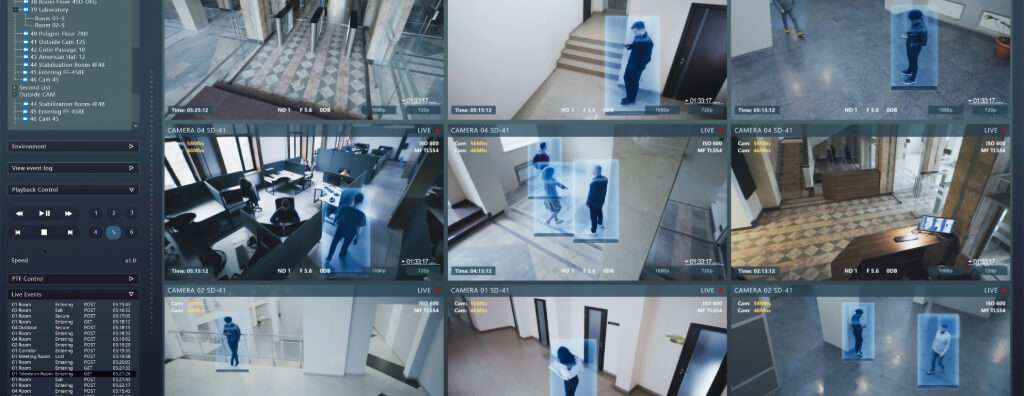
Understand how AI-enabled security cameras use video analytics, object classification, perimeter monitoring and forensic search in electronic security systems.
Check it out!
AI-enabled security cameras with artificial intelligence (AI) are video-capture devices that use algorithms to analyze images and video in real time, enabling complex tasks to be performed automatically. Unlike conventional cameras that only record or transmit images, AI-enabled cameras can interpret scenes, identify objects, patterns, and behaviors, and trigger actions based on those analyses.
In this article, we examine the role of cameras with Artificial Intelligence (AI) in video surveillance system design. The use of AI with video analytics and forensic search can optimize traditional surveillance processes and make the system more efficient, proactive, and intelligent, enabling faster responses to critical events and reducing false alarms.
This technological evolution directly affects security in a wide range of corporate environments, from industrial facilities to commercial centers.
[elementor-template id=”24446″]
What Are AI-Enabled Security Cameras?
AI-enabled cameras are devices that, in addition to capturing images and video, use algorithms to analyze visual content in real time. These cameras can identify behaviors and recognize objects and identify patterns that may indicate suspicious situations, all automatically and without continuous human intervention.
This automated analysis allows the system to identify events considered suspicious and trigger immediate responses such as alerts, event recording, or other security measures including alarms or access blocking.
How Do AI-Enabled Cameras Work?
AI-enabled cameras use machine learning and deep learning, technologies that allow models to learn patterns from captured imagery and improve detection and analysis capabilities through training. This means the system can be configured to recognize suspicious behaviors such as intrusions, unusual movement, or objects left in sensitive areas.
Key capabilities include:
Response automation: When suspicious events or behaviors are identified, cameras can trigger notifications or activate other parts of the security system.
Real-time video analytics: Processing occurs while images are captured, enabling immediate actions.
Pattern recognition: AI can detect recurring patterns, such as usual times and behaviors, and distinguish normal activity from potential threats.
Benefits of AI-Enabled Security Cameras
- More precise threat detection: AI enables cameras to identify suspicious activities such as rapid movement, aggressive behavior, or intruders in restricted areas automatically and with greater precision.
- Reduction of false alarms: By distinguishing relevant events from trivial motion, such as animals or environmental changes, AI can reduce false alarms and make monitoring more efficient.
- Better use of human resources: Security operators do not need to continuously watch every camera because the system can automatically flag incidents, allowing the team to focus on higher-value responses.
- Fast forensic search: AI facilitates searching large volumes of recorded video. Instead of reviewing hours of footage, the system can quickly locate events based on predefined criteria such as clothing color, suspicious movement, or vehicle presence.
AI-enabled cameras in electronic security system design:
AI-enabled cameras with Artificial Intelligence (AI) have transformed electronic security by combining advanced video analytics and forensic search, making surveillance workflows more efficient, proactive, and precise.
These capabilities can improve the performance and efficiency of security systems by providing a more intelligent approach to event detection and incident investigation.

AI Video Analytics
AI video analytics allows cameras to process video streams in real time, identifying behaviors, suspicious activity, and unusual patterns. Unlike conventional systems that only record and display images, intelligent cameras can classify events and trigger responses based on captured visual data.
AI video-analytics capabilities:
- Motion detection: Cameras can detect movement in specific areas and filter irrelevant events such as animals or environmental changes, focusing attention on security-relevant events.
- Object recognition: The system can identify and classify objects or people. For example, it can detect whether an object was left in a restricted area or whether an item was removed.
- Facial recognition: Where lawfully and appropriately deployed, cameras can recognize and alert on enrolled individuals, such as authorized personnel or persons of interest, supporting access control and security workflows.
- Perimeter monitoring: With AI, cameras can detect when a person or vehicle enters a protected zone, triggering alarms or notifying responsible teams for rapid response.
AI Forensic Search
AI AI forensic search is a valuable tool for reviewing events after an incident, saving time and improving investigative precision. Instead of manually reviewing hours of footage, AI can filter recordings using criteria such as object color, behavior type, or visual characteristics.
Forensic-search capabilities:
- Object search: If a camera captured a specific object such as a backpack or vehicle, the AI system can search for similar items across recordings, helping locate when and where the object appeared or was left.
- Movement filtering: Forensic search can isolate recordings based on specific movements, such as people running or moving at unusual times, helping locate suspicious events.
- Pattern analysis: AI can identify unusual patterns over a period of time or within a specific area, such as repeated movement in a location that is normally empty, providing useful investigative insights.
Integrating AI video analytics and forensic search
When video analytics and forensic search are integrated into AI-enabled camera systems, security monitoring becomes more proactive than reactive. These capabilities allow security operators to identify and respond to developing situations earlier. In addition, rapidly reviewing events with forensic-search tools makes investigations more agile and precise.
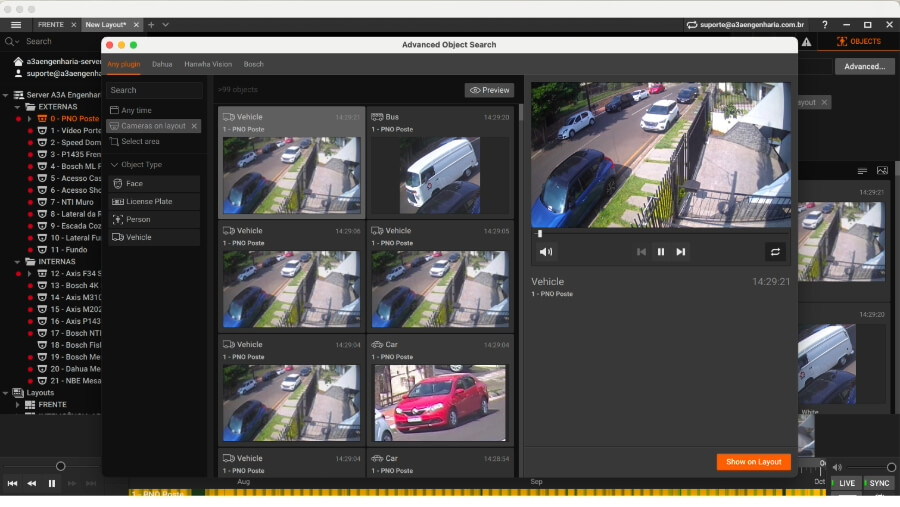
Source: A3A Engenharia
Practical benefits
- Operational efficiency: With automated analytics and forensic search, security teams can focus on relevant events, saving time and effort while AI handles background filtering.
- Higher precision: AI can reduce false positives by prioritizing security-relevant events such as intrusions or suspicious movement.
- Improved investigation: With forensic search, post-incident investigations can be faster, locating critical moments without manually reviewing long recordings.
Applications:
These cameras are commonly used in security systems for functions such as:
- Object detection: Identifying and classifying different object types such as vehicles, people, and animals.
- Facial recognition: Ability, where appropriately deployed, to match specific enrolled faces for authentication and access-control use cases.
- Behavior analysis: Identification of suspicious or unusual behavior, such as entering restricted areas or leaving objects in monitored spaces.
- Crowd monitoring: Analysis of people flows and occupancy density, useful in public spaces and events.
- Event detection: Ability to generate alerts when a defined event occurs, such as intrusion or movement outside expected hours.
With these capabilities, AI-enabled cameras are used across retail, industry, and smart-city applications, providing greater efficiency and automation in security-data management.
Conclusion
The combination of AI video analytics and forensic search represents a significant technological advance for security monitoring, making it more proactive and efficient.
AI-enabled cameras can be important tools for precise surveillance, supporting faster event detection in real time and more efficient post-incident analysis.
To optimize security performance, a customized engineering design developed with appropriate expertise, such as that offered by A3A Engenharia , is essential to achieving a high-performance solution.