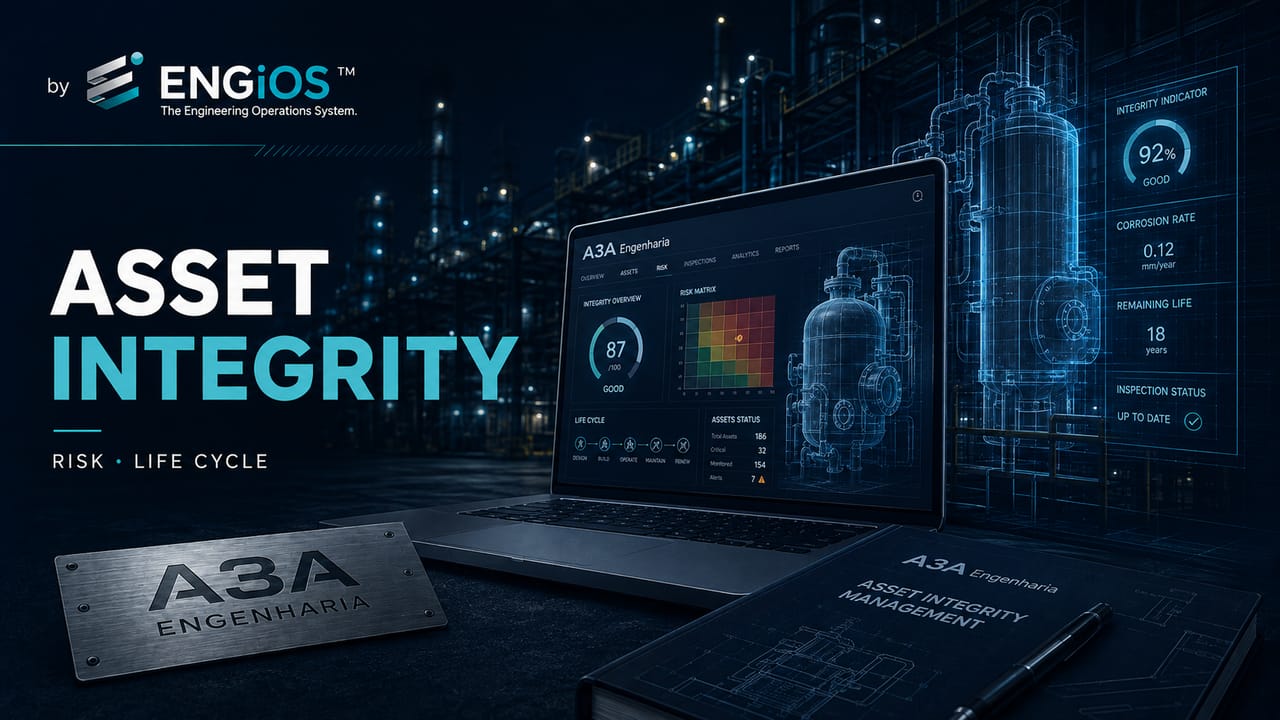
Asset Integrity Management: how to structure asset integrity through risk, criticality, inspection, maintenance, reliability, data, and lifecycle governance.
Check it out!
Asset Integrity Management (AIM) is the structured approach used to ensure that assets and systems remain capable of performing their required functions with acceptable levels of safety, performance, and risk throughout the lifecycle. The concept goes beyond inspection or maintenance: it integrates design requirements, physical condition, degradation mechanisms, protective barriers, operation, data, maintenance, reliability, change, and governance.
In a mature organization, integrity is not checked only when equipment shows visible damage. It is built from requirements definition and design, demonstrated during commissioning, preserved through controlled operation and maintenance, monitored through inspections and indicators, and reassessed when changes, failures, aging, or new service conditions arise. The objective is to prevent asset degradation from exceeding technical limits without the organization recognizing it and acting.
Asset Integrity Management should also not be confused with Asset Management. Asset management has a broader scope and seeks to generate value by balancing performance, risk, and cost throughout the lifecycle. Integrity management is a discipline within that broader system, focused on preserving the technical and functional capability of the asset, controlling degradation mechanisms, and demonstrating that relevant barriers and requirements remain effective.
This distinction makes AIM especially important in critical infrastructure, industry, energy, Data Centers, telecommunications, electrical installations, automation, and integrated systems. In these environments, failures rarely depend on a single component: integrity results from the interaction among engineering, configuration, environment, documentation, maintenance, people, software, interfaces, and management decisions.
What Asset Integrity Means in Practice
An asset has integrity when its condition and configuration are compatible with the functions, loads, environment, requirements, and limits under which it must operate. This includes not only the absence of physical damage, but also preservation of functional capability, protections, interfaces, and the information needed to operate and maintain the system safely.
Integrity can therefore be analyzed in different layers:
| Layer | Engineering question |
| Design basis | Was the asset specified and designed for the actual service conditions? |
| Physical integrity | Do materials, structures, connections, and components remain in acceptable condition? |
| Functional integrity | Does the system continue to deliver the required function and expected performance? |
| Barriers and protection | Do protections, redundancies, interlocks, and contingencies remain effective? |
| Configuration | Does the installed condition correspond to current documentation and assumptions? |
| Information | Are data, history, drawings, parameters, and records reliable and traceable? |
| Governance | Are there roles, criteria, limits, decisions, and controls capable of maintaining integrity? |
This perspective brings AIM close to Engineering Asset Management, Reliability and Availability Engineering, and Maintenance Engineering, while each discipline maintains its own focus.
Asset Integrity, Asset Management, Maintenance, and Reliability
The concepts overlap, but they are not equivalent.
| Discipline | Primary focus |
| Asset Management | generate value from assets throughout the lifecycle by balancing performance, risk, and cost |
| Asset Integrity Management | preserve technical condition, function, and barriers within acceptable limits |
| Maintenance Engineering | define and optimize maintenance policies, plans, tasks, resources, and criteria |
| Reliability Engineering | analyze failures, availability, maintainability, risk, and system performance |
| Maintenance Planning and Control | turn maintenance needs into planned, scheduled, and controlled work |
ISO 55000 and ISO 55001 provide the management structure that connects organizational objectives, decision-making, risk, resources, information, operation, measurement, and improvement. Within this logic, integrity must be linked to organizational objectives and decision criteria rather than existing as an isolated technical program.
Integrity Starts in Design and FEED
A large share of integrity losses that emerge during operation originate before the asset enters service. Inadequate materials, poor accessibility, lack of inspection points, redundancies with common-cause vulnerabilities, ventilation limitations, poorly defined interfaces, inadequate protection, and insufficient documentation may remain hidden until the system is exposed to actual conditions.
Integrity requirements therefore need to be considered from FEED — Front End Engineering Design, basic/detailed design, and Design Review. The design should define service conditions, margins, materials, environmental requirements, accessibility, inspection, maintainability, protection, redundancy, test criteria, and the data required for the operational phase.
This logic can be seen in A3A’s cross-disciplinary projects, such as the telecommunications FEED for a hydroelectric power plant and the electronic surveillance FEED for the same project, in which early definition of interfaces reduces risk during implementation and operation.
Commissioning and Handover as the Integrity Baseline
The transition into operation should establish the technical baseline against which future condition will be compared. Engineering Commissioning verifies installation, configuration, performance, and interfaces before acceptance. Technical Acceptance and Technical Handover transfer evidence, responsibilities, and information to operations.
An incomplete transfer creates integrity debt. Assets without reliable tags, updated diagrams, parameters, certificates, test results, manuals, spare parts, or initial plans make any future assessment difficult. In these cases, the maintenance team operates without an adequate reference for distinguishing degradation, modification, and original condition.
As-Built and technical closeout are therefore part of AIM. Documentation needs to represent the condition actually built and maintain traceability to requirements, tests, punch items, and changes.
Integrity does not mean applying the same effort to every asset. Criticality, degradation mechanisms, and risk should determine where inspection, maintenance, and engineering deliver the greatest reduction in exposure.
Criticality and Risk: Where to Focus Integrity Resources
It is not economically rational to apply the same level of inspection, monitoring, and engineering to all assets. The integrity program should be proportional to the consequence and probability of loss of function.
Asset Criticality Analysis organizes this prioritization by considering safety, environment, continuity, production, compliance, cost, quality, and other relevant impacts. In process environments, Risk-Based Inspection — RBI methodologies deepen this logic by relating probability of failure and consequence to guide inspection programs.
API RP 580 defines elements of an RBI program, while API RP 581 presents a specific quantitative methodology for process equipment. These references are particularly relevant to process industries, but the general principle is broader: inspection should be driven by risk and degradation mechanisms, not only by fixed intervals.
Engineering Risk Management connects these assessments to decision-making processes, enabling residual risk, actions, owners, deadlines, and escalation criteria to be managed.
Degradation Mechanisms: The Technical Basis of Integrity
Integrity is lost through specific mechanisms. Corrosion, fatigue, erosion, wear, thermal aging, insulation degradation, contamination, mechanical cycles, vibration, moisture, battery failures, optical degradation, component obsolescence, and software changes are examples that depend on the type of asset.
The program should relate asset → function → degradation mechanism → observable variable → inspection/monitoring technique → limit → action. This chain avoids generic inspection plans that accumulate measurements without explaining which risk is being controlled.
Condition-Based Maintenance — CBM uses variables capable of indicating deterioration before functional loss. In other cases, RCM or FMEA/FMECA help select strategies when the relationship among mechanism, failure, and consequence needs to be structured.
Inspection, Monitoring, and Operating Limits
Collecting data is not enough. Each inspection or monitoring technique needs an objective, interval, application condition, minimum quality, and interpretation criterion. A measurement without a limit or reference trend produces information, but not necessarily a decision.
The system should answer:
- what will be inspected and why;
- which degradation mechanism is being observed;
- which technique has adequate sensitivity;
- which baseline or limit should be used;
- which trend is acceptable;
- when the result requires additional engineering;
- who can authorize continued operation in a degraded condition;
- which evidence must be retained.
For assets subject to different process or environmental conditions, operating limits are also part of integrity. Systematically operating outside design assumptions can accelerate degradation even when no immediate failure occurs. Critical variables should therefore be monitored and linked to decision rules.
Failures and Incidents as Feedback for the Integrity System
An integrity program that does not learn from failures loses one of its most valuable sources of information. Failure Analysis can identify unforeseen mechanisms, incorrect assumptions, accelerated degradation, systematic failures, and ineffective barriers.
Depending on the event, the investigation may evolve into RCA, FTA, or RAM Analysis. The result should feed back into AIM through review of mechanisms, plans, limits, criticality, design, data, and decision criteria.
The recurrence of a failure after corrective action is also a governance indicator: it may mean that the cause was not properly addressed, that the action was not implemented, or that the process did not verify effectiveness.
Management of Change and Configuration Integrity
The integrity of a system can be lost without physical damage. Changes to firmware, logic, protection, configuration, cable routing, network topology, supplier, material, load, setpoint, process, or procedure may invalidate previous design and analysis assumptions.
Changes should therefore be assessed before implementation and reconciled afterward. Process, Workflow, and Technical Approval Management can structure authorization and review, while Document Governance keeps drawings, lists, parameters, matrices, and records aligned with the current condition.
Punch Item, RFI, and Nonconformity Management is also relevant because temporarily accepted deviations cannot disappear from organizational memory. Each exception needs an owner, operating condition, deadline, risk, and closeout criterion.
Data and Information as Part of Integrity
ISO 55001:2024 reinforces the importance of data and information in the asset management system. For integrity, this means the organization needs to know which attributes are necessary for decision-making, where they come from, how they are updated, and what level of quality is acceptable.
An information architecture may integrate CMMS/EAM, ERP, historians, BMS, SCADA, DCIM, inspection platforms, GED/EDMS, and field applications. Solutions such as Field Applications and Technical Data Collection, Indicators and Executive Dashboards, and Systems Integration can materialize this architecture once the governance model has been defined.
In digital infrastructure, NetBox, Zabbix, and DCIM can provide inventory, topology, telemetry, and condition. The value lies not in the amount of data, but in the ability to relate it to assets, functions, risks, and decisions.
Integrity also depends on configuration and information. An uncontrolled change to software, protection, topology, material, or operating condition can invalidate design assumptions even without apparent physical damage.
Asset Integrity Management Governance
AIM needs to define roles and authorities. Engineering, operations, maintenance, inspection, safety, supply chain, projects, and executive management may participate in the process, but each decision needs a clear owner.
A governance structure may separate:
| Level | Typical responsibility |
| Strategic | objectives, risk tolerance, budget, and lifecycle priorities |
| Technical | criteria, mechanisms, limits, inspection methods, and engineering decisions |
| Operational | execution, monitoring, response to deviations, and condition records |
| Assurance | audit, independent review, evidence verification, and effectiveness |
The Project, Program, and Portfolio Governance solution and the concept of Technical Authority help structure decision rights for critical issues. Engineering Technical Audit can verify alignment among the defined process, actual condition, and available evidence.
Integrity Indicators: Measuring Condition, Exposure, and Effectiveness
Integrity indicators need to combine asset condition, risk exposure, and process effectiveness. Measuring only the number of inspections completed may show good operational compliance without demonstrating risk reduction.
Examples of indicators include:
- critical assets with overdue inspections;
- open anomalies by criticality and age;
- unavailable barriers or redundancies;
- assets operating in degraded condition;
- percentage of critical recommendations implemented;
- recurrence of failure mechanisms;
- time to address critical anomalies;
- asset data quality and completeness;
- configuration and As-Built deviations;
- overdue corrective actions;
- condition trends by asset class.
Maintenance Indicators complement this perspective with availability, MTBF, MTTR, backlog, emergency work, and compliance. The executive dashboard should connect these signals to decisions and risk rather than merely display numbers.
Aging, Obsolescence, and Life Extension
Integrity also degrades through technological aging. An asset can be physically preserved and still represent increasing risk because of obsolescence, lack of support, unavailable spare parts, software vulnerabilities, or loss of internal competence.
In these situations, the decision is not simply whether to maintain or not. Risk, sustainment cost, spare-parts availability, repairability, reliability, future requirements, and modernization alternatives need to be compared. Life Cycle Cost — LCC helps incorporate the economic horizon, while Recommissioning can verify performance and condition after years of operation or significant changes.
The Asset Management Plan should consolidate these decisions into a medium- and long-term view, preventing the organization from treating aging assets only through successive corrective work orders.
Asset Integrity in Critical Infrastructure and Integrated Systems
In multidisciplinary systems, integrity needs to consider interfaces. A substation may have electrically sound equipment and still lose remote assistance because of network, auxiliary power, or configuration issues. A Data Center may have redundant UPS systems but share a common thermal or distribution cause. A security system may keep cameras operational and lose recording because of storage or communications.
The projects for operational monitoring to support remote assistance at a substation, perimeter security monitoring at a transmission substation, and turnkey implementation of intelligent video monitoring at a government complex illustrate this characteristic: continuity depends on power, network, infrastructure, software, configuration, and operational processes working as a system.
AIM applied to this type of environment therefore needs to be systemic. Equipment-by-equipment analysis is insufficient when a shared interface can compromise multiple functions simultaneously.
How to Structure an Asset Integrity Management Program
A consistent implementation can follow a maturity sequence:
1. Define scope, assets, functions, and relevant requirements. 2. Structure hierarchy and criticality. 3. Identify degradation mechanisms and failure modes. 4. Define risk criteria and tolerance. 5. Review the design baseline, documentation, and configuration. 6. Structure inspections, monitoring, maintenance, and limits. 7. Define governance, roles, workflows, and management of change. 8. Integrate data, systems, and evidence. 9. Establish KPIs and management review cycles. 10. Address anomalies, failures, and corrective actions with traceability. 11. Audit effectiveness and compliance. 12. Integrate decisions into asset planning and lifecycle management.
The program does not need to be born complete. An Engineering Technical Audit or Asset Reliability Assessment can establish the maturity baseline and prioritize the gaps with the greatest impact.
A mature integrity program connects engineering, maintenance, risk, data, and governance into a single decision line. The objective is to know the condition before loss of function and turn evidence into prioritized actions.
Asset Integrity Management as Engineering Consulting
Implementing AIM combines engineering, processes, data, and governance. Depending on the client’s maturity, the work may begin with inventory and criticality, review of plans, data diagnosis, assessment of recurring failures, or audit of existing processes.
A consulting approach can produce a critical asset matrix, degradation mechanisms, inspection and maintenance strategies, risk criteria, anomaly workflows, change rules, a data model, dashboards, an action plan, and an integrity roadmap. Execution may combine Engineering Asset Management, Reliability and Availability Engineering, Maintenance Engineering, and Ongoing Engineering Consulting Services.
The ultimate objective is not to maximize inspections or eliminate every possibility of failure. It is to build a system capable of knowing the condition, understanding the risk, deciding before loss of function, and demonstrating through evidence that integrity barriers remain effective throughout the lifecycle.
Technical references
[1] ISO. ISO 55000:2024 — Asset management — Vocabulary, overview and principles. Geneva: ISO, 2024.
[2] ISO. ISO 55001:2024 — Asset management — Asset management system — Requirements. Geneva: ISO, 2024.
[3] ISO. ISO 55002:2018 — Asset management — Management systems — Guidelines for the application of ISO 55001. Geneva: ISO, 2018.
[4] IEC. IEC 60300-3-10:2025 — Dependability management — Maintainability and maintenance. Geneva: IEC, 2025.
[5] API. API RP 580, 4th Edition (2023) — Elements of a Risk-Based Inspection Program. Washington, DC: API, 2023.
[6] API. API RP 581, 4th Edition (2025) — Risk-Based Inspection Methodology. Washington, DC: API, 2025.
Frequently asked questions
It is the structured management of asset integrity to ensure assets remain capable of performing their functions within acceptable levels of safety, performance, and risk throughout the lifecycle.
Asset Management is broader and seeks to generate value by balancing performance, risk, and cost. Asset Integrity Management focuses on preserving technical condition, function, barriers, and asset requirements.
No. Inspection is one of the tools. AIM also involves design, criticality, risk, maintenance, reliability, data, management of change, documentation, failures, indicators, and governance.
Risk-Based Inspection is an approach that prioritizes inspections based on probability and consequence of failure. API RP 580 and 581 are important references for process equipment.
Critical assets with overdue inspections, anomalies by criticality, unavailable barriers, overdue critical actions, recurring failures, degraded condition, and data quality are examples.
It generally begins with scope definition, inventory, criticality, degradation mechanisms, documentation baseline, risk criteria, and diagnosis of existing inspection, maintenance, and data processes.
Related technical materials
Related solutions
- Document Governance and Document Management System
- Requirements, Evidence, and Acceptance Criteria Management
- Process, Workflow, and Technical Approval Management
- Engineering Indicators, Dashboards, and Executive Reports
- Field Applications, Inspection, and Technical Data Collection
Related engineering services
- Engineering Asset Management
- Reliability and Availability Engineering
- Maintenance Engineering
- Engineering Technical Audit
- Systems and Facilities Recommissioning
- Engineering Commissioning
- Ongoing Engineering Consulting Services
Related technical content
- Asset Management: lifecycle, value, risk, and performance
- ISO 55000 and Asset Management
- Asset Management Plan
- Asset Reliability Assessment
- Asset Criticality Analysis
- Life Cycle Cost — LCC
- Failure Analysis
- Condition-Based Maintenance — CBM
Governance and lifecycle