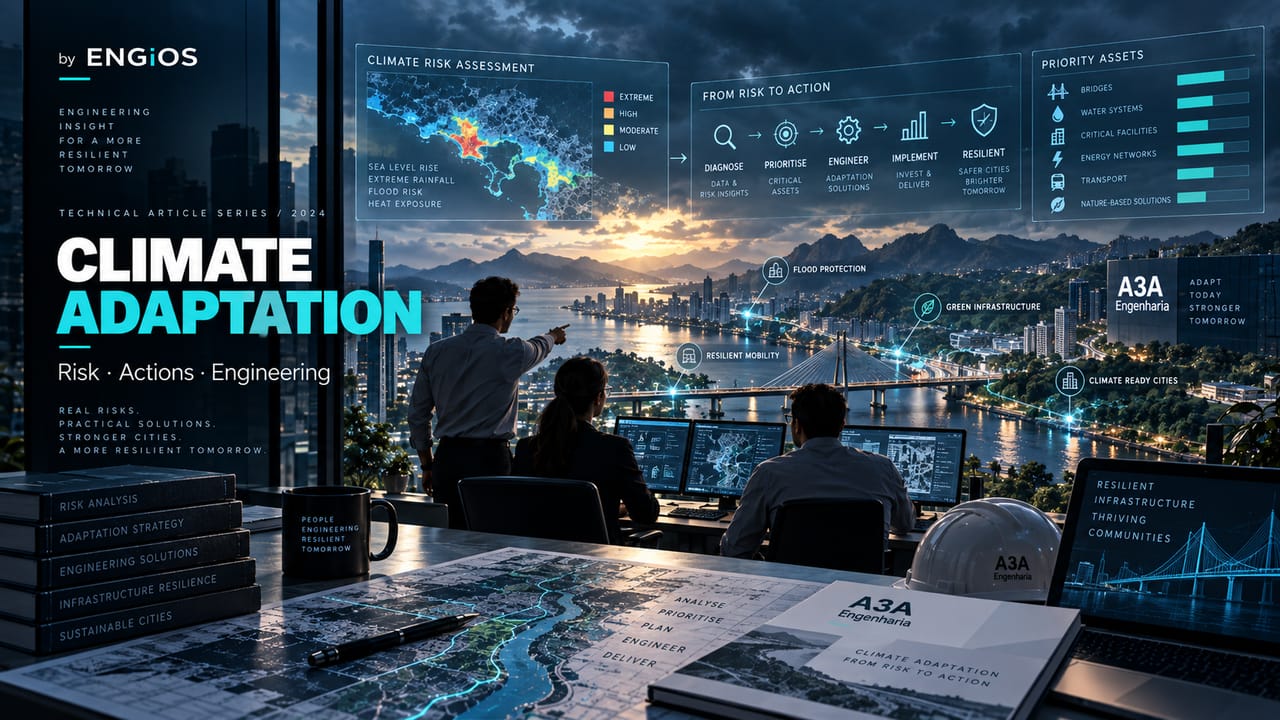
Climate adaptation for infrastructure: turn risk into requirements, alternatives, CAPEX, design, retrofit, testing, and an engineering roadmap.
Check it out!
Climate adaptation is the process of adjusting assets, systems, operations, and decisions to reduce vulnerability and risk under current and future climate conditions. In infrastructure, this means turning a hazard — extreme heat, flooding, storms, drought, prolonged failure of external services, or combinations of these events — into concrete engineering requirements: capacity, protection, redundancy, autonomy, monitoring, recovery, retrofit, and performance criteria.
Adaptation does not begin by selecting equipment. It begins by understanding the service that needs to be preserved, the conditions that can interrupt it, the assets and interfaces exposed, and which consequences are acceptable or intolerable. Only after this diagnosis is it possible to compare alternatives and decide whether the appropriate response is operational, maintenance-related, protective, capacity-enhancing, redundant, relocation-based, local generation, storage, automation, or partial reconstruction.
For long-life assets, adaptation also means recognizing that original design assumptions may not represent every relevant condition over the coming decades. Engineering needs to work with uncertainty without waiting for a perfect forecast: identify measures that already make sense, preserve flexibility for future interventions, and establish indicators and triggers for reviewing decisions throughout the lifecycle.
Climate Adaptation and Climate Mitigation Solve Different Problems
Adaptation and mitigation are complementary, but they serve different purposes. Mitigation addresses the causes of climate change by reducing greenhouse-gas emissions or increasing removals. Adaptation addresses impacts and vulnerabilities: it adjusts systems so they can continue functioning under current and future risk conditions.
For infrastructure engineering, this distinction prevents objectives from being confused. A photovoltaic generation project may contribute to mitigation by replacing part of higher-carbon-intensity energy, but it only contributes to energy resilience if its architecture also supports the required continuity — for example, through integration with storage, controls, protection, and islanded operation where technically applicable. Likewise, a more efficient HVAC system can reduce consumption, but adaptation requires verifying whether it preserves capacity and indoor conditions under relevant thermal scenarios.
The Climate Resilience and Infrastructure Hub organizes this broader view. Adaptation is the stage at which identified risk begins to be converted into technical action, investment, and governance.
The Starting Point Is the Critical Service, Not the Climate Hazard
An organization does not adapt “the building” in the abstract. It adapts functions, systems, and assets to reduce specific risks. The first step is therefore to identify which services need to remain available and what levels of degradation are acceptable during a contingency.
In a Data Center, the function may be to maintain computing capacity within a defined availability level. At a water or wastewater facility, it may be to preserve pumping, treatment, and supervision. In an operations center, it may be to maintain power, communications, data, visualization, and coordination. At an industrial facility, it may be to ensure process safety, utilities, and controlled shutdown.
Criticality guides the depth of the effort. Not every asset needs the same level of protection, autonomy, or redundancy. The response should consider failure consequences, tolerable downtime, the possibility of degraded operation, recovery time, and external dependencies.
Extreme climate events are important as scenario triggers. The adaptation design, however, needs to go beyond the event and identify the technical failure mechanism: overheating, surges, power loss, flooding, communications failure, water shortage, blocked access, loss of control, or combinations of these conditions.
Before Designing Adaptation, Understand the Existing Condition
Before deciding how to adapt, uncertainty about the existing facility needs to be reduced. Actual capacity, obsolescence, routes, protection, redundancy, and documentation need to be sufficiently understood so that investment addresses the correct risk.
In brownfields, one of the greatest risks is making decisions based on documentation that no longer represents the facility. Expansions, replacements, added loads, modified routes, obsolete equipment, and accumulated operational adjustments can change both capacity and vulnerability.
The baseline needs to answer objective questions: which assets exist, where they are located, how they are supplied, which routes they use, how much available capacity remains, which redundancies are genuinely independent, which protections exist, which alarms are monitored, and what failure history has already occurred.
Drawings, single-line diagrams, network diagrams, load lists, design narratives, protection curves, inventories, maintenance reports, alarm records, and inspections help build this basis. When records are insufficient, a Building and Facilities Survey may precede the assessment.
An Engineering Technical Due Diligence broadens the diagnosis by combining condition, capacity, risks, compliance, obsolescence, criticality, and recommendations. This stage is especially useful when an organization needs to decide where to invest before developing specific designs.
Assessing climate risk means linking hazard, exposure and vulnerability to failure modes
ISO 14091 provides guidance for assessing vulnerability, impacts and risks related to climate change. In infrastructure practice, this assessment must be connected to real assets and functions.
The hazard describes the potentially damaging condition. Exposure identifies what is in a position to be affected. Vulnerability expresses sensitivity and response capacity. For engineering, it is useful to explicitly add the failure mode and the operational consequence.
An electrical room subject to flooding is not a risk merely because water exists nearby. Elevation, ingress paths, equipment location, drainage, watertightness, accessibility, exposure time and recovery capability need to be assessed. An IT room exposed to extreme heat is not vulnerable only because of outdoor temperature: thermal capacity, redundancy, air distribution, available power, controls and failure behavior also matter.
The cycle is deliberately closed. Adaptation is not a one-time decision: after implementation, performance and residual risk need to be monitored and reassessed.
Risk Needs to Be Converted Into an Engineering Requirement
A diagnosis only creates value when its conclusion can guide design, operations, or investment. “There is a risk of extreme heat” is still a broad statement. The engineering requirement needs to define the performance necessary to preserve the function.
A requirement may establish that a given room maintain a defined environmental range under design outdoor conditions and after loss of one cooling unit. It may require minimum autonomy for critical loads during utility loss. It may establish physical separation between redundant routes, surge-protection levels, parameter monitoring, alarms, response times, or the capability to operate in a degraded state.
Good requirements need to be verifiable. Expressions such as “robust system,” “high availability,” or “adequate protection” are insufficient without performance criteria, reference conditions, and an acceptance method.
This transition from risk to requirement is one of the main functions of engineering consulting. It makes it possible to compare different technological solutions without prescribing brands and creates a basis for design, procurement, supervision, and commissioning.
Adaptation Options Follow a Hierarchy, Not a Product Catalog
A mature response first seeks to reduce exposure and vulnerability before adding complexity. Where possible, avoiding the risk condition is usually more robust than relying exclusively on active barriers.
A practical hierarchy can consider:
- avoid or reduce exposure through location, elevation, separation, or route changes;
- increase asset robustness and protection;
- increase capacity or performance margin;
- create redundancy and diversity against common causes;
- increase autonomy for power, water, or communications;
- improve detection, monitoring, and response;
- strengthen recovery, spare parts, procedures, and testing;
- preserve flexibility for future adaptation.
The first measure is not always construction. Setpoint adjustments, load prioritization, maintenance reviews, alarms, procedures, critical inventories, and documentation updates can reduce vulnerability. In other cases, the architecture itself needs to change.
The choice should consider residual risk. A measure may reduce failure probability while increasing operational complexity or creating a new dependency. Each option therefore needs to be assessed as part of a system.
Lightning Protection, Surge Protection, Grounding, and Equipotential Bonding Are Protective Measures Within a Broader Architecture
Storms and lightning show how adaptation needs to cross interfaces. A facility may have external lightning protection and still remain vulnerable to surges conducted through power, telecommunications, or signal lines.
Lightning protection, surge protective devices, grounding, and equipotential bonding need to be coordinated. The analysis should consider protection zones, routes, service entrances, devices, connections, separations, metallic interfaces, and sensitive equipment. Protection does not end at the air terminal or the main switchboard.
In distributed systems, cameras, switches, antennas, controllers, sensors, and outdoor equipment can introduce additional paths. Data Centers, NOCs, operations centers, and industrial facilities combine sensitive electronics with multiple power and communications interfaces.
When the risk requires an architectural review, Electrical Engineering Services can convert the diagnosis into protection criteria, design, specifications, coordination, and verification. The adaptation objective is to reduce the probability that a storm causes a material failure and limit propagation when it occurs.
Critical Power: Adaptation Needs to Address Capacity, Autonomy, and Control
Energy continuity is not solved merely by installing an alternative source. The architecture needs to be sized from critical loads, autonomy duration, transfer sequence, operating conditions, source availability, and the recovery strategy.
Generators, UPS systems, BESS, photovoltaic generation, and microgrids can play complementary roles. UPS systems serve loads that cannot tolerate interruption and provide autonomy according to design. Generators support longer periods but depend on fuel, startup, maintenance, and logistics. BESS can deliver power quickly, shift energy over time, support microgrids, and integrate renewable generation, but its usefulness depends on energy capacity, duration, state of charge, and the operating strategy.
Photovoltaic generation with storage can increase internal use of generated energy and, in suitable architectures, contribute to autonomy. To function as a resilience resource during a blackout, however, the system needs compatible protection, power conversion, controls, and islanded-operation capability. A system that is simply grid-connected should not be confused with a resilient microgrid.
The content on BESS sizing and Microgrids explores these architectures in greater depth. In an adaptation plan, they enter as alternatives to be compared against the requirement rather than as automatic answers to the problem.
HVAC: Adaptation Means Preserving Capacity Margin Under Relevant Conditions
Changes in outdoor conditions, growth in internal loads, and aging can reduce cooling margin. In mission-critical environments, the consequence may be degradation of electronics, reduced service life, shutdowns, or service unavailability.
Adaptation should verify design outdoor conditions, current and future thermal load, redundancy, air or water distribution, heat rejection, electrical capacity, automation, and behavior after component failure. The system needs to be analyzed as part of critical infrastructure, not only from the perspective of thermal comfort.
HVAC Design may result in increased capacity, architectural changes, redundancy, improved controls, distribution review, or technology replacement. In existing assets, measurements and tests help distinguish design deficiencies from problems in operations, balancing, or maintenance.
In Data Centers, thermal adaptation needs to be integrated with electrical design. Increasing HVAC capacity may create new electrical demand and reduce autonomy during contingencies. Likewise, electrical reinforcement that ignores heat rejection may enable more IT load than the cooling system can support.
Telecommunications, Automation, and IoT Improve Resilience When Their Own Dependencies Are Addressed
Networks and intelligent systems make it possible to monitor conditions and coordinate response, but they can also become points of failure. Link redundancy is insufficient if carriers share the same physical route. Sensing is ineffective if gateways, switches, servers, or platforms lose power during the event.
Adaptation may require physically diverse routes, emergency power, equipment redundancy, alternative communications, local buffering, availability monitoring, and procedures for degraded operation. Control systems also need assessment of sensor, actuator, network, and server loss.
BMS, SCADA, and IoT can monitor temperature, humidity, water level, battery state, fuel autonomy, power quality, and link availability. The value appears when data are connected to limits, alarms, accountable parties, and defined actions.
A Digital Twin can support analysis and management when a reliable asset and data foundation exists. It does not replace records, instrumentation, or governance, but it can consolidate condition, performance, and risk information to support lifecycle decisions.
Data Centers Concentrate Multiple Adaptation Dimensions in the Same System
Data Centers are a useful example because power, HVAC, telecommunications, security, automation, electrical protection, water, and operations need to function in a coordinated manner. Extreme heat can increase thermal and electrical loads; flooding can affect the site, access, and technical rooms; storms can cause surges and loss of external services; drought can affect architectures that depend on water.
The Resilient Data Center should be read as a cross-functional reference: resilience does not depend on a single subsystem, but on the ability to maintain the function when components or external resources fail.
Adaptation may involve site selection, equipment relocation, capacity review, new routes, electrical protection, increased autonomy, BESS, generators, microgrids, HVAC changes, monitoring, procedure updates, and integrated testing. Each measure needs to be coordinated with the others.
The same logic applies, at different scales, to hospitals, operations centers, telecommunications, industrial facilities, and public buildings with essential services.
Brownfields Usually Require Phased Retrofit
In brownfields, adaptation measures need to be implemented without creating a new vulnerability during construction. Phases, temporary contingencies, interfaces, shutdown windows, and return to operation need to form part of the technical planning.
Existing assets can rarely be rebuilt all at once. Adaptation needs to coexist with operations, physical constraints, obsolescence, shutdown windows, budget, and legacy systems.
The diagnosis should separate immediate low-impact measures, medium-term interventions, and structural transformations. Raising equipment, separating routes, installing new surge protective devices, reviewing grounding, expanding sensors, or updating controls can occur before larger power, HVAC, or relocation projects.
Retrofit and Upgrades is particularly appropriate when risk requires modifying existing infrastructure while preserving continuity. The scope needs to include interfaces, phases, temporary contingencies, testing, and return to operation.
The implementation strategy also needs to consider risk introduced by the work itself. Interventions in switchboards, UPS systems, control systems, or HVAC can temporarily reduce redundancy. Planning, execution methodology, and Owner’s Engineering help prevent adaptation from creating a period of vulnerability greater than the risk it is intended to reduce.
No-Regret, Low-Regret, and Adaptive Pathways Support Decisions Under Uncertainty
Climate uncertainty is not a reason to freeze decisions. Some measures provide benefits across a broad range of scenarios and are often treated as no-regret or low-regret. Improving records, eliminating critical single points of failure, correcting inadequate protection, expanding monitoring, or preserving access may make sense regardless of the exact magnitude of future change.
Other interventions are expensive, irreversible, or depend on a threshold. In these cases, adaptive pathways make it possible to organize decision sequences and triggers. Instead of sizing immediately for the most extreme scenario, the organization can implement an initial measure, monitor indicators, and prepare a second intervention when a defined risk, capacity, or condition threshold is reached.
This approach requires preserving space, interfaces, and flexibility. A design may provide for future HVAC expansion, spare capacity in switchboards, infrastructure for new sensors, areas for storage, alternative routes, or the ability to modularly expand a microgrid.
The objective is to avoid both underinvestment and lock-in to a solution that becomes inadequate before the end of its service life.
Prioritizing Adaptation CAPEX Requires Comparing Risk, Benefit, and Lifecycle
Not every risk can be treated at the same time. A prioritization matrix needs to combine consequence, probability or scenario relevance, service criticality, urgency, dependencies, residual life, cost, ease of implementation, and residual risk.
High-benefit, low-cost measures can advance first. Others need to be synchronized with renovations, expansions, or replacement cycles to reduce total cost. Equipment nearing end of life can be replaced with adaptation requirements already incorporated, while a new asset may justify retrofit only when the risk is sufficiently high.
Asset Management provides the logic for balancing performance, risk, and cost throughout the lifecycle. An adaptation plan should enter this governance rather than compete in isolation with maintenance, renewal, and expansion.
When alternatives have different CAPEX and OPEX profiles, a Technical and Economic Feasibility Study can compare scenarios and avoid decisions based solely on the lowest initial investment.
The Adaptation Plan Needs to Become an Engineering Roadmap
When risks generate dozens of interventions across multiple disciplines, the challenge becomes organizing dependencies, CAPEX, and the sequence of designs and projects. An engineering master plan turns dispersed recommendations into an executable short-, medium-, and long-term program.
In Brazil, Law No. 14,904/2024 establishes guidelines for climate-change adaptation plans and includes the identification, assessment, and prioritization of measures to reduce vulnerability and exposure. The Brazilian Climate Plan 2024–2035 organizes the national adaptation agenda into a strategy and sectoral and thematic plans.
For an organization or asset, the practical equivalent is a roadmap that connects risk to executable initiatives. Each action should have an accountable party, horizon, dependencies, cost or investment range, requirement, deliverable, acceptance criterion, and monitoring indicator.
A roadmap can be organized into horizons:
| Horizon | Examples of actions | Objective |
| immediate | correct critical gaps, update records, review procedures and alarms | reduce evident exposure and vulnerability |
| short term | studies, designs, electrical protection, sensors, targeted redundancies | eliminate priority failure modes |
| medium term | retrofit of HVAC, power, routes, automation, and physical infrastructure | increase capacity and autonomy |
| long term | structural replacements, relocation, microgrid, major expansions | align architecture with the service-life horizon |
An Engineering Master Plan can organize these interventions when the problem spans multiple disciplines, assets, and years of investment. Its role is to transform dispersed recommendations into a coordinated sequence of CAPEX and projects.
Monitoring and Indicators Close the Adaptation Cycle
An intervention does not eliminate the risk. Environmental conditions, loads, occupancy, technology, surroundings, and criticality can change. The plan should define indicators that show whether vulnerability is increasing or decreasing.
Indicators may include thermal margin, energy autonomy, availability, failure frequency and duration, number of critical single points of failure, residual capacity, environmental alarms, water consumption, battery condition, recovery time, and percentage of actions implemented.
Indicators need to be connected to decisions. A temperature limit that is approached more frequently over the years may trigger HVAC expansion. Reduced autonomy may indicate battery degradation or load growth. Flood occurrences approaching a design elevation may bring forward an intervention already defined in an adaptive pathway.
Engineering Asset Management is the natural environment for keeping risk, condition, performance, and CAPEX connected after initial implementation.
The Adaptation Measure Needs to Be Tested and Accepted
An installed protection system, a new generator, or an HVAC expansion does not by itself demonstrate that risk has been reduced. The requirement needs to be verified.
Tests may include UPS and BESS autonomy, generator startup and transfer, utility-power loss, priority-load behavior, HVAC redundancy, alarms, communications, network failover, sensor testing, electrical-protection inspection, and recovery procedures.
Engineering Commissioning creates traceability among requirement, test, evidence, outstanding item, and acceptance. In multidisciplinary systems, integrated testing is especially relevant because many failure modes emerge at interfaces.
Acceptance criteria need to be defined before implementation. If the objective is to sustain critical loads for four hours, autonomy cannot be assessed only from nominal capacity. If the requirement is to maintain temperature after loss of one unit, the test or verification method needs to represent that condition.
How to Procure a Climate Adaptation Plan or Design
The procurement scope should make clear whether the object is a diagnosis, risk assessment, adaptation plan, design, retrofit, management, Owner’s Engineering, or commissioning. Generic terms such as “resilience study” can produce very different deliverables and make measurement and acceptance difficult.
For an assessment and adaptation plan, the scope should define assets, locations, critical services, hazards considered, time horizons, available data, disciplines, and level of detail. Interfaces with external specialists — for example, hydrology, geotechnical engineering, or climate modeling — need to be defined where necessary.
Useful deliverables include an inventory of critical services and assets, hazard register, exposure and vulnerability matrix, failure modes, interdependency map, risk matrix, adaptation requirements, alternatives, prioritization, preliminary CAPEX estimates, roadmap, and indicators.
When the contract includes design, the required deliverables should define design narratives, drawings, calculations, specifications, sizing criteria, lists, interfaces, and test requirements. During implementation, the procurement scope should indicate responsibilities for document review, supervision, change control, testing, and closure of outstanding items.
Measurement should follow verifiable deliverables and decision milestones. Acceptance of a plan should not be limited to delivery of a PDF; it needs to confirm scope coverage, traceability between risks and measures, justification of priorities, and the ability to turn recommendations into executable projects.
Final Considerations
Climate adaptation applied to infrastructure is the process of turning risk into an engineering decision. It starts with the critical service, identifies hazards, exposure, and vulnerability, characterizes failure modes and consequences, and then selects measures proportional to the risk.
These measures may involve lightning protection, surge protective devices, grounding, electrical protection, capacity increases, HVAC, generators, UPS systems, BESS, photovoltaic generation, microgrids, telecommunications, automation, IoT, relocation, redundancy, monitoring, maintenance, or recovery. No technology is, by itself, “the adaptation solution.” Each responds to a specific mechanism within a service architecture.
The mature result is neither a list of risks nor a catalog of equipment. It is a roadmap of requirements, designs, investments, tests, and indicators capable of reducing vulnerability today while preserving adaptive capacity throughout the asset lifecycle.
An adaptation measure is only technically complete when the requirement has been verified. Tests, evidence, outstanding items, and acceptance criteria demonstrate whether the intervention delivers the resilience defined by the design.
Technical References
[1] BRAZIL. Law No. 14,904 of June 27, 2024. Establishes guidelines for the preparation of climate-change adaptation plans. Available at: [https://www.planalto.gov.br/ccivil_03/_ato2023-2026/2024/lei/l14904.htm](https://www.planalto.gov.br/ccivil_03/_ato2023-2026/2024/lei/l14904.htm)
[2] BRAZIL. Ministry of the Environment and Climate Change. Climate Plan 2024–2035. Available at: [https://www.gov.br/mma/pt-br/composicao/smc/plano-clima-1](https://www.gov.br/mma/pt-br/composicao/smc/plano-clima-1)
[3] INTERNATIONAL ORGANIZATION FOR STANDARDIZATION. ISO 14090:2019 — Adaptation to climate change — Principles, requirements and guidelines. Available at: [https://www.iso.org/standard/68507.html](https://www.iso.org/standard/68507.html)
[4] INTERNATIONAL ORGANIZATION FOR STANDARDIZATION. ISO 14091:2021 — Adaptation to climate change — Guidelines on vulnerability, impacts and risk assessment. Available at: [https://www.iso.org/standard/68508.html](https://www.iso.org/standard/68508.html)
[5] INTERNATIONAL ORGANIZATION FOR STANDARDIZATION. ISO 14092:2026 — Climate change adaptation — Requirements and guidance on adaptation planning for local governments and communities. Available at: [https://www.iso.org/standard/14092](https://www.iso.org/standard/14092)
[6] IPCC. Climate Change 2022: Impacts, Adaptation and Vulnerability. Working Group II contribution to the Sixth Assessment Report. Available at: [https://www.ipcc.ch/report/ar6/wg2/](https://www.ipcc.ch/report/ar6/wg2/)
Frequently Asked Questions
It is the process of adjusting assets, systems, operations, and decisions to reduce vulnerability and risk under current and future climate conditions. In practice, it turns risks into requirements, designs, retrofits, controls, tests, and prioritized investments.
Mitigation addresses the causes of climate change by reducing emissions or increasing greenhouse-gas removals. Adaptation addresses impacts and vulnerabilities, seeking to maintain performance, safety, and continuity under risk conditions.
No. Some measures are operational, maintenance-related, monitoring, contingency, or management actions. Others require design and physical intervention, such as increased capacity, electrical protection, redundancy, relocation, HVAC retrofit, or new energy sources.
They can be when they address an energy-resilience requirement. The benefit depends on critical loads, power, energy, duration, controls, integration with other sources, and islanded-operation capability where required. Technology should not be selected before the requirement.
Prioritization should combine service criticality, consequence, scenario relevance, vulnerability, urgency, cost, benefit, residual life, dependencies, implementation window, and residual risk. Low-regret measures can advance before structural interventions.
It should include scope, critical services and assets, hazards, exposure, vulnerabilities, failure modes, risks, requirements, alternatives, priorities, preliminary CAPEX, roadmap, accountable parties, indicators, triggers, and verification criteria.
Complementary Technical Materials
Related Services
- Engineering Technical Due Diligence
- Technical and Economic Feasibility Study
- Engineering Master Plan
- Electrical Engineering Services
- HVAC Design
- Retrofit and Upgrades
- Engineering Asset Management
- Engineering Commissioning
