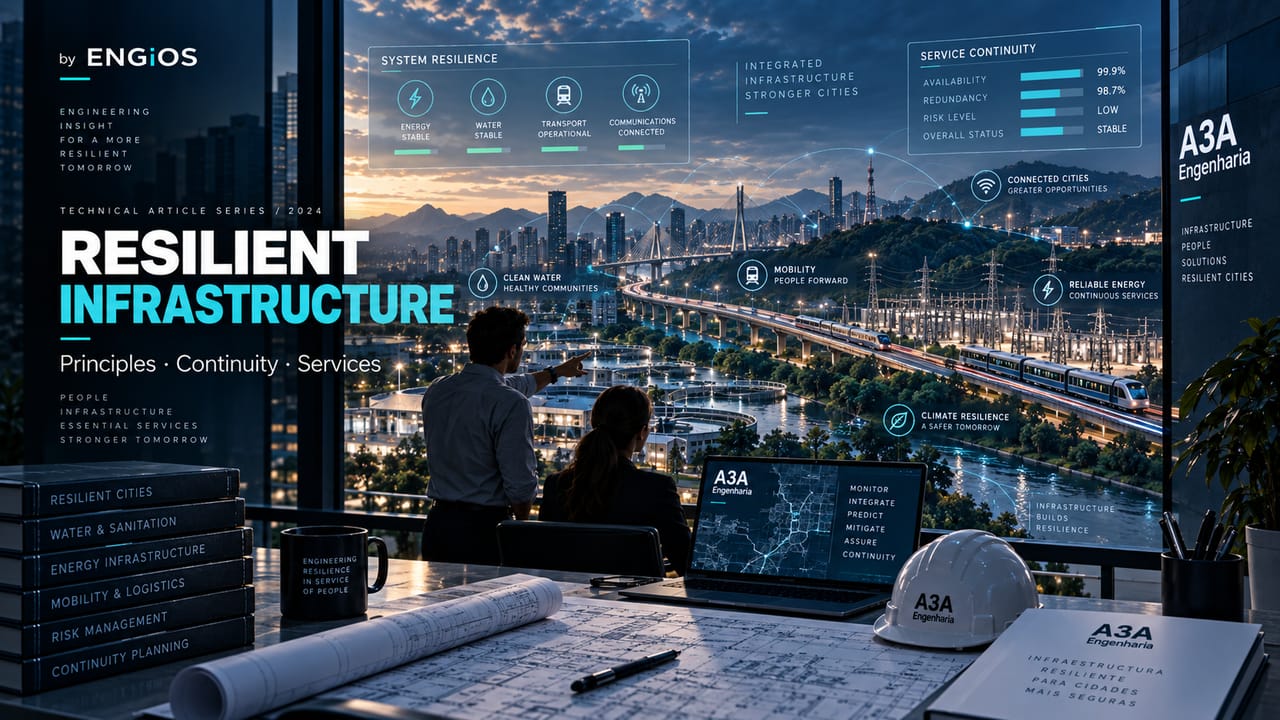
Understand resilient infrastructure principles: robustness, redundancy, diversity, autonomy, recovery, and adaptation across power, HVAC, telecom, and automation.
Check it out!
Resilient infrastructure is designed, operated, and adapted to maintain essential services, limit failure propagation, recover capacity within an acceptable time, and learn from conditions that exceed the original assumptions. Resilience does not mean making an asset indestructible or eliminating every risk. It means designing the capacity to absorb disturbances, continue operating safely — even in a degraded state — recover function, and adapt the system when necessary.
In engineering, this capability depends less on a single piece of equipment and more on the architecture. Power, telecommunications, HVAC, electrical protection, automation, water, access, monitoring, and operations need to function as a system. Duplicating components can increase availability, but not necessarily resilience if the redundancies share the same failure cause.
Resilient infrastructure should therefore be assessed by service continuity, not only by the physical integrity of assets. The objective is to identify what needs to remain operational, which threats can compromise that function, how failure propagates, and which measures reduce residual risk.
Infrastructure Resilience Starts With the Critical Service
The central question is not “is the equipment protected?”, but “does the service remain available?”. This shift in perspective is decisive in Data Centers, hospitals, water and wastewater facilities, industry, operations centers, telecommunications, public facilities, and other infrastructure where unavailability creates significant consequences.
The Climate Resilience and Infrastructure Hub organizes the relationship among hazards, exposure, vulnerability, and adaptation. In this article, the focus is the architecture that preserves function.
Robustness, Redundancy, Diversity, and Recoverability
Resilience combines different properties. Robustness is the ability to withstand conditions without losing function. Redundancy provides alternative resources. Diversity prevents those resources from sharing the same failure cause. Recoverability reduces the time required to restore operations. Adaptability makes it possible to change configuration, capacity, or strategy throughout the lifecycle.
| Property | Engineering question |
| Robustness | can the system withstand the expected condition? |
| Redundancy | is there an alternative when one element fails? |
| Diversity | does the alternative avoid the same failure cause? |
| Autonomy | how long can the function be maintained? |
| Recoverability | how much time and which resources are needed to restore it? |
| Adaptability | can the system be modified when risk changes? |
Infrastructure can have redundancy and still remain fragile. Two pieces of equipment installed in the same flood-prone room or supplied from the same vulnerable point can fail simultaneously. The analysis needs to look for common-cause failures rather than simply count units.
Operational Continuity and Degraded Operations
Resilience starts with the function that needs to continue. Reliability engineering helps translate criticality, availability, failure modes, and recovery into verifiable requirements.
Resilience does not require an entire facility to operate at nominal capacity during every event. In many systems, it is more effective to define a minimum service level and identify priority loads, functions, and processes.
This enables degraded-operation strategies. During loss of utility power, for example, noncritical loads can be shed to increase autonomy. During thermal constraints, equipment can operate at reduced capacity provided the essential function remains within safe criteria.
This logic connects to Reliability and Availability Engineering, because availability, criticality, and recovery need to be addressed in an integrated way.
Resilient Power: More Than Installing Generators
Energy resilience depends on the complete chain from source, distribution, protection, transfer, storage, loads, and control. Generators, UPS systems, BESS, solar arrays, and microgrids can all be part of the architecture, but they serve different functions.
A prolonged blackout shows the difference between instantaneous redundancy and autonomy. UPS systems can sustain loads during transition; generators can extend duration; BESS can support continuity, energy management, and islanded operation; photovoltaic generation can reduce energy dependence when integrated with appropriate storage and controls.
The article on Microgrids explores islanded operation and distributed energy resource integration in greater depth. Architecture decisions need to start from critical loads, required autonomy, source availability, and the recovery strategy.
Electrical Protection, Lightning Protection, Surge Protection, and Equipotential Bonding
Storms can cause failures even when a building suffers no structural damage. Lightning, surges, potential differences, and grid disturbances can affect switchboards, telecommunications, automation, CCTV, access control, IT, and supervisory systems.
Resilient infrastructure treats lightning protection, grounding, equipotential bonding, and surge protective devices as parts of a protection system. The objective is to control current paths and potential differences, protect interfaces, and reduce the probability of losing essential equipment.
The analysis should also consider power and telecommunications interfaces because an overvoltage can enter through different paths. Designs, inspections, surge protection coordination, and technical documentation form part of the evidence needed to verify protection.
HVAC and Capacity Margin
Extreme heat simultaneously increases thermal load and stresses equipment capacity. In critical facilities, HVAC is not merely about comfort: it can be a continuity requirement for electronics, batteries, Data Centers, control rooms, and technical environments.
The assessment should compare thermal load, available capacity, redundancy, heat rejection, outdoor design conditions, setpoints, automation, and contingency behavior. HVAC Design provides the path to translate thermal needs into a verifiable solution when existing margin is insufficient.
Telecommunications, Networks, and Physical Routes
A logically redundant network can remain vulnerable if links share the same physical route, rack, power supply, or building entrance. Telecommunications resilience requires genuine path diversity, emergency power, interface protection, failover capability, and documented architecture.
For operations centers, Data Centers, security systems, and automation, loss of communications can eliminate visibility and command precisely during the event when those functions are most necessary.
Automation, BMS, SCADA, and IoT
Smart systems increase the ability to detect loss of margin before failure. Temperature, humidity, level, energy, autonomy, pressure, alarms, and equipment states can be integrated into BMS, SCADA, or IoT platforms.
Monitoring, however, does not replace architecture. A sensor can warn that temperature is rising, but the facility needs the capability to respond. The value of automation lies in detecting, correlating, commanding, and recording evidence for operations and continuous improvement.
Physical Infrastructure, Flooding, and Equipment Location
When an existing facility lacks documentation, clearly mapped margins, or dependencies, diagnosis should precede solution selection.
Resilience also depends on seemingly simple layout decisions. Electrical equipment below critical elevations, cable routes in areas exposed to water ingress, technical rooms without adequate drainage, and generators located where floods make them inaccessible can turn external hazards into internal failures.
In existing facilities, Technical Due Diligence can consolidate exposure, condition, criticality, and gaps before retrofit is defined.
Resilience by Design: Building Resilience Before Construction
Designed resilience needs to appear in routes, margins, physical separation, requirements, and acceptance criteria — not only in a statement of intent.
New projects provide greater freedom to avoid vulnerabilities. Resilience requirements can guide room locations, diverse routes, physical separation, capacity margins, autonomy, measurement points, and test criteria.
Design Review can verify whether these requirements were effectively translated into the design, interfaces, and acceptance criteria before implementation.
Retrofitting Existing Infrastructure
Existing assets can rarely be rebuilt all at once. Adaptation normally occurs in stages: correcting single points of failure, restoring protections, elevating equipment, increasing capacity, diversifying routes, instrumenting systems, and preparing future expansions.
Retrofit and Upgrades should be prioritized according to risk and criticality, not only equipment age. An older component with low consequences may have lower priority than a newer interface that concentrates a critical failure.
How to Verify Whether Infrastructure Is Truly Resilient
Redundancy shown on drawings does not demonstrate field performance. Tests need to verify transfer, startup, autonomy, failover, alarms, degraded operation, and recovery.
Engineering Commissioning closes traceability among requirement, installation, testing, and acceptance. In critical systems, integrated scenarios are especially important because many failures only emerge through interactions among disciplines.
What to Include in a Resilience Assessment
An assessment should start with critical services and progress to assets, dependencies, and failure modes. The scope may include inventory, criticality, architecture analysis, hazards, redundancies, autonomy, interdependencies, risks, recommendations, CAPEX, and a roadmap.
The deliverable needs to show not only “what is missing,” but why it matters, which risk it reduces, which dependency exists, and how intervention effectiveness will be verified.
Redundancy and Shared Causes
Redundancy only improves resilience when alternatives do not depend on the same vulnerable elements. Two circuits may appear independent while still sharing a room, an upstream supply, or an environmental condition. The same applies to HVAC, telecommunications, and control.
The design needs to verify actual independence among alternative paths, considering physical separation, route diversity, distinct sources, and events capable of simultaneously affecting elements considered redundant.
Design Margins and Lifecycle
Resilient infrastructure needs to know its margins. Electrical capacity, thermal capacity, autonomy, route availability, and operating limits should be compared with actual demand and expected conditions throughout the service life.
These margins are not permanent. Expansions, aging, changes in occupancy, and new loads can consume reserves that were originally available. Resilience therefore needs to be reassessed during operations, maintenance, and investment planning.
Autonomy: How Long Does the Service Need to Survive?
Autonomy is a design variable and needs to be linked to the service rather than to a generic rule. A facility that can tolerate only a few minutes of interruption requires a different strategy from one capable of operating in a degraded state for hours. Power, water, telecommunications, fuel, and thermal capacity can establish different autonomy limits.
For power, autonomy depends on critical load, storage capacity, fuel, source availability, and recharge strategy. In telecommunications, it depends on equipment power, link availability, and carrier infrastructure. In HVAC, it may depend on the thermal inertia of the environment and the time until equipment reaches operating limits.
The resilience design should define required autonomy by scenario and identify the link that first limits continuity. There is no benefit in increasing fuel for dozens of hours if HVAC loses capacity within minutes or if external telecommunications disappear during the same event.
Recovery: Resilience Continues After Failure
Infrastructure can absorb a disturbance and still have low resilience if recovery is slow, uncertain, or dependent on unavailable resources. Recoverability involves restoration sequence, access to teams, spare parts, fuel, communications, documentation, and authority to make decisions during the contingency.
Designs and procedures should identify restoration priorities. Control systems, telecommunications, and utilities may need to be restored before the final load. In electrical installations, restoration also needs to consider selectivity, startup conditions, demand peaks, and verification of the causes that triggered the interruption.
Recovery tests are as important as transfer tests. They demonstrate whether the system can return to a stable condition, whether alarms and records are available, and whether the team can recognize when the contingency has actually ended.
Interdependencies Among Power, HVAC, Telecommunications, and Automation
The main systems in critical infrastructure rarely fail in isolation. Power sustains HVAC and telecommunications; telecommunications enable supervision; automation commands transfers and alarms; HVAC keeps electronics and batteries within operating conditions. Loss of one discipline can reduce the effectiveness of the others.
Resilience engineering therefore needs to examine interfaces. A generator may be available but depend on automation or ventilation that has lost power. A BMS may detect rising temperature yet have no path to command an action. A security system may have local UPS and lose connectivity to the operations center. These are architectural failures, not merely equipment failures.
Dependency diagrams, interface matrices, and integrated test scenarios help reveal these relationships. The purpose is to identify combinations capable of taking down the service even when each subsystem, analyzed separately, appears adequate.
How to Procure a Resilience Design or Retrofit
A contracting scope should start from critical functions and record performance criteria. It is advisable to define included systems, boundary conditions, autonomy, redundancy, interfaces, design deliverables, required studies, inspection criteria, and acceptance tests.
Boundaries between disciplines and responsibilities should also be clear. Power, HVAC, telecommunications, automation, electrical protection, and physical infrastructure need coordinated interfaces; otherwise, contracting can produce solutions that are locally correct but globally incompatible.
For existing facilities, the scope should include assessment of actual conditions and implementation constraints. For new projects, resilience requirements should enter the design basis early. In both cases, measurement and acceptance need to be tied to expected performance rather than only to document delivery.
Integrated Testing: How to Prove Resilience Before the Real Event
Testing each piece of equipment independently does not demonstrate that the infrastructure will continue operating when several systems need to respond together. Resilience verification should include integrated scenarios consistent with identified failure modes: loss of main power, unavailability of an HVAC unit, link failure, automation unavailability, reduced autonomy, or a combination of more than one condition.
A utility-power-loss scenario, for example, can follow the entire chain: outage detection, protection operation, UPS support, generator startup, load transfer, HVAC behavior, continuity of networks and security systems, alarms in the BMS or SCADA, and the ability to return to normal conditions. The test reveals interfaces that do not appear in individual tests.
Acceptance criteria need to exist before execution. Transfer times, loads that must remain available, maximum allowable temperature, minimum duration, expected alarms, failover behavior, and recovery sequence need to be defined as measurable requirements. Without prior criteria, a test may end merely with the conclusion that “the system worked,” without demonstrating the expected service level.
It is equally important to record test conditions. Actual load, battery state, fuel level, unavailable equipment, setpoints, and limitations should form part of the evidence. This makes it possible to interpret the result and repeat the scenario in the future after capacity changes, retrofit, or expansion.
When integrated tests identify deviations, the response may involve logic adjustment, protection review, load redistribution, setpoint changes, documentation correction, or physical intervention. The cycle only closes after correction, retesting, and recording of final behavior. This discipline transforms resilience from a concept into verifiable performance.
Sector Applications: Architecture Changes With the Asset Mission
Resilience principles are common, but their application depends on the asset’s mission. In Data Centers, power continuity, thermal capacity, telecommunications, detection, automation, and autonomy form an inseparable chain. Electrical redundancy loses value if cooling cannot sustain the load during a contingency or if external links share the same vulnerable point.
In hospitals, the architecture needs to distinguish essential loads, critical areas, support systems, and maximum interruption times. Power transfer, power quality, cooling of technical areas, communications, security, and control-system availability should be assessed against the ability to maintain care and recover safely.
In water and wastewater infrastructure, pumping stations, treatment plants, wastewater treatment plants, and control centers depend on distributed power, automation, and telecommunications. Resilience may require local autonomy, communication redundancy, level monitoring, switchboard protection, manual contingency operation, and recovery capability after flooding or prolonged power loss.
In industry, the objective may be to maintain production, enable controlled shutdown, or preserve safety systems while the main process is interrupted. This changes load classification, response times, energy-storage requirements, and the recovery strategy. The design needs to reflect the acceptable operating mode during a contingency.
Operations centers and telecommunications infrastructure have another characteristic: visibility and command are part of the response itself. Losing supervision, recording, communications, or system integration during an emergency reduces the ability to coordinate recovery. In these assets, network, power, and technical-environment resilience directly support crisis management.
Resilience Governance During Operations and Expansion
Infrastructure does not remain resilient simply because it was designed correctly. Expansions consume margins, equipment ages, layout changes alter routes, and new systems create dependencies. Governance needs to ensure that changes are also assessed for their effect on criticality, redundancy, autonomy, and recovery.
A new rack can increase thermal and electrical loads; renovation can bring previously diverse routes closer together; connecting an automation system can introduce network dependency; an expansion of photovoltaic generation or storage can alter power flows and protection requirements. Changes that appear local can modify infrastructure behavior during contingencies.
Documentation and configuration management therefore play a direct role in resilience. Diagrams, load lists, control logic, inventories, As-Built documentation, and operating criteria need to remain current. Without this basis, teams may believe they have redundancy or autonomy that no longer exists after successive interventions.
Indicators also help detect loss of margin: capacity utilization, temperature, available autonomy, transfer failures, link unavailability, recurring alarms, battery condition, and maintenance backlog can serve as leading signals. The objective is to intervene before an external event exposes the weakness.
When an organization has multiple assets, corporate resilience criteria allow maturity to be compared and investments prioritized. These criteria can define minimum levels of documentation, protection, redundancy, autonomy, monitoring, testing, and periodic review while leaving room for site-specific requirements.
Final Considerations
Resilient infrastructure is not infrastructure filled with redundant equipment. It is an architecture capable of preserving critical functions, limiting common-cause failures, operating in a degraded state when necessary, recovering capacity, and adapting throughout the lifecycle.
Engineering turns this objective into concrete requirements: electrical protection, energy capacity, HVAC, telecommunications, automation, layout, redundancy, diversity, monitoring, retrofit, and testing. The final criterion remains the service: the solution is appropriate when it reduces risk and improves the ability to maintain or recover the required function.
The architecture is only proven when testing demonstrates transfer, autonomy, failover, and recovery under the expected conditions.
Technical References
[1] UNITED NATIONS OFFICE FOR DISASTER RISK REDUCTION. Principles for Resilient Infrastructure. Geneva: UNDRR, 2022. Available at: https://www.undrr.org/publication/principles-resilient-infrastructure
[2] UNITED NATIONS OFFICE FOR DISASTER RISK REDUCTION. Handbook for implementing the principles for resilient infrastructure. Geneva: UNDRR, 2023. Available at: https://www.undrr.org/publication/handbook-implementing-principles-resilient-infrastructure
[3] INTERNATIONAL ORGANIZATION FOR STANDARDIZATION. ISO 14090:2019 — Adaptation to climate change — Principles, requirements and guidelines. Geneva: ISO, 2019. Available at: https://www.iso.org/standard/68507.html
[4] IPCC. Climate Change 2022: Impacts, Adaptation and Vulnerability. Geneva: IPCC, 2022. Available at: https://www.ipcc.ch/report/ar6/wg2/
Frequently Asked Questions
Infrastructure capable of preserving critical services, absorbing disturbances, operating safely, recovering function, and adapting throughout the lifecycle.
No. Redundancy needs to be combined with diversity, autonomy, recovery, and control of common-cause failures.
They can be important components of energy resilience, but they need to be sized and integrated based on critical loads, required autonomy, and operating strategy.
Yes. In systems exposed to storms and surges, lightning protection, grounding, equipotential bonding, and surge protective devices form an important layer for equipment protection and continuity.
Through inspections, commissioning, and scenario testing that demonstrate transfer, autonomy, failover, alarms, degraded operation, and recovery.
Complementary Technical Materials
Related Services
- Reliability and Availability Engineering
- Engineering Technical Due Diligence
- HVAC Design
- Retrofit and Upgrades
- Engineering Commissioning
