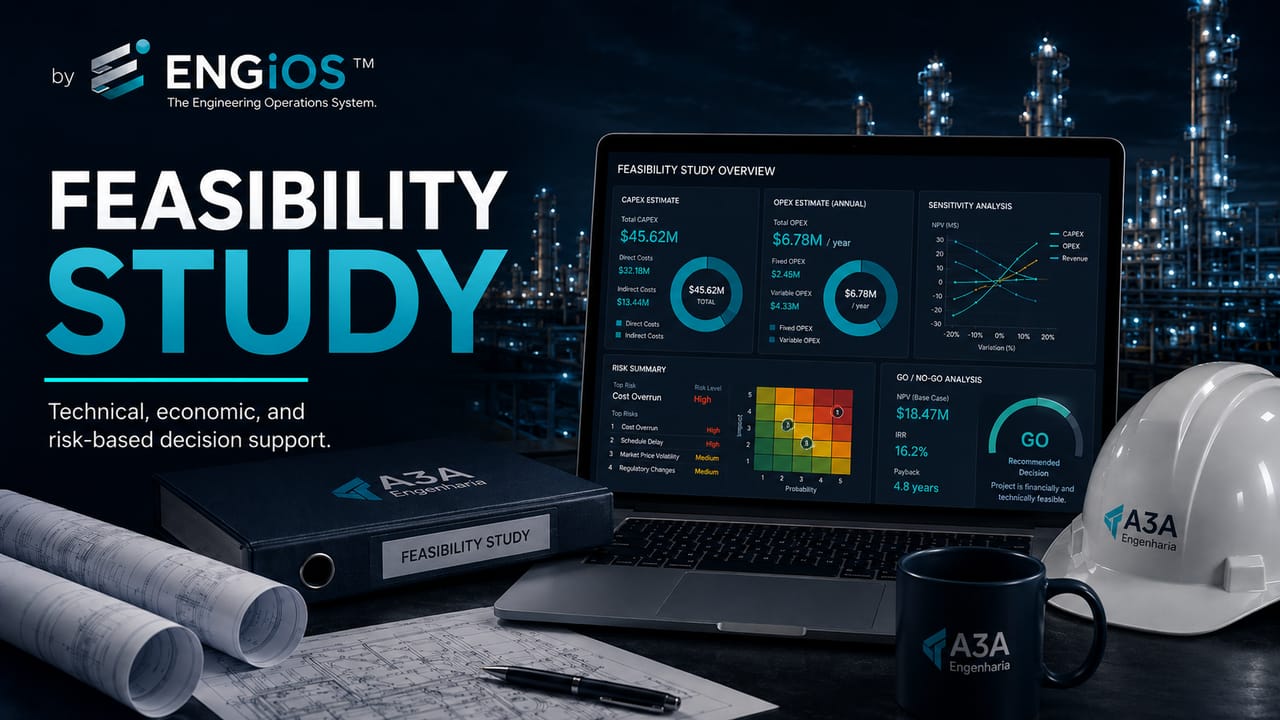
Understand how an engineering feasibility study works: alternatives, requirements, CAPEX, OPEX, risks, NPV, IRR, scenarios, sensitivity, and investment decisions.
Check it out!
An engineering feasibility study is the structured analysis used to determine whether a project, modernization, expansion, or technical solution should advance, be reformulated, postponed, or discarded. It compares alternatives against technical, economic, operational, regulatory, schedule, and risk criteria before the organization commits significant resources to detailed design, contracting, or implementation.
A feasibility study is not merely a financial spreadsheet. The economic result is only reliable when it derives from coherent technical assumptions: capacity, location, technology, interfaces, availability, service life, implementation requirements, CAPEX, OPEX, schedule, and risks. The role of Engineering Consulting is to transform an open-ended need into comparable alternatives and a technically defensible recommendation for an investment decision.
What Is an Engineering Feasibility Study?
A feasibility study reduces uncertainty before a relevant decision. In essence, it answers three questions: is the solution technically possible, does it make business sense, and are the risks acceptable compared with the available alternatives?
The answer is rarely binary. A project may be technically possible but economically weak; economically attractive but operationally infeasible; feasible only at a certain scale; or dependent on conditions that must be resolved before the next gate.
Therefore, the final product should make assumptions, uncertainties, alternatives, and conditions for advancement explicit. A “feasible” conclusion without criteria or traceability creates a false sense of certainty.
When Should a Feasibility Study Be Performed?
The study makes sense before commitments that are difficult to reverse. Examples include implementing a new plant or facility, expanding capacity, infrastructure retrofit, technology replacement, Data Center construction, electrical modernization, automation, critical systems, or relevant process changes.
It is also useful when competing alternatives exist. If the decision has already been made and the work is limited to detailing a defined solution, conceptual, basic, or detailed engineering may be the appropriate stage; calling everything “feasibility” only adds terminology without improving the decision.
Technical and Economic Feasibility Are Parts of the Same Problem
Completely separating Engineering from economics usually produces fragile conclusions. The investment estimate depends on the technical solution; the technical solution depends on requirements, capacity, and constraints; and the economic benefit depends on expected performance and operations.
A technology change, for example, may reduce CAPEX and increase OPEX. A redundant solution may increase investment while reducing availability risk. Phased implementation may alter the schedule, initial capacity, and cash flow. The study needs to capture these interdependencies.
Start With the Need, Not the Preferred Solution
One of the most common mistakes is to begin the study already committed to a technology or supplier. In that case, the work tends to justify a choice instead of testing alternatives.
Engineering should formulate the problem: what capacity is required, what performance, which constraints, what horizon, which interfaces, and which risks need to be reduced. From there, alternatives can be developed and compared.
Needs Program and Requirements
The needs program organizes the owner’s demands. Requirements translate those demands into verifiable criteria for performance, capacity, availability, safety, operation, and integration.
Without this foundation, alternatives are compared on different characteristics and the decision becomes vulnerable to subjective preference.
Defining the Alternatives
When the decision is still open, the study should compare alternatives and make conditions explicit — not merely produce a justification for the preferred solution.
A useful study should consider genuinely distinct alternatives. These may include technologies, capacities, locations, redundancy levels, greenfield or brownfield implementation, investment phases, and even the alternative of not executing the project at that time.
The “do nothing” alternative, or base case, is important because it provides the reference against which incremental benefits and costs are measured.
Technical Comparison Criteria
The criteria depend on the asset or system, but normally include:
- meeting capacity requirements;
- performance and availability;
- technology maturity;
- compatibility with existing infrastructure;
- ease of expansion;
- operation and maintenance requirements;
- availability of support and spare parts;
- integration risks;
- energy and utility consumption;
- space and implementation requirements;
- environmental and regulatory constraints;
- schedule and constructability.
The comparison should distinguish mandatory criteria from graduated criteria. If an alternative cannot meet a mandatory requirement, it makes little sense to offset that failure solely with a lower price.
Existing-Condition Survey
In brownfield projects, feasibility depends on what actually exists. Outdated documentation can distort capacity, interfaces, and adaptation costs.
Site Survey, as-built survey, inspections, and document analysis help transform assumptions into evidence. The greater the dependence on existing systems, the more important the quality of this survey becomes.
Capacity and Demand
The solution needs to be sized for a reference demand. This requires understanding the current situation, growth, seasonality, peaks, contingencies, and the planning horizon.
Oversizing increases CAPEX and may reduce efficiency. Undersizing creates bottlenecks and brings future investments forward. In many cases, modular alternatives or phased implementation provide a better balance.
CAPEX
CAPEX represents the investments required to place the alternative into operating condition. The study should define the estimate basis and the maturity level of the information.
Equipment, materials, construction, installation, engineering, management, commissioning, mobilization, permits, contingencies, auxiliary infrastructure, and integration costs may be included.
An estimate without recorded assumptions does not allow consistent updating or comparison.
OPEX
OPEX considers operating costs over the analyzed horizon. Energy, maintenance, licenses, labor, consumables, support contracts, and replacement may significantly alter the decision.
A solution with a lower initial investment may have a higher total cost when analyzed over its lifecycle.
Lifecycle Cost
Life Cycle Cost broadens the view beyond CAPEX. The horizon should be compatible with the economic and technical life of the assets, considering relevant replacements and residual value when applicable.
The analysis should also make inflation, rates, price assumptions, and the time basis explicit, avoiding the mixing of nominal and real values without consistent treatment.
Benefits and Incremental Cash Flow
Benefits may come from increased production, reduced losses, energy savings, lower maintenance, reduced downtime, elimination of rent, risk reduction, or other measurable effects.
Cash flow should be incremental: it should compare what changes if the project is executed against the base case.
NPV, IRR, Payback, and Profitability Index
Financial indicators help interpret the project, but each answers a different question.
Net Present Value measures value creation considering the discount rate. Internal Rate of Return expresses the rate that makes NPV equal to zero under certain assumptions. Payback indicates the time required to recover the investment, but by itself does not capture value after the recovery period. The Profitability Index can support prioritization when capital is constrained.
No indicator should replace technical and risk analysis.
Discount Rate and Cost of Capital
The discount rate strongly affects long-duration projects. It should reflect the financial methodology adopted by the organization rather than be chosen to produce a desired result.
When the study is technical-consulting work, Engineering can structure scenarios and provide cash flows, while corporate WACC and hurdle-rate criteria should be aligned with finance or investment governance.
Sensitivity Analysis
Feasibility should not depend on a single forecast. Sensitivity analysis shows how the conclusion changes when important assumptions vary.
Typical variables include CAPEX, energy price, demand, production, schedule, availability, OPEX, and discount rate.
Scenarios
Scenarios combine coherent assumptions. A conservative scenario may combine lower demand, higher CAPEX, and delay; a favorable scenario may use more positive assumptions, provided they are technically justifiable.
The objective is not to predict the future, but to understand under which conditions the decision remains rational.
Switching Values
A switching value is the point at which an assumption changes the decision. Knowing that a project ceases to be attractive if CAPEX rises by a certain proportion or if demand falls below a given threshold is more useful than presenting only an expected value.
This directs due diligence and negotiations toward the variables that actually matter.
Technical Risks
Technical risks may involve immature technology, unknown interfaces, network capacity, the condition of existing assets, supplier dependencies, downtime during migration, and requirements that are not yet closed.
The study should record probability, impact, mitigation, owner, and the potential effect on the alternatives.
Schedule Risks
Schedule can be a feasibility factor. Permitting, long-lead equipment, shutdown windows, site access, and specialized resources may make an otherwise sound technical alternative incompatible with the required date.
A feasibility schedule does not need the detail of an execution schedule, but it should capture the conceptual critical path and key constraints.
Regulatory and Compliance Risks
Legal, environmental, standards-based, and utility requirements may make a solution infeasible or impose conditions on it. The analysis should identify which permits and studies are required and which assumptions still depend on confirmation.
Feasibility does not mean obtaining every permit in advance, but it cannot ignore conditions capable of changing cost or schedule.
Operational Risks
A solution needs to fit the organization’s operating capability. Excessive complexity, lack of staff, training requirements, dependence on external support, and maintenance difficulty affect value throughout the asset lifecycle.
The assessment should include the availability of competencies and the support strategy.
Multi-Criteria Matrix
Not every decision can be reduced to money. MCDA and other approaches allow technical, economic, and strategic criteria to be weighted transparently.
False precision should be avoided. Weights and scores need to be justified and sensitivity-tested. The matrix should make the decision more auditable, not conceal prior preferences.
Value Engineering in Feasibility
Value Engineering can review functions and seek alternatives with a better relationship between performance and cost. It is particularly useful before definitions become expensive to change.
Reducing cost by eliminating an essential requirement is not Value Engineering; it is scope reduction.
Conceptual Engineering as Support
The selected alternative needs to mature technically before contracting. Conceptual Engineering and Front-End Planning reduce the uncertainties identified by the feasibility study.
Many feasibility studies require enough conceptual engineering to size alternatives, identify interfaces, and estimate costs. The level of design should be proportional to the decision.
Excessively detailed engineering before the gate consumes resources on alternatives that may be discarded. Insufficient engineering produces estimates without an adequate basis.
FEL and Front-End Planning
In capital projects, the feasibility study relates directly to Front-End Loading. As the project matures, requirements, alternatives, scope, risks, and estimates gain definition before execution is authorized.
The logic is simple: decisions made early cost less to change and strongly influence subsequent performance.
PDRI and Maturity
Maturity tools such as PDRI can help assess whether the scope is sufficiently defined to advance. They do not determine financial feasibility, but they reveal gaps that increase uncertainty and risk.
Feasibility Study vs. ETP
The Preliminary Technical Study (ETP) has its own context, especially in Brazilian public procurement. It analyzes the need and alternatives to support solution definition and contracting.
A corporate or engineering feasibility study may have a broader or different scope. The documents can support one another, but they should not be treated as automatically equivalent.
Feasibility Study vs. Business Case
A Business Case connects the proposal to organizational value and the investment decision. The feasibility study provides an important part of the technical and economic evidence supporting that case.
In mature governance, the two may be integrated into the approval gate.
Data Sources and Assumption Quality
Every relevant assumption should have a source. Data may come from measurements, operating history, quotations, benchmarks, existing designs, contracts, standards, and market studies.
The quality of the source should be recorded. An assumption based on an actual survey should not receive the same confidence level as a preliminary inferred value.
Estimate Classes and Uncertainty
The lower the project definition, the greater the estimate uncertainty tends to be. It is inappropriate to present a conceptual estimate with the appearance of detailed-design precision.
The report should record the basis, exclusions, contingency, base date, and an uncertainty range compatible with the stage.
Contingency
Contingency is not an arbitrary percentage added to “protect” the budget. It should reflect remaining uncertainties and risks according to the adopted methodology.
Separating contingency from known scope helps preserve transparency.
How to Structure the Study
A robust structure normally includes:
- context and objective;
- needs and requirements;
- assumptions and constraints;
- existing condition;
- alternatives;
- technical analysis;
- CAPEX and OPEX;
- conceptual schedule;
- risks;
- economic analysis;
- sensitivity and scenarios;
- multi-criteria comparison;
- recommendation;
- conditions for the next gate.
Decision Process
The recommendation should result from the comparison rather than appear only at the end as an opinion.
Go, Hold, and No-Go Criteria
Governance may define outcomes such as go, hold, rework, or no-go. This avoids forcing every project into a binary decision when relevant conditions remain unresolved.
Hold may be the correct response when a critical permit, demand confirmation, or field investigation is still missing.
Independence of the Analysis
When the supplier of one alternative also prepares the feasibility study, there is a risk of bias. This does not invalidate the manufacturer’s technical data, but it does call for independent governance in defining criteria and comparing alternatives.
Engineering Consulting operates precisely in this separation between the owner’s need and the commercial solution.
Expert Review
Multidisciplinary projects may require specialists in electrical, automation, telecommunications, civil, mechanical, process, security, cost, and operations. Coordination needs to integrate the conclusions into a single recommendation.
Evidence and Traceability
Spreadsheets, calculation records, quotations, drawings, meeting minutes, and assumptions should be traceable. If the decision is revisited months later, the organization needs to understand why an alternative was selected.
Updating the Study
Feasibility remains valid only while its assumptions remain valid. Relevant changes in prices, demand, scope, legislation, technology, or schedule may require an update.
This does not mean repeating everything. The organization should identify which parts were affected and whether the conclusion remains robust.
Common Mistakes
Recurring mistakes include:
- defining the solution before defining the need;
- comparing alternatives with different scopes;
- using CAPEX without a technical basis;
- ignoring OPEX and lifecycle cost;
- treating risk only qualitatively and without considering its effect on the decision;
- presenting a single forecast as certainty;
- omitting the base case;
- using financial indicators in isolation;
- failing to record sources and assumptions;
- advancing to detailed engineering without closing critical conditions.
The Role of Engineering Consulting
Engineering Consulting structures the decision, organizes requirements, coordinates specialists, develops alternatives, validates assumptions, integrates risks, and produces an independent recommendation.
It does not replace the decision-maker. Its role is to improve the quality of information and make consequences explicit so governance can decide consciously.
When to Advance to Conceptual, Basic, or FEED Engineering
After the alternative is selected, the next stage depends on the type and maturity of the project. It may be necessary to deepen conceptual engineering, FEL, FEED, basic engineering, or another definition phase.
The study should end by making clear which deliverables are required to reduce the next layer of uncertainty.
Checklist for a Defensible Study
Before approval, verify:
- was the need defined without tying it to a supplier?
- is there a base case?
- are the alternatives truly comparable?
- are mandatory requirements clear?
- do CAPEX and OPEX have documented assumptions?
- were risks and constraints incorporated?
- does sensitivity analysis test critical variables?
- do economic indicators use a coherent methodology?
- does the recommendation explain trade-offs?
- are conditions for advancement recorded?
- are documents and sources traceable?
Final Considerations
A feasibility study is an engineering decision-making tool. Its value lies in preventing an organization from advancing with a poorly defined solution, an economically weak project, or an alternative that is incompatible with technical and operational constraints.
A mature study integrates need, requirements, alternatives, existing condition, CAPEX, OPEX, schedule, risks, economics, and scenarios. The best conclusion is not necessarily to approve the project; it is to produce enough evidence to consciously choose whether to advance, reformulate, investigate further, or stop the investment.
A complex investment decision improves when requirements, risks, costs, and trade-offs are organized by engineering that is independent from the solution supplier.
Technical References
[1] 1. INTERNATIONAL ORGANIZATION FOR STANDARDIZATION. ISO 31000 — Risk management. Available at: https://www.iso.org/iso-31000-risk-management.html
[2] 2. PROJECT MANAGEMENT INSTITUTE. Standards and PMBOK Guide. Available at: https://www.pmi.org/pmbok-guide-standards
[3] 3. WORLD BANK. Public-Private Partnership Resource Center — Project Assessment and Feasibility. Available at: https://ppp.worldbank.org/
[4] 4. AACE INTERNATIONAL. Recommended Practices and technical resources for cost engineering. Available at: https://web.aacei.org/resources/publications/recommended-practices
Frequently Asked Questions
It is the structured analysis of technical, economic, operational, schedule, and risk alternatives used to decide whether an investment should advance, be reformulated, or be discarded.
Technical feasibility verifies compliance with requirements and constraints; economic feasibility evaluates costs, benefits, and return. In a robust study, the two are integrated because each determines assumptions for the other.
No. The Preliminary Technical Study (ETP) has a specific role in preparing procurements, especially in the Brazilian public sector. A feasibility study may have a broader scope and a different structure, although the analyses may overlap.
NPV, IRR, payback, profitability index, and others, depending on the organization’s governance. None should be interpreted without technical assumptions, risks, and sensitivity analysis.
When relevant changes in scope, demand, prices, technology, schedule, regulation, or existing conditions alter critical assumptions underlying the decision.
Complementary Technical Materials
Related Solutions
Related Services
- Technical and Economic Feasibility Study: Alternatives, Risks, and Decision
- Conceptual Engineering: Alternatives, Architecture, and Solution Definition
- FEL (Front-End Loading): Project Maturation, Feasibility, and Definition
Core Content on the Topic
Related Technical Content
- Multi-Criteria Decision Analysis (MCDA) in Engineering Projects: How to Compare Technical Alternatives
- Sensitivity and Scenario Analysis in Engineering Projects: Assumptions, Switching Values, and Decision
- PDRI — Project Definition Rating Index in Engineering: How to Measure Scope Maturity Before Advancing
- Project Readiness in Engineering: How to Assess Whether a Project Is Ready to Advance