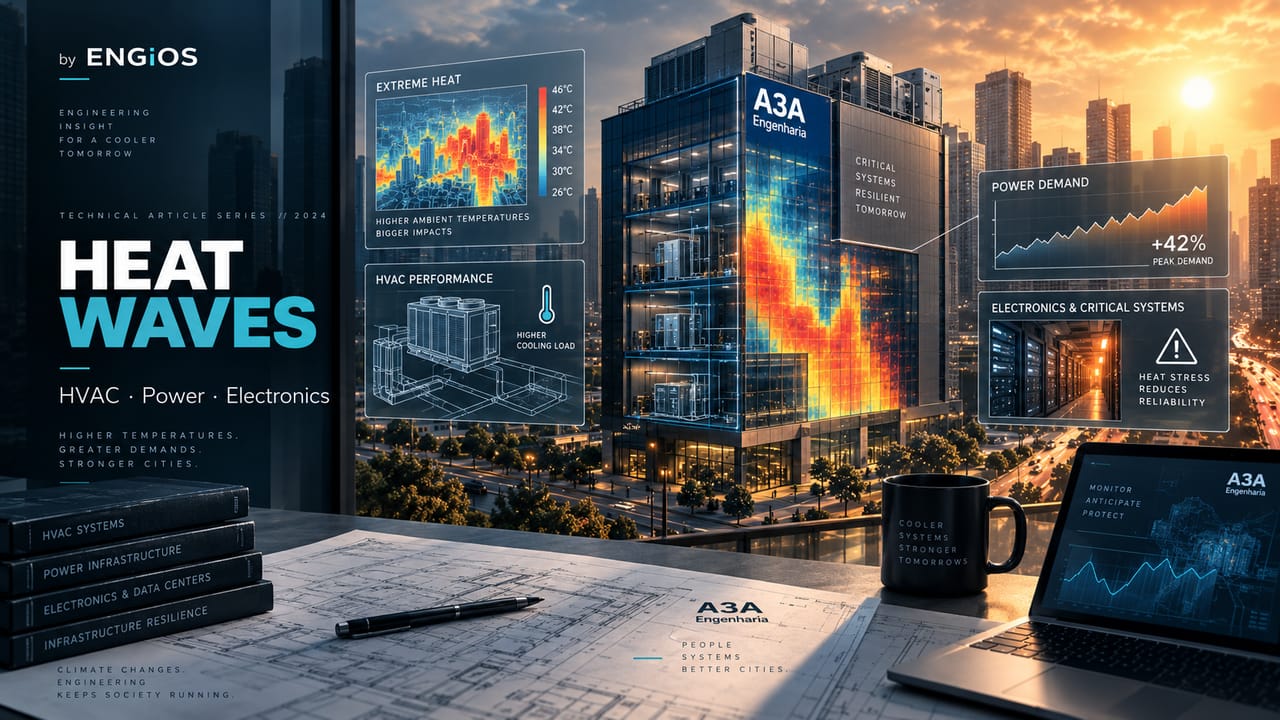
Heat waves can compromise critical infrastructure even when no individual device immediately exceeds an absolute temperature limit. The engineering issue is the simultaneous loss of thermal, electrical and operational margin across HVAC, power, batteries and critical systems.
Check it out!
Heat waves can compromise critical infrastructure even when no individual device immediately exceeds an absolute temperature limit. The engineering issue is the simultaneous loss of thermal, electrical and operational margin: cooling systems operate closer to maximum capacity, electrical equipment undergoes derating, batteries age faster, cooling loads increase, and simple failures become more likely to cause downtime.
In critical facilities, the assessment should answer four questions: what external thermal condition the asset must withstand; which systems lose capacity as temperature rises; how much margin exists between actual load and available capacity; and what happens when extreme heat coincides with a power loss, equipment failure or maintenance. The solution is rarely just to install more air conditioning: it involves integrated HVAC, electrical supply, UPS, generators, BESS, automation, sensing, redundancy, layout, operations and commissioning.
Why heat waves become an engineering problem
Extreme heat affects infrastructure through two paths at the same time. The first is direct: it changes the operating conditions of equipment, materials and systems. The second is indirect: it increases demand on the systems that keep the facility within acceptable conditions, especially cooling and power.
The IPCC, when addressing cities, settlements and critical infrastructure, notes that heat waves and higher temperatures increase risks of infrastructure degradation and failure and can produce cascading impacts. For engineering, this means outdoor temperature should not be treated as merely meteorological data: it is a design boundary condition.
A facility may operate normally for most of the year and still have significant vulnerability if its capacity was sized too close to historical design conditions, without sufficient margin for extremes, load growth, degradation or partial unavailability.
The margin problem
The more useful question is not “what is the maximum temperature supported by the equipment?”, but “what system capacity is available under the extreme condition and what is the simultaneous load at that time?”.
In HVAC, for example, outdoor temperature and humidity influence heat-rejection capacity and the performance of condensers, chillers, cooling towers, evaporative systems and direct-expansion units. In electrical installations, high ambient temperature changes current-carrying capacity, panel ventilation, transformer behavior, power electronics and component life.
Thus, a system that has spare capacity under moderate conditions may have much less margin during a heat wave. If a unit is simultaneously unavailable, heat exchangers are dirty, batteries are degraded or IT load increases, the margin can disappear.
Climate design conditions need review
HVAC engineering uses climatic design data to size systems. ASHRAE maintains climatic design information including dry-bulb temperature, wet-bulb temperature, dew point, wind and extreme conditions used to size cooling systems and other energy processes. The 2025 edition expanded and updated the global dataset.
This is important because historical averages alone are not sufficient for critical systems. Applications that cannot tolerate occasional loss of capacity may require analysis of extreme conditions, recurrence intervals, additional design margin and degraded-operation strategies.
Design temperature is not operating temperature
The external climate condition is only one input. The design must convert it into actual thermal load by considering solar gains and the building envelope, internal loads from equipment and people, ventilation and infiltration, heat generated by UPS, batteries, panels and IT equipment, simultaneity, unavailability, degradation and future expansion.
In technical rooms and data centers, a significant share of thermal load is generated continuously by equipment and does not depend on outdoor temperature. External heat, however, reduces the system’s ability to remove that energy and increases the work required to keep the environment within its operating range.
HVAC: the first system pressured by extreme heat
HVAC is usually the first infrastructure layer to feel a heat wave. This does not mean the solution should be treated in isolation. Increased cooling load directly affects electrical supply, generators, UPS, BESS and the autonomy available during contingencies.
When extreme heat reduces thermal margin, the response must start from load, capacity, contingency and redundancy calculations — not from isolated equipment replacement.
A thermal-resilience study should compare load and capacity in different operating states:
| State | Condition to verify | Engineering question |
| Normal | all equipment available | is there sufficient margin under the critical outdoor condition? |
| N-1 | one main unit unavailable | does the critical service remain within limits? |
| Maintenance | equipment intentionally taken out of service | can the facility withstand extreme heat during the intervention? |
| Power failure | operation on emergency generation | is all required cooling supported by backup power? |
| Recovery | return after a failure | how long does the environment take to return to normal? |
The HVAC Design service is appropriate when the diagnosis shows a need to recalculate loads, review architecture, change equipment, add redundancy or adapt air distribution and controls.
Thermal redundancy must be functional
Having two pieces of equipment does not necessarily mean having real redundancy. Two chillers may share the same electrical supply, pump, cooling tower, controller or hydraulic path. Two precision units may depend on the same panel or the same reference sensor.
The assessment must identify common-cause failure points. In critical infrastructure, it is common to discover that redundancy exists in the simplified diagram but not across the full chain of dependencies.
Data centers and IT rooms: external heat meets continuous internal load
Data centers clearly show how extreme heat exposes system interdependencies. Servers, storage, network equipment, UPS and power electronics convert electrical energy into heat, and the cooling infrastructure must continuously remove that load from the environment.
ASHRAE guidance for data centers and telecommunications facilities distinguishes recommended and allowable operating ranges and emphasizes maintaining appropriate conditions at equipment inlets. Temporary operation within an allowable range during a contingency is not equivalent to continuously designing at the edge of that range.
During heat waves, the assessment should consider actual HVAC capacity, heat rejection, equipment inlet temperature, air recirculation, high-density loads, redundant units, additional electrical demand and the thermal time available after loss of cooling.
The content on data center site selection should also be read from this perspective: climate exposure and external conditions influence siting, infrastructure and redundancy decisions.
Average room temperature can hide the problem
Poorly positioned sensors may show an apparently normal room while some equipment zones or electrical panels operate under critical conditions. In mission-critical environments, monitoring must reflect the condition that actually matters to the equipment.
Therefore, BMS, distributed sensors and telemetry should be treated as engineering instruments. The article on Building Automation and BMS explores this layer in more depth.
Temperature also reduces electrical infrastructure margin
Cooling is not the only affected system. High ambient temperature may require correction factors for cables, devices, panels and equipment, and can also change the thermal capability of transformers and power electronics.
The practical consequence is that the same installation may behave differently depending on ambient temperature. An electrical distribution system that operates comfortably under moderate conditions may approach thermal limits during prolonged heat, especially when HVAC demand rises at the same time.
Increased HVAC load and electrical derating must be assessed together. Capacity, protection, UPS, generators and expansion should be verified under the same extreme condition.
The assessment should consider transformer loading, cable and busbar capacity, panel ventilation and heat dissipation, connection losses, inverters and converters, UPS, generators, and coordination between electrical and thermal load growth.
When the vulnerability lies in the power infrastructure, the appropriate approach is to review capacity, selectivity, contingency and expansion through Electrical Engineering Services, rather than simply replacing individual components.
UPS and batteries: autonomy is not constant
Batteries are particularly sensitive to the thermal environment. Temperature influences performance, degradation and service life, and the battery system itself also requires cooling compatible with its technology and architecture.
This creates a circular dependency: the battery supports critical loads during a power failure, but may depend on the thermal system itself to remain within its intended operating conditions.
In a heat-wave assessment, the autonomy stated in the design should be challenged when batteries operate in a hotter-than-expected environment, age has reduced capacity, actual load has increased, HVAC is not on backup power, or recovery takes place under unfavorable thermal conditions. Autonomy needs to be verifiable performance, not a nominal number.
BESS can increase resilience, but it also creates thermal requirements
BESS can contribute to continuity, peak shaving, load shifting, microgrid support and energy management. However, they also introduce their own thermal-control, safety, electrical-integration and operating-strategy requirements.
The complete BESS guide shows that power, energy, duration, battery technology, PCS, BMS, EMS, HVAC and protection must be coordinated.
For climate resilience, the question is not “do we have a battery?”, but “what function will the BESS perform during the extreme condition?”. It may reduce the peak caused by HVAC, keep essential loads supplied during transfer to generation, support a microgrid or enable internal management of locally produced energy.
The content on Behind-the-Meter BESS is relevant when the goal is to increase autonomy and control energy within the facility.
Generators also suffer under severe environmental conditions
Generators are often treated as the final solution to grid loss without checking how the environment affects the set. High temperature can change engine, alternator, cooling and heat-rejection performance. The problem becomes worse when the generator must supply the same HVAC system whose demand has increased.
The critical scenario should be calculated with realistic simultaneity: process load, IT, security, telecommunications, required HVAC, auxiliaries, and margins for starting and transients. Undersizing appears when cooling for technical areas is treated as nonessential even though continuity depends on it.
Solar PV, BESS and energy management during extreme heat
Heat and high solar irradiance can occur simultaneously. Photovoltaic generation can contribute to daytime load, but it should not be confused with a continuity guarantee. Without storage, controls and an appropriate islanding or microgrid architecture, generation may not remain available during a utility outage.
Engineering should evaluate the local generation profile, critical and noncritical load, additional HVAC demand, BESS power and energy, autonomy, load shedding, interaction with generators and the utility, EMS controls and safe operating conditions.
This is the difference between having distributed generation and having a resilient energy architecture.
Sensing, BMS and IoT turn heat into an operational variable
Resilient infrastructure needs to detect loss of margin before failure. For that, temperature cannot be observed only through a central thermostat.
A monitoring architecture may include temperature and humidity in critical rooms, inlet and outlet temperatures, differential pressure and flow, panel temperatures, status of redundant units, electrical load, UPS and battery state of health, and trend alarms.
The value of IoT and BMS lies in correlation. A persistent rise in temperature combined with increased current, efficiency loss and reduced autonomy is more informative than independent alarms.
Derating: rated capacity may not exist at the worst moment
Derating is the reduction of an equipment’s permissible capacity under specific operating conditions. Temperature is a classic variable that can require this reduction.
The assessment should avoid comparing actual load with nameplate power without considering environmental conditions. For each critical component, the curves and limits applicable to the installed model must be checked, especially for inverters, PCS, UPS, transformers, generators, cables, and telecommunications and security electronics.
How to assess a facility’s vulnerability to extreme heat
The Climate Risk Assessment provides the broader methodology. For heat waves, the detailed assessment should include specific thermal and electrical variables.
Document review
Gather HVAC design narratives and criteria, climate data used in the design, thermal and electrical loads, single-line diagrams, equipment curves, automation logic, alarm history, maintenance records, failures, load expansion, and autonomy and contingency tests.
Field inspection
The inspection should verify actual conditions, including filters and coils, flow obstructions, recirculation, hot spots, panel ventilation, battery location, redundancy status and sensors.
When documentation and reality diverge, an Engineering Technical Due Diligence can consolidate inventory, evidence, risks and CAPEX.
Tests that turn assumptions into evidence
Not every vulnerability can be confirmed by calculation alone. Critical facilities need planned tests: transfer to emergency generation, verification of backup loads, loss of one HVAC unit, temperature trending, alarm testing, controller failover, thermography and UPS/BESS autonomy according to safe procedures.
Thermal resilience is demonstrated only when the facility maintains the required functions under contingency and the results are recorded as acceptance evidence.
Engineering Commissioning converts requirements into test criteria, evidence and acceptance. In existing facilities, recommissioning identifies degradation and deviations that emerged after the original handover.
When the problem requires retrofit
Retrofit is appropriate when existing infrastructure does not have enough margin for current or future risk. The solution may combine air-distribution changes, increased HVAC capacity, thermal segregation, review of emergency power supply, expansion of UPS, BESS and generators, automation, electrical reconfiguration and envelope improvements.
The Retrofit and Upgrades page addresses this modernization as a life-cycle intervention rather than isolated equipment replacement.
How to procure a heat-wave resilience study
The scope should avoid generic descriptions such as “assess air conditioning.” A useful scope should include definition of critical services, climate design conditions, review of thermal and electrical loads, normal and contingency capacity, derating, an interdependency map, risk matrix, adaptation alternatives, CAPEX, design requirements and a test plan.
The team should be multidisciplinary when the risk spans cooling, electrical systems, automation and mission-critical infrastructure. The deliverable must enable a decision: maintain, monitor, recalibrate, reinforce, replace or redesign.
Useful indicators for resilient operations
After interventions, resilience still needs to be observed. Indicators may include thermal margin, percentage of available capacity, hours outside the recommended range, degraded-operation events, actual autonomy, maximum panel loading and recovery time.
These indicators support asset management and investment planning. A resilient facility is not one that received a one-time project, but one whose capacity is reassessed as climate, load, aging and criticality evolve.
Degraded operation during extreme heat
Not every facility will be able to maintain 100% of its capacity during an exceptional thermal condition. In critical assets, this does not mean accepting an uncontrolled failure. Engineering can define in advance a degraded operating mode that preserves priority functions and reduces thermal and electrical load before the margin disappears.
This planning starts by classifying loads by criticality. Processes, servers, administrative areas, lighting, auxiliary equipment and comfort systems do not necessarily require the same priority. The strategy may include reducing nonessential loads, redistributing HVAC capacity, temporarily limiting IT loads, coordinated use of BESS and generation, setpoint adjustments within acceptable limits and enhanced monitoring.
The technical point is that load shedding should not be improvised during the event. It is necessary to know in advance which circuits can be disconnected, what power and thermal-load reduction will be obtained, which interlocks exist and what operational consequence results from each action.
In data centers and control centers, for example, reducing compute load or transferring services may be preferable to waiting for HVAC saturation. In industrial facilities, certain processes may be sequenced to avoid simultaneous peaks. In corporate buildings, comfort loads may be reduced to preserve technical rooms.
Degraded operation also needs to consider recovery. When the outdoor temperature returns to less severe conditions, reconnecting all loads simultaneously may create a new electrical and thermal peak. Return to normal should follow a planned sequence, observing available capacity and system stability.
This discipline brings climate resilience closer to operational reliability: the facility does not need to be invulnerable to every condition, but it does need known limits, monitored margins and predictable behavior when the design condition is stressed.
Final considerations
Heat waves turn external conditions into simultaneous pressure on HVAC, power and electronics. Risk grows when the facility operates with little margin, shared redundancies, insufficient automation or unverified energy autonomy.
The engineering response should begin with diagnosis, capacity and failure modes; proceed to requirements, design or retrofit; and end with testing. In data centers, electrical rooms, control centers, industrial facilities and other critical environments, the central issue is preserving function and continuity during the extreme condition.
Technical references
[1] INTERGOVERNMENTAL PANEL ON CLIMATE CHANGE. Climate Change 2022: Impacts, Adaptation and Vulnerability. Chapter 6 — Cities, settlements and key infrastructure. Geneva: IPCC, 2022. Available at: https://www.ipcc.ch/report/ar6/wg2/chapter/chapter-6/
[2] ASHRAE. Weather Data Center — Climatic Design Information. Atlanta: ASHRAE, 2025. Available at: https://www.ashrae.org/technical-resources/bookstore/weather-data-center
[3] ASHRAE. Data Centers and Telecommunication Facilities. ASHRAE Handbook — HVAC Applications, Chapter 20. Atlanta: ASHRAE. Available at: https://handbook.ashrae.org/Handbooks/A23/SI/A23_Ch20/a23_ch20_si.aspx
[4] INTERNATIONAL ORGANIZATION FOR STANDARDIZATION. ISO 14091:2021 — Adaptation to climate change — Guidelines on vulnerability, impacts and risk assessment. Geneva: ISO, 2021. Available at: https://www.iso.org/standard/68508.html
Frequently asked questions
High temperature can reduce thermal margins in cables, panels, transformers, UPS and power electronics while HVAC increases electrical demand. The assessment should consider loading, derating, ventilation, contingencies and actual environmental conditions.
Not necessarily. Redundancy must be assessed across the full chain: electrical supply, pumps, heat rejection, controls, sensors and routes. Redundant components that share a common cause can fail together.
Yes, especially after load growth, changes in reference climate, equipment aging or operation near capacity. The assessment should verify inlet conditions, N-1 capacity, backup power and thermal ride-through time during contingencies.
They can increase resilience, but only when integrated by design. Critical load, power, energy, autonomy, controls, islanded or microgrid operation where applicable, generator interaction and the BESS thermal conditions must be defined.
When the problem is not yet characterized, a Due Diligence or Climate Risk Assessment can consolidate risks. Once the deficiency is defined, HVAC design, electrical studies, retrofit, automation and commissioning may follow.
Complementary technical materials
Related services
- HVAC Design: cooling, thermal comfort, efficiency and control
- Electrical Engineering Services: design, inspections, studies, reports and commissioning
- Engineering Technical Due Diligence
- Engineering Commissioning
- Retrofit and Upgrades