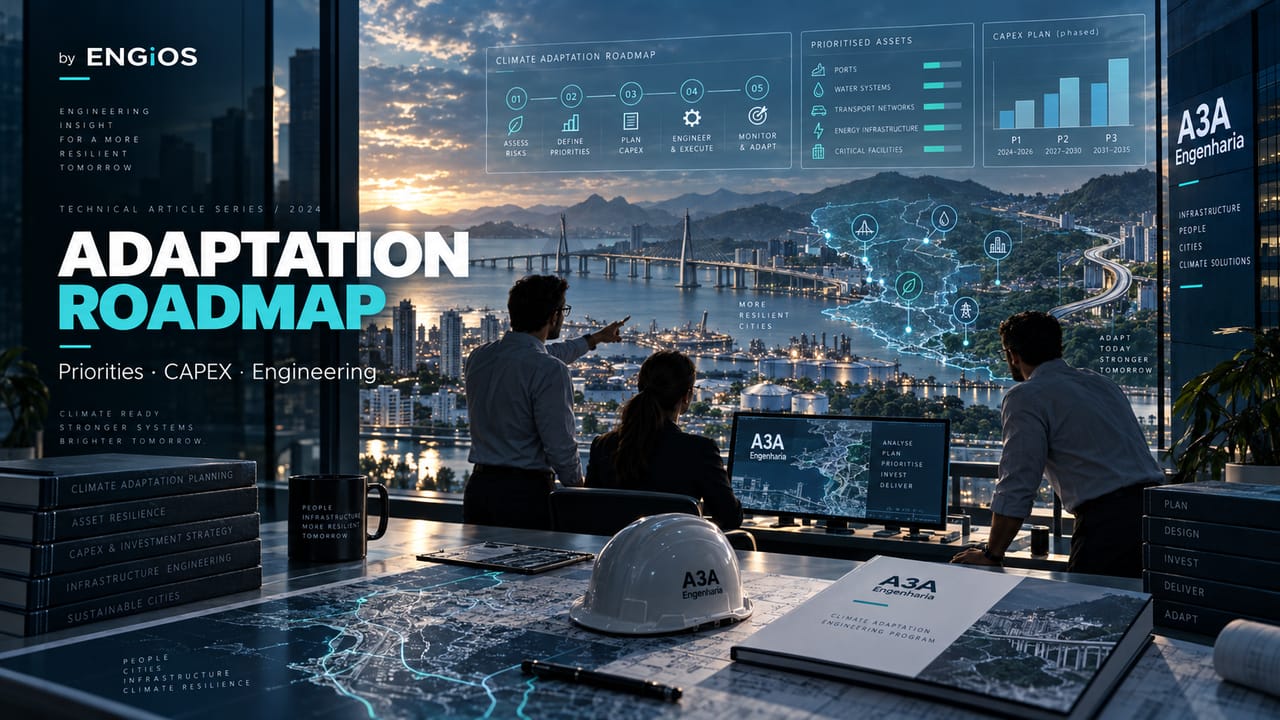
How to structure a Climate Adaptation Plan for assets: risks, priorities, CAPEX, projects, retrofit, monitoring and an engineering roadmap.
Check it out!
A climate adaptation plan for assets and infrastructure organizes how climate risks become engineering priorities. The objective is not to produce a generic list of improvements, but to establish which services must continue operating, which assets and dependencies support them, which hazards can generate failures, which measures reduce vulnerability, and how the effectiveness of interventions will be demonstrated.
The expected result is an executable roadmap with owners, deadlines, CAPEX, projects, retrofits, monitoring and acceptance criteria. Adaptation must be traceable: each action should be linked to a risk, a failure mode and a critical service.
The plan should begin with critical services
The first question is not which assets exist, but which functions cannot stop. Power, cooling, telecommunications, automation, pumping and data processing are systems that support broader services. Criticality defines the consequence and guides prioritization.
From risk to the roadmap
The plan must distinguish hazard, exposure, vulnerability, criticality and consequence. It must then select adaptation options, prioritize investments and convert measures into verifiable requirements.
CAPEX should originate from risk
Investment should be a consequence of the diagnosis. Depending on the identified failure modes, the plan may include electrical protection, capacity reinforcement, redundancy, energy autonomy, HVAC, drainage, automation, monitoring and asset relocation.
How to procure
The scope should include critical services, inventory, hazards, vulnerabilities, consequences, a risk register, adaptation options, prioritization, CAPEX, schedule, indicators and verification criteria. For existing assets, Technical Due Diligence may precede the plan to validate documentation and condition.
A reliable roadmap depends on evidence about asset condition, capacity, criticality and documentation. When this baseline does not exist, the first investment should be diagnosis.
Historical climate and future climate must be separated
Existing assets were designed using data, assumptions and criteria valid at a given time. An adaptation plan must verify whether those assumptions remain representative over the remaining service life. This does not mean treating projections as certainty. It means recording source, reference period, horizon, scenario, variable and limitations, and then assessing whether the engineering decision remains robust.
When uncertainty is material, measures that work across several scenarios or preserve flexibility for future adjustment gain value. This avoids both inaction and unsupported overdesign.
Adaptation options: avoid, reduce, tolerate and recover
Measures are not limited to construction. The strategy can combine physical, operational and management changes. Relocating critical assets reduces exposure; increasing capacity or protection reduces vulnerability; redundancy and diversity reduce single points of failure; automation and sensing improve detection; degraded-mode procedures reduce consequence; and recovery plans shorten downtime.
For an electrical room vulnerable to flooding, for example, the plan may combine immediate physical protection, level sensors, review of cable penetrations and, in the medium term, relocation of the most critical equipment.
CAPEX should originate from risk, not the other way around
The technical path is to identify risks, develop alternatives and estimate the investment required to achieve defined performance. Adaptation CAPEX may involve SPDA and DPS, grounding and equipotential bonding, electrical-supply reinforcement, UPS, generator sets, BESS, microgrids, cooling, room relocation, automation, telecommunications, drainage and associated civil works.
Each investment line should state which risk it reduces, which service it protects and how it will be accepted.
Blackouts and energy autonomy naturally belong in the plan
Extreme events can interrupt the external power grid and delay recovery. It is therefore not enough to record the existence of a generator or UPS: the effective autonomy of the system under the critical load profile must be known.
This involves load priority, generation capacity, fuel, battery autonomy, start sequence, transfers, thermal capacity during emergencies and telecommunications and automation dependencies. BESS, photovoltaic generation and microgrids can be resilience measures when they respond to clear requirements for autonomy, power and operating strategy.
In behind-the-meter systems, local generation and storage can reduce grid dependency and preserve priority loads. The decision must start from the operating requirement, not from the technology in isolation.
Storms require an integrated view of SPDA, DPS and sensitive systems
A plan that mentions storms without assessing lightning, overvoltages, external interfaces and electronic systems leaves an important gap. SPDA, DPS, grounding and equipotential bonding must be treated as coordinated layers.
External protection does not eliminate surges conducted through power, telecommunications or metallic interfaces. For critical assets, the roadmap may include risk assessment, SPDA design, DPS review, grounding inspection, upgrades and testing.
Heat waves connect HVAC and electrical infrastructure
Extreme heat increases cooling demand and can reduce the available capacity of electrical and electronic equipment. Thermal load, installed capacity, redundancy, electrical distribution, protection, autonomy and automation must be assessed together.
The article Heat Waves: impacts on HVAC, power, electronics and critical infrastructure examines this chain in greater depth.
Flooding and intense rainfall change location and protection requirements
Adaptation measures may include elevating equipment, relocating rooms, barriers, drainage, sealing penetrations, pumps, level sensors, access review and rerouting infrastructure. Protecting a single device is not enough when switchboards, generators, telecommunications or access remain vulnerable.
This logic is examined in greater depth in the articles on flood risk in critical facilities and intense rainfall.
Convert measures into verifiable requirements
“Increase resilience” is not a technical requirement. The action must define capacity, autonomy, redundancy, interfaces, environmental condition, operating mode, alarms and test criteria. This allows the roadmap to feed the Program of Requirements, Terms of Reference, designs, procurement, Owner’s Engineering and commissioning.
The earlier performance criteria enter the design, the less dependence there is on later corrections and the simpler technical acceptance becomes.
New projects and brownfield assets require different approaches
In greenfield projects, adaptation can be incorporated into location, elevations, power architecture, routes, redundancy and specifications from the beginning. In brownfield assets, the priority is to identify existing vulnerabilities and build interventions compatible with operational continuity.
Retrofit requires migration planning, shutdown windows, contingency arrangements, interfaces with legacy systems and recommissioning. The roadmap should recognize these constraints and avoid recommending interventions that are technically correct but operationally impracticable.
Governance: every action needs an owner, deadline and trigger
A useful plan identifies the action owner, deadline, budget, dependencies and the condition that triggers execution. Some actions are immediate; others depend on load growth, renovation, expansion or scenario changes.
Triggers prevent CAPEX from being executed too early or too late. Loss of capacity margin, approaching end of life, occurrence of a severe event, increased criticality or operational expansion may justify moving to the next stage.
Indicators and monitoring close the cycle
Technical indicators may include thermal margin, energy autonomy, recovery time, availability of critical systems, number of single points of failure, environmental alarms, surge-related failures, flooding events, battery condition and the backlog of high risks.
An indicator does not replace engineering; it signals loss of margin and guides risk review.
Adaptation measures only close the cycle when implemented performance is verified against the requirements and failure modes defined during planning.
Tests demonstrate whether adaptation worked
An installed measure is not necessarily an effective measure. Critical interventions need acceptance criteria and tests related to the failure mode they are intended to control. This may involve power transfer, autonomy, pump operation, level alarms, HVAC redundancy, telecommunications failover, BMS/SCADA integration, SPDA/DPS inspection and electrical testing.
Commissioning connects intent, design, installation and evidence.
Inventory and criticality define the plan baseline
The roadmap must start from a reliable inventory. Location, capacity, age, condition, redundancy, routes, documentation, failure history and external dependencies help explain how each asset supports the service. In complex facilities, the inventory should also include interfaces among electrical systems, HVAC, telecommunications, automation and physical infrastructure.
Criticality adds the consequence dimension. A low-value asset may be decisive for continuity if its failure interrupts an entire chain. The plan should therefore classify assets by the service they support and the impact of unavailability, not only by replacement cost.
No-regret and low-regret measures help start the roadmap
Some measures generate benefits across several scenarios and can be implemented before major interventions. Updating documentation, eliminating single points of failure, correcting blocked drainage, testing transfers, reviewing electrical protection, verifying autonomy and installing monitoring are examples of actions that can reduce current vulnerabilities.
The no-regret or low-regret classification does not eliminate the need for technical analysis. It helps order decisions when there is uncertainty about how the hazard will evolve but sufficient evidence of operational weakness already exists.
Once risks, dependencies and alternatives are identified, engineering must convert that diagnosis into a sequence of investments, projects and decision milestones.
Prioritization must combine risk, urgency and feasibility
The most intense hazard does not always drive the first investment. Sequencing should consider risk level, consequence for critical services, implementation time, shutdown windows, engineering maturity, dependencies with other disciplines, cost and opportunities to integrate with planned works.
A sound prioritization matrix also records expected residual risk. This makes it possible to compare alternatives with different costs that reduce the same failure mode to different degrees. The decision changes from “which project should be built?” to “which intervention delivers the required risk reduction within a timeframe compatible with criticality?”
The roadmap must show dependencies among projects
Interventions are rarely independent. HVAC expansion may require electrical reinforcement; a BESS may require protection, ventilation, controls and space; relocating a room may affect telecommunications, automation and cable routes. The plan should record these dependencies to prevent isolated CAPEX from creating new incompatibilities.
Organizing projects in waves improves governance. The first wave may eliminate critical vulnerabilities and produce data; the second develops designs and procurements; the third implements larger interventions and closes the cycle with integrated testing.
Deliverables must support decisions and procurement
A robust plan should deliver more than a narrative. The organization needs a baseline of assets and critical services, a risk matrix, vulnerability records, adaptation options, prioritization criteria, preliminary CAPEX, schedule, owners, dependencies, design requirements and monitoring indicators.
For each action, it is useful to record the source risk, current situation, recommended intervention, deadline, investment estimate, disciplines involved, completion evidence and expected residual risk. This structure allows the document to be used by engineering, management, maintenance, procurement and budgeting.
Responsibilities and interfaces must be defined
Climate adaptation is multidisciplinary. Electrical systems, HVAC, telecommunications, automation, civil works, operations and asset management can act on the same risk. The plan should define who leads each action, which interfaces depend on specialists and who technically accepts the result.
This definition reduces gaps between disciplines. A system may be adequate in isolation and still fail at its interface with another system. Roadmap governance should treat these boundaries as part of the engineering scope.
The cost of inaction helps compare adaptation CAPEX
Adaptation investment should not be assessed only by construction cost. Service interruption, production loss, emergency recovery, premature equipment replacement, penalties, team mobilization and reputational impacts can make inaction more expensive than preventive intervention.
The comparison does not need to create false financial precision. The objective is to make consequences and orders of magnitude explicit so that CAPEX decisions consider the cost of remaining vulnerable. For essential assets, the economic value of continuity may greatly exceed the physical cost of the affected component.
Adaptive pathways avoid excessively rigid decisions
When future scenarios carry material uncertainty, the roadmap can be structured through adaptive pathways. Short-term measures preserve performance today; capacity, condition or risk triggers indicate when to advance to larger interventions.
This logic is useful for long-life assets. Instead of choosing between “do nothing” and immediately executing the largest possible project, the organization creates stages compatible with risk evolution and keeps options open for future decisions.
Procurement must preserve adaptation requirements
Once the plan defines expected performance, procurement of designs, equipment and construction must preserve those requirements. Technical bid equalization should not compare only price and isolated specifications; it should verify capacity, environmental conditions, interfaces, redundancy, documentation, tests and responsibilities.
When a requirement is lost between diagnosis and purchase, the organization may implement a solution that is technically valid under normal conditions but insufficient for the scenario that justified the investment. The plan should identify which criteria cannot be relaxed during procurement.
Owner’s Engineering and Project Assurance help preserve the roadmap
Multidisciplinary interventions can cross design, procurement, implementation and commissioning. Owner’s Engineering or Project Assurance is especially useful for maintaining traceability among risk, requirement, contracted solution, design changes and acceptance evidence.
This reduces the risk of an adaptation measure being simplified during execution without reassessing the effect on resilience. Material changes should return to the risk register before they are accepted.
Final considerations
Define a decision baseline before prioritizing investments
A technically useful plan must state the baseline on which decisions were made. This includes current asset condition, planning horizon, remaining service life, load-growth assumptions, service criticality, climate data used, scenarios considered and limits of available information. Without this baseline, two actions may appear equivalent on paper even though they address completely different risks, horizons and constraints.
Engineering should also record which assumptions are stable and which must be reviewed. Load expansion, occupancy changes, Data Center expansion, BESS installation, HVAC changes or a new telecommunications route can alter the priority of an adaptation measure. The plan should therefore not be treated as a final snapshot: it needs clear update criteria.
This logic is close to what we apply in Engineering Master Plans: first the baseline is established, then scenarios, dependencies, priorities and investments are structured. Climate risk becomes an additional decision layer over the asset life cycle.
Criticality should be defined by the service, not only by equipment value
Expensive equipment is not synonymous with a critical asset. A low-cost component can have a much greater operational consequence if its failure interrupts power, communication, automation, cooling, security or access to an essential facility. Prioritization should therefore begin with the service that must be preserved and then trace the assets, interfaces and utilities that support it.
A robust criticality classification considers impacts on safety, continuity, production, public service, data integrity, environment, recovery and the dependency chain. In a technical room, for example, the main switchboard may be critical, but so may the cooling system that keeps electronics within their permissible range, the fiber route that connects operations to the control center and the generator that sustains loads during grid loss.
This approach avoids treating adaptation as a list of isolated projects. The objective is to preserve function. When function is the starting point, engineering can compare different alternatives — physical protection, redundancy, relocation, capacity increase, automation, maintenance, local generation or operating procedures — using the same consequence framework.
A prioritization matrix must combine risk, urgency and executability
Prioritizing only by inherent risk can produce an impractical roadmap. CAPEX decisions must combine risk severity with urgency, cost, dependencies, ease of implementation, operating windows, procurement time, design maturity and the effect on residual-risk reduction.
| Criterion | Engineering question | Effect on priority |
|---|---|---|
| Criticality | Which service is lost if the asset fails? | Raises priority when the consequence is high |
| Vulnerability | How sensitive is the asset to the event? | Directs retrofit, protection or replacement |
| Urgency | Is there a current risk or a trend toward loss of margin? | Defines the intervention horizon |
| Risk reduction | How much does the measure reduce residual risk? | Compares effectiveness among alternatives |
| Dependencies | Is there a preceding design, project or authorization? | Organizes the roadmap sequence |
| Executability | Does the intervention require shutdown, civil works or migration? | Affects implementation time and strategy |
The value of this matrix is not to produce an apparently precise mathematical score. It is to make explicit why one intervention comes before another. Decision traceability is as important as the score, especially when the plan supports budgeting, public procurement, asset governance or executive approval.
No-regret and low-regret measures help start adaptation without waiting for absolute certainty
Not every decision needs to wait for detailed long-term modeling. Some measures reduce known vulnerabilities and continue to make sense under different scenarios. Updating inventories and As-Built documentation, restoring blocked drainage, correcting water ingress, reviewing SPDA and DPS, elevating critical sensors, testing generators, verifying UPS autonomy, restoring HVAC redundancy or implementing temperature monitoring are examples of actions that can be justified by current condition and operational criticality.
These measures should be separated from interventions with greater irreversibility or CAPEX. Structural retrofit, substation relocation, electrical-room relocation or microgrid implementation requires deeper studies, compared alternatives and design criteria linked to the service-life horizon. A mature adaptive strategy combines immediate low-regret actions with decisions conditioned on future triggers.
This is where the concept of adaptive pathways becomes useful: instead of assuming one definitive solution, the roadmap defines possible pathways and the triggers that indicate when a new stage should be brought forward. This reduces both the risk of investing too early and the risk of acting too late.
Adaptation projects should be grouped into coherent packages
The plan should not produce dozens of fragmented actions that reach procurement as disconnected scopes. Measures with strong technical relationships should be consolidated into engineering packages. An electrical-resilience package, for example, may involve studies, switchboard upgrades, protection review, SPDA, DPS, grounding, emergency power, automation and testing. A thermal package may integrate HVAC, air distribution, electrical capacity, sensing, BMS and degraded-mode operating procedures.
Grouping improves coordination, interfaces, technical responsibility and acceptance. It also reduces the possibility of procuring an intervention that solves one component and transfers risk to another. For more complex projects, the Owner’s Engineering framework helps structure requirements, governance, review and acceptance across multiple disciplines and suppliers.
Brownfield adaptation requires constructability, migration and continuity planning
Much climate adaptation will take place in existing, operating assets. In these cases, the technically ideal solution may be impractical if it requires downtime that operations cannot tolerate. Engineering must analyze access, available areas, interferences, shutdown sequences, temporary contingencies, load migration, bypasses, temporary supplies and safe return to normal conditions.
This planning should appear in the roadmap before construction is procured. Otherwise, cost and risk only emerge during execution. A sound plan distinguishes equipment CAPEX, associated-infrastructure CAPEX and implementation cost in a brownfield environment. It also identifies when Retrofit and Upgrades are sufficient and when the solution requires deeper system reconfiguration.
The plan must reach procurement as a contractible scope
A roadmap only becomes execution when each initiative has a clear object, scope, deliverables, interfaces and acceptance criteria. Generic expressions such as “improve resilience,” “upgrade power” or “reinforce drainage” are not sufficient to procure engineering. The plan should translate the recommendation into a technical package: survey, study, design, specifications, documents, responsibilities, procurement support, implementation oversight and testing.
For each package, the available level of definition should be identified. Some actions can proceed directly to detailed design; others still require Due Diligence, a Feasibility Study, Design Review or an As-Built survey. This distinction avoids tendering execution before the problem has been sufficiently characterized and reduces change orders caused by premature scope definition.
The whitepaper on procuring consulting engineering is particularly useful in this transition because it organizes traceability, governance and acceptance of technical services before construction.
Owner’s Engineering helps preserve the plan’s intent during implementation
Adaptation projects often cross several procurements, disciplines and suppliers. Between the roadmap and final delivery there is a risk of improper requirement simplification, solution substitution without consequence analysis, loss of interfaces or acceptance of performance below that originally defined. The role of Owner’s Engineering is to maintain technical consistency on behalf of the owner.
This includes reviewing design documents, technically equalizing proposals, answering technical queries, tracking deviations, controlling interfaces, verifying performance criteria and supporting decisions with evidence. When an adaptation measure depends on several layers — for example BESS, photovoltaic generation, automation, electrical upgrades and operating strategy — this governance prevents each supplier from optimizing only its own scope.
Climate adaptation must preserve the original functional requirement: reduce vulnerability and keep the service within defined limits. The installed solution may change during the process, but the performance objective and verification criteria cannot disappear.
Acceptance criteria should be defined before procurement
An intervention cannot be considered effective merely because it was installed. The plan should indicate how it will be demonstrated that risk was actually reduced. Depending on the system, this may involve inspections, measurements, functional tests, simulation of grid loss, generator-transfer testing, autonomy verification, HVAC redundancy tests, alarm validation, SPDA and DPS inspection, alternative-communication tests or watertightness verification.
The criterion must be measurable. “System operating” is insufficient; it is better to define, for example, maximum transfer time, minimum autonomy, permissible thermal range, redundancy condition, expected alarm state or operating sequence under contingency. This structure connects design, commissioning and operation.
The Commissioning Guide and the verification and acceptance frameworks in the technical library help structure this stage with checklists, procedures, evidence and traceability.
Residual risk must be explicit
No measure eliminates all risk. After an intervention, the plan should record what risk remains, under which conditions protection can be exceeded and which contingencies are still required. This transparency avoids the false perception that an asset has become “climate-proof” after a single project.
Residual risk can be accepted, monitored, transferred, mitigated in a later phase or treated through operational response. The decision needs an owner and a justification. In some cases, the best strategy is not to increase physical capacity indefinitely, but to combine protection, redundancy, monitoring and rapid recovery.
This reasoning also improves CAPEX allocation. Investments can stop when the marginal benefit no longer justifies the cost and the remaining risk is better managed through other control layers.
Review triggers keep the plan alive
The roadmap should state when it must be reassessed. Load changes, area expansion, replacement of a critical asset, recurring incidents, material climate-scenario changes, loss of operating margin, obsolescence, failed tests or regulatory changes can trigger a new assessment.
Simple indicators help: hours of downtime due to climate causes, number of overtemperature events, water-level alarms, transfer failures, actual energy autonomy, unavailability rate of redundant systems, critical-maintenance backlog and percentage of completed actions. The objective is not to create an excessively complex dashboard, but to detect when actual vulnerability begins to diverge from the assumptions of the plan.
Example of an integrated adaptation roadmap
Consider a critical facility with three vulnerabilities: overtemperature during hot periods, low autonomy during grid interruptions and an electrical room located at an elevation vulnerable to flooding. The roadmap can begin with instrumentation and condition surveys, proceed to HVAC and electrical-capacity analysis, include review of emergency generation, evaluate BESS or local generation, design physical protection or component relocation and finish with integrated testing.
The actions do not need to occur simultaneously. Low-cost measures can be brought forward while higher-CAPEX projects advance through studies and decision gates. The maturity logic is similar to the 7 Gates framework: each stage reduces uncertainty before more resources are committed.
This example shows why an adaptation plan is not simply a climate document. It is an engineering-portfolio instrument capable of converting heterogeneous risks into projects, priorities and verifiable decisions.
A Climate Adaptation Plan is an engineering and investment tool. It connects risk, requirements, projects, CAPEX and verification throughout the life cycle.
Technical references
[1] BRAZIL. Law No. 14,904, June 27, 2024. Guidelines for climate-change adaptation plans. Available at: https://www.planalto.gov.br/ccivil_03/_ato2023-2026/2024/lei/l14904.htm
[2] INTERNATIONAL ORGANIZATION FOR STANDARDIZATION. ISO 14090:2019 — Adaptation to climate change — Principles, requirements and guidelines. Available at: https://www.iso.org/standard/68507.html
Frequently asked questions
It is a technical plan that converts climate risks into priorities, requirements, investments, projects and verification criteria.
For assets and infrastructure, preliminary CAPEX helps convert risk into executable and prioritized decisions.
Complementary technical materials
Related services
- Engineering Technical Due Diligence
- Engineering Master Plans
- Retrofit and Upgrades
- Engineering Commissioning
- Engineering Asset Management
Key content on this topic
Related technical content
- Complete Guide to Consulting Engineering
- Project Management: complete guide to engineering, governance and control
- BESS: Complete Engineering Guide
- Owner’s Engineering: executive framework for procurement, governance and acceptance
- Procuring Consulting Engineering with Traceability, Governance and Cost Engineering
- Resilient Data Center: assessment, design, modernization and acceptance
- 7 Gates of Maturity for Public Engineering Investments
