
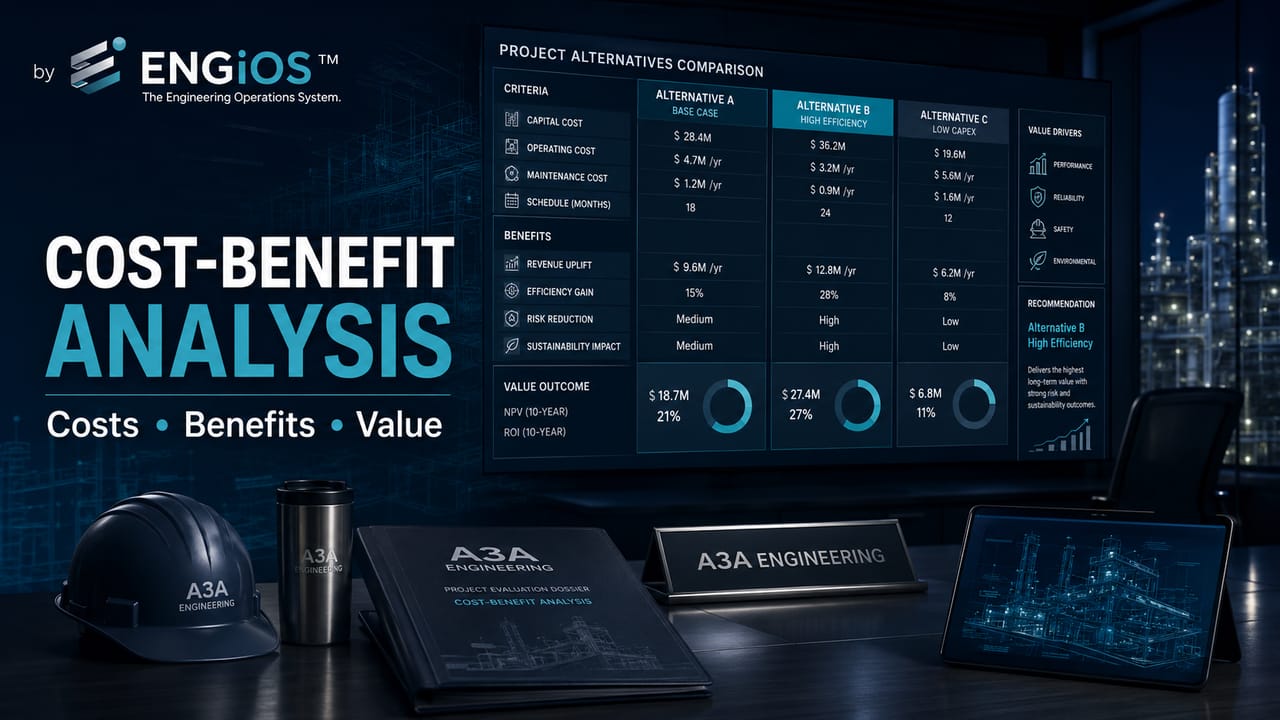
Understand cost-benefit analysis in engineering projects, comparing CAPEX, OPEX, benefits, BCR, NPV, risks, and life cycle for investment decisions.
Check it out!
Cost-benefit analysis is an appraisal technique that compares, in a structured manner, the costs and benefits associated with a decision, alternative, or project. In engineering, it should not be treated as a superficial comparison between “how much it costs” and “what it delivers.” A technically defensible analysis considers life-cycle horizon, CAPEX, OPEX, operating impacts, avoided losses, risks, time, residual value, alternatives, and decision criteria.
When costs and benefits occur at different times, they must be compared on the same time basis. Cost-benefit analysis therefore connects to discounted cash flow, present value, and indicators such as NPV and the benefit-cost ratio. In infrastructure, modernization, energy, telecommunications, automation, security, reliability, or regulatory-compliance projects, a substantial share of value may arise from benefits that do not appear as direct revenue: avoided losses, increased availability, lower maintenance, reduced exposure to failures, operating efficiency, safety, and continuity.
The result is not just a number. The objective is to produce a traceable justification for the decision: which alternatives were considered, which costs and benefits were included, which assumptions support the model, which variables can change the conclusion, and under what conditions the preferred option remains the best choice.
What Is Cost-Benefit Analysis
Cost-benefit analysis organizes the positive and negative effects of an alternative and seeks to compare them on a common basis. In private financial applications, that basis is usually monetary and linked to incremental cash flow. In broader economic appraisals, effects on users, society, the environment, safety, productivity, and other stakeholders may be included.
The distinction matters because “benefit” does not necessarily mean revenue. In an engineering project, a benefit may be a measurable reduction in losses, avoided maintenance cost, reduced downtime, improved energy efficiency, deferred investment, increased capacity, reduced risk, or compliance with a requirement that preserves operating continuity.
The analysis must also establish a perspective. What is a benefit for one department may simply be a cost transfer to another. What improves a supplier’s cash flow does not automatically represent an economic gain for the asset owner. The perspective of the owner, sponsoring organization, or public authority must therefore be explicit before any effect is quantified.
ABNT NBR ISO 21502 connects projects to value creation and recommends that justification consider benefits, risks, budget, resources, scenarios, and continued justification throughout the life cycle. This logic is consistent with a well-structured cost-benefit analysis: the technique must support decision-making and governance, not merely produce a spreadsheet.
Informal “cost-benefit” and formal cost-benefit analysis are not the same
In everyday use, “best cost-benefit” often means a perceived combination of price and quality. That reasoning can be useful for simple decisions, but it is insufficient for engineering undertakings.
A formal analysis must answer, among others, the following questions:
- What is the base case or no-investment scenario?
- Which alternatives can actually meet the need?
- Which costs change because of the decision?
- Which benefits are incremental and attributable to the project?
- When do those costs and benefits occur?
- What appraisal horizon is technically appropriate?
- How do risks, uncertainties, and delays change the result?
- Which effects cannot be monetized reliably?
- Which criterion will be used to recommend or reject an alternative?
Without these answers, the term cost-benefit may conceal a subjective assessment with a quantitative appearance.
Financial and economic analyses have different perspectives
A financial analysis considers cash inflows and outflows relevant to the investing entity. It is appropriate when the objective is to evaluate financial return, capital requirements, cash generation, OPEX impact, and investment attractiveness for the organization.
An economic analysis can broaden the boundary and consider effects that do not appear directly in the investor’s cash flow. In public investments or projects with material externalities, costs and benefits to users, society, the environment, or other agents may be relevant.
The Green Book 2026, published by HM Treasury, distinguishes financial analysis from social cost-benefit appraisal and recommends considering costs and benefits over the entire life of the proposal, with time discounting and explicit treatment of risk, uncertainty, and non-monetizable effects. This principle is particularly useful in engineering because many assets remain in operation for decades.
The Starting Point Is the Base Case
Every analysis needs a reference. The base case describes what will probably happen if the project is not carried out or if the organization maintains the current condition.
In asset modernization, for example, the base case may include increasing failures, maintenance costs, unavailability, obsolescence, loss of support, energy consumption, and interruption risk. In capacity expansion, it may represent production constraints, unmet demand, or the future need for emergency solutions. In regulatory compliance, it may include operating restrictions, enforcement risk, or inability to maintain a given process.
Without a base case, benefits are often overstated because every improvement observed after the investment is attributed to the project, even when part of it would have occurred independently of the intervention.
The logic is incremental: the alternative is compared with the reference scenario. The project’s economic benefit lies in the difference between the two worlds, not in the gross value of future operations.
Alternatives Must Be Comparable, Not Merely Different in Name
A sound analysis does not begin by trying to justify the preferred solution. It starts with the need and develops technically plausible alternatives.
In a modernization of critical infrastructure, for example, the comparison may include:
- keeping the asset with enhanced maintenance;
- partial retrofit of critical subsystems;
- complete replacement in a single stage;
- phased modernization;
- adoption of a redundant architecture;
- contracting the solution as a service;
- deferral with temporary risk mitigation.
Each alternative will have different CAPEX, OPEX, residual risk, useful life, schedule, capacity, availability, and technology exposure. Comparing only the initial price removes precisely the variables that normally determine value over the life cycle.
Value Engineering helps structure this stage because it forces a comparison among function, performance, requirements, cost, and alternatives without reducing the decision to the lowest price.
How to Identify Relevant Costs
An alternative with lower CAPEX may be economically worse when maintenance, energy, unavailability, useful life, and risk are evaluated over the full life cycle.
A relevant cost is one that changes as a function of the alternative being analyzed. This definition avoids two common errors: including costs that would occur anyway and ignoring future costs associated with the choice.
CAPEX is more than equipment price
In engineering projects, the initial investment may include engineering, surveys, studies, licensing, mobilization, civil works, infrastructure, equipment, integration, testing, commissioning, training, documentation, contingencies, and transition to operations.
CAPEX Management in Engineering Projects shows why investment needs to be treated as a composition of scope, budget, risk, and governance. An incomplete estimate tends to make one alternative appear artificially “cheap.”
OPEX must reflect the technical configuration
Operating costs may include energy, licenses, personnel, preventive maintenance, corrective maintenance, parts, support contracts, calibration, telecommunications, upgrades, insurance, inspections, and consumables.
Two alternatives with similar CAPEX may have very different operating costs. In energy- or maintenance-intensive assets, this difference can reverse the decision when the full horizon is analyzed.
The article on TCO and life-cycle cost examines this boundary in greater depth: total cost of ownership is not synonymous with cost-benefit analysis, but it provides an essential basis for estimating the cost side.
Transition costs also belong to the project
Replacing an asset may require downtime, temporary operation, data migration, training, temporary parallel operation, dismantling, physical adaptations, disposal, and recommissioning. Ignoring these costs improperly favors the change alternative.
In critical environments, the transition strategy may be as relevant as the selected equipment. The cost of a shutdown window or a poorly planned migration may exceed the price difference between two solutions.
Closeout and demobilization costs do not disappear
Assets may require decommissioning, waste treatment, dismantling, site restoration, technology migration, or contract closeout. If the decision creates a foreseeable future obligation, that obligation should be incorporated into the appraisal.
How to Identify Relevant Benefits
Benefits should be attributable to the alternative, measurable where possible, and consistent with the project’s objectives.
Additional revenue is only one form of benefit
Industrial projects may increase production, capacity, or yield and therefore generate incremental revenue. However, many engineering projects do not have directly associated revenue.
An electrical protection modernization, for example, may create value by reducing the probability and duration of interruptions. A monitoring system may anticipate failures. A safety improvement may reduce exposure to incidents. A retrofit may reduce energy and maintenance. A new telecommunications arrangement may increase availability and reduce operational risk.
The benefit must first be expressed in the asset’s operating logic before it is converted into economic value.
Avoided losses can be economically relevant
Reducing expected losses is an important category of benefit. It may include:
- avoided production loss;
- avoided hours of unavailability;
- avoided corrective maintenance;
- avoided emergency replacement;
- reduced contractual penalties;
- reduced material or product losses;
- lower exposure to incidents;
- deferred additional investments.
The value should not be calculated as if every negative event were certain. When uncertainty exists, probability, frequency, severity, or occurrence scenarios need to be considered.
Availability and reliability must be translated into impact
Increased availability by itself is a technical indicator. To enter a financial cost-benefit analysis, it is necessary to understand what an additional hour of availability produces or avoids.
In some environments, each hour of downtime represents lost production. In others, it may mean service delay, manual operation, service degradation, or merely reduced safety margin. Economic value depends on the context.
This translation between technical performance and economic consequence is one of the areas where Engineering Consulting adds the most value because it requires understanding the asset, operation, process, risk, and finance at the same time.
Energy efficiency must use consistent consumption and tariffs
Energy savings can be estimated from power, load profile, operating hours, efficiency, demand, tariffs, and expected changes in utilization. A common error is multiplying nominal power by every hour of the year without considering load factor or the actual operating regime.
The analysis should document the source of each assumption. If the benefit depends heavily on future tariffs or the utilization profile, that variable should be addressed in sensitivity analysis.
Safety and compliance benefits require care
Not every benefit should be converted into money. Personnel safety, legal compliance, and certain regulatory obligations may constitute mandatory requirements. In such cases, the question is not necessarily “is it worth complying?”, but which alternative meets the obligation more efficiently, safely, and sustainably.
When it is appropriate to monetize risk or expected losses, the methodology should be explicit and technically defensible. Values should not be invented merely to make every column monetary.
Costs and Benefits Must Use the Same Horizon
The appraisal horizon must be long enough to capture relevant differences among alternatives. Using only the implementation period favors solutions with lower initial investment even when they have shorter useful lives or higher operating costs.
The horizon may be defined by economic life, technology cycle, contract duration, regulatory period, planning horizon, or comparable useful life. When alternatives have different lives, it may be necessary to adopt a common horizon, equivalent replacements, or residual value.
The central issue is comparability. The choice of horizon must be explained rather than adjusted to favor a conclusion.
Discounting Places Future Values on a Common Time Basis
Costs and benefits distributed over time cannot be added directly. A future amount is not economically equivalent to the same amount today.
Discounted Cash Flow in Engineering Projects explains how to structure DCF, select a consistent time basis, and convert future cash flows into present value.
The basic logic is:
Present value = Value in period t / (1 + rate)^t
The rate must be consistent with the appraisal perspective. A private financial appraisal may use a hurdle rate or cost of capital. A social appraisal of public investment may use a social discount rate defined by public policy.
Mixing these perspectives is a methodological error. WACC, hurdle rate, and social discount rate apply to different contexts.
Benefit-Cost Ratio: How to Interpret BCR
BCR is an economic-efficiency indicator; it does not replace NPV, risk, technical requirements, or governance. The recommendation must preserve the complete decision logic.
The benefit-cost ratio, frequently called BCR — Benefit-Cost Ratio — compares the present value of benefits with the present value of costs.
BCR = Present value of benefits / Present value of costs
In simplified terms:
- BCR greater than 1 indicates that monetized benefits exceed monetized costs;
- BCR equal to 1 indicates equivalence between the two;
- BCR less than 1 indicates that, under that model, costs exceed benefits.
The indicator is intuitive, but it must be interpreted carefully.
BCR does not measure absolute value created
Consider two alternatives:
| Alternative | PV of benefits | PV of costs | BCR | Net value |
| A | R$ 1,5 milhão | R$ 1,0 milhão | 1,50 | R$ 0,5 milhão |
| B | R$ 12 milhões | R$ 9 milhões | 1,33 | R$ 3 milhões |
Alternative A has a higher BCR, but alternative B creates substantially more net value. If the projects are mutually exclusive, the choice should not be made automatically based on the higher ratio.
BCR should therefore be used together with NPV, capital constraints, investment scale, risk, technical requirements, and strategy.
How costs and benefits are classified can change BCR
If an operating-cost reduction is treated as a benefit, the denominator decreases less than if that same reduction is netted directly against costs. NPV may remain consistent, but BCR changes.
This means that the classification methodology must be standardized when multiple projects are compared within a portfolio. Without a convention, the organization can create artificial rankings.
NPV and BCR Answer Different Questions
The article on NPV, IRR, Payback, and ROI shows that financial indicators should not be treated as substitutes for one another.
NPV measures net value created in present currency. BCR expresses a ratio between benefits and costs. Under severe capital constraints, investment efficiency may become more relevant; for mutually exclusive alternatives, absolute value may be decisive.
Mature governance does not ask “which is the best indicator?”, but “which criterion best represents the decision we need to make?”
Non-Monetizable Benefits Should Not Be Erased
Not every relevant effect has a market price or can be monetized with acceptable precision.
Benefits may relate to:
- personnel safety;
- operational resilience;
- service quality;
- user experience;
- reputation;
- future flexibility;
- interoperability;
- expandability;
- sustainability;
- regulatory compliance.
The decision still needs these elements. The correct approach is not to assign arbitrary numbers, but to record the effect, its relevance, evidence, qualitative magnitude, and influence on the recommendation.
The Green Book 2026 recommends that appraisals explicitly consider non-monetizable costs and benefits alongside quantitative indicators. This practice is also useful in corporate decisions because it prevents the apparent precision of a spreadsheet from eliminating critical technical factors.
Risk Must Enter Before the Conclusion
When the greatest uncertainty lies in availability, reliability, useful life, maintenance, energy, or integration, the economic model must originate in engineering — not in generic percentages.
An analysis built only with deterministic values can convey false confidence. CAPEX, schedule, demand, availability, energy savings, maintenance cost, and useful life are estimates, not certainties.
The first layer is to identify critical variables. The organization can then use sensitivity analysis, scenarios, probability ranges, or simulation according to complexity and materiality.
Monte Carlo Simulation in Engineering Projects is appropriate when the combination of several uncertainties needs to be treated probabilistically. For less complex decisions, deterministic sensitivity and scenario analyses may be sufficient.
Delay can destroy value even without materially increasing CAPEX
Delaying implementation postpones benefits and may prolong the costs of the current scenario. In capacity-increase projects, this means deferred revenue. In modernization, it means maintaining exposure to failures, maintenance, or inefficiency for longer.
The time effect must be modeled. Adding a generic contingency percentage to the investment is not enough.
Overestimated benefits are often as dangerous as underestimated costs
Investment governance often concentrates effort on CAPEX accuracy and devotes less attention to benefit assumptions. This asymmetry creates optimistic business cases.
A 30% reduction in maintenance, 20% energy savings, or a 0.5 percentage-point increase in availability needs a technical basis, reference data, and an associated operating condition. If the benefit depends on behavior, demand, or operating discipline, this must appear in the model.
Sensitivity Analysis Shows What Actually Drives the Decision
Sensitivity analysis changes one variable at a time, or a controlled set of assumptions, to observe the effect on NPV, BCR, IRR, or another indicator.
The objective is not to produce dozens of tables. It is to discover which assumptions have enough influence to reverse the conclusion.
Common variables include:
- CAPEX;
- implementation schedule;
- demand;
- energy tariff;
- maintenance cost;
- availability;
- useful life;
- residual value;
- discount rate;
- unit benefit;
- failure frequency.
The World Bank highlights the use of sensitivity tests precisely to verify how changes in costs, benefits, timing, capacity, and other assumptions affect project viability.
Switching value is more useful than an arbitrary variation
In addition to testing ±10% or ±20%, it is possible to calculate the switching value: how much an assumption would need to change for the alternative to cease being attractive.
Examples:
- What CAPEX increase makes NPV equal to zero?
- What reduction in energy savings makes BCR fall to 1?
- What delay causes one alternative to lose its advantage over another?
- What maintenance cost eliminates the retrofit benefit?
This type of information is directly actionable by management because it shows the decision’s margin of safety.
Simplified Cost-Benefit Analysis Example
Consider a facility evaluating the replacement of a critical system. The investment requires R$ 1.2 million and generates estimated annual benefits through reduced maintenance, energy use, and unavailability.
Simplified assumptions:
| Item | Value |
| Initial CAPEX | R$ 1.200.000 |
| Annual maintenance savings | R$ 180.000 |
| Annual energy savings | R$ 90.000 |
| Annual avoided loss due to unavailability | R$ 140.000 |
| Additional software/support OPEX | R$ 40.000 |
| Annual net benefit before discounting | R$ 370.000 |
| Horizon | 5 years |
| Discount rate | 10% p.a. |
The simplified annual net benefit would be R$ 370 thousand. Bringing those cash flows to present value, the decision could be analyzed through NPV and BCR.
The example, however, is still insufficient for a real decision. At minimum, it would be necessary to test:
- whether the reduction in unavailability is technically supported;
- whether the R$ 140 thousand benefit represents expected value rather than maximum loss;
- whether there will be residual value after five years;
- whether implementation requires downtime;
- whether integration and training costs exist;
- whether energy savings depend on a stable operating profile;
- whether the project changes personnel or maintenance requirements.
The spreadsheet is the final stage of the evidence chain, not the starting point.
Cost-Benefit Analysis and the Business Case
The Business Case in Engineering Projects is broader than a cost-benefit analysis. It organizes the complete justification for the decision, including need, strategic alignment, alternatives, benefits, costs, risks, execution capability, governance, and recommendation.
Cost-benefit analysis can be one of the Business Case’s main quantitative evidence sources. It addresses whether benefits justify costs under specific assumptions. The Business Case must also address whether the alternative is technically feasible, executable, strategically aligned, acceptable in terms of risk, and governable.
In other words, an alternative may have a favorable BCR and still be impossible to execute. A project may also be mandatory for safety or regulatory reasons, with the choice made through cost-effectiveness rather than maximization of financial return.
Cost-Benefit Analysis and TCO Should Not Be Confused
TCO calculates the total cost of owning or operating an alternative over time. It is especially useful when functional benefit is equivalent among options and the primary question is which solution costs less over the life cycle.
Cost-benefit analysis adds the benefit side and can compare alternatives that produce different outcomes.
Example: two systems may have TCOs of R$ 2 million and R$ 2.4 million. If the second reduces losses by an additional R$ 1 million over the period, the alternative with the higher TCO may have the better economic relationship.
Cost-Effectiveness May Be Better When the Benefit Should Not Be Monetized
When alternatives deliver the same mandatory outcome or a benefit that should not be monetized, it may be more useful to compare the cost of achieving one unit of outcome.
Examples:
- cost per additional availability point;
- cost per MWh saved;
- cost per unit of capacity added;
- cost per regulatory requirement met;
- cost per protected area;
- cost per unit of residual-risk reduction on a defined scale.
This approach is particularly relevant in compliance, safety, health, environment, and certain public projects.
The Analysis Must Be Updated as Engineering Matures
At the beginning of an undertaking, alternatives, costs, and benefits are estimated with lower maturity. As surveys, conceptual engineering, studies, estimates, and risks evolve, the analysis should be updated.
FEL — Front-End Loading creates an appropriate environment for this maturation. At each gate, the organization can review whether the project remains justified based on the latest information.
The same logic appears in ABNT NBR ISO 21502: project justification is not a static document; it should be reassessed as context, scope, and information change.
Governance Must Define Who Builds, Reviews, and Approves the Model
The area advocating an investment naturally tends to understand its benefits and urgency. That does not mean it should define all economic assumptions on its own.
Material projects may require participation from engineering, operations, maintenance, finance, risk, sustainability, procurement, and management. Each party’s role must be clear.
A robust structure usually separates:
- who produces data and assumptions;
- who consolidates the model;
- who technically reviews costs;
- who validates operating benefits;
- who validates the rate and financial assumptions;
- who reviews risk and sensitivity;
- who recommends;
- who has authority to decide.
This separation reduces conflicts of interest and improves traceability.
Project, Program, and Portfolio Governance can structure gates, criteria, authorities, and evidence so that investment decisions do not depend on isolated presentations.
Common Errors in Cost-Benefit Analysis
Starting with the desired solution
When the analysis is created only to justify a solution already selected, alternatives are artificially weakened. The process loses decision value and becomes documentation of a preference.
Comparing CAPEX without OPEX
This error favors alternatives with lower initial investment and shifts costs to operations. In long-life assets, the effect can be significant.
Treating every operating improvement as a financial benefit
Not every KPI improvement generates cash. A benefit must be linked to an economic consequence or to an explicitly considered non-financial objective.
Using maximum loss as expected loss
If a potential failure causes an impact of R$ 5 million, that does not automatically mean an annual benefit of R$ 5 million from eliminating the risk. Probability, exposure, frequency, and residual risk must be considered.
Ignoring the base case
Without a reference, the model attributes to the project benefits that would occur even without the investment.
Mixing nominal currency and a real rate
Cash flows with inflation and cash flows without inflation require consistent rates. Inconsistency can materially change present value.
Ignoring delays
The schedule changes the timing of costs and benefits. In many projects, delayed benefits are economically more relevant than a small CAPEX deviation.
Forcing everything to be monetized
Turning safety, compliance, or qualitative impacts into weak numbers can worsen the decision. It is preferable to make non-monetizable effects explicit and address them through governance.
Presenting BCR without a calculation record
The ratio is auditable only when costs, benefits, sources, dates, rate, horizon, and assumptions are traceable.
What a Good Study Should Deliver
A professional cost-benefit analysis should allow another team to understand and test the decision. Among the most relevant deliverables are:
- definition of the need and base case;
- alternatives evaluated and discarded;
- technical and economic assumptions;
- CAPEX and OPEX calculation basis;
- benefits map and accountable owners;
- analysis horizon;
- discount rate and monetary basis used;
- annual cash flows by alternative;
- NPV and BCR;
- non-monetizable effects;
- sensitivity analysis and switching values;
- risks that could change the conclusion;
- recommendation and conditions for approval;
- sources and evidence used.
The level of detail should be proportional to the value, criticality, and irreversibility of the investment.
When Engineering Consulting Adds Value
An economic appraisal is not merely a financial exercise when the main drivers are technical. In many projects, the greatest uncertainty lies in service life, reliability, availability, demand, maintenance strategy, energy performance, implementation schedule, obsolescence risk, or integration costs.
In these situations, Engineering Technical Consulting can bridge executive decision-making and technical evidence. The work does not replace Finance; it organizes the engineering parameters that make the financial model defensible.
A Technical and Economic Feasibility Study is particularly appropriate when alternatives, risks, costs, benefits, and implementation conditions need to be compared before committing significant CAPEX.
Final Considerations
Cost-benefit analysis in engineering is a decision process, not a ratio calculated at the end of a spreadsheet. The quality of the result depends on the quality of the base case, alternatives, cost engineering, benefit estimation, horizon, discount rate, risk treatment, and traceability of assumptions.
The benefit-cost ratio is useful because it communicates economic efficiency intuitively, but it should not be isolated from NPV, capital constraints, non-monetizable effects, and technical criteria. A project with a higher BCR is not automatically the best investment; an alternative with lower CAPEX is not automatically the most economical; and a technically possible benefit is not automatically realizable.
The most robust decision emerges when engineering, operations, finance, and governance share the same evidence base. In that environment, the analysis ceases to be a post-hoc justification and becomes a mechanism for selecting, prioritizing, and continuously reviewing the investment.
In material projects, cost-benefit analysis should mature together with engineering and be revalidated at decision gates before additional CAPEX commitments are made.
Technical references
[1] ASSOCIAÇÃO BRASILEIRA DE NORMAS TÉCNICAS. ABNT NBR ISO 21502:2021 — Project, programme and portfolio management — Guidance on project management. Rio de Janeiro: ABNT, 2021.
[2] PROJECT MANAGEMENT INSTITUTE. The Standard for Project Management and A Guide to the Project Management Body of Knowledge (PMBOK® Guide). 8th ed. Newtown Square: PMI, 2025. Available at: https://www.pmi.org/standards/pmbok
[3] HM TREASURY. The Green Book 2026: appraisal and evaluation in central government. London, 2026. Available at: https://www.gov.uk/government/publications/the-green-book-appraisal-and-evaluation-in-central-government/the-green-book-2026
[4] WORLD BANK. Cost-Benefit Analysis — Technical Note. Washington, DC: World Bank. Available at: https://gpss.worldbank.org/sites/default/files/knowledge_products/2019/CBA%20Technical%20Note_IPF.pdf
[5] ASIAN DEVELOPMENT BANK. Cost-Benefit Analysis for Development: A Practical Guide. Manila: ADB, 2013. Available at: https://www.adb.org/documents/cost-benefit-analysis-development-practical-guide
Frequently asked questions
It is a structured appraisal that compares the incremental costs and benefits of an alternative over a defined horizon, considering time, risks, assumptions, and monetizable and non-monetizable effects.
The benefit-cost ratio, or BCR, is calculated by dividing the present value of benefits by the present value of costs, provided both are defined under the same perspective, horizon, and discount rate.
Not necessarily. A BCR greater than 1 indicates that monetized benefits exceed monetized costs in the adopted model, but the decision must also consider NPV, risk, scale, constraints, non-monetizable effects, and technical feasibility.
TCO measures the total cost of owning or operating an alternative over its life cycle. Cost-benefit analysis adds benefit measurement and allows comparison of alternatives that produce different outcomes.
Cost-benefit analysis is a quantitative appraisal technique. The Business Case is the broader justification for the decision and includes need, alternatives, strategy, risks, execution capability, governance, and recommendation.
In some contexts, risks and expected losses can be monetized using defensible methodologies. However, safety and compliance requirements should not receive arbitrary values merely to fit a spreadsheet; non-monetizable effects should remain explicit in the decision.
Because CAPEX, demand, savings, availability, schedule, service life, and other assumptions are uncertain. Sensitivity analysis shows which variables can actually change the conclusion and the decision’s margin of safety.
When the decision involves material alternatives, significant CAPEX, operational risk, a long life cycle, technical uncertainty, or the need to justify the investment traceably before approval.
Supplementary technical materials
Related solutions
- Project, Program, and Portfolio Governance
- Engineering Indicators, Dashboards, and Executive Reports
- Process Management, Workflows, and Technical Approvals
Related services
Core content on the topic
- Business Case in Engineering Projects
- NPV, IRR, Payback, and ROI in Engineering Projects
- Discounted Cash Flow in Engineering Projects
