
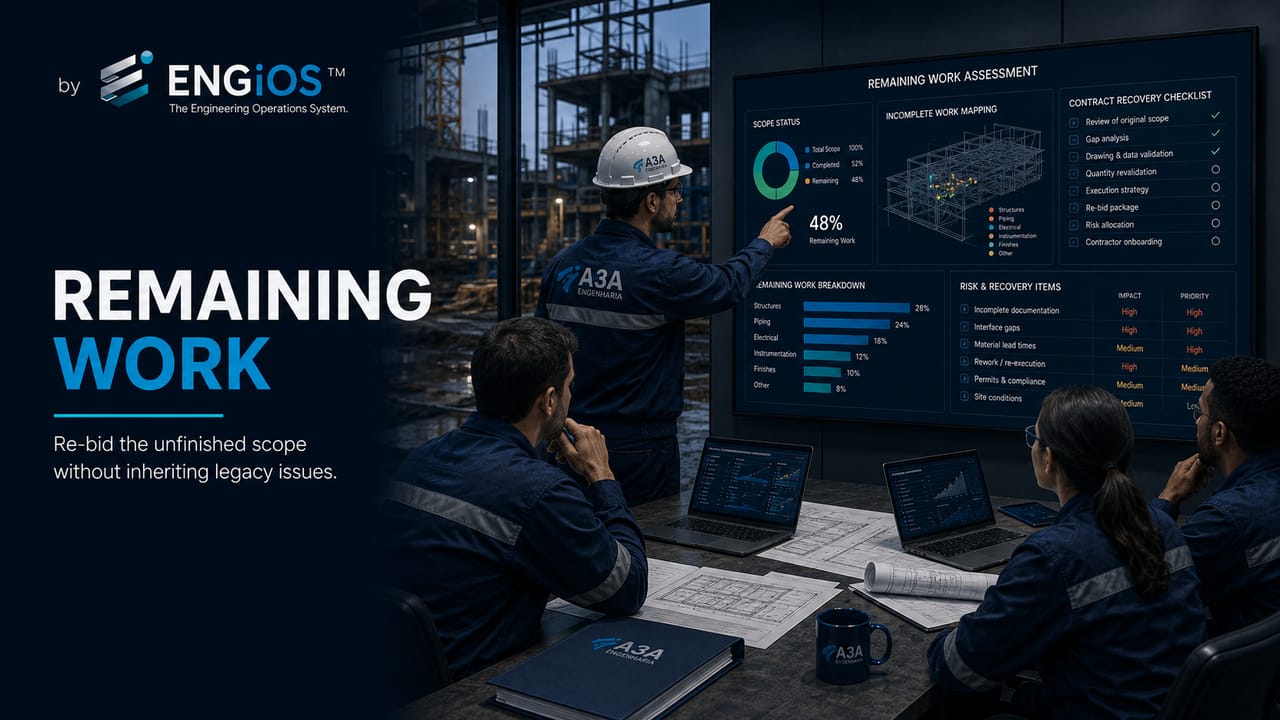
How to define and contract the remaining scope of a stalled public work without transferring liabilities from the previous contract: assessment, design, cost estimate, Terms of Reference, procurement documents, risks and acceptance.
Check it out!
The remaining scope of a public work is the set of services, corrections, completions, tests, documents and deliverables still required to transform an interrupted project into a completed and technically acceptable asset. It should not be defined merely as the difference between the original contract value and what has already been paid, nor only by the items that remained unmeasured. The remaining scope must be reconstructed from the actual field condition, the current design, the quality of what has already been executed and the requirements that still need to be satisfied.
It is also important to correct a common oversimplification: contracting the remaining works does not automatically mean conducting a new competitive procurement. Article 90, paragraph 7 of Brazilian Law 14,133/2021 allows the Administration, following contract termination, to call the other ranked bidders to contract the remaining works, services or supply, subject to the criteria in paragraphs 2 and 4. The law itself, after amendments introduced by Law 14,770/2023, also regulates the use of outstanding committed balances and, under certain conditions, the availability of those funds for a new procurement. The legal route is a decision for the Administration and must be assessed in the appropriate proceeding; engineering must provide the technical basis that makes any of those routes executable.
This point completely changes the strategy. Before asking “how do we retender?”, the manager must answer “what exactly still needs to be contracted?”. If the balance is taken to market without an assessment, the new contractor may receive incorrect quantities, degraded work, undefined interfaces, outdated designs, equipment without traceability and responsibilities inherited from a contract in which it did not participate. The result may be defensive pricing, excessive qualifications, clarification requests, low competition, contract amendments, claims or a second stoppage.
For this reason, contracting the remaining works should be treated as establishing a new technical baseline. The process begins by factually closing out the previous condition, continues with surveying what was executed and what can be reused, reviewing designs and interfaces, quantifying the real balance, updating the cost estimate, defining risks and responsibilities, choosing the contracting strategy and preparing Terms of Reference or a technical package capable of clearly separating inherited liabilities from the obligations of the new contractor.
Remaining works are not the financial balance of the contract
The first distinction is conceptual. The financial balance indicates how much of the original contract value has not yet been consumed, according to the applicable accounting and contractual rules. The technical remaining scope indicates how much work still exists to reach the contracted result. The two figures may be very different.
Consider a project in which 70% of the contract value has already been measured. That does not mean exactly 30% of the work needs to be contracted. Part of what was measured may have deteriorated during the stoppage; some services may have been executed under a design revision that will no longer be retained; interfaces may require demolition and reinstatement; stored equipment may have lost its usable condition; tests may need to be repeated; and services not originally foreseen may become necessary to recover or adapt the project.
The reverse is also possible. An item may have been only partially measured because its payment criterion was tied to a broader milestone, even though a large portion of the physical work is already present. If the new estimate simply copies the balance from the original bill of quantities, it may contract again work that already exists.
This difference is explained by the relationship among the Works Measurement Bulletin, physical progress, contractual criteria and current condition. Measurement is relevant historical evidence, but it does not replace a current survey.
The remaining-works baseline should distinguish, at a minimum:
| Condition found | Treatment in the new scope |
| Service executed, compliant and evidenced | preserve and protect; do not contract again |
| Service executed without sufficient evidence | provide for inspection, testing or documentary reconstruction |
| Service partially executed and reusable | contract only the completion and necessary interfaces |
| Service executed with a feasible repair | contract the repair with defined acceptance criteria |
| Service executed but not suitable for reuse | provide for removal, disposal and re-execution |
| Service not executed | include directly in the remaining scope |
| New service resulting from design revision | include in the new baseline with justification and cost estimate |
This framework converts the “balance” into scope. Without it, the procurement remains dependent on assumptions that each bidder will interpret differently.
Before the new contract, the condition left by the previous contract must be technically closed out
An interrupted project often remains in a gray area: there are partially accepted services, pending measurements, materials on site, stored equipment, redlines, nonconformities, unanswered RFIs, informal changes, ongoing warranties and documents that belong to the closeout process of the previous contractor.
The new contractor should not be used as the mechanism to discover what the Administration itself still does not know. That discovery must occur before contracting because it affects price, schedule and risk allocation.
The technical closeout work should reconstruct:
- the designs and revisions effectively applicable to what was executed;
- measured services and their calculation records;
- services physically verified;
- the status of nonconformities and outstanding items;
- materials and equipment owned by the Administration or already paid for;
- test, inspection and quality records;
- the preservation condition during the stoppage;
- available As-Built documents, redlines and markups;
- pending documentation and delivery obligations;
- interfaces that remained open.
The Daily Construction Log and inspection reports help reconstruct the chronology, while QA/QC documentation helps determine whether the executed work has sufficient evidence of compliance. The As-Built, in turn, consolidates what will actually remain incorporated into the asset.
When this reconstruction cannot be completed through documents alone, the team must return to the field. Existing-condition surveys, inspections, selective openings, tests and equipment verification may be required to establish the condition that the new contract will receive.
The boundary between contracts must be recorded. The new contractor needs to know what condition is being handed over by the Administration and from what point it becomes responsible for the services under its scope. The more ambiguous this boundary is, the greater the likelihood that the first event after restart will be a dispute over who should correct an old liability.
Survey the condition of the project before quantifying the remaining works
Quantification should begin only after the physical condition has been classified. The same quantity can produce completely different costs depending on the state in which the service is found.
A partially installed piping section, for example, may require only completion and testing; it may need dismantling for cleaning and reassembly; or it may need to be replaced because it is incompatible with the revised design. An installed electrical panel may be preserved and ready for inspection, or it may have been exposed to moisture and require assessment of insulation, components and connections before acceptance. A structure may be geometrically complete but require investigation of pathological manifestations before receiving new loads.
The logic of an existing-condition engineering survey is useful to reconstruct geometry and configuration. When the decision also depends on liabilities, condition, risks, future costs and documentation, the work approaches a Technical Due Diligence.
The field matrix should make it possible to link each item to a future action:
- retain;
- protect;
- document;
- test;
- repair;
- replace;
- remove;
- complete;
- redesign.
It is this action — not merely the physical existence — that feeds the remaining scope.
The design must represent the restart condition, not the condition from years ago
One of the main sources of error is to use the same design package that accompanied the interrupted contract as the basis for the new procurement. Between the first procurement and the restart, reality may have changed.
Unrecorded interferences may have emerged, standards may have changed, technologies may have evolved, equipment may have been discontinued, new operating conditions may apply, accessibility adjustments may be required, environmental requirements may have changed, or modifications may have been made during the first execution. In addition, what has already been built creates geometric and functional constraints that did not exist when the original design was developed.
The design for the remaining works should start from the validated condition and clearly establish three layers:
| Layer | Content |
| Existing to preserve | accepted elements that the new contract will receive |
| Existing to modify | repairs, adaptations, demolitions and reconnections |
| New to execute | remaining services and approved changes |
This separation helps designers, cost engineers and bidders see the interfaces. In a single drawing without distinction between existing and new work, the risk of double counting and omission increases.
The review must remain consistent with the Basic Design and Executive Design and with the maturity required by the contracting strategy. When the remaining scope involves many disciplines, multidisciplinary design and interface coordination becomes central.
It is not necessary to redraw everything indiscriminately. The objective is to eliminate uncertainties that are materially relevant to pricing, execution and acceptance. If an existing section is documented and will not be modified, the effort may be smaller. If an interface conditions the execution of several disciplines, it should be detailed sufficiently before going to market.
How to convert the condition found into a remaining-works bill of quantities
The bill of quantities should be rebuilt service by service. The original cost structure may be used as a starting point, but it should not be treated as a rigid boundary.
Each line should be reconciled against:
- current contractual quantity;
- quantity previously measured;
- quantity verified;
- quantity reusable;
- quantity to repair;
- quantity to remove;
- quantity effectively remaining;
- new service resulting from design revision;
- future unit and measurement criterion;
- design and specification reference.
In some cases, the best solution is to break down an old item into new services. “Complete system installation,” for example, may need to be separated into inspection of existing work, component replacement, infrastructure completion, configuration, testing and documentation. This level of detail improves bid comparison and reduces disputes during measurement.
The ABC Curve in construction cost estimates helps prioritize validation of the items with the greatest financial impact. However, low-value items may be critical to schedule or operation. An automation interface, a mandatory test or a utility authorization may cost little and still block the entire asset from entering operation.
Therefore, review of the remaining scope should combine economic materiality, technical criticality and impact on the path to completion.
The cost estimate must be rebuilt from the current technical balance
The cost estimate for the remaining works must be based on the current condition: reusable work, repairs, demolitions, new interfaces, revalidations and quantities actually outstanding. Merely updating the old financial balance can produce a reference price that is technically disconnected from the object.
Construction and Engineering Services Cost Estimating to structure the remaining scope
Once the scope is stabilized, Cost Engineering comes into play. The remaining-works estimate should not be produced by simply applying monetary adjustment to the previous balance.
Market prices may have changed; compositions may need to be adapted to work in a partially occupied project; productivity may differ from construction started from scratch; mobilization may be proportionally more expensive; dismantling and protection of existing elements create additional activities; access and logistics may have changed; and small quantities may lose economies of scale assumed in the original contract.
Price Research for Public Works and Engineering Services under Law 14,133 must reflect the actual conditions of the object. When references such as SINAPI, SICRO or applicable sector databases are available, they must be used according to the relevant legal and technical methodology, without ignoring particularities that require custom compositions or specific market research.
The execution regime should also be reviewed. A project whose original design had stable quantities may have become an intervention on existing work with greater variability. The choice between lump-sum and unit-price contracting should consider the actual ability to define quantities and risks, rather than automatically repeat the model of the previous contract.
The estimate should include, when applicable:
- mobilization and remobilization;
- protection of existing work;
- inspections and revalidations;
- demolitions and removals;
- repairs;
- remaining services;
- interfaces and temporary works;
- testing and commissioning;
- documentation and As-Built;
- training and assisted operation;
- demobilization and handover.
Contingency, when used in project planning, should not serve to hide poorly defined scope. Technically investigable uncertainties should be reduced before contracting.
Define the legal and contracting strategy after understanding the object
Once the remaining scope has been defined, the Administration can assess the contracting route on the basis of a technically intelligible object.
Article 90, paragraph 7 of Law 14,133 provides that the Administration may call the other ranked bidders to contract the remaining works, services or supply as a consequence of contract termination, subject to the criteria in paragraphs 2 and 4 of the same article. Therefore, there is a specific legal route that may avoid an entirely new competition in certain situations.
Law 14,770/2023 added paragraphs 8 and 9 to article 90. Paragraph 8 allows, in the situation described in paragraph 7, the use in favor of the new contractor of any outstanding balance to be settled that is recorded in committed expenditures or unprocessed accounts payable. Paragraph 9 provides that, if the measures in paragraphs 2 and 4 are unsuccessful, that balance may be treated as effective budget availability for a new procurement, provided that advantage to the Administration is demonstrated and the programmed object is maintained.
Brazil’s Federal Court of Accounts (TCU), in Decision 1106/2024-Plenary, addressed the application of these provisions in a consultation involving the use of balances for contracting remaining works or a possible new procurement. This reference reinforces the need to analyze the specific situation, the origin of the termination, the ranking order, the proposed conditions and the legal requirements before choosing the procedure.
The role of engineering is not to determine which legal provision must be used. It is to ensure that, whatever route is selected, the object is technically contractable. Without this, even a legally correct route may inherit the same problem that caused the stoppage.
When a new procurement may require the preparatory phase to be almost entirely rebuilt
If the configuration of the project has changed significantly, if the design had to be revised, if the old balance no longer corresponds to the current work or if the available remaining-works contracting alternatives are not applicable or are unsuccessful, the Administration may need to structure a new procurement under the competent procedure.
In this scenario, the procurement notice, Terms of Reference and bill of quantities should not simply be “recycled” by changing dates and values. The preparatory phase must reflect the new reality. The Preliminary Technical Study for public works and engineering services may need to reassess the need, the solution, existing conditions, alternatives and contracting requirements.
The Engineering Contracting Strategy should address how to divide packages, which execution regime to use, which risks to transfer, which to retain and how to treat interfaces with systems or suppliers already in place.
The Terms of Reference must separate inherited liabilities from new obligations
For remaining works, the Terms of Reference must translate the inherited condition into verifiable responsibilities. Design, bill of quantities, interfaces, measurement, tests and documentation must point to the same object before the procurement goes to market.
Technical Review of Terms of Reference for public works and engineering services
The Terms of Reference for the remaining works are among the most sensitive documents in the process. If they merely state that the new contractor must “fully complete the project,” they transfer to the market a question that should have been resolved by the Administration: in what condition is the project being handed over?
The document should establish a clearly documented entry condition and attach the relevant surveys, designs, bills of quantities and records. It also needs to state what the new contractor must verify on its own, without using a generic clause that attempts to transfer all risk arising from incomplete information.
The contract scope in engineering should distinguish inclusions, exclusions, assumptions and interfaces. For remaining works, there is an additional dimension: responsibilities associated with the existing condition.
A boundary matrix can be useful:
| Topic | Condition handed over by the Administration | Responsibility of the new contractor |
| Accepted existing elements | identified in design and matrix | preserve and integrate |
| Elements pending testing | condition and history provided | perform the specified tests and treat results according to the contract |
| Defined repairs | solution and technical criterion established | execute and demonstrate compliance |
| Provided materials | inventory and declared condition | receive, verify and use according to defined rules |
| Interfaces with third parties | limits and responsible parties identified | coordinate activities within its sphere |
| Final documentation | baseline of available documents | produce records of the new execution and consolidate handover according to scope |
A Technical Review of the Terms of Reference can verify consistency among scope, designs, bill of quantities, measurement, acceptance, risks and attachments before the document reaches the market.
The risk allocation matrix must be rebuilt for the existing condition
The new contract starts in a project that already has history. This creates risks very different from those of a greenfield project.
There may be concealed elements executed by a third party, incomplete documentation, components out of warranty, interfaces with discontinued equipment, altered ground conditions, licenses under renewal, pending issues with utility companies, access restrictions and quality liabilities.
The Risk Allocation Matrix should identify events, responsible parties, treatment measures and contractual consequences. A common mistake is to use generic wording such as “the contractor shall verify all site conditions and assume any discrepancies.” A site visit is important, but it does not automatically turn information unknown even to the Administration into a risk that bidders can technically price.
Where legitimate residual uncertainty remains, the contract needs coherent mechanisms to handle it: measurement criteria, RFI procedures, change management, solution approval, treatment of interferences and documentation of evidence.
The difference between risk and undefined scope must be preserved. Risk is an uncertain event that can be identified and allocated; undefined scope is the lack of definition of what is to be contracted. Trying to solve the latter only through a risk matrix produces incomparable bids.
The procurement documents must test capacity to complete the remaining works, not to repeat the original project
Remaining-works procurements concentrate inconsistencies among attachments because they combine old documents, new revisions and a partially built physical condition. Cross-document technical review identifies discrepancies before they become clarification requests, challenges or incomparable prices.
Technical Review of Procurement Notice and Attachments for engineering procurements
Technical qualification requirements should be consistent with the relevant portions of the current object. If the original project had a large volume of earthworks that is already complete and the remaining scope now focuses on hospital installations, automation and commissioning, requiring experience based on the historical profile of the contract may select capacity that is no longer the most relevant.
Requirements must comply with the applicable legal limits and proportionality, but from an engineering standpoint the question is objective: which capabilities are indispensable to execute the critical portions that still remain?
The contents on Technical Qualification in Engineering Procurements and Technical Capacity Certificates help distinguish relevant evidence from artificial barriers.
The procurement notice must also be consistent with the Terms of Reference. Divergences among the bill of quantities, design, draft contract, schedule and risk matrix transfer interpretation to bidders and increase clarification requests or challenges.
Before publication, a Technical Review of Procurement Notice and Attachments can cross-check the documents and identify engineering inconsistencies that are difficult to see when each attachment is reviewed in isolation.
How to avoid making the new contractor responsible for defects it did not create
This is one of the most delicate issues in practice. The new contractor must integrate its work with the existing asset, but it is not technically reasonable to treat every pre-existing element as if it had been executed by that contractor.
The solution is to create a documented transfer condition. Before start-up, the Administration, technical support team and new contractor should record which elements are being received, which are accepted, which remain under verification, which repairs are part of the new scope and which limitations are known.
This does not eliminate the new contractor’s responsibilities for its own work or for damage it causes to existing assets. It defines the origin of the condition so that a future failure can be investigated with evidence.
In integrated systems, the boundary may be even more complex. The new company may connect equipment installed under the previous contract and become responsible for the performance of the integration it performs without having been responsible for the manufacture or initial installation of all components. The contract must specify which prerequisite checks are mandatory before that integration.
The logic of requirements, evidence and acceptance-criteria management is suitable for this transition: each requirement should have evidence and a party responsible for producing or validating it.
The remaining-works schedule must start from inherited constraints
Copying the remaining portion of the original schedule is another frequent mistake. The construction sequence planned for the initial project may no longer exist.
The new schedule must consider current condition, access, constraints, recovery services, revalidations, mobilization, procurement of replacement equipment, design approvals and interfaces with parallel contracts.
Construction Planning and Control should identify the real predecessors and the current critical path. On restart, a seemingly small activity may become a predecessor to several work fronts because the original construction sequence was interrupted.
It is advisable to build a start-up constraints matrix containing the responsible party, deadline, release evidence and schedule impact. No critical work front should be opened merely on the assumption that the constraint will be resolved later.
Remobilization also needs readiness criteria: released design, accessible area, approved materials, established safety conditions, resolved interfaces and minimum documentation available.
Measurement, changes and claims must be redesigned before execution
A remaining-works project carries greater risk of quantity and interpretation divergences. Measurement criteria should therefore be especially clear.
Each service should state the unit, measurement event, required documentation, associated tests and acceptance condition. Repair, dismantling, inspection or revalidation services cannot depend on criteria designed only for new construction.
The change process should also be formalized. If the new contractor finds a different condition, there must be a workflow to record it, analyze it technically, estimate the impact, approve the solution and only then execute it when applicable. Management of outstanding items, RFIs and nonconformities reduces informal decisions that later become disputes.
Where liabilities from the previous contract already exist, it is important not to mix them with occurrences under the new contract. Coding systems, cut-off dates and separate records help preserve causality.
Technical Analysis of Contract Amendments, Scope Changes and Claims can support the Administration when an occurrence requires technical reconstruction of cause, scope, quantities and impact, without replacing the administrative decision or legal analysis.
Acceptance of the remaining works must consider the project as a complete system
The new contract may represent only a financial portion of the overall project, but its delivery must result in a functional asset. Accepting only what the new company physically executed does not solve the problem if integration with existing work has not been demonstrated.
Article 140 of Law 14,133 establishes provisional and final acceptance under the applicable terms and provides for tests and other evidence needed to verify satisfactory execution. The specific content on Article 140 and acceptance of public works should be read together with remaining-works planning.
In building and industrial systems, tests must cross the boundaries between old and new. An electrical system cannot be evaluated only by the added circuits; automation must demonstrate integration; hydraulic networks must prove leak-tightness and operation; security systems must be tested under scenarios; equipment must operate under the specified load and interlock conditions.
Commissioning of buildings and facilities is especially important when the remaining works complete systems executed under different contracts. The process helps establish requirements, prerequisites, tests, outstanding items, documentation and performance evidence.
Acceptance should also require coherent final documentation: As-Built drawings, manuals, certificates, test reports, training records, punch lists and a Data Book where applicable. Without this consolidation, the asset may be physically complete yet still be unable to operate safely and be properly maintained.
Owner’s Engineering during restart: integrate what is usually fragmented
When assessment, design, costs, procurement, inspection, quality and commissioning are fragmented, assumptions are lost between stages. Owner’s Engineering creates a technical governance line from the initial survey to final acceptance, while preserving the Administration’s legal responsibilities.
Contracting the remaining works crosses several specialties. The assessment may be produced by one team, the design by another, the cost estimate by another, procurement by an administrative area and execution inspected by different public officials. Without an integrating function, each stage may lose assumptions from the previous one.
Owner’s Engineering can act as the technical integration layer on behalf of the owner, coordinating requirements, interfaces, documents, risks, designers, cost estimating, procurement, inspection, quality and commissioning.
In the public sector, this role must respect legal boundaries: the consultant does not replace the contract inspector, contract manager, competent authority, legal counsel or internal control. It structures information, produces analyses, verifies evidence and formulates recommendations to support the decisions of those agents.
This distinction is consistent with article 117 of Law 14,133, which allows third parties to be contracted to assist and support the contract inspector with relevant information while preserving the Administration’s legal responsibilities.
The advantage of an integrated approach is maintaining traceability from the condition report through final acceptance. The same matrix that classifies existing work can feed the design; the design feeds the estimate; the estimate feeds the Terms of Reference and procurement documents; and the requirements in the Terms of Reference return as inspection, testing and acceptance criteria.
What to contract to structure the remaining works before returning to market
When the Administration has a stalled project and still cannot confidently answer what remains to be done, the first contract should reduce uncertainty rather than transfer it to the future contractor.
A consulting engineering package to structure the restart can be divided into stages:
- assessment and Technical Due Diligence: documents, condition, risks and liabilities;
- existing-condition survey and condition report: existing work, quantities and reusability;
- design review and coordination: existing condition, interfaces and new scope;
- cost engineering: quantities, compositions, references and cost estimate;
- Terms of Reference review: scope, measurement criteria, acceptance and responsibilities;
- technical review of procurement notice and attachments: consistency of the contracting package;
- technical support for bid analysis: technical compliance, feasibility and clarifications;
- Owner’s Engineering and inspection support: governance of the new execution;
- QA/QC, commissioning and acceptance: evidence of compliance and performance;
- As-Built and handover: consolidation of the delivered asset.
Not every project requires all these services or separate contracts. The composition should reflect size, complexity, internal capacity and documentation maturity. The central point is that every gap be assigned to an activity before the new execution begins.
Deliverables that should exist before contracting execution
As a practical reference, the manager should seek a basis composed, as applicable, of:
- condition and assessment report;
- survey of existing work;
- matrix of executed and reusable services;
- matrix of outstanding items and constraints;
- revised designs;
- interface matrix between existing and new work;
- remaining quantities;
- cost estimate and calculation memorandum;
- preliminary schedule and milestones;
- risk matrix;
- Terms of Reference or technical specification;
- measurement criteria;
- inspection, testing and acceptance criteria;
- documentation and handover requirements.
The more clearly the market can see this information, the less it needs to price uncertainty.
How to review the package before publishing the procurement
The final review should not be conducted document by document in isolation. The greatest risk lies in the interfaces among attachments.
The design may indicate one quantity, the bill of quantities another and the Terms of Reference a third. The schedule may assume a supply obligation that the specification assigns to the Administration. The risk matrix may transfer an event that the design has not yet defined. The measurement criterion may fail to recognize activities that are mandatory for acceptance.
A cross-check should test at least:
| Verification | Control question |
| Design x bill of quantities | are all necessary services quantified? |
| Design x Terms of Reference | are responsibilities and requirements consistent? |
| Bill of quantities x measurement | is there a payment criterion for every relevant service? |
| Terms of Reference x risk matrix | do risks correspond to the information actually provided? |
| Schedule x interfaces | are predecessors and releases included? |
| Quality x payment | are tests and evidence linked to the correct milestones? |
| Handover x scope | have final documents and training been priced? |
This is the stage at which an independent review can prevent the reintroduction of problems from the previous contract. The objective is not to make the package immune to any change — that would be unrealistic — but to eliminate contradictions and gaps that are already visible before publication.
Final considerations
The remaining scope of a public work is not an administrative leftover from the previous contract. It is a new technical object formed by the difference between the result the Administration still needs to deliver and the effectively reusable condition that remains in the project.
Defining this object requires closing out the inherited condition, surveying existing work, separating executed work from reusable work, reviewing designs, quantifying corrections and missing services, estimating current reality, rebuilding risks, and aligning the Terms of Reference, procurement documents, measurement, tests and documentation. Only after this preparation can the chosen contracting route operate on a reliable basis.
Law 14,133 provides specific mechanisms for contracting remaining works after termination and also regulates situations that may lead to a new procurement. Consulting engineering does not choose the legal route; it turns the stalled project into an object that can be analyzed, priced, contracted, inspected and accepted.
When this preparation is ignored, the new contract tends to inherit the unanswered questions of the previous one. When it is done well, the market receives a clear entry condition, delimited responsibilities and verifiable completion criteria. This is how restart stops being merely the replacement of one contractor and becomes a technical reconstruction of the ability to complete the project.
Technical references
[1] BRAZIL. Law No. 14,133, of April 1, 2021. Public Procurement and Administrative Contracts Law. Available at: https://www.planalto.gov.br/ccivil_03/_ato2019-2022/2021/lei/l14133.htm.
[2] BRAZIL. Law No. 14,770, of December 22, 2023. Amends Law No. 14,133/2021 and other statutes. 2023. Available at: https://www.planalto.gov.br/ccivil_03/_ato2023-2026/2023/lei/l14770.htm.
[3] BRAZILIAN FEDERAL COURT OF ACCOUNTS. Procurement and Contracts — Call to contract. Available at: https://licitacoesecontratos.tcu.gov.br/5-11-6-convocacao-para-contratar-2/.
[4] BRAZILIAN FEDERAL COURT OF ACCOUNTS. Decision 1106/2024 — Plenary: remaining-works contracting and use of balances. 2024. Available at: https://pesquisa.apps.tcu.gov.br/documento/resposta-consulta/restos%2520a%2520pagar/%2520/score%2520desc%252C%2520COLEGIADO%2520asc%252C%2520ANOACORDAO%2520desc%252C%2520NUMACORDAO%2520desc/2/sinonimos%253Dtrue.
[5] BRAZILIAN CHAMBER OF THE CONSTRUCTION INDUSTRY. Stalled public works in Brazil: diagnosis, proposals and the New Procurement Law. 2023. Available at: https://cbic.org.br/obras-publicas-paralisadas-no-brasil-diagnostico-propostas-e-a-nova-lei-de-licitacoes/.
Frequently asked questions
They are the services, corrections, completions, tests, documents and deliverables still required to complete the project based on the effectively reusable condition found. They do not automatically correspond to the financial balance of the previous contract.
No. Article 90, paragraph 7 of Law 14,133 allows the other ranked bidders to be called to contract the remaining works following contract termination, subject to the applicable legal criteria. In other situations, including when the available measures do not apply or are unsuccessful, a new procurement may be required. The legal determination belongs to the Administration in the specific case.
The current design, contracted and measured quantities, verified condition, technical reusability, repairs, removals and new services resulting from revision must be reconciled. The remaining quantity results from this reconciliation, not from simply subtracting what was measured.
Responsibilities depend on the contract and the specific case. Technically, the restart package should document the entry condition, identify existing liabilities and define which repairs, checks and integrations are part of the new scope, avoiding ambiguous assignments.
In general, the estimate must represent current prices, productivity, mobilization, repairs, quantities and execution conditions. Merely applying monetary adjustment to the previous estimate balance may be insufficient if the scope or execution conditions have changed.
It can be reused where it remains valid, but it must be checked against the built condition and subsequent changes. Interfaces, existing elements, discontinued equipment, new requirements or field discrepancies may require revision before contracting.
They should clearly describe the existing condition, services to preserve, repair, replace and execute, responsibilities for interfaces, designs and attachments, measurement criteria, tests, acceptance, final documentation, risks and entry conditions for the new contractor.
Depending on the situation, Technical Due Diligence, existing-condition surveys, condition reports, design review, cost engineering, review of the Terms of Reference and procurement documents, technical procurement support, Owner’s Engineering, inspection support, QA/QC, commissioning, acceptance and As-Built may be required.
Supplementary technical materials
Related solutions
- Contract, Scope and Deliverables Management
- Requirements, Evidence and Acceptance Criteria Management
- Outstanding Items, RFIs and Nonconformities Management
- Process, Workflow and Technical Approval Management
- Document Governance and Document Management System
- Project, Program and Portfolio Governance
Related services
- Construction and Engineering Services Cost Estimating
- Technical Review of Terms of Reference for Public Works and Engineering Services
- Technical Review of Procurement Notice and Attachments for Engineering Procurements
- Owner’s Engineering
- Technical Support for Inspection of Public Works and Engineering Contracts
- Technical Analysis of Contract Amendments, Scope Changes and Claims
Main content on the topic
- Complete Guide to Procurement and Contracts for Public Works and Engineering Services
- Preliminary Technical Study for Public Works and Engineering Services
- Engineering Contracting Strategy
- Price Research for Public Works and Engineering Services under Law 14,133
- Risk Allocation Matrix in Engineering Contracts
- Technical Inspection of Public Works and Engineering Services
- Article 140 of Law 14,133: Acceptance of Public Works and Engineering Services
Related technical content
- Owner’s Engineering: Executive Framework for Contracting, Governance and Acceptance
- Contracting Consulting Engineering with Traceability, Governance and Cost Engineering
- Complete Guide to Cost Engineering and Estimating
- Contract Amendments in Public Works and Engineering Services
- Economic-Financial Rebalancing in Engineering Contracts
- Lump-Sum vs. Unit-Price Contracting
- Works Measurement Bulletin
- Technical Qualification in Engineering Procurements
- Commissioning of Buildings and Facilities
- Technical Handover Framework for Public Works and Systems
